Ratings for the final pre-season test from the Bahrain International Circuit were level year-on-year with Sky Sports F1’s live coverage from last year, unofficial overnight viewing figures show. If you are to do a best like-for-like comparison, live airings of testing versus the first round-up/Notebook airings from this week then it is a dead heat. The repeats I don’t think would make much difference, although if you were to do a peak figure comparison, then there would be a significant difference, as the live testing coverage from last year was longer than this year’s round-ups.
Coverage began on Thursday with 44k (0.2%) watching Sky’s coverage, this dipping to 29k (0.1%) for Friday’s round-up, both ratings up on live testing in 2013. 40k (0.2%) tuned in on Saturday, whilst 30k (0.1%) watched on Sunday, figures for the weekend down in both raw numbers and share on 2013. I really do think Sky should have made every effort possible to screen testing live on Saturday and Sunday. I would have agreed with ditching Thursday and Friday’s live coverage given that they are weekdays, but I personally would not have been opposed to something like this for the weekend:
12:00 – Live Testing
15:00 – Testing round-up/Notebook repeats
18:00 – Testing (repeat of earlier)
21:00 – Ted’s Notebook
I wouldn’t be surprised if the location played a hand in the decision to not pursue testing live. Of course, we mustn’t forget that, according to Sky Sports F1’s channel scheduler, “live testing is pointless”. One thing I want to mention, I have seen some people saying that allegedly ‘nobody cares’ about testing, yet the testing figures (as I have said before) beat the GP2 and GP3 figures from previous years and multiple episodes of The F1 Show. Using the same logic, the aforementioned items are pointless, too.
Note that I believe that Ted’s Notebook overran on the Saturday and Sunday, however I do not know the exact times that it finished so, for the purposes of this blog post I have kept the original timings.
One of the biggest talking points in the broadcasting scene in recent years has been the sky-rocketing cost of television rights to broadcast sporting events. Whilst Formula 1’s deals have indeed risen in the last ten to fifteen years, the cost of Formula 1’s rights pales in comparison to the Premier League television deal which now runs into the billions. Formula 1’s rights in comparison, are less than a tenth of that. One Premier League season, for Sky Sports or BT Sport could buy the equivalent of about seventeen Formula 1 seasons. Yes, I agree, that is completely bonkers.
But where did the rights picture start for Formula 1 in the UK? Back in the early 1990’s, the BBC signed a deal to cover Formula 1 for three years from 1994 to 1996, for just under £7 million (or £2.3 million a season – source: The Guardian, December 14th, 1995), a paltry amount compared to today. In other words, for the BBC, Formula 1 in 1994 and MotoGP in 2013 were probably close to one of the same, except the former’s viewing figures were much higher than the latter. Back then, ITV were fed up of losing in the Sunday afternoon ratings battle. And who could blame them, this being a time where there were fewer channels so the audience was more pointed towards terrestrial, except ITV was losing hands over first while BBC was consistently bringing in five to six million viewers for each Formula 1 race. That changed in December 1995, when it was announced that ITV had bid six times the amount of BBC previously, with a new deal from 1997 to 2001. Turn £2.3 million to £14 million per season, a substantial rise. A nice profit if your name is Bernie Ecclestone.
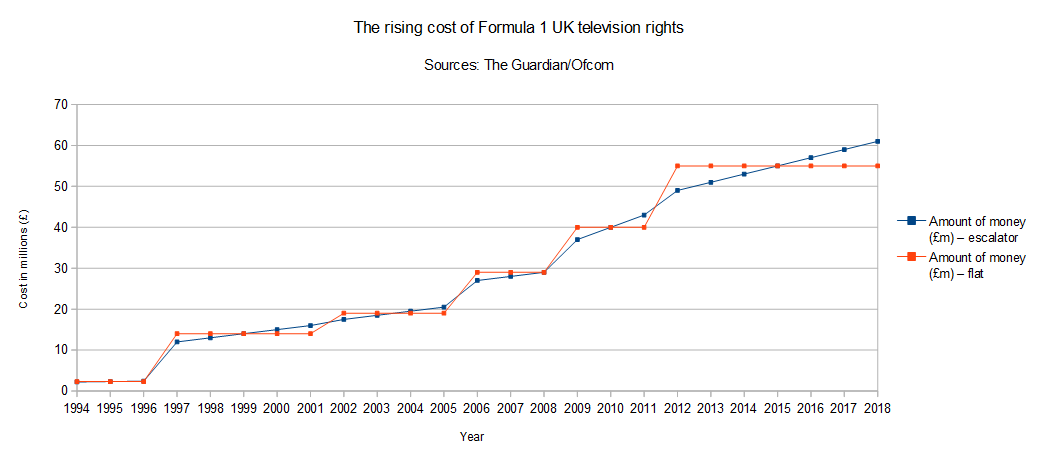
Away from the cost implications, ITV appeased the Formula 1 fan by having longer pre-race and post-race broadcasts which were largely successful and definitely paved the way to what we know now. In an Ofcom consultation back in 2007, details on all of ITV’s contractual costs were published by the regulator (page 79). We can see that the cost rose again in 2001 despite Michael Schumacher’s dominance from £14 million a year to £19 million a year for the 2001 to 2005 contract. However, it must be remembered that some broadcasting contracts work on an ‘escalator’ approach, meaning that the amount a broadcaster pays increases throughout the contract (the graph below gives an idea of the amounts involved). This means that the £19 million a year would not be too much higher for ITV – they would be paying essentially £16 million at the end of the previous contract and possibly £17 million at the beginning of the next contract.
A graph showing the amount that Formula 1’s UK television rights have rose in the past two decades.
For ITV, the death knell came when they overpaid on Formula 1’s television rights from 2006. They overpaid badly, and the viewing figures at the time definitely did not justify that. With no other broadcasters bidding, ITV’s rights increased immediately by about £7 million, a near 33 percent increase. In hindsight it was a frankly stupid decision made by those who were not thinking long term, however an unsurprising one when you consider that they also overbid on The FA Cup the following year. ITV did not foresee the advertising recession that would follow leaving those in charge needing to save money, and fast. Sadly, with a choice between the Champions League and Formula 1, ITV went for the former, activating a get-out clause. Formula 1 was heading back home. Which was another chance for Ecclestone to get more money out of a broadcaster. Seizing the opportunity, Ecclestone signed a contract with the BBC, estimated to be around £200 million for the five years, or £40 million per year for Formula 1. I’ve spoke before about how this was a disastrous mistake for the BBC that would have major consequences. I feel sometimes that broadcasters ‘play’ with money, going back to the ITV bit above, just why did they need to increase the rights by that much, I don’t know. It doesn’t make any financial sense whenever I see any sporting contract go up significantly, but it is a repeating pattern over and over again. The bubble will burst, especially where the Premier League rights are concerned. It is a matter of ‘when’, not ‘if’.
BBC’s financial problems soon hit Formula 1, in 2011. A reduction of the BBC Sport budget meant that BBC went to Sky and agreed a deal that would only see half of the races live on terrestrial television, an irreversible move. In terms of cost, it is believed to be in the region of £40 million per year for Sky and £15 million per year for BBC, again on an escalator approach. As always, broadcasters always use the word ‘undisclosed’ whenever announcing new deals, so a degree of caution must always be taken, especially when different websites can report different figures. At the moment, it is difficult to say whether the BBC will see out the remainder of their contract. I expect they will, but nothing is guaranteed. It was reported this past Wednesday that the BBC are about to make another round of £100 million cuts, the full details of which will be announced at the end of this month. It should be noted though that Tony Hall said that further “salami-slicing” cuts would not happen. But, at the end of the day, if any cuts to BBC Sport are announced at the end of this month, then alarm bells have to start ringing where BBC’s Formula 1 television coverage are concerned. An interesting question to be asked is whether the BBC and Sky contracts are treated ‘independently’ of each other, or if they are treated as ‘one’. I assume that they are independent, i.e. any future BBC actions regarding Formula 1 do not affect the current Sky contract, but I don’t know for sure.
So, what can £55 million a year get you?
– ten Premier League games
– the group stages of a Champions League season
– one and a third Six Nations championships
– four and a half MotoGP seasons
Formula 1’s television rights have not yet descended into silly money, like the football rights have for both the Premier League and the Champions League rights have, for which I personally am thankful for, as we still have Formula 1 live on free to air television in some capacity. If the current contract is seen through to the end, then the silly money will not begin for quite some time yet, but as always in this game, things can change with the flick of a coin. There is a long, long way before the finishing line in this contract.
From Thursday 27th February, Motors TV will be available to those with a Freeview HD or HD+ box, with an active internet connection only, it was confirmed today.
Arqiva’s Director of Hybrid TV, Digital Platforms Russ Armstrong said that “Motors TV is a brand that understands their audience and the various nuances between devices and platforms their audience engage on. Providing their content on the Freeview platform allows new viewers to discover their channel. Great content is as popular as ever and through Connect TV we’re working with broadcasters to ensure a seamless delivery of their channels.”
Frederic Viger, Head of Programming and Acquisitions at Motors TV, added “We’re delighted to be joining the Freeview family through Arqiva’s Connect TV. Scores of motor sport fans will now have access to the widest and most diverse range of live, delayed and highlights programming that features both international and domestic championships. It was something that prospective viewers had been calling for and I’d like to think that we’ve responded to their wishes. The proliferation of internet-connected television made this a very attractive platform.”
An interesting take on things from Motors TV, although I find it ironic that it is only available to those with a HD box, despite Motors TV being anything but high definition. Still, it is good to see Motors TV heading to Freeview, albeit for those who only have the box connected to the internet.
The F1 Show is to be revamped for the 2014 Formula One season and will feature a studio audience, it has been confirmed by Sky Sports today. The past two years have not featured a studio audience, and have been presented by Ted Kravitz alongside Georgie Thompson and Natalie Pinkham respectively. Sky did deviate from this last Summer with a 90 minute special taped the day before, which 62 percent of you wanted to see happen again. The revamp will feature a completely new studio, presumably you can expect one similar to that last Summer. Audience figures for the past two years have been generally low, rarely hitting 100,000 viewers per week.
My first thought is that I hope that the Midweek Report will move into The F1 Show’s old studio, possibly a scaled down version, personally I’d be very happy if that happened and extended to an hour, basically taking its place in terms of format. With a studio audience it means that the entire format of the show could potentially change depending on how involved the audience are going to get. Sky have an audience for Saturday Night Football, and I’ll be honest, they clap when they want to clap and be silent when they’re meant to, and it doesn’t add to the show (unlike say, Top Gear). Audience members do ask questions after the football game finishes on Saturday nights, but these are pre-prepared and generally are cookie cutter in nature.
One fear is that the show could become too lightweight, but this hinges on their guests. If you had Christian Horner and another Formula 1 boss on the show, and the audience was able to throw questions at them (yes, double points, I’m looking at you) then it could be great. But if we have more ‘samey’ guests who don’t give us much, I’m not sure it will work too well. Let’s have people on the show who fans want to get up close to and ask key questions to. The guests I think will be the deal breaker here. For reference, these are the studio based dates for The F1 Show this season:
– March x2 (7th and 21st)
– April x2 (11th and 25th)
– May x3 (2nd, 16th and 30th)
– June x2 (13th and 27th)
– July x1 (11th)
– August x4 (1st, 8th, 15th and 29th)
– September x2 (12th and 26th)
– October x2 (17th and 24th)
– November x2 (14th and 28th)
Note that those are based on my calculations, quite possible of course that Sky may end up with a mix of audience vs no audience shows, whilst two of those August shows will be a mid-season review and a Journalist’s review I imagine. What is unclear from the article is whether the show will be live, reference is made to a live studio audience, but then mentions that the programmes will be recorded later on, but I imagine we will get the answer sooner rather than later.
Update on February 27th – Gaz in the comments says that he will be in the audience for the first episode, noting that the filming is taking place between 20:00 and 21:00, meaning that the show will indeed be live.
Update on March 1st – Sky say that Natalie Pinkham and Simon Lazenby are presenting Friday’s show, I strongly hope that is just for the launch and not for every live studio show going forward.
Update on March 2nd – Ted Kravitz noted in the final testing Notebook that the presenting duties for The F1 Show will be shared around in 2014 between himself, Pinkham, Lazenby and David Croft. I suspect it will be Pinkham and Kravitz for the paddock shows, with it being a mix of Pinkham/Kravitz, Pinkham/Croft and Pinkham/Lazenby for the studio shows.
It appears that Sky Sports F1 have had a Winter clean, as today’s schedule updates for the channel following the Australian Grand Prix reveal some perhaps surprising developments.
– Ted’s Notebook remains, continuing to be fifteen minutes in length.
– Sky are repeating the Classic F1 races that they originally shown last year. Conviently, Sky repeating those races last December meant that I made a full list of them on the aforementioned link. In between Australia and Malaysia, schedules already show Japan 1998, USA 1981, Abu Dhabi 2010, Japan 1988 and Brazil 2003. Interestingly, I don’t think that USA 1981 has been shown before on Sky Sports F1, so that race at least is new. If Sky have flexibility to do this, and if they plan to, I’d much prefer to see an entire season across two or three weeks as I have advocated on this blog before.
– Midweek Report is back! A new timeslot, Wednesday’s at 20:30. I hope Anna Woolhouse is back presenting, and I hope the discussion and guests differs from the main Sky Sports F1 team, please don’t turn it into ‘another show’, Sky.
– F1 Legends returns with Juan Pablo Montoya, an edition I’m definitely looking forward to.
Those four points are not surprising. However, Weekend in Stills, Fast Track, Inside Track are not in the schedule, nor are the Brundle and Pinkham fifteen minute segments that Sky created last season. If you were hoping for Sky to create new programming aside from their 2013 offerings between races you are going to be disappointed, however if you want to sit down and watch a classic race each night I think you’ll be pretty pleased. Regarding new programming, I am wondered what has happened to the Max Chilton series that they were meant to be filming with him last season, as talk on that front has gone quiet from all directions.
A final note is that Sky’s race day programme will continue to be split into three for 2014, Australia is down as three separate shows. Remember that, when it comes to PR reporting should viewing figures be down year-on-year, if you’re going to compare, do it fairly. As The F1 Broadcasting Blog intends to throughout the upcoming season…
Of course schedules are subject to change, so I’ll update this blog post if anything post-Australia scheduling wise changes.
Update on February 25th – Sky are indeed maxing out on classic races, one race a day from March 7th through to December 31st. In terms of content, I don’t think there will be more content, just that the scheduling will actually make sense in 2014. And hey, they are actually promoting it, which is good!
Update on March 3rd – Forgot to say that Sky’s schedules do indeed confirm Anna Woolhouse as host of the Midweek Report again.


 Motorsport Broadcasting