A new era, and a new graphics set for Formula Two

The machinery on the track might have looked the same in Bahrain, but off the track Formula 1’s leading feeder series has a new identity. Enter, the Formula Two Championship. The championship takes over that title from the now defunct GP2 Series.

Throughout its duration from 2005 to 2016, the GP2 Series maintained the same style of graphics: a combination of blue and white, with rounded ‘squircle’ like edges. Whilst Formula One Management (FOM) enhanced the graphics set when Formula 1 moved to high-definition, it retained the same look and feel as the original non-HD version.

By 2016, the graphics set had outlasted its stay compared to other championships. Formula 1, MotoGP, and IndyCar had refreshed their graphics on numerous occasions whereas GP2 and GP3 were left behind. A common GP2 complaint was the lack of a timing tower during qualifying, meaning that it was incredibly tricky to follow the action. In this respect, GP2 was a decade behind Formula 1, FOM introducing the tower when Formula 1 moved to a three-part qualifying format in 2006.
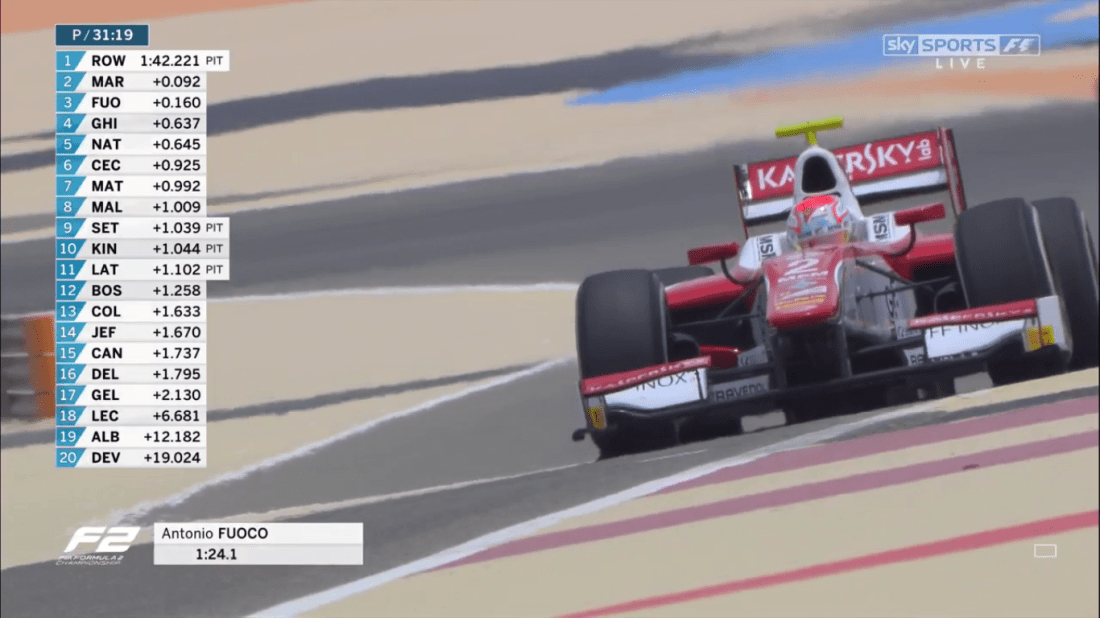
2017 Bahrain Formula Two - Fuoco.png
A shot of Prema’s Antonio Fuoco during the 2017 Bahrain Formula Two practice session. Note the familiar timing wall down the left hand side of the picture.

Finally, with the rebirth of Formula Two, F1’s leading feeder series is no longer treated as inferior in the production department. The new graphics set is consistent with F1, the only difference being the colour scheme, which is distinctive to Formula Two and with a call back to GP2’s colour scheme. I dare say that Formula Two’s graphics set is better than its bigger brother.

Elsewhere, there was some evidence in Bahrain that the new FOM may use Formula Two as a testing ground for new techniques. For the first time in twelve years, FOM used picture in picture during both of their live race broadcasts. The first occasion was as one of the leading drivers made a pit stop, with the second used on the formation lap of the sprint race.

I do not know if this happened in the old regime, but it would make sense to use GP3 and Formula Two as a test bed for new ideas, bringing the new features into F1 once tested. Admittedly that is difficult when the two championships run different schedules (unlike Moto2 and Moto3; Formula Two and GP3 are not present at every of their big brother’s races such as the Russian Grand Prix this weekend), but it is something that FOM should look to do now that both series are using a streamlined graphics set.
2017 Bahrain Formula Two - Leclerc
On-board with Charles Leclerc during the 2017 Bahrain Formula Two practice session.

It is not just on the graphical side, but all the way through production, the feeder series are a feeding ground in many ways. New talent should start work on directing GP3 and Formula Two, working their way to Formula 1.

Is it right to criticise Sky over lack of Formula Two promotion?
A criticism on social media over the Bahrain Grand Prix weekend was Sky Sports F1’s treatment of the series. Sky did little to promote the series opener, treating Formula Two (like they did with GP2) as a channel “add-on” rather than an integral piece of furniture. Furthermore, Sky’s scheduling was not up to scratch throughout the weekend, cutting off an excellent feature race on the slow-down lap as opposed to after the podium celebrations.

On one hand, yes, Sky should promote the series more through their supplementary programming. However, it is Liberty Media’s task to help encourage broadcasters to promote the series further, and to help embed the championship into the wider product. The new FOM needs to make Formula Two and GP3 feel important, in the same way that Dorna treat Moto2 and Moto3 with care.

Formula Two’s and GP3’s social media standing across Facebook and Twitter for an international motor racing series is alarmingly poor, whilst neither championship has a presence on YouTube. The second Formula Two race in Bahrain won by Charles Leclerc featured fantastic racing, but this was unexploited due to Formula Two’s absent YouTube presence (GP2 did not have a YouTube channel either).

A lot of drivers in Moto2 have built up sizeable fanbases due to social media, which needs to occur in Formula Two as well, given that Formula 1 will be relying on this talent in the future. It is probably no surprise that Sky have treated GP2 / Formula Two the way they do given that the Commercial Rights Holder has done little historically to help the championship. Hopefully that will change under Liberty Media’s ownership.

Scheduling: The 2017 Russian Grand Prix

The 2017 Formula One season moves back onto the European season for round four of the championship, as the paddock moves to Sochi for the Russian Grand Prix!

For the second race in a row, Channel 4 are broadcasting live coverage, and for the first time in 2017, Eddie Jordan is back with the team. Jordan joins Channel 4’s usual line-up headed by Steve Jones and David Coulthard.

As in Bahrain, the channel will be airing another new episode of F1 Meets prior to qualifying. On this occasion, Coulthard chats to Red Bull driver Daniel Ricciardo. Elsewhere in their line-up, their race day programme is a whopping four and a half hours long, with Channel 4 staying on air until 16:30.

Unusually, Channel 4 are airing new programmes following F1 on Saturday and Sunday afternoon: The Auctioneers on Saturday at 14:30 and the World’s Most Expensive Cars with Ant Anstead on Sunday at 16:30. This is good to see as there were occasions last year where repeats followed live Formula 1 programming.

The full scheduling details, including the IndyCar Series and the World Rally Championship, can be found below.

Channel 4 F1
Sessions
28/04 – 08:55 to 10:35 – Practice 1
28/04 – 12:55 to 14:35 – Practice 2
29/04 – 09:55 to 11:25 – Practice 3
29/04 – 11:55 to 14:30 – Qualifying
30/04 – 12:00 to 16:30 – Race
=> 12:00 – Build-Up
=> 12:35 – Race
=> 15:10 – Reaction

Supplementary Programming
29/04 – 11:25 to 11:55 – F1 Meets… Daniel Ricciardo

Sky Sports F1
Sessions
28/04 – 08:45 to 10:45 – Practice 1
28/04 – 12:45 to 15:00 – Practice 2
29/04 – 09:45 to 11:10 – Practice 3
29/04 – 12:00 to 14:40 – Qualifying
30/04 – 11:30 to 16:10 – Race
=> 11:30 – Track Parade
=> 12:00 – Pit Lane Live
=> 12:30 – Race
=> 15:30 – Paddock Live

Supplementary Programming
26/04 – 20:30 to 21:00 – F1 Report: Preview
27/04 – 13:00 to 14:00 – Driver Press Conference
27/04 – 21:00 to 21:15 – Paddock Uncut
28/04 – 15:00 to 15:30 – Team Press Conference
28/04 – 15:30 to 16:00 – The F1 Show
03/05 – 20:30 to 21:00 – F1 Report: Review

BBC Radio F1
27/04 – 21:00 to 22:00 – Preview (BBC Radio 5 Live)
28/04 – 08:55 to 10:35 – Practice 1 (BBC Radio 5 Live Sports Extra)
29/04 – 09:55 to 11:05 – Practice 3 (BBC Radio 5 Live Sports Extra)
29/04 – 12:55 to 14:05 – Qualifying (BBC Radio 5 Live Sports Extra)
30/04 – 13:00 to 15:00 – Race (BBC Radio 5 Live Sports Extra)

British GT – Oulton Park (Frontrunner)
30/04 – Races
=> 10:45 to 14:00
=> 15:00 to 17:15

British Superbikes – Oulton Park
30/04 – 16:00 to 18:00 – Qualifying (Eurosport 2)
01/05 – 12:30 to 18:00 – Races (Eurosport 2)
02/05 – 20:00 to 21:00 – Highlights (ITV4)

Euroformula – Estoril
29/04 – 14:00 to 15:00 – Race 1 (BT Sport 3)
30/04 – 12:00 to 13:00 – Race 2 (BT Sport 2)

FIM CEV Repsol – Albacete (BT Sport/ESPN)
30/04 – 10:45 to 15:45 – Races

IndyCar Series – Phoenix (BT Sport/ESPN)
29/04 – 02:00 to 05:00 (Saturday night) – Race

International GT Open – Estoril
29/04 – 15:00 to 16:45 – Race 1 (BT Sport 3)
30/04 – 13:00 to 14:30 – Race 2 (BT Sport 2)

Speedway Grand Prix – Slovenia (BT Sport 2)
29/04 – 17:30 to 21:15 – Races

World Rally Championship – Argentina
29/04 – Day 1 Highlights
=> 09:40 to 10:10 (Motorsport.tv)
=> 13:30 to 14:00 (BT Sport 3)
30/04 – 02:30 to 03:30 – Stage 1 (BT Sport 3)
30/04 – Day 2 Highlights
=> 09:40 to 10:10 (Motorsport.tv)
=> 11:30 to 12:00 (BT Sport 2)
30/04 – 16:00 to 17:30 – Power Stage (BT Sport/ESPN)
01/05 – Day 3 Highlights
=> 09:40 to 10:10 (Motorsport.tv)
=> 16:00 to 16:30 (BT Sport 1)
01/05 – 19:00 to 20:00 – Highlights (Channel 5)

World Superbikes – Assen
29/04 – 09:15 to 14:00 – Qualifying and Race 1 (Eurosport 2)
30/04 – 10:00 to 13:00 – Support and Race 2 (Eurosport 2)
02/05 – 20:00 to 21:00 – Highlights (ITV4)

World Touring Car Championship – Italy
29/04 – 14:00 to 14:30 – MAC3 time trial (Eurosport 2)
30/04 – 11:00 to 12:00 – Race 1 (Eurosport)

As always if anything changes, the above schedule will be updated.

Update on April 26th – I have added Euroformula, the International GT Open and the Speedway Grand Prix to the above post, all three starting their 2017 seasons this weekend. Unlike previous years, Euroformula and the GT Open will not be on Motors TV (now rebranded Motorsport.tv of course).

Vettel’s Bahrain victory peaks with 4.3 million viewers

Sebastian Vettel’s victory in the 2017 Bahrain Grand Prix peaked with 4.3 million viewers, overnight viewing figures show. In comparison to recent times, it was a stronger than usual afternoon for Formula 1.

Race
A special note about Channel 4’s live races this season. Channel 4 have decided this season to split their programming into three sections: pre-race, the race itself and then post-race analysis. As with Sky Sports F1’s viewing figures, this site will take Channel 4’s build up and race numbers for the season average. This will help provide a valid year on year comparison given that Channel 4’s live programming is expected to run longer this season.

With that in mind, Channel 4’s programme from 14:50 to 18:15 averaged 2.23m (15.2%). The build-up averaged 991k (8.2%) from 14:50 to 15:35, with the race itself averaging 2.57m (17.2%) until 18:15. Around 950,000 viewers continued to watch Channel 4’s analysis from 18:15 to 18:45. Channel 4’s average audience is in-line with last year’s average audience of 2.30m (16.2%), which considering the tough football competition on Sky is a strong number.

Sky Sports F1’s live coverage from 15:00 to 18:30 averaged 597k (4.1%), an increase of 51,000 viewers on the 2016 average audience of 546k (3.9%). Nevertheless, the average audience is down slightly on 2015’s average of 640k (4.3%).

Looking at Channel 4’s breakdown, one of the fascinating aspects is that its pre-race segment rated significantly lower year-on-year, by around 400,000 viewers which deflated the overall average. Channel 4’s programme clawed back the year-on-year difference throughout the build-up, drawing level at race start time.

Across Channel 4 and Sky Sports, the race started at 16:00 with 4.03 million viewers. The race followed the same trajectory as last year with a small dip to around 3.8 million viewers, but unlike last year the viewership climbed back up, hitting 4.04m (26.1%) at 17:00.

The audience dipped again slightly, but quickly picked back up, with 4.34m (25.9%) watching at 17:30, an increase of 433,000 viewers compared with the equivalent point last year, despite both races starting off with the same base. Last year’s race peaked as the lights went green, whereas this year built to its conclusion, showing the difference between a close fought contest and a relatively one-sided fight.

The combined average audience of 2.82 million viewers is in-line with last year’s average audience of 2.84 million viewers, the marginal drop a result of Channel 4’s pre-race build-up bringing in less viewers’ year-on-year. The combined peak audience of 4.34 million viewers is up 8.4 percent on last year’s peak audience of 4.01 million viewers. As with last year, both numbers are significantly down on the live BBC days from 2009 to 2011. Nevertheless, the increase compared with 2016 is promising.

Qualifying
Channel 4’s live coverage of qualifying, which aired on Saturday afternoon from 14:55 to 17:30 averaged 1.23m (12.7%), a drop of around 190,00 viewers on last year’s average audience of 1.44m (13.2%). An audience of 349k (3.5%) watched Sky Sports F1’s qualifying programme from 15:00 to 17:45, a marginal drop on their audience last year of 360k (3.3%).

A peak audience of 2.54m (22.6%) were watching qualifying across Channel 4 and Sky at 16:55, which compares with a peak of 2.60m (20.3%) last year. The reason the peak audience is much closer to last year was because 2016 saw the elimination qualifying farce, meaning that the session did not build to a crescendo like it did this time around.

The combined audience of 1.58 million viewers is down on last year’s average of 1.80 million viewers, the lowest for Bahrain since 2008.

Analysis
The overnight viewing figures that were released for the opening two rounds of 2017 were disappointing for all concerned. Does the Bahrain Grand Prix mark the start of a turnaround?

It is always fascinating that the first race live on free to air television in the first one that shows a stabilised, or increased in the case of the peak, picture year-on-year. A peak audience of 4.3 million viewers against two of the biggest football teams in the country is a good result and something that Channel 4 and Sky can further build on as we head towards the Russian Grand Prix.

The 2016 Bahrain Grand Prix ratings report can be found here.

overnights.tv-bannersF1

Scheduling: The 2017 Bahrain Grand Prix

The battle between Lewis Hamilton and Sebastian Vettel rolls into Bahrain for round three of the 2017 Formula One season, in a busy weekend at home and abroad.

Bahrain marks Channel 4’s first live Grand Prix of the season. As revealed last week, in a change to their structure from last season, the broadcaster has opted to follow Sky’s approach by segmenting their programme into separate chunks. Mark Webber will be with Channel 4’s usual team fronted by Steve Jones and David Coulthard. Channel 4 will also air their first ‘F1 Meets’ programmes of the new season, with Lee McKenzie chatting to Murray Walker in an extended season.

Alongside Formula 1 in Bahrain is the return of the Formula Two Championship, which replaces the GP2 Series. As with GP2, every race of the Formula Two Championship will be live on Sky Sports F1. For the first time, the action will be covered in ultra high-definition.

Also returning this weekend is the World Endurance Championship, with Silverstone hosting the season opener. Live coverage will air across Motorsport.tv (was Motors TV), BT Sport and Eurosport, with Sky Sports News also airing news reports. Viewers watching across the first two networks will hear some slightly different voices compared to previous years. Toby Moody and Martin Haven will share play-by-play duties throughout the year, with Moody commentating on the season opener from Silverstone. Allan McNish will be present at six rounds, whilst Louise Beckett and Graham Goodwin are also part of the team.

Elsewhere, it is a very busy weekend on the domestic front, with a lot of racing within an hour and a half radius of one another across the weekend: the aforementioned WEC, BTCC from Donington Park, and the British GT cars are racing at Oulton Park on Bank Holiday Monday.

Channel 4 F1
Sessions
14/04 – 11:55 to 13:35 – Practice 1
14/04 – 15:55 to 17:35 – Practice 2
15/04 – 12:55 to 14:25 – Practice 3
15/04 – 14:55 to 17:30 – Qualifying
16/04 – 14:50 to 18:45 – Race
=> 14:50 – Build-Up
=> 15:35 – Race
=> 18:15 – Reaction

Supplementary Programming
15/04 – 14:25 to 14:55 – F1 Meets… Murray Walker

Sky Sports F1
Sessions
14/04 – 11:45 to 13:50 – Practice 1
14/04 – 15:45 to 18:00 – Practice 2
15/04 – 12:45 to 14:15 – Practice 3
15/04 – 15:00 to 17:45 – Qualifying
16/04 – 14:30 to 19:15 – Race
=> 14:30 – Track Parade
=> 15:00 – Pit Lane Live
=> 15:30 – Race
=> 18:30 – Paddock Live

Supplementary Programming
12/04 – 20:30 to 21:00 – F1 Report: Preview
13/04 – 13:00 to 14:00 – Driver Press Conference
13/04 – 20:45 to 21:00 – Paddock Uncut
14/04 – 18:30 to 19:00 – Team Press Conference
14/04 – 19:00 to 19:30 – The F1 Show
19/04 – 20:30 to 21:00 – F1 Report: Review

BBC Radio F1
13/04 – 21:00 to 22:00 – Preview (BBC Radio 5 Live)
14/04 – 11:55 to 13:35 – Practice 1 (BBC Radio 5 Live Sports Extra)
15/04 – 12:55 to 14:05 – Practice 3 (BBC Radio 5 Live Sports Extra)
15/04 – 15:55 to 17:05 – Qualifying (BBC Radio 5 Live Sports Extra)
16/04 – 15:30 to 19:00 – Race (BBC Radio 5 Live Sports Extra)
=> updates also on BBC Radio 5 Live

British GT – Oulton Park (Frontrunner)
17/04 – Races
=> 10:45 to 14:00
=> 15:00 to 17:15

British Superbikes – Brands Hatch (Eurosport 2)
16/04 – 14:15 to 17:00 – Qualifying
17/04 – 12:30 to 18:00 – Race

British Touring Car Championship – Donington Park (ITV4)
16/04 – 10:45 to 18:15 – Races

Formula Two – Bahrain (Sky Sports F1)
14/04 – 09:30 to 10:15 – Practice
14/04 – 18:00 to 18:30 – Qualifying
15/04 – 11:10 to 12:15 – Race 1
16/04 – 12:15 to 13:05 – Race 2

Formula V8 3.5 – Silverstone (BT Sport/ESPN)
15/04 – 11:30 to 13:15 – Race 1
16/04 – 09:30 to 10:30 – Race 2

World Endurance Championship – Silverstone
16/04 – Race
=> 11:30 to 18:00 (BT Sport/ESPN)
=> 11:45 to 18:20 (Motorsport.tv)
=> 17:00 to 18:15 (Eurosport 2)

As always, if the schedules change, I will update the above times.H

Chinese Grand Prix continues F1’s UK ratings turmoil

The Chinese Grand Prix continued what is turning into a difficult start to the year for Formula 1 in the United Kingdom, overnight viewing figures show.

Race
Live coverage of the race, broadcast on Sky Sports F1 from 06:00 to 09:30, averaged 484k (13.5%). This is a relatively strong number, an increase of around 50,000 viewers on last year’s average of 433k (11.1%). However, it is still a drop on 2015’s average audience of 589k (15.2%), which aired in the same time slot.

Sky’s coverage peaked with 813k, compared with 687k last year, an increase of 18.5 percent year-on-year. Certainly, Sky’s numbers appear to have been boosted by a competitive start to the championship between Lewis Hamilton and Sebastian Vettel, which they will be looking to maintain going forward.

Channel 4’s coverage was not boosted to the same effect, dropping slightly year-on-year. Their highlights programme, which aired from 14:30 to 16:45, averaged 1.52m (18.5%), a drop on last year’s average audience of 1.68m (17.0%), although the percentage share did rise. Coverage of Lewis Hamilton’s win peaked with 2.06m (22.3%) at 16:05, compared with a peak audience of 2.25m (21.6%) in 2016.

The combined audience of 2.00 million viewers is for the second year running the lowest for the Chinese round of the championship on record, a drop of 5.4 percent year-on-year. The combined peak audience of 2.87 million viewers is down slightly on last year’s peak audience of 2.94 million viewers.

In response to a Twitter user who wondered how this compared with 2011: yesterday’s average audience was down 57.8 percent on the 2011 average audience of 4.74 million viewers. That is a lot of lapsed viewers… a small portion will have moved onto other forms of viewing (such as Now TV and online streaming), but the harsh reality is that Formula 1 has lost a significant chunk of viewers in the past five years. Some of that can be blamed on the change of television deals, but some of it can also be blamed the haphazard direction of the sport in recent years.

Qualifying
Channel 4’s highlights of qualifying, which aired from 13:00 to 14:30, averaged 861k (13.6%). The raw audience is down 27.8 percent, but the percentage share was down only 3.3 percent on last year’s average of 1.19m (14.1%). Whilst Formula 1 was on air (including VOSDAL), the total television audience was 6.3 million viewers, compared with 8.5 million viewers from 2016. Clearly, the number is also a sizeable drop on historical BBC and ITV numbers for the Chinese Grand Prix qualifying sessions.

Sky Sports F1’s live coverage of qualifying averaged 255k (5.3%) from 07:00 to 10:00, the programme being extended due to the red flag caused by Antonio Giovinazzi. In any event, Sky’s average audience is down slightly on 2015 and 2016’s averages of 324k (6.2%) and 308k (5.9%) respectively. The average is, however, up on the 2014 fiugure of 236k (7.1%), although it should be noted that the 2014 qualifying session occurred an hour earlier than later years.

The combined average of 1.12 million viewers is down 27 percent on the 2016 combined average of 1.50 million viewers, and half of that recorded in 2015.

Analysis
As with the Australian Grand Prix two weeks ago, the Chinese Grand Prix saw some hefty drops across the board. You could argue that this is the start of a trend, showing that viewers are not interested in the new style Formula 1, and that the lack of overtaking is turning viewers off. It is an easy conclusion to come to, with multiple data points across two rounds supporting that argument.

However, such an argument at this stage is narrow-minded. Let us take a look at the total television audience for the slots that Formula 1 highlights programming has aired in for both Australia and China historically. This takes into account any VOSDAL activity within these slots as well, making up the overnight audience.

2015 2016 2017
Australia – Qualifying 9.3 million 9.0 million (-0.3 million) 6.7 million (-2.3 million)
Australia – Race 10.9 million 11.1 million (+0.2 million) 8.0 million (-3.1 million)
China – Qualifying 8.7 million 8.5 million (-0.2 million) 6.3 million (-2.3 million)
China – Race 12.1 million 9.9 million (-2.3 million) 8.2 million (-1.7 million)

What does this tell us? That, beyond Formula 1, television viewing figures on these particular Saturday and Sunday afternoons are down significantly compared with 2015 and 2016. Clearly with less of an audience around (whether it is sunshine related or not), audiences are bound to drop to some degree year-on-year, although this does not change the long-term problem for the sport.

For those hoping that Formula 1 was going to receive some ratings boost in the off-season, that has not happened – yet. With Hamilton and Vettel tied in the championship standings heading into this weekend’s Bahrain Grand Prix, live across Channel 4 and Sky Sports, broadcasters and paddock people alike will be hoping for a reverse in ratings fortunes, starting with Bahrain.

The 2016 Chinese Grand Prix ratings report can be found here.

overnights.tv-bannersF1