The 2015 Formula One season concluded in November with Mercedes finishing a dominant season. Off the track, what the future holds no one seems to know. As usual, the blog asked readers to give their opinion on BBC’s and Sky’s 2015 coverage, and the response was in stark contrast to last year.
Last year, many readers noted that Sky Sports F1’s coverage had improved. The opposite can be said this year, with multiple readers not keen on their 2015 service.
I enjoyed 2012 and 2013 seasons but since then it seems like Sky has lost its glory. A very limited production, no more season reviews, no more F1 Legends etc. very limited Classic races, they are not as active as they used to be in the first two seasons. – Ayrton01CZ
Overall, I thought that the BBC did a much better job in dealing with a dud season, whilst Sky came up with too many sensationalist non-stories, terrible features and montages, and also had naff commentary. – craighypheno
Jack Picko is also not keen on Sky’s coverage, notably the Fogglebox feature during the United States Grand Prix weekend, however did state that Ted Kravitz is still the “pound for pound the best reporter/presenter/commentator in the Formula 1 business”. The commentary duo of Martin Brundle and David Croft for Sky resulted in a lot of conflicting opinions, Rishi made an interesting comment in response to a lot of negativity directed towards the pair in comparison to the BBC commentary team:
Bit surprised to see Crofty and Brundle knocked so much in the comments. I actually think they’re the better commentary duo; in particular, I also think they’re better at reading a race and getting the drivers right. Ben Edwards has disappointed me somewhat at the Beeb as he tends to make fairly basic errors (naming drivers, getting results or strategies wrong); a shame as overall he has a good pedigree and is a commentator I respect (having listened to him back when A1 GP was around). We’re all human though and it is a tough job of course.
Given the news over the past few weeks, and potential developments that may or may not unfold soon, there was a lot of reflection focussing on BBC’s coverage:
BBC seem more comfortable in their own skin these days. They recognise it’s not 2010 any more in terms of personnel, budget or on track product and set their stall out accordingly. There’s a reasonable range of views, some sort of concession to the casual viewer and they don’t present in an uncritical manner. I also suspect that they do a good job of keeping Sky on their toes. – Richard
By far the best aspect of the BBC’s coverage were some of it’s VT’s, which as this blog has consistently pointed out, have been thoughtful and extremely well constructed. Cases in point: The Button Rallycross piece and the Max/Jos Verstappen feature. Clearly shot and edited by people who love the sport and make use of every penny to make sure it goes towards what’s on screen. – uf1redster
Lesmo makes a fascinating suggestion about a potential hybrid programme to save costs for both BBC and Sky, presenting value for money:
We could soon be back to the days of watching the race only, as I did in the ITV days. And on that note, if the resources of the BBC and Sky were pooled in some way; perhaps we’d get to keep the coverage and enjoy the quality of show we do today. Food for thought.
If ITV were to take BBC’s Grand Prix rights, questions would quickly turn to personnel. And, based on the feedback, Suzi Perry is one of the main choices for the presenter role:
Suzi Perry’s improved (see how little Coulthard has been surprised this year by the line of questioning) – Richard
Suzi Perry is growing on me now, she is the far better presenter of the two broadcasters. – Jack Picko
The Sky presenting team generated a lot of mixed responses, especially in response to their coverage of Lewis Hamilton, as alluded to earlier. Ayrton01CZ gives a summary of the current situation:
I still don’t understand what Lazenby is doing there, he is like an alien in the F1 paddock and clearly has nothing in common with the sport. The rest of the team sounds good on the paper, but (and here we go) to make everything around Lewis Hamilton is wrong. Yes, he’s British, he’s successful, but to praise him and to make a coverage all around him are two very different things. And to even have a problem to admit that someone else could be simply faster and it is not down to the technical problem… no, no, no. The basic rules of journalism are to be impartial and objective. Whatever is the reason (no theories here), it should not happen and they should go back to enjoying F1, the sport itself.
There were again one or two comments comparing the UK coverage to other parts of the world. As we come to the end of 2015 in uncertain muddy waters, this is a good comment to end on.
My point is simply that in the UK and EU, you have a cornucopia of excellent motorsport coverage – and a choice between not just one but TWO F1 broadcasters – and here in the USA we are living in the desert. You are very fortunate indeed to even entertain a discussion about “BBC F1 versus Sky Sports F1.” – geeyare
As always, the original post has a lot of detailed comments worth reading, the above is just a taster of what readers are talking about.
Posted on December 17th, 2015 – Broadcast are reporting this evening that the BBC are to exit broadcasting Formula 1 on television with immediate effect, with ITV taking over their coverage from 2016.
This has yet to be confirmed. As soon as we have any news, I will update this blog. My gut instinct though is that the report is true, and that ITV will confirm this officially tomorrow (Friday 18th December). That is my opinion, I’m not privvy to anything that is not currently in the public domain. If the news is true, it marks the end of BBC’s return to covering Formula 1 on television, which started back in 2009. Alongside the various news stories that have been covered recently, the news earlier this week that BBC’s Euro 2016 picks run right through the Canadian Grand Prix window mean that the BBC were not planning to pick the race live. Of course, that is the usual pick process – but now we have a clearer reason why that was probably the case.
Regarding the source: Broadcast is a reputable industry magazine, and not a website that would pluck stories out the air for ‘hits’. The fact they have published it means that it is more likely to be true than false. Tomorrow is likely to be the last day that any deal would be announced (it being the last business day before Christmas, early next week being slow down days), leads me to believe that ITV’s return will be announced tomorrow. If that happens, questions inevitably turn to the personnel. ITV should swoop in for the majority of BBC’s team… but that is a question for later rather than now (although we are only four months away from Melbourne). Another question surrounds the return of adverts during F1 races, and lastly if ITV taking Formula 1 affects their Formula E rights.
Either way, there’s little point speculating until we have official confirmation from BBC or ITV. So, for the moment, we wait patiently, but it looks like The Chain is going to be broken….
Update on December 18th at 18:05 – To my surprise, we have heard no news today. A request for comment from this blog to the BBC resulted in no comment, which is to be expected in the middle of rights negotiations. The BBC Sports Personality of the Year is being held on Sunday, so both parties may have mutually decided to hold off an announcement until Monday. Realistically, if we hear nothing either Monday or Tuesday, then it will be a wait until the New Year. Other media and motor sport outlets have since covered the story, mostly repeating Broadcast’s original story, including Motorsport.com, the Daily Mail and the Telegraph. Neither AUTOSPORT or The Guardian have yet covered the story.
In an interview with the Press Association via Motorsport.com in response to the latest story, Bernie Ecclestone said “The bottom line is that they [BBC] are cutting back on all types of sport and if we really, really, really had to, we’d say ‘you have got a contract and you better get on with it.’ They can’t leave the contract early. The Beeb have always done a very, very good job. I have no problem at all with them. It is just they can’t afford to continue with what they have done in the past.” Ecclestone concludes by saying that he does not know what will happen in 2016, which sounds worrying.
Ecclestone’s lines are again expected, he said very similar last month. The situation we are in is bizarre. Party 1 wants to exit contract and Party 2 is interested. Sport 1 wants to stay with Party 1 and appears to be distancing himself from Party 2. The more Ecclestone tries and persuades BBC to stay, the less interested ITV will become. Does Ecclestone really want an uninterested BBC to stay on-board, and potentially limit resources as much as possible? I’m not entirely sure that is the best option. In my opinion: If BBC want to get out of the contract, and ITV want to take over, then let that happen. Don’t hold it up. Yes, ITV may give you fewer viewers, but they are still free to air. They will still bring in between two and three million viewers a weekend. Annoying ITV and prolonging any negotiations will not do F1 any good in the long run.
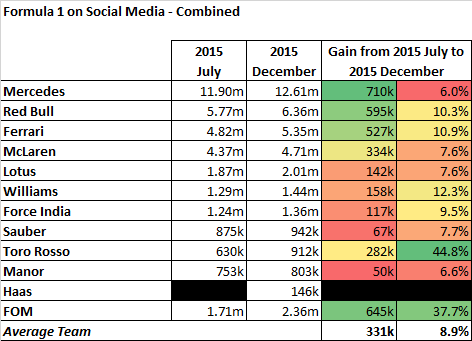
The youngest line-up on the grid in 2015 of Max Verstappen and Carlos Sainz not only made an impact on the track, but they also made an impact off it as Toro Rosso jumped up the social media standings. Analysis from The F1 Broadcasting Blog shows that, across Facebook, Twitter and Instagram, the team is close to overtaking Sauber whilst recording higher increases than the likes of Williams and Lotus since July. That was not the only social media story in the latter half of 2015.
Overall, the 2015 Formula One season was disastrous for McLaren, with an unreliable Honda engine down on power affecting their performance throughout the season. Their social media highlight was generated by the average fan from off the street. #PlacesAlonsoWouldRatherBe quickly became a trend following the Brazilian Grand Prix qualifying session and was a moment of light relief during what was a sombre weekend due to events outside of the paddock. McLaren’s performance on the track hurt their social media following off the circuit. McLaren started the Summer with 4.37 million accounts following them across the three main social media platforms, climbing to 4.71 million accounts as the season came to a close, an increase of 7.6 percent. Only Mercedes, Manor and Lotus recorded a lower percentage increase during the second half of 2015, showing that McLaren’s poor on track performance had a negative impact when it came to a social media meaning that they were unable to further exploit the McLaren brand name.
The Formula 1 social media statistics, covering Facebook, Twitter and Instagram, as of December 2015.
Mercedes’ percentage increase of 6.0 percent is the lowest of any team in the field, but when you’re coming from a high user base in the first place, a lower percentage increase than the midfield teams should be expected. An increase from 11.90 million to 12.61 million accounts following their activities is still a sizeable increase for the Brixworth based team. McLaren’s poor performance not only affected the brand following, but also adversely affected Fernando Alonso and Jenson Button’s following. Button’s following increased 9.9 percent compared with the Summer, however Alonso’s percentage increased only 3.9 percent, from a combined audience of 4.00 million to 4.16 million. Those are not good numbers for what is supposed to be one of Formula 1’s biggest drivers, and is further proof of why Formula 1 needs a successful McLaren as soon as feasibly possible.
Is Max Verstappen the future?
Alonso’s raw increase of 156,000 from July to December was the eighth highest in the field, again across Facebook, Twitter and Instagram. Up front you had Lewis Hamilton and Nico Rosberg, the latter recording an increase of a whopping 1.21 million followers largely due to a huge uplift in Instagram numbers. Hamilton’s numbers will only surge further as he tries to break America. Behind the Mercedes drivers you had Button, Daniel Ricciardo and Felipe Massa. No major surprises there, Ricciardo continung to get a boost from his fantastic 2014 season. In sixth position, and ahead of Alonso, enter Verstappen. At the half-way stage of the 2015 season, a combined audience of 247,000 were following Verstappen’s activities. That number climbed to 479,000, a whopping increase of 94.1 percent! Facebook led the way from a percentage perspective for Verstappen, increasing from 57,000 to 118,000. Of course, these numbers are miniscle in comparison to Lewis Hamilton, whose increase of 1.21 million since the Summer dwarfed the majority of the field. But a year or two from now? If Verstappen continues to perform on the circuit, then who knows. Based on the latter half of this season, I would expect Verstappen’s combined audience to quickly surpass one million in early-2016.
We should not forget Carlos Sainz, Jnr and the Toro Rosso team as a whole in the Verstappen puzzle. In the second half of 2015, Sainz’s following has increased 44.6 percent from 273,000 to 395,000. The reason Sainz has fallen behind Verstappen is because the Dutchman has surged ahead on Facebook, whereas Sainz’s increase since the Summer has been relatively slow in comparison. Toro Rosso is the only big surprise from a team perspective, jumping by 282,000 followers from July to December, an increase of 44.8 percent. I suspect as soon as either Verstappen or Sainz switch teams then Toro Rosso’s following will stagnate again. Either way, they have made enough of an impression to climb over the back of Sauber’s gearbox and has, for the moment, given them an identity.
The Formula 1 social media statistics, covering Facebook, Twitter and Instagram, as of December 2015.
All social media outlets have grown in size and stature versus July, but it was Instagram who jumped the biggest, with their Formula 1 reach growing from a cumulative total of 5.34 million to 8.57 million, an increase of over three million accounts. As a result, Instagram’s Formula 1 market share on social media increased from 9.0 percent to 12.8 percent at the expense of both Facebook and Twitter. Bear in mind that all numbers presented in this piece are a combined count, there is no way to work out distinct people across different social media sites. What we do know is that 2.29 million people follow Lewis Hamilton on Instagram, so the distinct count of accounts that follow F1 related accounts on Instagram is probably around the ~5 million range.
We come to the end of another season though where I place the URL https://www.facebook.com/F1 in the middle of a post and I get the result “Page not found.” To see that heading into 2016 is immensely disappointing and frustrating. Why there is such a barrier towards creating exciting, innovative and groudbreaking content for Facebook users, I do not know. We knew Facebook would come later than Twitter and Instagram in terms of content, Marissa Pace, part of the Formula One Digital Media team told us that this time last year. And at a time when Formula 1’s viewing figures are dropping as the population exploits new and emerging technologies, having a presence on Facebook is more critical in my opinion than ever before. The now infamous #SepangClash between Valentino Rossi and Marc Marquez during this year’s MotoGP championship was viewed 15 million times on Facebook. You cannot buy numbers like that, and you cannot let opportunities like that slip through your figures. The longer Formula One Management waits to exploit Facebook, the harder their task becomes, it is as simple as that. #SepangClash was also a fantastic example of on the spot thinking from Dorna’s social media team, instantly creating that hashtag to drive conversation across every platform: TV and online. It was successful, and it kept MotoGP in the spotlight between Sepang and Valencia. Something for F1 to learn should a big on-track clash occur in 2016.
Whilst Facebook is yet to come, the team at FODM have done some fantastic work creating content for both Twitter and Instagram. Really, this season has been what you should expect from those platforms, with discussion based talking points, fan voting and video content being posted, the video content in conjunction with SnappyTV. Understandably, there has not been video content posted ‘live’ yet given the agreements FOM have with broadcasters’. Over on YouTube, archive footage is the clear winner, something that is became more apparent as the season progressed. This reminds me of when BBC returned to Formula 1 in 2009. Fans made it clear to the BBC that they wanted archive footage, and the same message is being put to FOM now.
The question for FOM going into 2016 has to be, how do they exploit their archive without treading on broadcasters’ toes? Of course, FOM own any footage filmed inside a race track, but putting extensive archive highlights online may rub broadcasters’ up the wrong way. I do think there is middle ground though, and certainly one that should be investigated. I think there is a market for creating 20 minute highlight packages of past classic races for the YouTube market. All of FOM’s videos so far have been ‘bite size’, clocking in at under five minutes. The benefit of creating longer highlights packages now of archive races will help them later, if they were to go down the ‘F1 Network‘ route sometime. Again, with viewing figures from the traditional viewing methods dropping, the potential for an over the top network has to be considered within the next few years.
In terms of their social media following, Formula One Management’s two accounts on Instagram and Twitter respectively have increased from a combined audience of 1.71 million in July to 2.36 million, an increase of 37.7 percent. In comparison to the teams (see the first figure in this post), that is a huge increase and shows how important it is for FOM to have a profile on social media. Instagram is the main factor in the increase, jumping 395,000 followers despite a much lower base than Twitter. The good news is that Formula 1 teams, drivers and media are exploiting Instagram more than previously, and that is replicated in the numbers. Whilst Formula One Management smashed into social media in March, at the same time the team also relaunched the official Formula 1 website. The relaunch seems to have been successful, the old version of the website let us not forget was horrendously behind the times from what you would expect out of a modern-day site.
The biggest part of the website relaunch was F1 Access. The main difficulty in the early days was that the website version of F1 Access failed to link to the app version of F1 Access. To be honest, I have not purchased F1 Access. I know it is only £2.29 a month, but as of writing I haven’t heard anyone shout from the rooftops about it. Is there anything in F1 Access that, as a fan, I desperately need to get my hands on? I suspect not, and until there is a compelling reason for me to subscribe to F1 Access, I can’t see myself subscribing anytime soon. Looking ahead to 2016, I think FOM to some degree can continue to do what they are currently doing on Twitter and Instagram. Some exploration needed in relation to YouTube, and a kick-start needed on Facebook sooner rather than later.
The second season of the Formula E championship continues next weekend live from Punta del Este in Uruguay, with all the race action live on ITV4. Jennie Gow will present the action, as of writing guests are to be confirmed.
Preceding the race on ITV4 will be a new Formula E magazine show called Sound of the Future. The first three episodes were aired out of the limelight, and episode four premièred last weekend. Each episode was uploaded to the ITV Hub, but were only available for seven days meaning that they have since been removed, which seems a bit of a shame. Either way, episode four will air again next Saturday before the Uruguay race day programme.
Also as of writing, ITV4 will not be showing the Punta del Este qualifying session live, meaning it should be available for UK viewers to watch online via Formula E’s website.
Formula E – Punta del Este (online via FIAFormulaE.com)
19/11 – 11:10 to 12:10 – Practice 1
19/11 – 13:25 to 14:10 – Practice 2
19/11 – 14:45 to 16:10 – Qualifying
Formula E – Punta del Este
19/12 – 17:20 to 20:30 (ITV4)
=> 17:20 – Sound of the Future: Episode 4
=> 18:00 – Race
20/12 – 09:25 to 10:20 – Highlights (ITV)
As always I will update the schedule if anything changes.
Normally British success in sport leads to an increase in television audiences for that particular event. In Formula 1, over the past eighteen months, the opposite appears to have occurred. Based on unofficial overnight viewing figures, the 2015 Formula One season recorded the lowest average audience since the 2007 season. Lewis Hamilton’s and Mercedes’s dominance has not had the intended effect.
> BBC records lowest average in modern times > Sky average drops back to 2013 level > Only two out of last eight races increased year-on-year
As I have done in previous years, it is worth re-iterating what exactly the numbers represent for those of you that are new to the blog. For Sky Sports F1, all viewing figures are for the three and a half hour race day slot. This covers the ‘Pit Lane Live’ and ‘Race’ segments in the EPG, the reason for this is to allow a fair comparison year-on-year. As thus, the equivalent slots are used for 2012, 2013 and 2014 to present a transparent picture and so the viewing figures presented are not misleading. Numbers also include any Sky simulcasts on Sky Sports 1, where applicable. For the BBC, the figures are all programme averages, irrespective of whether the programme was live or in highlights form, and irrespective of channel. Repeats are accounted for where Asian-based races were covered by the BBC live. As always, viewing figures do not include over the top methods of viewing such as BBC iPlayer and Sky Go.
The 2015 story
The trajectory that the 2015 season took is largely similar to that from two years ago. In my Summer post, I stated that 2015 was up on 2012 and 2014, but down on 2013. In 2013, the dominance of Sebastian Vettel sent audiences tumbling. In 2015, it is the dominance of Mercedes that appears to have a profound effect on viewing figures.
Sky Sports F1’s race day programme has averaged 638k from 12:00 to 15:30, or equivalent this season. That number is down 19.3 percent on 2014’s figure and down 0.4 percent on 2013’s figure of 640k. 2015’s average is also down 10.3 percent on 2012’s average of 711k. By a margin of around two thousand viewers, Sky’s average Formula 1 viewing figures are at their lowest level since they joined the sport in 2012. Given that the gap between 2013 and 2015 is only two thousand viewers, I’m reluctant to read too much into it as two thousand viewers is within the margin of error.
So what has happened here? In essence, any gain that Sky made last season has disappeared. A near 20 percent drop in viewers is bad, whichever way you look at it. There is perhaps some knowledge to be gained in stating that Sky’s numbers are back at 2013 levels when you consider both season’s followed similar patterns on the track. Whilst Sky was no doubt hampered by some races starting earlier, it is a fact that only four races increased year-on-year: Spain (+5.0%), Austria (+4.4%), Britain (+27.3%) and Italy (+7.5%). Twelve races recorded double digit drops compared with 2014, including the US Grand Prix which dropped 15.3 percent. That is not good and is a stark contrast to this time last year. The comparisons include the relevant Sky Sports 1 simulcasts for this year. I think Sky’s drop is a combination of the on-tract action being resolved early this year and also viewer apathy towards the product that Sky Sports have been putting out this year.
The BBC’s figures have dropped year-on-year by 3.6 percent, recording an average of 3.11m. It is their lowest average under this current deal, and therefore their lowest since the BBC returned to the sport in 2009. 2014 averaged 3.22m, whilst 2013 averaged 3.42m. At a time when the BBC’s current coverage is under threat, any drop does not make for good reading. However, eleven races actually increased their average audience compared with 2014. The biggest gainers were Bahrain (+60.9% – BBC showed highlights in 2014), Britain (+28.6%) and Austria (+27.0%). The reason that BBC’s average number is down is because of Mexico, a low-rating highlights race, plus the fact that three races lost over a quarter of their audience year-on-year (Singapore, Japan and Abu Dhabi). Undoubtedly, BBC’s biggest problem, and one of the major flaws in this current contract was that Lewis Hamilton’s championship victory was not screened live on free-to-air television.
An eight year low in the TV same day world
The combined average of 3.74m is down 6.7 percent on 2014’s 4.01m, down 7.3 percent on 2013’s 4.06m and down 4.5 percent on 2012’s 3.92m. For the first time since the current rights agreement between BBC and Sky started, both channels dropped year-on-year based on overnight viewing figures. Last year I commented on the closeness of the figures from 2012 to 2014. 2015 has dipped below that line as it were, meaning this season sits between 2007 and 2008 in the popularity stakes. Considering Formula 1 has a British world champion, the idea that viewing figures have dropped to an eight year low in the UK may be considered alarming to those within the sport.
The most watched race in 2015 was the Canadian Grand Prix which averaged 5.35m, whilst the season ending Abu Dhabi Grand Prix falls at the opposite end of the spectrum with 2.61m. As I noted earlier, all the numbers exclude online viewing, including iPlayer, Sky Go and Now TV. Including those methods of viewing would send 2015 above 2008’s average of 3.94m, but I would be surprised if it made much of a difference year-on-year, unless there has been drastic changes of viewing habits to more online methods from Grand Prix fans. If people are changing their viewing habits in relation to Formula 1, the question is why. There is always a reason if habits have changed, a live viewer does not become an on-demand viewer for an event which should be viewed live without a good reason.
It would be amiss I feel to write off 2015 as saying “well, online would increase numbers”. To do so would ignore the bigger picture. Formula 1 has well documented issues on and off the track at the moment concerning the spectacle the sport is presenting. One team dominating is historically a turn off for the casual viewer. Ferrari’s dominance in the mid 2000s led to a worldwide switch off (Germany and Italy aside). If the dominance of Mercedes is leading to the same pattern, then you have to be concerned. The casual viewer does not want to watch one team dominating. You can’t punish dominance, of course you can’t. But it does not help when that same team appears to be anti-racing, repeatedly. That is a switch off. Maybe you could blame Lewis Hamilton himself as the reason for the decline, in that he is in BBC’s and Sky’s coverage too much, and there is an argument that features with him as the main attraction do not move television ratings at the moment.
Heading into 2016
A dominant Mercedes or not, Formula 1 needs three things in 2016 if viewing figures are to move in a positive direction. A resurgent McLaren. Formula 1 cannot have two world champions at the back of the field. Fernando Alonso and Jenson Button should be near the front, competing for points and podiums, week in, week out. Secondly, Ferrari to challenge Mercedes. We did see flashes of it at the start of this season, but nothing ever materialised, aside from Singapore.
From a media perspective, Lewis Hamilton versus Sebastian Vettel writes itself. We never quite got it when Vettel was at Red Bull, plus other drivers were involved in the championship battle too. Hamilton versus Vettel, Mercedes vs Ferrari. It is something the casual audience would watch and become invested in. One of the reasons why 2011 was the most watched season in the modern era was not only because of Vettel, but because of Hamilton’s on-track duels with Felipe Massa. We need to see Hamilton versus Vettel, and I hope we see that in 2016. It would draw audiences, not only in the UK but in Germany too. In my opinion, Hamilton vs Nico Rosberg is not something the general public are interested in and the viewing figures reflect that.
Lastly, Formula 1 needs the BBC. Formula 1 needs the BBC more than the BBC needs Formula 1. The BBC could replace Formula 1 with repeats on a Sunday afternoon and claim one million viewers, whereas Formula 1 would need to find a new home on ITV or Channel 4, to a significantly reduced audience, more so on the latter. I’ll finish this piece with a quote from David Coulthard: “My personal view is that if F1 allows itself to lose free-to-air television coverage in the UK, it will not only affect the popularity of the sport, and by extension the teams’ ability to raise money to compete, but it will also reduce its exposure to the next generations of engineers and mechanics. F1 has inspired people to enter a workforce that numbers tens of thousands of people – the drivers are just the lucky ones at the end of the rainbow.”



 Motorsport Broadcasting