Scheduling: The 2017 Spanish Grand Prix / Monaco ePrix

The Formula 1 paddock moves into Europe for round five of the 2017 Formula One season, the Spanish Grand Prix. The weekend’s action will be broadcast exclusively live on Sky Sports F1, with highlights airing each evening on Channel 4.

Anthony Davidson will be back with Sky Sports for the Spanish round of the season. As announced pre-season, Davidson will be with the team for five races this year. Elsewhere, the Formula E championship returns with round five from Monaco. Martin Haven will be back in the commentary box as Jack Nicholls will be covering the Formula 1 action for BBC Radio 5 Live. Haven will be alongside Bob Varsha and Mike Conway as Dario Franchitti is stateside for the Indianapolis 500 build-up. The electric championship speeds up now with eight races taking place in the next two and a half months!

Also in action, next weekend is IndyCar action from the Indianapolis road course, whilst the World Superbike riders will be at Imola.

Channel 4 F1
Sessions
13/05 – 17:30 to 19:00 – Qualifying Highlights
14/05 – 18:45 to 21:00 – Race Highlights

Sky Sports F1
Sessions
12/05 – 08:45 to 11:00 – Practice 1
12/05 – 12:45 to 14:50 – Practice 2
13/05 – 09:45 to 11:15 – Practice 3
13/05 – 12:00 to 14:35 – Qualifying
14/05 – 11:30 to 16:15 – Race
=> 11:30 – Track Parade
=> 12:00 – Pit Lane Live
=> 12:30 – Race
=> 15:30 – Paddock Live

Supplementary Programming
10/05 – 20:30 to 21:00 – F1 Report: Preview
11/05 – 14:00 to 15:00 – Driver Press Conference
12/05 – 01:30 to 01:45 – Paddock Uncut
12/05 – 17:35 to 18:15 – Team Press Conference – to be confirmed
12/05 – 18:15 to 18:45 – The F1 Show – to be confirmed
17/05 – 20:30 to 21:00 – F1 Report: Review

BBC Radio F1
11/05 – 21:00 to 22:00 – Preview (BBC Radio 5 Live)
12/05 – 08:55 to 10:35 – Practice 1 (BBC Radio 5 Live Sports Extra)
13/05 – 09:55 to 11:05 – Practice 3 (BBC Radio 5 Live Sports Extra)
13/05 – 12:55 to 14:05 – Qualifying (BBC Radio 5 Live Sports Extra)
14/05 – 12:30 to 15:00 – Race (BBC Radio 5 Live Sports Extra)

Formula Two – Spain (Sky Sports F1)
12/05 – 11:00 to 11:45 – Practice
12/05 – 14:55 to 15:25 – Qualifying
13/05 – 14:35 to 15:45 – Race 1
14/05 – 09:30 to 10:25 – Race 2

Formula E – Monaco (online via Channel 5’s social media channels and YouTube)
13/05 – 06:55 to 07:55 – Practice 1
13/05 – 09:25 to 10:10 – Practice 2

Formula E – Monaco
13/05 – 10:45 to 12:10 – Qualifying (Spike)
13/05 – 14:30 to 16:15 – Race (Channel 5)

Formula V8 3.5 – Monza (BT Sport 3)
13/05 – 14:00 to 15:00 – Race 1
14/05 – 10:30 to 12:00 – Race 2

GP3 Series – Spain (Sky Sports F1)
13/05 – 08:45 to 09:20 – Qualifying
13/05 – 16:10 to 17:00 – Race 1
14/05 – 08:20 to 09:00 – Race 2

IndyCar Series  Grand Prix of Indianapolis (BT Sport 2)
14/05 – 20:30 to 23:00 – Race

Porsche Supercup  Spain
13/05 – 17:15 to 18:15 – Race 1 (Eurosport 2)
14/05 – 10:30 to 11:30 – Race 2 (Eurosport 1)

Speedway Grand Prix – Poland (BT Sport 3)
13/05 – 17:45 to 21:15 – Races

World Rallycross Championship – Belgium (Motorsport.tv)
14/05 – 13:00 to 14:55 – Race

World Superbikes – Imola
13/05 – 09:15 to 14:00 – Qualifying and Race 1 (Eurosport 2)
14/05 – 10:00 to 15:00 – Support and Race 2 (Eurosport 2)
16/05 – 20:00 to 21:00 – Highlights (ITV4)

As mentioned, once Sky’s schedules are in shape, I will update the above information.

Update on May 9th – I have had confirmation from Sky that their original schedules were incorrect. Sky will not be broadcasting the Porsche Supercup series and GP3 practice live, so exactly the same as previous years. I have also amended the Formula E commentary line-up – Dario Franchitti is in fact stateside and not covering the event.

A catalyst for change?

Fernando Alonso’s testing and rookie orientation day in preparation for the Indianapolis 500 later this month has drawn attention from far and wide. His orientation day has also reignited the debate about whether there is value in covering testing live.

From the outset, the circumstances around Alonso’s IndyCar appearance are unique, in a situation unlikely to be repeated. A peak of around 72,000 devices watched Alonso’s orientation via YouTube, with the stream provided by the IndyCar Series consistently above 40,000 devices.

Furthermore, IndyCar streamed the event via Facebook to a reach of 800,000 users. Other forms of motor racing, such as Formula E, have struggled to break through live streaming barriers on YouTube. The numbers recorded for Alonso’s orientation are staggering, especially considering that this was a weekday event.

There is a great deal motor racing can learn from this, not just Formula 1 but also other forms of the sport. Watching cars drive around a track, essentially collecting data, for hours at a time may seem like a useless activity for much of the population to watch.

The actual process of testing doesn’t have the intensity. It is much more difficult to understand because different people are doing different things. Testing highlights are really interesting, live coverage of testing is really, really boring. – MotoGP journalist David Emmett speaking to me last year.

Dorna broadcasts MotoGP testing live from Valencia post-season and Sepang pre-season via their app, combining ‘as live’ footage with studio discussion. Sky Sports F1 aired Formula 1 testing live in 2013, although this was shoe-horned around the 3D gimmick that never went any further.

The argument against live testing is that the cost is too high and the expected audience is too low. Setting up a full camera crew at say Barcelona requires a lot more people than the Indianapolis oval. For Dorna, cameras are already in Valencia following their season finale a few days earlier, so it makes logistical sense to cover the post-season test in an in-depth format.

Alonso’s Indy 500 test is the first time that testing, in any form, has aired live via outlets such as YouTube and Facebook in this live and raw form. Firstly, I absolutely applaud IndyCar and those involved from McLaren through to NBC for making this happen. The stream today allowed new fans to appreciate the demands of oval racing.

Discussions between Alonso and his mechanics were broadcast, with an openness displayed throughout. In comparison, during Formula 1 testing, the prying media have no access to drivers’ conversations with mechanics. To broadcast F1 testing in the same way as Alonso’s IndyCar test would require a significant culture change for teams up and down the pit lane.

Imagine Lewis Hamilton testing new parts on his Mercedes, and then openly giving feedback on camera in front of his mechanics instead of behind closed doors, with microphones picking up his every word. Whilst fascinating to those watching, the information provided would also be golden to his rivals.

Broadcasting testing live via social media would help viewers and fans of the sport appreciate the intrinsic nature of testing. It may bring new fans to the sport, if they stumble across live testing and become captivated by the nature of it, in the same way fans were captivated by the stream today.

Whilst I do not want to see every minute of testing live (a few hours at most each afternoon would suffice), the extremely positive reaction to IndyCar’s live stream ahead of the Indianapolis 500 may serve as a catalyst for change. How Liberty Media can implement that into Formula 1 might need a little bit of persuading from a variety of parties…

Bottas win peaks with 3.4 million viewers

A peak audience of 3.4 million viewers watched Mercedes driver Valtteri Bottas clinch his first Formula 1 victory at the Russian Grand Prix, overnight viewing figures show.

Race
Last year, Channel 4 aired highlights of the race with Sky broadcasting the race exclusively live, meaning that year-on-year comparisons are difficult to make.

Live coverage of the race, which aired on Channel 4 from 12:00 to 15:10, averaged 1.92m (19.7%). Channel 4 split their programming into three sections in television guides and on the EPG.

The pre-race build-up averaged 865k (11.8%) from 12:00, with the race itself bringing in 2.16m (21.5%) from 12:35 to 15:10. An audience of 656k (6.0%) stuck around for Channel 4’s analysis from 15:10 to 16:30.

Channel 4’s coverage peaked with 2.73m (27.6%) at 13:15 as the race restarted following the Safety Car period. Compared with last year, the peak is on the lower end of the scale for live races.

Sky Sports F1’s live coverage averaged 447k (4.5%) from 12:00 to 15:30, peaking with 752k (7.3%) at 13:55. The timing of Sky’s peak coincides with the gap between BT Sport’s Premier League game yesterday (Man Utd vs Swansea) and Sky’s first Premier League match (Everton vs Chelsea).

The combined average audience of 2.37 million viewers is marginally down on last year’s average audience of 2.40 million viewers. The peak audience is unusual, in that the peak audience did not occur at the same point as Sky’s and Channel 4’s own unique peak audiences.

In fact, the combined peak audience of 3.44 million viewers (31.3% share) occurred at 14:30. At the time of the peak, 2.72m (24.8%) were watching on Channel 4 (down 4,000 viewers on their own peak at 13:15) and 713k (6.5%) were watching on Sky Sports F1 (down 39,000 viewers on their own peak at 13:55).

There was a core audience of 3.2 million viewers watching with very little movement throughout the first 75 minutes, the race never once dropping below 3.16 million viewers. The audience breakdown for the respective broadcasters shows off the different audience profiles, Sky driven by other programming in their portfolio, with Channel 4 more general channel hopping. The numbers for the race are solid, but like the event itself, not spectacular.

Qualifying
Live coverage of qualifying across Sky Sports and Channel 4 fared poorly on Saturday afternoon.

Channel 4’s programme, which aired from 11:55 to 14:30, averaged 937k (12.4%). Their broadcast peaked with 1.60m (19.3%) at 13:55 as Sebastian Vettel claimed pole position. It is Channel 4’s second lowest audience ever for a live Formula 1 qualifying broadcast, only ahead of last year’s Malaysian Grand Prix (811k/11.4%).

Sky Sports F1’s broadcast averaged 197k (2.6%) from 12:00 to 14:40, which is one of their lowest qualifying audiences on record. Vettel’s pole position peaked with 371k (4.5%) at 13:55.

The qualifying session was up against other live sporting competition on free-to-air television: snooker on BBC One and horse racing on ITV, however both programmes started at 13:30, so are unlikely to have had a major impact.

The combined audience of 1.13 million viewers is the lowest for a qualifying session since the 2008 European Grand Prix, which was up against the Olympic Games closing ceremony. The combined peak audience of 1.97 million viewers (23.7% share) is marginally up on last year’s peak audience of 1.9 million viewers, last year shown in highlights form on Channel 4.

A larger proportion of Formula 1’s viewership is skipping the pre and post-session festivities, instead choosing to just watch the on-track action. Earlier in the day, an audience of 370k watched the third practice session across Channel 4 and Sky Sports F1 (291k and 79k respectively), peaking with 446k (7.3%) at 10:40.

The 2016 Russian Grand Prix ratings report can be found here.

overnights.tv-bannersF1

A new era, and a new graphics set for Formula Two

The machinery on the track might have looked the same in Bahrain, but off the track Formula 1’s leading feeder series has a new identity. Enter, the Formula Two Championship. The championship takes over that title from the now defunct GP2 Series.

Throughout its duration from 2005 to 2016, the GP2 Series maintained the same style of graphics: a combination of blue and white, with rounded ‘squircle’ like edges. Whilst Formula One Management (FOM) enhanced the graphics set when Formula 1 moved to high-definition, it retained the same look and feel as the original non-HD version.

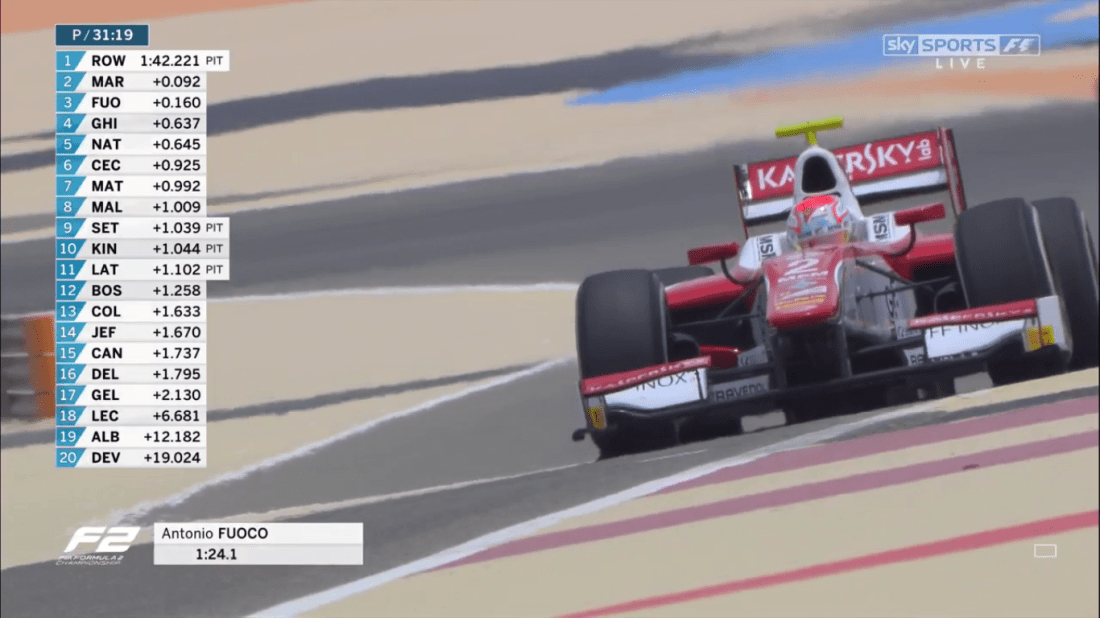
By 2016, the graphics set had outlasted its stay compared to other championships. Formula 1, MotoGP, and IndyCar had refreshed their graphics on numerous occasions whereas GP2 and GP3 were left behind. A common GP2 complaint was the lack of a timing tower during qualifying, meaning that it was incredibly tricky to follow the action. In this respect, GP2 was a decade behind Formula 1, FOM introducing the tower when Formula 1 moved to a three-part qualifying format in 2006.

2017 Bahrain Formula Two - Fuoco.png
A shot of Prema’s Antonio Fuoco during the 2017 Bahrain Formula Two practice session. Note the familiar timing wall down the left hand side of the picture.

Finally, with the rebirth of Formula Two, F1’s leading feeder series is no longer treated as inferior in the production department. The new graphics set is consistent with F1, the only difference being the colour scheme, which is distinctive to Formula Two and with a call back to GP2’s colour scheme. I dare say that Formula Two’s graphics set is better than its bigger brother.

Elsewhere, there was some evidence in Bahrain that the new FOM may use Formula Two as a testing ground for new techniques. For the first time in twelve years, FOM used picture in picture during both of their live race broadcasts. The first occasion was as one of the leading drivers made a pit stop, with the second used on the formation lap of the sprint race.

I do not know if this happened in the old regime, but it would make sense to use GP3 and Formula Two as a test bed for new ideas, bringing the new features into F1 once tested. Admittedly that is difficult when the two championships run different schedules (unlike Moto2 and Moto3; Formula Two and GP3 are not present at every of their big brother’s races such as the Russian Grand Prix this weekend), but it is something that FOM should look to do now that both series are using a streamlined graphics set.

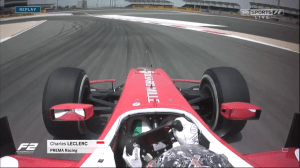
2017 Bahrain Formula Two - Leclerc
On-board with Charles Leclerc during the 2017 Bahrain Formula Two practice session.

It is not just on the graphical side, but all the way through production, the feeder series are a feeding ground in many ways. New talent should start work on directing GP3 and Formula Two, working their way to Formula 1.

Is it right to criticise Sky over lack of Formula Two promotion?
A criticism on social media over the Bahrain Grand Prix weekend was Sky Sports F1’s treatment of the series. Sky did little to promote the series opener, treating Formula Two (like they did with GP2) as a channel “add-on” rather than an integral piece of furniture. Furthermore, Sky’s scheduling was not up to scratch throughout the weekend, cutting off an excellent feature race on the slow-down lap as opposed to after the podium celebrations.

On one hand, yes, Sky should promote the series more through their supplementary programming. However, it is Liberty Media’s task to help encourage broadcasters to promote the series further, and to help embed the championship into the wider product. The new FOM needs to make Formula Two and GP3 feel important, in the same way that Dorna treat Moto2 and Moto3 with care.

Formula Two’s and GP3’s social media standing across Facebook and Twitter for an international motor racing series is alarmingly poor, whilst neither championship has a presence on YouTube. The second Formula Two race in Bahrain won by Charles Leclerc featured fantastic racing, but this was unexploited due to Formula Two’s absent YouTube presence (GP2 did not have a YouTube channel either).

A lot of drivers in Moto2 have built up sizeable fanbases due to social media, which needs to occur in Formula Two as well, given that Formula 1 will be relying on this talent in the future. It is probably no surprise that Sky have treated GP2 / Formula Two the way they do given that the Commercial Rights Holder has done little historically to help the championship. Hopefully that will change under Liberty Media’s ownership.

Happy 5th Birthday!

The journey of The F1 Broadcasting Blog started in early 2012. I had been toying with the idea of starting a Formula 1 blog site for some time, but never quite hit the right note.

I have been watching motor racing since 1999, and wanted to start writing about the sport, alongside my University studies (now turned full-time job which I thoroughly enjoy). Like most people, my first attempt of blogging consisted of writing race reports. Quite quickly, it felt like a chore to write the reports. I love watching motor racing, but writing about the action did not interest me, it did not click.

Motor racing is not just about the cars or bikes on the circuit, there are a range of topics associated with the sport left unexplored by the mainstream press. Broadcasting has many different avenues that can be dissected. Scheduling. Viewing figures. Television rights. Social media. On-screen graphics, and so on. With that in April 2012, The F1 Broadcasting Blog was born. Broadcasting is an area that I am passionate about, and I hope that comes across in the opinion and analysis pieces I post.

In the five years since inception, the site has recorded over 1.5 million total hits with visitors from around 200 countries. I am immensely proud of how far this site has come since then, breaking stories to readers around the motor sport broadcasting landscape. Last year, I attended both Channel 4’s Formula 1 launch and the British MotoGP in a professional capacity, with the intention to bring readers closer to the sport, something that continued at the AUTOSPORT Show in January and will continue moving forward.

The top 10 pieces on the blog (by number of hits) from the past five years are as follows:

10. Channel 4 announces Formula 1 on-air team – March 2016
9. Dissecting Georgie Thompson’s decision to leave Sky F1 – February 2013
8. Davidson and Brundle highlight strengths and weaknesses in Sky’s Formula 1 team – July 2016
7. Doing the sums: the cost of viewing Sky Sports F1 in 2013 – January 2013 (2017 piece: here)
6. Predicting BT Sport’s MotoGP team – October 2013
5. Tom Clarkson added to BBC F1 TV team – March 2013
4. Predicting Channel 4’s Formula 1 team (part 1) – December 2015
3. ITV4 wins rights to screen MotoGP highlights – March 2014
2. Georgie Thompson to leave Sky’s F1 team – February 2013
1. Gary Anderson to leave BBC’s Formula 1 team – January 2014

If you are a long-term reader from the beginning or someone who has just spotted this site, thank you for reading and I hope you enjoy the content coming up in the remainder of 2017.

Thanks,
Dave
Creator and Editor of The F1 Broadcasting Blog