Doing the sums: the cost of viewing Sky Sports F1 in 2021

2021 marks Sky’s tenth season covering Formula 1 for fans in the UK, the sport having last aired fully free-to-air via the BBC in 2011.

From 2012 to 2018, the pay-TV broadcaster aired half of the races exclusively live, with the other half also airing live on free-to-air television.

Since 2019, Sky has covered F1 exclusively, with only the British Grand Prix airing live on free-to-air television on Channel 4. So, what options are available for UK F1 fans, and how does this compare to previous years?

Motorsport Broadcasting takes an in-depth look at the figures, to help fans decide which package is best for them…

All calculations in this article assume that we are still going to see a full 23-race Formula 1 season without COVID-19 causing an impact, but also comes with a slight caveat attached to them.

Who is airing what?

For fans of motor sport generally, Sky Sports is not just airing Formula 1 in 2021. As well as F1 itself, the F1 channel is also airing live coverage of Formula 2, Formula 3, Porsche Supercup, and the IndyCar Series.

In addition, fans can watch the GT World Challenge, Ferrari Challenge and Extreme E via Sky Sports, a shift from a few years ago when Sky’s motor sport portfolio consisted of the F1 programme and nothing else.

Meanwhile, BT Sport is home to live coverage of MotoGP, Moto2, Moto3 and MotoE, with BT also airing live coverage of the World Rally Championship this year.

As in previous years, expect coverage of the World Endurance Championship (outside of Le Mans) and World Rallycross to turn up on BT. However, fans also have access to most, if not all, of BT Sport’s motor sport portfolio via the respective championship’s over-the-top service.

Analysis that Motorsport Broadcasting conducted at the end of 2019 showed that, broadly speaking, if you are only interested in MotoGP or rallying, then the relevant over-the-top passes are the way to go.

Over on Eurosport, fans should expect to find coverage of Superbikes, both domestically and internationally, as well as Formula E and World Touring Cars, whilst the annual 24 Hours of Le Mans is always a highlight.

Remaining live on free-to-air television is the British Touring Car Championship on ITV4, whilst both Formula E and Extreme E air via the BBC’s digital platforms. Incredibly, the latter has also secured live coverage on ITV’s main channel for its finale each race weekend.

The big question mark this year is the W Series. The inaugural season aired live on Channel 4 in 2019 when the series formed part of the DTM weekend offering. Now, the series has joined forces with F1, and will be a fixture at 8 race weekends this year.

It begs the question as to whether W Series will air exclusively live on Sky Sports F1, or whether W Series are able to strike their own rights deal outside of F1’s existing agreements, potentially remaining live on Channel 4.

W Series have yet to comment on their 2021 offering, but this is an area to keep an eye on over forthcoming weeks.

F1 TV Pro

Formula 1 launched their over-the-top service in May 2018, and since then the service has grown in stature, both in terms of archive and in terms of live content.

Speculation mounted last year that F1 TV Pro was set to land in the UK when F1 released a survey, suggesting that F1 TV Pro would be part of Sky’s TV platform Sky Q.

Despite the suggestions, nothing has since come to fruition, and for 2021, F1 TV Pro is again not an option for UK fans. UK fans can subscribe to F1 TV Access for £2.29 a month, or £19.99 across the year, which gives you access to F1’s rich archive.

Sky

In the past two seasons, Sky have enticed F1 fans with their “F1 for £10” offer, which has been a success given that viewing figures for the F1 channel rose strongly last year.

The bad news for fans hoping to utilise a similar offer this year, is that no such offer exists this time around.

After changes to their packages last year, Sky’s pricing for new customers remains static this year. Sky’s Signature pack remains Sky’s entry level package for new subscribers.

Currently, new customers can grab the Signature Pack for £24.00 a month, or £21.00 when taking Sky Sports, which compares favourably to the previous Entertainment price of £22.00.

OptionF1 only – HD
Sky Q 1TB Box
F1 only – UHD
Sky Q 2TB Box
Sports – HD
Sky Q 1TB Box
Sports – UHD
Sky Q 2TB Box
Signature£24.00£24.00£21.00£21.00
Sky Sports F1 only£18.00£18.00  
Sky Sports  £22.00£22.00
Ultra HD and HD £9.00 £9.00
Monthly Cost£42.00£51.00£43.00£52.00
Yearly Cost£504.00£612.00£516.00£624.00
One-Off Installation Cost£20.00£20.00£20.00£20.00
Yearly Cost£524.00£632.00£536.00£644.00

I mentioned last year that the price for viewing Formula 1 in ultra-high definition had tumbled thanks to the package changes.

Comparing like-for-like (ignoring the £10 offer), the F1 only options stay static year-on-year, but a £2 increase for the Sky Sports pack and a £1.00 increase for the Ultra HD add-on means that the Sky Sports Ultra HD option jumps by £36.00 year-on-year.

No matter whether you are interested in HD or Ultra HD, going for Sky Sports F1 alone instead of the whole Sky Sports pack means you save just £12.00 a year, or £1.00 per month.

Sky are increasingly looking at the big picture, there are many apps integrated into their Sky Q box such as YouTube, Spotify, Netflix, All 4 and BBC iPlayer.

The prices above apply for new customers, and account for any offers that Sky are currently running. Note that, outside of the offer periods, the Signature package will cost £31.00 as of April 1st, whilst the Sky Sports pack is £30.00. My advice: phone up, and renegotiate…

Overall, as the pricing structures currently stand, if you want to watch every Formula 1 race live on Sky, you are looking at a Sky monthly bill of between £42.00 and £52.00.

Virgin Media

By this stage, if you are seriously considering Virgin Media, it is because you also want to get broadband and phone with them as a triple-play, as their TV only prices are steep.

The only way to get Sky Sports via Virgin Media is to take their Maxit TV pack at £55.00 a month (an increase of £2.00 per month on last year), and then add Sky Sports for an additional £31.75 a month.

This does changes radically however if also want to take Virgin’s broadband package. If you want to take their broadband offering, then you can grab their basic Maxit TV pack with Sky Sports, reducing the overall cost.

OptionSD
TiVo 500GB Box
HD
TiVo 500GB Box
Maxit TV (including BT Sport)£55.00£55.00
Sky Sports£31.75£31.75
Sky Sports HD £7.00
Monthly Cost£88.75£95.75
Yearly Cost£1,041.00£1,125.00
One-Off Installation Cost£35.00£35.00
Yearly Cost£1,076.00£1,160.00

BT TV

BT TV subscribers can watch Sky Sports via a Now pass.

BT TV is an IPTV service, meaning that readers wanting to subscribe to Sky Sports F1 will first need to sign up to BT’s broadband offering, making the below an apple and oranges comparison compared to Virgin Media and Sky.

BT’s pricing is like Virgin Media’s, although Virgin’s television offering is more comprehensive than BT’s. The benefit of BT is that you can flexibly change your packages as you see fit without any penalty.

OptionSDHD
BT Broadband£27.99£27.99
Big Sport£40.00£45.00
Monthly Cost£67.99£72.99
Yearly Cost£815.88£875.88
One-Off Installation Cost£49.98£49.98
Yearly Cost£865.86£925.86

Now

If the idea of paying a significant amount of money for the pay-TV players does not sit well with you, there is still the option of Now, previously known as Now TV.

As well as Sky moving away from the “F1 for £10” offer, the F1 Season Ticket from Now has also disappeared for 2021. Some fans were e-mailed an exclusive offer to view Now for £20 a month, but oddly Now did not make this available more widely.

However, there are two offers currently running for F1 fans, although only one has a use for most of the season. Their offer gives you the Sports Monthly Membership pack for £25.00 per month for six months, after which it switches to £33.99 a month.

This option also includes Now Boost, allowing you to watch in full HD and surround sound, at a cost of £3.00 per month after the first three month. Assuming you cancel the Boost immediately after the six months, this works out at £266.97.

Now’s day pass remains £9.98, but the weekly pass is no more.

Sky Sports Mobile TV

In previous years, Sky Sports Mobile TV was clearly the cheapest of the bunch, and technically it still is based on the pricing on Sky’s website.

However, reviews of the app on both the iOS and Android app stores show that the app is clearly not working as intended, with users unable to purchase a subscription. As thus, Sky Sports Mobile TV disappears off the list of potential options, for now at least.

In summary, there are 10 different options, across four different players this year:

– £1,160.00 a year – Virgin Media (HD)*
– £1,076.00 a year – Virgin Media (SD)*
– £925.86 a year – BT TV (HD)**
– £865.86 a year – BT TV (SD)**
– £644.00 a year – Sky (All – UHD)
– £632.00 a year – Sky (F1 – UHD)
– £536.00 a year – Sky (All – HD)
– £524.00 a year – Sky (F1 – HD)
– £266.97 – Now (6 months Sports Membership + Boost) – offer (expires April 11th)
– £229.54 – Now (Day Pass x 23)

* includes BT Sport as mandatory
** includes BT Broadband as mandatory

In comparison, F1 TV Pro for fans in America costs $79.99 per year, which translates to £58.00 across the whole year, significantly cheaper than any option above.

The long and short of it is that the cheapest ways to view F1 in the UK have disappeared across the board for this year.

Are any of the options above cheap enough to hook you in? If you have spotted anything worth adding, or noted any other deals out there, drop a line in the comments below.

Pricing and information correct as of March 27th, 2021, with BT’s prices amended and Now’s clarified on March 29th, 2021. Pricing is subject to change.

Contribute to the running costs of Motorsport Broadcasting by donating via PayPal. If you wish to reproduce the contents of this article in any form, please contact Motorsport Broadcasting in the first instance.
Gavin Emmett to lead BT Sport’s MotoGP commentary team as Quirk joins line-up

Gavin Emmett is to become BT Sport’s lead MotoGP commentator for the 2021 season, the broadcaster has confirmed.

Emmett succeeds Keith Huewen as their lead, following Huewen’s decision to step down after the 2020 season. Emmett steps up to the role having been part of BT’s coverage since its inception in 2014, primarily serving as reporter and co-commentator.

Motorsport Broadcasting understands that Neil Hodgson will join Emmett for the main MotoGP series, with Michael Laverty joining him for Moto2. Hodgson and Laverty will then rotate on a race-by-race alongside Emmett to cover the Moto3 class.

As a result of Emmett’s promotion, BT have brought Natalie Quirk into the MotoGP fold. Quirk will serve as MotoGP reporter, also presenting some segments of the programme in a similar vein to Emmett previously.

Quirk has been part of BT Sport’s wider programming since 2014, as both presenter and reporter. In recent years, Quirk has led BT’s speedway offering, both domestically and internationally.

Currently, Quirk serves as one of BT’s regular football presenters, presenting coverage of the UEFA Europa League and The National League, amongst others.

The rest of BT’s line-up remains the same, with Suzi Perry continuing to present the broadcaster’s main MotoGP offering.

Last month, BT and MotoGP confirmed that the pay-TV channel will continue to broadcast the series until the end of the 2024 season, extending their current rights deal by an additional three seasons.

BT to remain in UK for the first 5 rounds

The pay-TV broadcaster will remain in the UK for at least the first 5 rounds this season, Motorsport Broadcasting can confirm.

BT began 2020 covering MotoGP from Triumph’s UK headquarters in Hinckley, before relocating to the BT Tower in London from September onwards.

I understand that BT’s presentation will continue from the BT Tower as the 2021 season gets underway due to the ongoing international travel restrictions.

The UK government hopes to ease international travel restrictions on May 17th. On that basis, BT intends to present their Mugello offering on-site over the weekend of May 28th to May 30th, but this is subject to change.

BT cannot realistically present their coverage on-site before then, as all their UK based talent would need to quarantine upon arrival back in the UK.

This is not an issue for the crew working on Sky’s Formula 1 coverage, as F1 has an exemption in place with the UK government meaning that their talent do not need to quarantine after returning from a race weekend.

The 2021 MotoGP season gets underway in Qatar on Sunday 28th March.

Contribute to the running costs of Motorsport Broadcasting by donating via PayPal. If you wish to reproduce the contents of this article in any form, please contact Motorsport Broadcasting in the first instance.
Scheduling: The 2021 F1 and MotoGP season openers

After a shorter than usual winter break, both Formula 1 and MotoGP are back!

Coverage of Formula 1, along with feeder series Formula 2 and Formula 3, airs live on Sky Sports in 2021, the broadcaster now entering their tenth season of covering the sport.

In addition, highlights of every race will air on Channel 4, with the free-to-air broadcaster also airing live coverage of the British Grand Prix weekend.

F1 – the personnel

The big change from a personnel perspective is the departure of Ben Edwards from Channel 4’s line-up, Edwards deciding to step down from his position at the end of last season.

Replacing Edwards in the box is Alex Jacques, who will commentate on Channel 4’s coverage alongside his existing Formula 2 and Formula 3 commitments.

Joining Jacques in the Channel 4 box is David Coulthard, whilst Mark Webber and presenter Steve Jones also remain part of Channel 4’s line-up. The crew will be out in Bahrain presenting coverage, as opposed to remotely in the UK.

Over on Sky, Simon Lazenby continues to front their coverage, with David Croft and Martin Brundle remaining in the commentary box.

Ted Kravitz and his Notebook return in an increased capacity. ‘Ted’s Notebook’, as it was affectionally known, returns after being absent from the 2019 and 2020 schedules during Scott Young’s previous tenure as Sky’s Director of F1.

Ted’s Notebook as a programme will not only be present post-race, but will also return to cover qualifying as well during 2021.

Elsewhere on Sky’s presentation line-up, expect the likes of Anthony Davidson, Karun Chandhok, Johnny Herbert, Natalie Pinkham, Paul di Resta and Rachel Brookes to feature as the season progresses.

Over on the radio airwaves, Jack Nicholls, Jennie Gow and Jolyon Palmer return to BBC Radio 5’s offering to talk listeners through the 23-race season.

F1 – the coverage

The championship reverts to a weekend structure last seen 15 years ago, with the two Friday practice sessions reduced to 60 minutes, a throwback to the 2006 season.

Furthermore, races will now start on the hour instead of ten past the hour, again a throwback to yesteryear.

The structure of Formula 2 and Formula 3 changes radically for 2021: less weekends, more races, intended to reduce costs.

Each race weekend will now feature 3 races, the two series alternating their way through 2021.

As well as adapting to the above, Sky have moved The F1 Show to a Thursday evening time slot, with both Welcome to the Weekend and The Story so Far dropped from their schedules.

Plans for a Sunday Social show preceding the main build-up on Sunday’s have not materialised after being in Sky’s pre-COVID plans for 2020.

Channel 4’s scheduling remains identical to 2020, with a 90-minute show for qualifying and a 150-minute show for the race itself, both including ad-breaks.

F1 – over-the-top

The only way to watch F1 live legally in the UK is via Sky Sports F1 in some form.

Fans cannot access the premium tier of F1’s over-the-top service, despite F1 and Sky exploring this openly last year.

For those outside of the UK watching via F1 TV Pro, access to on-board angles from every car is available, as well as the Pit Lane Channel.

With no Jacques on the Pit Lane Channel this season, F1 says that Alex Brundle, Sam Collins, Rosanna Tennant, Matt Gallagher, and Jordan King will provide commentary this year.

All F1 sessions are available to listen live via BBC’s F1 website

Friday 19th March
19:30 to 21:30 – The F1 Show: Season Launch (Sky Sports F1)
All Day – Drive to Survive: Season 3 (Netflix)

Tuesday 23rd March
21:00 to 22:00 – F1: Preview (BBC Radio 5 Live)

Thursday 25th March
13:00 to 16:35 – F1: Drivers’ Press Conference (Sky Sports F1)
17:00 to 18:00 – The F1 Show (Sky Sports F1 and Sky Sports Main Event)

Friday 26th March
10:00 to 11:00 – F2: Practice (Sky Sports F1)
11:00 to 12:45 – F1: Practice 1 (Sky Sports F1)
– also BBC Radio 5 Live Sports Extra from 11:25 to 12:35
13:45 to 14:25 – F2: Qualifying (Sky Sports F1)
14:45 to 16:30 – F1: Practice 2 (Sky Sports F1)
– also BBC Radio 5 Live Sports Extra from 14:55 to 16:05

Saturday 27th March
10:15 to 11:20 – F2: Sprint Race 1 (Sky Sports F1 and Sky Sports Main Event)
11:45 to 13:10 – F1: Practice 3 (Sky Sports F1 and Sky Sports Main Event)
14:00 to 16:30 – F1: Qualifying (Sky Sports F1 and Sky Sports Main Event)
– also BBC Radio 5 Live Sports Extra from 14:55 to 16:10
16:30 to 17:35 – F2: Sprint Race 2 (Sky Sports F1)
18:30 to 20:00 – F1: Qualifying Highlights (Channel 4)
21:00 to 21:30 – Ted’s Qualifying Notebook (Sky Sports F1)

Sunday 28th March
11:40 to 13:00 – F2: Feature Race (Sky Sports F1)
14:30 to 19:30 – F1: Race (Sky Sports F1 and Sky Sports Main Event)
=> 14:30 – Grand Prix Sunday
=> 15:55 – Race
– also BBC Radio 5 Live Sports Extra from 16:00 to 18:00
=> 18:00 – Chequered Flag
=> 19:00 – Ted’s Notebook
20:30 to 23:00 – F1: Race Highlights (Channel 4)

Full scheduling details for the 2021 Bahrain Grand Prix. Scheduling details correct as of Friday 26th March and are subject to change.

Live coverage of MotoGP remains on BT Sport for 2021, the pay-TV broadcaster having recently extended their deal with MotoGP to continue airing the sport until 2024.

MotoGP – the key details

In a similar vein to Edwards on the F1 front, BT’s lead commentator Keith Huewen also decided to step away from the day-to-day commentary role at the end of 2020.

Huewen cited the “unexpected positive effect of the pandemic” as to the reason for his departure. Gavin Emmett succeeds Huewen as lead commentator, with Natalie Quirk stepping into Emmett’s previous role as reporter.

For fans not wanting to subscribe to BT, coverage is also available via MotoGP’s over-the-top VideoPass service.

Available to fans for €199.99 (£171.73) across the season, the service gives fans the ability to watch from multiple angles, as well as access to MotoGP’s rich archive from 1992 onwards.

On the free-to-air highlights front, coverage will return to ITV4 this season after negotiations between Dorna and prospective broadcasters went to the eleventh hour.

Highlights will again air on Monday evenings, moving from Quest where it has aired for the past two seasons, but with limited success.

Friday 26th March
10:45 to 18:00 – Practice (BT Sport 2)
=> 10:50 – Moto3: Practice 1
=> 11:45 – Moto2: Practice 1
=> 12:40 – MotoGP: Practice 1
=> 15:10 – Moto3: Practice 2
=> 16:05 – Moto2: Practice 2
=> 17:00 – MotoGP: Practice 2

Saturday 27th March
10:15 to 13:15 – Practice (BT Sport 2)
=> 10:25 – Moto3: Practice 3
=> 11:20 – Moto2: Practice 3
=> 12:15 – MotoGP: Practice 3
14:00 to 18:00 – Qualifying (BT Sport 2)
=> 14:30 – Moto3: Qualifying
=> 15:25 – Moto2: Qualifying
=> 16:20 – MotoGP: Practice 4
=> 17:00 – MotoGP: Qualifying

Sunday 28th March
11:45 to 19:30 – Races (BT Sport 2)
=> 11:45 – Asia Talent Cup
=> 12:30 – Warm Ups
=> 14:15 – Moto3: Race
=> 16:00 – Moto2: Race
=> 17:30 – MotoGP: Race
=> 19:00 – Chequered Flag

Monday 29th March
20:00 to 21:00 – Highlights (ITV4)

Full scheduling details for the 2021 Qatar MotoGP. Scheduling details correct as of Friday 26th March and are subject to change.

As I announced in my piece last month, I will not be publishing scheduling articles for every single F1 and MotoGP race weekend this season.

Instead, this site will publish schedules for key events in the motor racing calendar throughout the year, such as the Monaco Grand Prix weekend, Indianapolis 500, and 24 Hours of Le Mans.

Last updated on Friday 26th March.

Contribute to the running costs of Motorsport Broadcasting by donating via PayPal. If you wish to reproduce the contents of this article in any form, please contact Motorsport Broadcasting in the first instance.

Murray Walker, 1923-2021

The voice of Formula 1, Murray Walker has died at the age of 97, the BRDC has confirmed.

Walker commentated on motor sport for decades, from his first Grand Prix race in 1949 all the way through until retiring from his Formula 1 commentary role at the end of 2001, for both the BBC and ITV.

In a statement, the BRDC said “It’s with great sadness we share the news of the passing of BRDC Associate Member Murray Walker OBE.”

“A friend, a true motorsport legend, the nations favourite commentator and a contagious smile. Murray will be sadly missed; his mark and voice will live on in motorsport and our hearts forever.”

“We thank Murray for all he has done for our community.”

Writing on Twitter, Martin Brundle, who commentated with Walker full-time from 1997 to 2001 said “Rest in Peace Murray Walker. Wonderful man in every respect. National treasure, communication genius, Formula One legend.”

Silverstone’s Managing Director Stuart Pringle said “It is with great sadness that I have to inform Silverstone’s fans that Murray Walker died earlier today. He was to so many of us fans of F1, the voice that epitomised the sport we love.”

“Knowledgeable beyond words and with a passion that occasionally got the better of him in commentary, he brought the sport and some of its greatest moments to life in a way that ensured they remained seared in our memories for ever.”

“Much will be written about the impact that Murray had on the sport and we will make a more fulsome tribute in due course, but for the time being rest in peace Murray and thank you.”

A legend who has inspired generations

When people think of F1, past or present, they think of a handful of names. Senna. Schumacher. Fangio. Prost. Hamilton. Bernie. And Murray.

The first F1 race I watched was the 1999 Canadian Grand Prix. Two things got me addicted to F1 that year and into the 2000s: Michael Schumacher in the iconic Ferrari, with Murray Walker and Martin Brundle providing the sound track. Without Murray, I doubt this site would exist.

Although Walker did step aside at the 2001 US Grand Prix, the joys of the internet means that his commentary lives forever, and is easy to find on any F1 archive clip from the 1970s to the 1990s.

I cannot mention Walker without mentioning James Hunt, two opposites, but joined together in the commentary box discussing the one thing they loved most: motor sport.

During Walker’s tenure, F1’s popularity in the UK boomed, thanks in part to Nigel Mansell’s and Damon Hill’s on-track successes, but also due to Walker’s commentary, Walker communicating the intricates of the sport to the masses.

Lines such as “And I’ve got to stop, because I’ve got a lump in my throat!” are forever etched in F1 history, and will always will be.

I had the pleasure of meeting Murray twice. The first was at a signing for his ‘Unless I’m Very Much Mistaken’ book in late 2002. What I remember about the evening most was not the actual signing, but the long queue of hundreds of people, which stretched far outside the Waterstones.

From kids, like me, through to the grandparents, everyone wanted Murray to sign a copy of the book. And that was a sign of just how much people connected with Murray at home. Murray was special, and he brought our wonderful sport to life.

Fast forward 16 years, and to the second meeting of me and Murray, this time at Channel 4’s Formula 1 launch.

Murray was on stage with the rest of the Channel 4 team, before joining the rest of the team in roundtable discussions with media afterwards. Even at the age of 92, Murray was in fine form.

Sadly, there will not be a third meeting.

The motor racing paddock is filled with young talent: racers, mechanics, hospitality, and on the broadcasting side, producers, commentators, presenters and so on.

All of them have a connecting bond: they grew up listening to Murray’s infectious commentary. Without Murray, the motor racing paddock today would be a worse place. There will never be another Murray Walker.

Murray, you inspired generations, not one generation, but multiple. Legend is bandied around far too much, but you were a legend, and simply the best.

We’ll miss you.

Who’s hot, who’s not? Reviewing 2020’s social media metrics

Each race weekend, teams, drivers and riders battle for points and prizes, with the aim of reaching the top of the mountain in their respective series.

Underpinning each entity is a social media team. For the likes of Formula 1 or MotoGP, the social media team may be a genuine business unit. For smaller championships, it may be a single person running the show.

The objective in all cases remains the same: to drive engagement on their social media channels, turning casual fans into passionate fans which, hopefully for the entity in question, turns into a profit further down the line when the fan begins to purchase their products.

Motorsport Broadcasting is an independent website without big backers, and therefore relies on trackable information already in the public domain, such as the number of followers across Facebook, Twitter, and Instagram.

Whilst this may not show who has engaged with individual posts, what it does help to show is who is attracting a newer, fresher fanbase to their platform, therefore becoming more marketable to their team or stakeholders around them or, alternatively, who is struggling to hit the mark.

A note of caution on Facebook: the platform is removing the ability to ‘like’ pages, instead only allowing users to ‘follow’ pages. Facebook notes that the update will “simplify the way people connect with their favourite Pages.”

“Unlike Likes, Followers of a Page represent the people who can receive updates from Pages, which helps give public figures a stronger indication of their fan base,” Facebook adds. This does mean some figures in this piece have increased slightly more than previously.

Championships

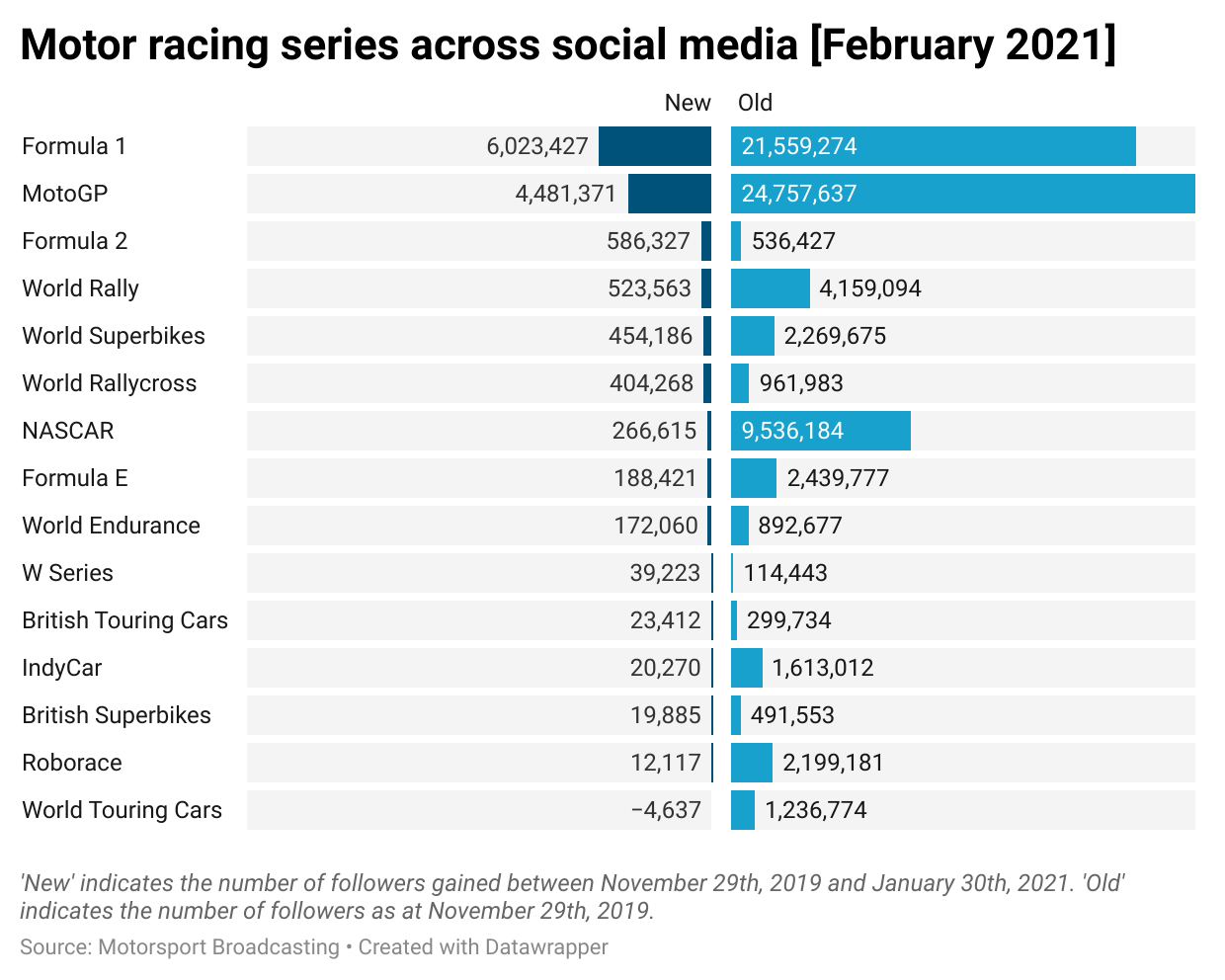
Motorsport Broadcasting compares social media data from 15 different championships, from Formula 1 to the new W Series. 2020 was disruptive for those hoping to grow their following, with most series inactive from March to July.

Some ventured down the Esports route to keep fans engaged during last year’s lockdown before the action restarted. Two championships suffered the most because of COVID: the electric Formula E series and the W Series.

Formula E hosted their final 6 races across 9 days in August, whilst W Series cancelled their second season owing to the pandemic.

Nevertheless, the W Series increased its following from 110,000 fans to 154,000 fans, the series no doubt hoping to capitalise on their presence during F1 weekends in 2021. Meanwhile, Formula E’s portfolio grew from 2.44 million fans to 2.63 million fans across 2020, an increase of just 7.7%.

After a period in 2018 where Formula E’s following was rising sharply, the electric series has seen its growth stall in comparison to other series. Whilst COVID has halted any momentum the series had; the reality is that Formula E’s social media platforms have been struggling since early 2019.

In April 2019, 2.19 million fans hooked onto their platforms, meaning that Formula E has only gained half a million fans on social media across the past 22 months.

Whilst Formula E’s slowdown is somewhat explainable, IndyCar’s stagnation cannot. The American series grew its following by just 20,000 fans during 2020, despite holding an Esports series which garnered worldwide attention, followed by a successful 14 race calendar.

Formula 2 continued its social media rise during 2020, doubling its reach from 536,000 followers to an excellent 1.12 million followers.

With Mick Schumacher and Callum Ilott both moving on, however, it is difficult to envisage Formula 2 continuing such strong growth during 2021.

Something that, in my view, will likely play against Formula 2 this season is the new championship structure, as the feeder series alternates its slot on the F1 calendar with Formula 3.

If Formula 2 continues to grow strongly during 2021, then it is possible F2 could overtake IndyCar in the social media pecking order later this year.

Out in front, F1 and MotoGP continued to surge unaffected by COVID during 2020, both quickly heading towards 30 million followers across Facebook, Twitter and Instagram combined.

F1 teams

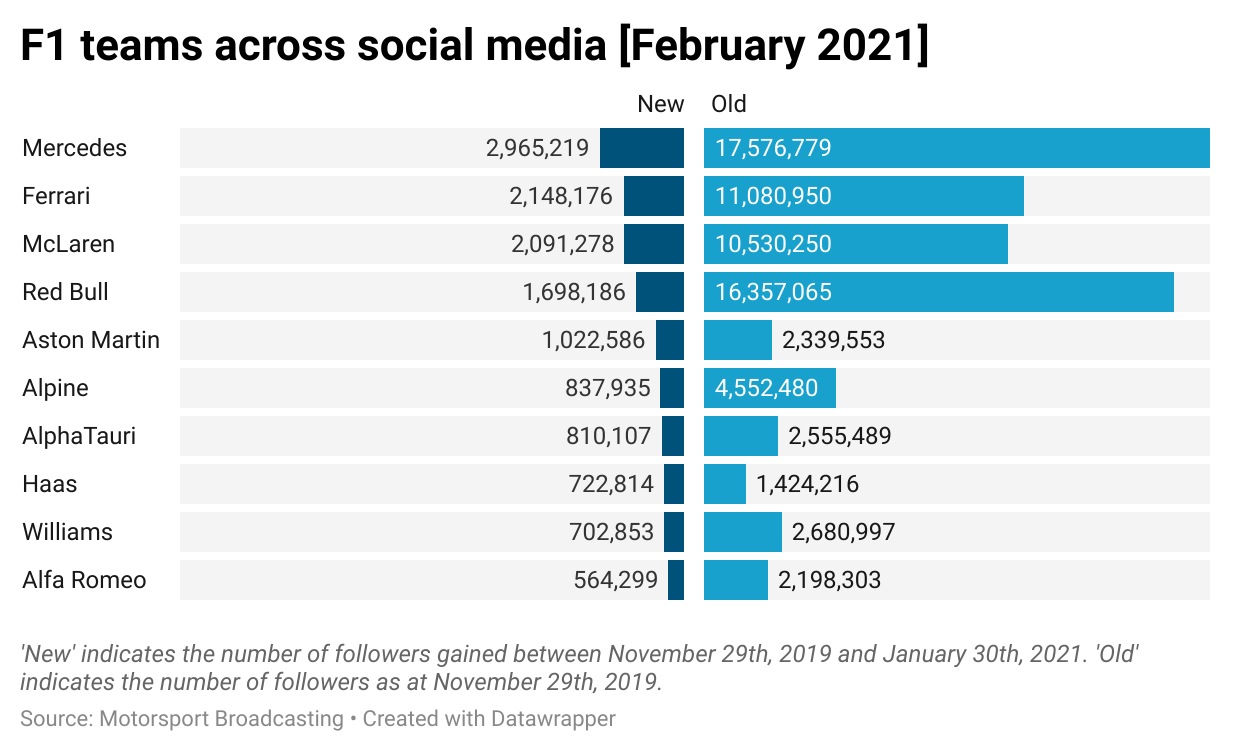
1st on track, and 1st in the socials. 2020 was a success on and off track for Mercedes, as they continued to increase their lead over Red Bull in the social media stakes.

Mercedes’ advantage on social media is reflective of their openness across their social media platforms.

Despite Lewis Hamilton and Valtteri Bottas being their main players on-track, it is technical director James Allison who plays a key role in Mercedes’ digital output. Allison explains in clear detail the design decisions that his team make during each Grand Prix season, helping put Mercedes a step ahead of the rest both on and off-track.

Whilst Red Bull’s portfolio is still growing strong, arguably the Milton Keynes outfit has slipped back in recent times – a slip that we can trace back to Daniel Ricciardo’s departure at the end of 2018.

Statistics compiled by Motorsport Broadcasting show that Red Bull consistently recorded the strongest growth of any F1 team between 2015 and 2018, but has now not only slipped behind Mercedes, but also Ferrari and McLaren.

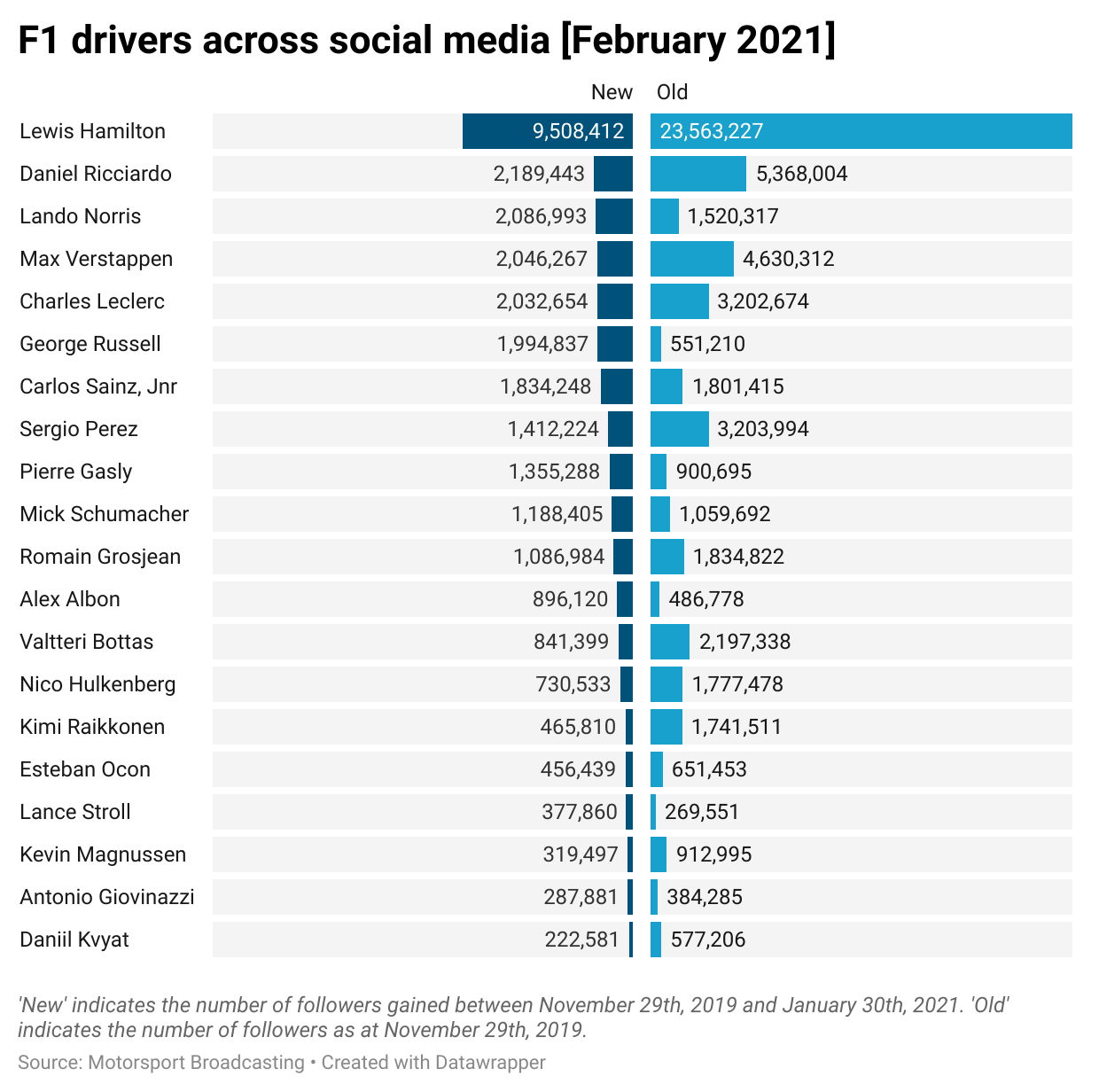
And, despite Ricciardo not being in a race winning car at Renault / Alpine, his growth on social media during 2020 was still bigger than his former team-mate Max Verstappen (see the chart below), showing how popular he is amongst the motor sport fan base.

Has Red Bull’s revolving second seat turned potential new fans off the team? Of course, we should note that Red Bull still has a combined 18 million followers across the three major social media platforms, an excellent number and only behind the black cars.

Red Bull’s figures will be one to watch this season as Sergio Perez brings his Mexican contingent with him from Racing Point, now rebranded as Aston Martin.

Fuelled by Perez’s shock win in Bahrain, Aston Martin ended up best of the rest on social media in 2020, meaning that they are highly likely to overtake both AlphaTauri and Williams in total followers as 2021 gets underway.

Both Ferrari and McLaren maintained strong growth despite their on-track misfortune in recent years (although the latter is now firmly on the road to recovery), showing how important it is to have a strong brand name behind you during tough times.

F1 drivers

If social media was a championship, then Hamilton, Ricciardo and McLaren’s Lando Norris were 2020’s winners.

The gulf between Hamilton and the rest of the F1 continues to get larger and larger, as Hamilton’s activism off the circuit cuts through to a wider audience that transcends the sporting world.

Hamilton’s combined social media following of 33 million fans is over 4 times the next best in F1, with Ricciardo in 2nd on a combined 7.56 million followers. On Instagram alone, Hamilton has 21.6 million followers, the highest for any motor sport driver by some margin.

Behind Hamilton and Ricciardo, 2020 was the year of the Twitchers, with Norris, Max Verstappen, Charles Leclerc, and George Russell all reaping the rewards, building a strong following during the first lockdown in spring.

Norris attracted further attention during the lockdown by participating in IndyCar’s iRacing Challenge, even if it did not necessarily help the latter in the social media standings.

Russell’s growth was one of the strongest during 2020. Helped by his Mercedes drive in Sakhir, his following surged from 551,000 fans at the end of 2019 to 2.55 million fans across the three main social platforms, a rise of 362% in 14 months!

To put that into context, current Mercedes driver Valtteri Bottas grew his following by just 841,000 fans, considerably lower than his Twitch counterparts, including Alex Albon. If this was a qualifying session, both Bottas and Albon would be out in Q2.

The figures show how important the UK territory is to Formula 1, with 3 of the top 6 ‘growers’ during 2020 consisting of the British contingent.

In addition to the Grand Prix field, Motorsport Broadcasting also tracked Mick Schumacher’s following through his second season in Formula 2.

Schumacher’s growth across the year is remarkable for a driver who was, at that point, in the feeder series, reflecting the name and the weight that he carries on his shoulders with him into F1.

The 2021 season, for both MotoGP and F1, begins on Sunday 28th March, with live coverage of F1 testing beginning of Friday 12th March.

Coverage of testing for UK viewers airs live on Sky Sports F1, with coverage also available via F1 TV Pro for those territories with access to the series.

All the figures above compare the number of followers across Facebook, Twitter and Instagram between November 29th, 2019 and January 30th, 2021, therefore encompassing the whole of the 2020 motor racing season.

Contribute to the running costs of Motorsport Broadcasting by donating via PayPal. If you wish to reproduce the contents of this article in any form, please contact Motorsport Broadcasting in the first instance.