Hamilton continues to surge on social media

Four-time Formula One champion Lewis Hamilton continues to remain far above the remainder of the Formula 1 field on social media, analysis of the three major platforms show.

At regular intervals during the year, this site crunches the number of followers each Formula 1 driver and team, along with key championships has across Facebook, Twitter, and Instagram.

Hamilton leads the way
As has been the case for many years, Hamilton leads at the front of the field, growing his reach faster than all his rivals. With a cumulative audience of 16.30 million followers across Facebook, Twitter and Instagram, Hamilton now has nearly 10 million more followers than his nearest championship contender.

To show the scale of Hamilton’s reach, the drivers placed from 2nd to 5th in the social media standings bring in a combined following of 16.43 million followers. In social media terms, Fernando Alonso, Daniel Ricciardo, Max Verstappen, and Sergio Perez equal Hamilton, showing how the Brit on social media transcends the motor sport audience, and why F1 needs to tap into said audience.

Formula 1’s loss is likely to be IndyCar’s gain where Alonso is concerned in 2019, presenting the American series with an excellent opportunity to capitalise on Alonso’s broad reach in the same way they did with last year’s Indianapolis 500. From 2019, Verstappen will be Formula 1’s next big thing on social media behind Hamilton and Ricciardo. But both Red Bull drivers are currently no match for Hamilton on social media.
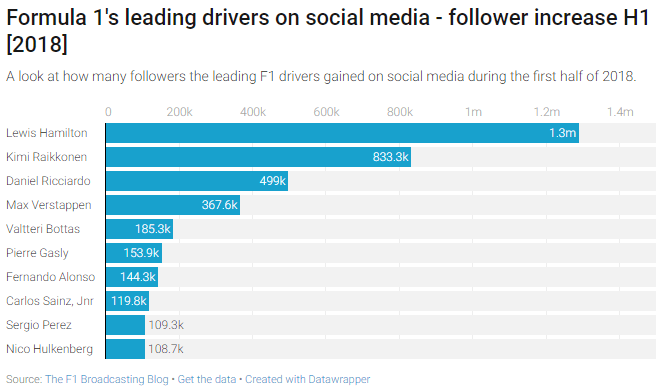
Social media - 2018-08 - F1 drivers gain
In the first half of 2018, Hamilton gained 1.29 million followers across the three main platforms, whilst Ricciardo and Verstappen gained 499,000 and 368,000 followers respectively. Currently, Verstappen’s contingent of fans is no match for Hamilton on Instagram, which is where most of Hamilton’s increase lies.

The further down the field you look, the slimmer the pickings get. As an example, Valtteri Bottas’ social media accounts gained 185,000 additional followers during the first half of 2018, which is a small number in the social media sphere. Considering millions of viewers worldwide watch these drivers every two weeks, are the gains considered poor, or expected now that social media is mature?

Following a poor start to the 2018 season, Williams driver Lance Stroll deleted his Instagram account in June, reducing his social media reach from 179,000 followers to 42,000 followers. The reality is though that Stroll never used his two active social media accounts. His Twitter was last updated in February 2017, whilst his team updated his Facebook last November.

Meanwhile, since joining Instagram at the end of last year, Kimi Raikkonen has amassed nearly one million followers. The Iceman’s reach of 833,000 followers places him tenth in the overall list of drivers, despite having no presence on either Facebook or Twitter! Raikkonen is the fifth most popular driver on the image sharing platform, only behind Hamilton, Alonso, Verstappen and Ricciardo.

Red Bull closes the gap on Mercedes
In the first half of 2018, Mercedes’ following across social media increased from 14.83 million across Facebook, Twitter, and Instagram to 15.03 million followers. Red Bull, Ferrari and McLaren in comparison increased their following by around 900,000 followers.

The metrics suggest that Mercedes are close to hitting their roof, and struggling to attract new followers, even though the content produced is fantastic. There is a real possibility that, based on current growth figures, Red Bull will become the number one team on social media, at least based on the number of followers, within the next twelve months.

The perceived two-tier Formula 1 goes far beyond the race track, and into the social media metrics. Beyond the top four teams, the growth for the mid-field teams resembles a barren wasteland, with the remaining six teams attracting an average growth figure of 133,000 followers.

For a team nearer to the foot of the table, it is proving to be very difficult to make waves outside of the typical Formula 1 social media circles. Ask yourself this: how many teams go ‘the extra mile’ to produce something relevant to a general sporting audience as opposed to the motor racing fan who might already be following them?

Currently, Red Bull, Ferrari, Mercedes, and McLaren are the big Formula 1 brands, although it will be interesting to see if Renault usurp McLaren on that front in 2019 with Ricciardo joining the Enstone outfit.

Roborace crashes
On the championship front, Roborace’s combined following has dropped by 15 percent over the course of the first half of 2018. From 2.82 million followers across Facebook, Twitter, and Instagram last November, Roborace now has 2.37 million followers as of the end of July.
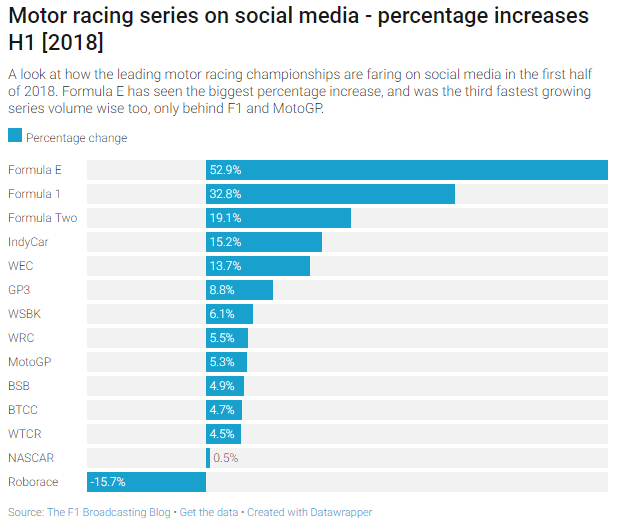
Social media - 2018-08 - percentage gain

The drop for the autonomous series, which has yet to begin, is a result of social media sites clamping down on suspicious accounts. Twitter has taken action recently to remove locked accounts from account follower numbers. Roborace has been prominent in this space in recent years, with their number of followers spiking at different times.

Further down the pecking order, Formula E has experienced a strong first half of 2018, culminating in the latter stages of its fourth season. The electric series has increased its combined audience from 584,000 followers to 893,000 followers, an increase of 52.9 percent.

IndyCar, the World Endurance Championship and Formula Two also recorded percentage increases of over 10 percent, but in the case of the latter, that equated to an increase of just 34,000 followers across the first half of 2018. Both Formula Two and their feeder GP3 have low numbers on Facebook, with 51,000 and 17,000 followers respectively.

Out in front, MotoGP continues to lead the way with a combined 21 million followers across Facebook, Twitter, and Instagram, although F1 has closed the gap, with a cumulative following now of 14.66 million.
Two out, one in as Sky refresh supplementary F1 shows

Sky Sports have refreshed their Formula 1 line-up over the 2018 Summer break, by removing two shows from their schedules and adding a new show.

The new programme, Welcome to the Weekend is a 30-minute live show that will air on Thursday’s during each race weekend. Natalie Pinkham presents to begin with, the show wrapping up all the stories from Thursday’s driver interviews.

However, the addition of Welcome to the Weekend comes at the same time as Sky axing two shows from their schedules. Welcome to the Weekend replaces the 15-minute Paddock Uncut broadcast, which served a similar purpose on Thursday evenings.

Sky have also axed The F1 Report from their weekly schedules. The studio-based magazine show, which started life as the Midweek Report in 2013, aired on Wednesday evenings for thirty minutes following each race weekend.

The show began in an online-only format presented by Anna Woolhouse, before moving onto the main channel shortly afterwards. Sky dropped the ‘Midweek’ branding at the start of 2016, airing each week as a result of the axing of the studio-based version of The F1 Show at that time.

Now, half way through the 2018 season, Sky have discontinued The F1 Report, the last episode airing following the German Grand Prix on Wednesday 25th July.

Although Sky have yet to respond to a request for comment from this site, I suspect the main driver behind this is that both Paddock Uncut and The F1 Report did not rate well across their platforms, resulting in Sky choosing to try something different. Of course, Scott Young now leads Sky’s F1 output, so Young is likely to have influenced the decision.

The change means that, when Sky go off the air at the end of their race day programme, the next time new and original content will air on Sky Sports F1 will in some cases be eleven days later, with Welcome to the Weekend the following race.


Scheduling: The 2018 Belgian Grand Prix / British MotoGP

12 down, 9 to go. Formula 1 returns from its Summer break, with the classic Spa Francorchamps circuit playing host to round 13 of the season, as the championship speeds towards the finish line.

Given what has been a frantic month so far for the sport, one would expect a packed weekend for all the UK’s F1 broadcasters, with no room for filler.

Sky have a new kid on the block, with a new programme on Thursday afternoons. Welcome to the Weekend is a live 30-minute show wrapping up the Thursday interviews with Natalie Pinkham presenting. The show replaces Paddock Uncut, which used to fulfil the same purpose and aired for 15 minutes on Thursdays prior to each weekend.

Elsewhere, a special 90-minute edition of Speed with Guy Martin airs on Bank Holiday Monday on Channel 4. As noted last month, the show sees Williams Heritage rebuild their FW08C car for Martin to race at Silverstone in a challenge that occurred prior to the British Grand Prix weekend.

Martin challenges Jenson Button, who will be in the banned six-wheel Williams FW08B car, which the team were going to race in the 1983 Formula One season. As with his two previous Formula 1 orientated programming in March 2016 (bike versus racing car) and September 2017 (pit stop challenge), the turnaround time from filming the challenge to airing has been short, with a six-week gap in total.

On two wheels, MotoGP are the ones heading to Silverstone this weekend, with live coverage as always on BT Sport 2. In addition to their usual coverage, BT are also covering both British Talent Cup races live, whilst a one-hour live magazine show will air live from Woodlands campsite on Thursday evening, with Suzi Perry presenting.

Because the F1 races this year are starting 70 minutes later, it means that the British MotoGP round starts at 13:00 UK time instead of 15:30 as it has done for the past few years, avoiding a clash with the F1.

Channel 4 F1
Sessions
24/08 – 09:55 to 11:35 – Practice 1
24/08 – 13:55 to 15:35 – Practice 2
25/08 – 10:55 to 12:25 – Practice 3
25/08 – 12:55 to 15:45 – Qualifying
26/08 – 13:00 to 17:35 – Race
=> 13:00 – Build-Up
=> 13:40 – Race
=> 16:30 – Reaction

Supplementary Programming
27/08 – 21:00 to 22:30 – Speed with Guy Martin: Classic F1 Special

Sky Sports F1
Sessions
24/08 – 09:45 to 11:50 – Practice 1 (also Sky Sports Main Event from 10:00)
24/08 – 13:45 to 15:50 – Practice 2 (also Sky Sports Main Event)
25/08 – 10:45 to 12:15 – Practice 3
25/08 – 13:00 to 15:40 – Qualifying
=> 13:00 – Pre-Show
=> 13:55 – Qualifying
26/08 – 12:30 to 17:10 – Race
=> 12:30 – Pit Lane Live
=> 13:30 – On the Grid
=> 14:05 – Race (also Sky1 from 14:00)
=> 16:30 – Paddock Live (also Sky1)

Supplementary Programming
23/08 – 14:00 to 14:30 – Driver Press Conference
23/08 – 17:00 to 17:30 – Welcome to the Weekend
25/08 – 16:55 to 17:30 – The F1 Show

BBC Radio F1
23/08 – 20:00 to 21:00 – Preview (BBC Radio 5 Live)
24/08 – 09:55 to 11:35 – Practice 1 (BBC Radio 5 Live Sports Extra)
24/08 – 13:55 to 15:35 – Practice 2 (BBC Radio 5 Live Sports Extra)
25/08 – 10:55 to 12:05 – Practice 3 (BBC Radio 5 Live Sports Extra)
26/08 – 14:00 to 16:00 – Race (BBC Radio 5 Live)

MotoGP – Britain
24/08 – 08:45 to 16:15 – Practice 1 and 2 (BT Sport 2)
24/08 – 19:00 to 20:00 – ICYMI Live (BT Sport 1)
25/08 – 09:00 to 16:15 (BT Sport 2)
=> 09:00 – Practice 3
=> 12:00 – Qualifying
26/08 – 08:45 to 16:00 (BT Sport 2)
=> 08:45 – Warm Ups
=> 10:30 – Moto3 MotoGP
=> 12:30 – MotoGP
=> 12:45 – Moto3
=> 14:15 – Moto2
=> 15:30 – Chequered Flag

MotoGP – Britain (Channel 5)
28/08 – 19:00 to 20:00 – Highlights

British Talent Cup – Silverstone (BT Sport 2)
25/08 – 16:15 to 17:15 – Race 1
26/08 – 16:00 to 16:45 – Race 2

British Touring Car Championship – Knockhill (ITV4)
26/08 – 11:00 to 18:15 – Races

Formula Three European Championship – Misano
25/08 – 16:45 to 17:45 – Race 1 (BT Sport 3)
26/08 – 07:00 to 08:00 – Race 2 (BT Sport 2)
26/08 – 16:30 to 17:30 – Race 3 (BT Sport X2)

Formula Two – Belgium (Sky Sports F1)
24/08 – 11:50 to 12:45 – Practice (also Sky Sports Main Event)
24/08 – 15:50 to 16:30 – Qualifying
25/08 – 15:40 to 16:55 – Race 1
26/08 – 09:45 to 10:50 – Race 2

GP3 Series – Belgium (Sky Sports F1)
24/08 – 16:45 to 17:25 – Qualifying
25/08 – 08:30 to 09:25 – Race 1
26/08 – 08:30 to 09:15 – Race 2

IndyCar Series – Gateway 500 (BT Sport/ESPN)
25/08 (Sunday morning) – 01:00 to 04:00 – Race

Porsche Supercup – Belgium
26/08 – Race
=> 10:45 to 11:45 (Eurosport 2)
=> 11:15 to 12:00 (Sky Sports F1)

Virgin Australia Supercars – The Bend (Motorsport.tv)
25/08 – 07:30 to 09:00 – Race 1
26/08 – 04:45 to 07:00 – Race 2

The above schedules will be amended if anything changes.

Update on August 21st – It appears Sky have also dropped the F1 Report from their weekly schedule. I am chasing up an official line on this, and will post further in the forthcoming days with an update.

Update on August 25th at 20:30 – If you are recording MotoGP tomorrow, I strongly advise scheduling a massive amount of overrun. Inclement weather has prompted organisers to move the MotoGP race to 11:30 UK time. I suspect that on its own is not going to be enough, but we shall see. I’ve updated what the BT schedule is at the moment above.

Update on August 26th at 12:00 – Sky snuck in a Sky1 simulcast in their final exchanges last week, which I have added above.

“Stay on this! Stay. On. This.” – the split second decisions behind Formula 1’s television direction

For the first time ever, Formula 1 has given fans a behind the scenes look at how they direct a Grand Prix, and what happen during a race-changing incident.

Through Formula 1’s Fan Voice site (login required), a six-minute clip covering Sebastian Vettel’s accident during the German Grand Prix, complete with full open audio of the main production desk, has been uploaded by the team [note added on 21/08 – also available on YouTube now below].

The clip offers an eye-opening account into how motor sport production works, and the effort that goes in by those working on the television product, from the camera operators situated at each of the designated points, to the lead director. Before going any further, it is worth taking a look at how the British Superbikes outside broadcast truck is operated, which is what this site did last year (here and here). Whilst F1’s production is on a much grander scale; the broad principles apply across the spectrum.

For the six people portrayed in the video to function properly, many other people must be on their toes and ready at the correct time for the machine to turn. To put it simplistically, the video depicts four work streams:

  • Main Feed – otherwise known as the World Feed that millions of fans around the globe see. Philip Rorke leads the ship, with Paul Young the production assistant. Rorke chooses between the Track Mix and all the other camera options available to him, such as heli-cam, on-board, and pit lane angles, whilst Young is making sure we are not missing anything on the other feeds.
  • Track Mix – imagine Formula 1, but without the added extras, such as replays, crowd shots, on-board angles, or pit lane shots. The track feed is simply that. Dave directs the track mix, calling the next camera number along with the style of the shot, whilst “Foxy” is the link between Dave and the camera operators, ensuring Dave has not missed anything.
  • Replays – the ability to isolate specific shots, and choosing an order for the play out of the best angles. If you heard Tony shouting different colours during the video, that is what he is doing.
  • Team Radio – a team of four, led by Ray, listen to the radio feeds throughout the race, choosing which snippets are worth playing out over the World Feed.

The four work streams are constantly interacting with each other, to deliver the best product to fans. In the six-minute video, the underlying World Feed switches feed twenty times, flipping between the track mix, roaming pit lane and paddock cameras, the ‘cam cat‘ camera, amongst other angles. I will at this point apologise if I have misinterpreted anyone’s voice and attributed it to the wrong person below.

Feeds used during Vettel’s German Grand Prix accident
00:00 to 00:16 – track mix
00:16 to 00:43 – heli-cam
00:43 to 00:53 – track mix
00:53 to 00:57 – roaming camera 2
00:57 to 01:05 – track mix
01:05 to 01:09 – roaming camera 3
01:09 to 01:13 – track mix
01:13 to 01:27 – roaming camera 1
01:27 to 01:31 – special
01:31 to 01:44 – cam-cat
01:44 to 01:57 – track mix
01:57 to 02:39 – replay (roll A)
02:39 to 02:50 – track mix
02:50 to 03:08 – heli-cam
03:08 to 03:19 – track mix
03:19 to 03:24 – roaming camera 2
03:24 to 03:42 – cam-cat
03:42 to 03:59 – roaming camera 4
03:59 to 05:05 – track mix
05:05 to 05:10 – roaming camera 2
05:10 to 05:55 – replay (roll A)
05:55 to 06:00 – track mix

Although only used for just over two minutes in the clip, the track mix is operational for the entire race. If you listen carefully, even while the heli-cam was the focus of the World Feed before Vettel’s crash, you can hear Dave calling the track mix shots.

“Stand by 12. Stand by 12. And take 12. Stand by 15. Stand by 15. And take 15. Stand by 16, we are going early, wait for Hamilton. Stand by 18. Stand by 18. Take 18 early. Stand by 19 early. Ooh, there’s an off!” The very moment you hear Dave start to begin the last sentence, a wall of noise reverberates on the clip, along with shouts from Rorke to take track mix.

Some of the above should be self-explanatory, but to explain, the camera angles around the circuit are numbered 1 through to an arbitrary number, not every circuit will have the same number of cameras. Some turns may have more than one angle, so camera angle 11 may not be turn 11. “Stand by 15” means “stand by, track camera 15” rather than “stand by, camera at turn 15”, an important distinction to make.

A director may want to take an angle earlier than usual if they want to establish a shot, usually the case if a new segment is about to begin (for example, an emerging battle). By having multiple feeds in the background, it meant that Rorke and his team could switch straight from the heli-cam to the track mix as soon as Vettel headed towards the tyre barrier.

2018 German GP - Safety Car.png
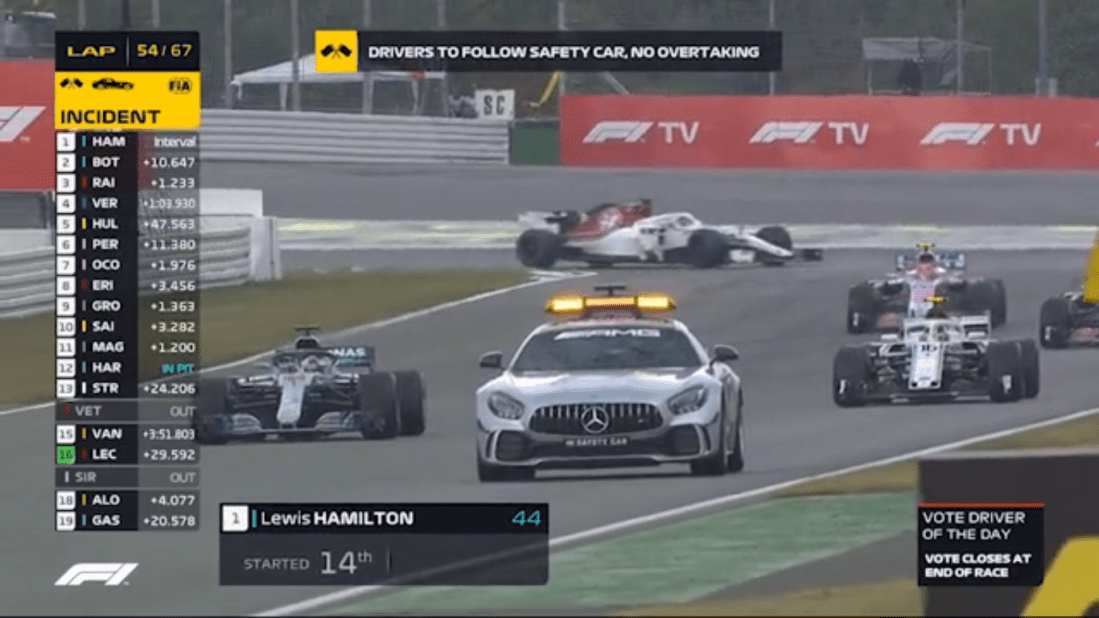
Lewis Hamilton leads the field behind the Safety Car, but note how the order behind him does not represent the timing wall order. Establishing the true order on camera is critical for the director…

The emphasis from Rorke about what he expects is fundamentally clear throughout the video, Rorke leading the team from start to finish. No two races are the same from a direction perspective.

Telling the story
Directing a live sports broadcast is not just about capturing the incidents, it is about telling the story, something Rorke reiterates throughout the clip. The story was Lewis Hamilton versus Sebastian Vettel, with the other drivers playing a supporting role.

That might be exaggerating the point slightly, but other potential points of interest, such as Carlos Sainz changing onto intermediates and Lance Stroll spinning were excluded from the main feed as they were not considered part of the story that Formula 1’s production team was trying to tell. “Is it important to see Sainz on intermediates, not really, this is the story,” notes Rorke.

One of the roaming cameras captured Sainz’s change to intermediates, so the option was there to switch, whilst the attention of the track mix was on Hamilton and Vettel. Given that Stroll spun not too long before Vettel crashed, switching to Stroll on the track mix could have resulted in switching to Vettel slightly later than what they did on the main feed. Playing Stroll’s spin out following Vettel’s accident would have added very little to the overall story-arc.

Later in the six-minute period, Sergey Sirotkin retired with a mechanical problem, Sirotkin’s retirement considered a minor topic compared to re-establishing the running order up front following Vettel’s accident. Anyone who has ever watched a motor race will know that the order can radically change because of a Safety Car period. In between Vettel’s accident and Sirotkin’s retirement, several cars pitted, and whilst the timing wall is present in the graphics set, Rorke considers establishing the order critical, with several back markers also in shot.

Phil – Okay, now let’s see who is behind the Safety Car.
Dave – Hamilton is leading, now let’s get to the front please.
Phil – Don’t worry about Sirotkin for the moment. [camera cuts to him] Go to the cars then.
Dave – Here come the cars coming down here. There’s the cars.
Phil – I just need to establish the order again on that next shot again please.

It is a high-pressured environment, with things that fans, including myself, take for granted at home, discussed in finite detail to ensure that the product is not rough around the edges.

All perspectives covered following Vettel’s crash
The World Feed goes “round the houses”, covering all angles of Vettel’s accident, including crowd shots, and angles from both Ferrari’s garage and pit wall.

As well as this, the team are keen to portray the raw emotion and body language that comes with Formula 1. “Stay on this. Stay. On. This.” is the very direct instruction given by Rorke to remain on the same track feed in the opening seconds after the crash.

The supplementary stories of both Bottas’s and Raikkonen’s pit stops play out, but the overarching story is clearly Vettel’s accident as the production team returns to him walking away from his car instead of changing focus. Rorke again establishes the leadership position aboard the production truck. “Vettel is absolutely pissed off, stay with this please. There’s loads of stops going on, but this is what is all about.”

The team continue to follow Vettel back through the paddock and into the Ferrari motor home. Throughout all of this, the graphics appear at the right time, almost invisible to the conversations that we hear in the video.

Vettel’s accident is replayed over the World Feed twice from different vantage points, once without team radio and once with team radio included. There is enough breathing time between the two replay suites, the second set of replays also including a slow-motion angle of Vettel entering the motor home. Throughout the video, different conversations are taking place in the background, with decisions made that impact the television product.

Would supplementary track feeds make for good additions to F1 TV?
As mentioned earlier, the track mix is simply a feed without additional bells and whistles. For the retro gamers amongst you, think of Geoff Crammond’s Grand Prix 4, which featured a TV mode, but without the obligatory helicopter angles, pit lane shots or crowd reactions.

There are some fans who may prefer this method of viewing, and if F1 is putting together this feed for internal purposes, one might argue that the feed should be made available via Sky Race Control and F1’s new over-the-top service.

One other thing that the six-minute video brought to the forefront was that the World Feed consciously missed some moments that occurred further down the field. In the grand scheme of things, I cannot imagine many getting too upset at missing a Carlos Sainz pit stop or Lance Stroll spnning. The decision-making in this instance was on point.

Nevertheless, it brings up an interesting question as to whether a ‘Track B’ feed, which was prominent during the F1 Digital+ days, should return. The feed focused on action further down the field that the main feed may not have been covering, which in 2018 terms would be the equivalent of covering anyone from Haas downwards.

A nice idea maybe for F1 TV, but the video posted by Formula One Management represented the most dramatic portion of the season so far, and not representative of the season so far where such a feed may be useless. In a 22 or 24 car field, maybe so, but I am not sure you can justify producing a mid-pack feed in a field of 20 cars. Nevertheless, it would give the main director an extra track feed to switch to, should they desire.

Motor sport is a team event in many different respects, and that extends itself to the production side of the event. If this video does anything, it helps make you appreciate just how much effort week in, week out, goes into producing Formula 1 television. It is not an easy job…

F1 broadcasters raised “serious concerns” about superimposed Rolex clock to FOM

A superimposed Rolex clock during coverage of the 2016 Singapore Grand Prix resulted in multiple Formula 1 broadcasters raising concerns to Formula One Management (FOM), the UK communications body Ofcom has revealed.

Ofcom, the body that regulates UK television and radio communication in the UK, received a complaint in relation to Sky Sports F1’s coverage of the Singapore qualifying session from 2016. The complaint related to a Rolex clock, which FOM superimposed over the Singapore Flyer during coverage that weekend, the complainant arguing that the clock was unduly prominent. As part of their investigation, Channel 4’s highlights programme was also brought into scope.

Readers will be aware that Rolex plays a major part in Formula 1’s timing system and graphics set, with their logo displayed at regular intervals, something that is frequently referenced during Ofcom’s write-up (an area they are unconcerned about). However, the Rolex clock went far beyond what had taken place before.

2016 Singapore GP - animated watch.png
The superimposed Rolex clock during Formula 1’s coverage of the 2016 Singapore Grand Prix qualifying session.

Sky argued that, under the terms of their contract with Formula 1 to broadcast the action live, they had to broadcast an unaltered World Feed of qualifying, and as a result an “increased tolerance around undue prominence and product promotion was needed,” something that applies for all live sporting events.

Channel 4 argued that, for practicality reasons, the turn-around time between the live broadcast ending and their highlights show starting was “extremely limited”, and that the placement of the graphic made it difficult to remove from the broadcast without disturbing the flow of the action significantly.

Whisper Films, who produce Channel 4’s Formula 1 coverage, raised what Ofcom describe as “serious concerns” about the undue prominence “at a senior level with Formula One”, with another broadcaster according to Ofcom’s write-up doing the same. In addition, Sky informed Formula 1 that the superimposed Rolex clock was “beyond levels it felt would generally be accepted.”

Both Sky and Channel 4 in their submissions to Ofcom stated that this level of undue prominence has not occurred since. In both rulings, Ofcom said “These images [of the superimposed clock face] dominated the screen, appeared during location shots, and were not integral to the sporting event that was the subject of the programme.”

Ofcom declared Sky’s incident as resolved, because of the steps Sky took following the broadcast, and the fact that Sky’s broadcast was live. However the body, in this instance, did not believe the inclusion of the images was justified for Channel 4’s highlights broadcast, declaring the broadcaster in breach of Rule 9.5 of Ofcom’s Broadcast Code (No undue prominence may be given in programming to a product, service or trade mark).

The body said “We took into account Channel 4’s submission about the time constraints on producing the programme. However, this was not a live programme but an edited one featuring highlights of the race. There was therefore an opportunity for these images to be edited out of the programme as broadcast. [..] We therefore concluded that the commercial references were unduly prominent, in breach of Rule 9.5.”