The Bank Holiday weekend here in the United Kingdom means that there is not a lot of motor sport choice as May begins.
Round four of the 2016 Formula One season comes from Russia, which moves from its early October slot in the calendar. Russia is Sky Sports F1’s third exclusively live race of the season, with Channel 4 screening highlights of both qualifying and the race on the edge of primetime.
There is no further action of four wheels to be aware of this weekend looking at the schedule. Further afield on two wheels, the Speedway Grand Prix season gets underway live on BT Sport. British Eurosport meanwhile plays host to both the World and British Superbike Championships and as is tradition, the domestic super bike action takes place on Bank Holiday Monday.
Channel 4 F1 Sessions
30/04 – 17:30 to 19:00 – Qualifying Highlights
01/05 – 18:00 to 20:00 – Race Highlights
Sky Sports F1 Sessions
29/04 – 07:45 to 09:50 – Practice 1
29/04 – 11:45 to 14:00 – Practice 2
30/04 – 09:45 to 11:15 – Practice 3
30/04 – 12:00 to 14:45 – Qualifying
01/05 – 11:30 to 16:15 – Race
=> 11:30 – Track Parade
=> 12:00 – Pit Lane Live
=> 12:30 – Race
=> 15:30 – Paddock Live
Supplementary Programming
27/04 – 20:30 to 21:00 – F1 Report: Preview
28/04 – 13:00 to 13:30 – Driver Press Conference
28/04 – 20:45 to 21:00 – Paddock Uncut
29/04 – 14:00 to 14:30 – Team Press Conference
29/04 – 14:30 to 15:00 – The F1 Show
04/05 – 20:30 to 21:00 – F1 Report: Review
BBC Radio F1
29/04 – 07:55 to 09:35 – Practice 1 (BBC Radio 5 Live Sports Extra)
29/04 – 11:55 to 13:35 – Practice 2 (BBC Radio 5 Live Sports Extra)
30/04 – 09:55 to 11:05 – Practice 3 (BBC Radio 5 Live Sports Extra)
30/04 – 12:55 to 14:05 – Qualifying (BBC Radio 5 Live Sports Extra)
01/05 – 12:30 to 16:00 – Race (BBC Radio 5 Live Sports Extra)
British Superbikes – Oulton Park
01/05 – 14:00 to 16:00 – Qualifying (British Eurosport 2)
02/05 – 12:30 to 18:00 – Races (British Eurosport 2)
04/05 – 20:00 to 21:00 – Highlights (ITV4)
Speedway Grand Prix – Slovenia (BT Sport 1)
30/04 – 17:30 to 21:15 – Races
World Superbikes – Imola
30/04 – 12:00 to 13:15 – Superpole and Race 1 (British Eurosport 2)
01/05 – 10:00 to 14:00 – Race 2 (British Eurosport 2)
03/05 – 20:00 to 21:00 – Highlights (ITV4)
As always, if anything changes, I will update the schedule.
Last updated on May 1st at 11:00 to reflect the BBC Radio 5 Live schedule change. Race coverage will now be on BBC Radio 5 Live Sports Extra so that the main station can cover updates in the Manchester United vs Leicester City football match.
The 2016 Chinese Grand Prix recorded the lowest audience for a Formula 1 race in the United Kingdom for a decade, unofficial overnight viewing figures show.
Race
Live coverage of the race, broadcast live on Sky Sports F1 from 06:00 to 09:30, averaged 433k (11.1%). The programme hit a five-minute peak audience of 687k. The average audience is down 26.4 percent on 2015, whilst the peak audience is down 29.1 percent year-on-year. Considering nothing has changed year-on-year from a timeslot perspective, the large drop has to be a concern. The picture for Sky is similar to their Australian Grand Prix numbers from last month, whereby both average and peak are down a similarly large amount.
Channel 4’s highlights programme from 13:30 to 15:25 (tape-checked) averaged 1.68m (17.0%). The audience peaked with 2.25m (21.6%) at 14:45 as their highlights edit came to a conclusion. As is now usual, Channel 4’s programming won its timeslot and thrashed their own slot average. Last year, BBC’s highlights programme averaged 2.97m (24.5%), peaking with 3.42m. Year-on-year, Channel 4’s average is down 43.4 percent, with the peak audience down 34.3 percent. The percentage drop for the programme average is the largest recorded yet this year.
Unfortunately, the broader historical picture is bleak. The combined audience of 2.11 million viewers is the lowest for the Chinese Grand Prix since at least 2005. It is also the lowest audience for a Grand Prix since 2006. You have to go back to the 2006 Italian Grand Prix to find a lower average audience. That particular race averaged just 1.86m (23.2%) live on ITV1. The combined peak audience of 2.94 million viewers is also the lowest since Italy 2006.
Qualifying
Live coverage of qualifying on Saturday morning performed solidly on Sky Sports F1, averaging 308k (5.8%) from 07:00 to 10:05. The programme, slightly extended due to the two red flag periods, recorded a five-minute peak of 528k (7.9%) at 09:15. Both measures are down around 20k year-on-year, which in the grand scheme of things is immaterial.
As was been the case in Australia and Bahrain, Channel 4’s qualifying programme was down on BBC’s coverage last year. Highlights of qualifying from 12:30 to 13:55 (tape-checked) averaged 1.19m (14.1%), hitting a peak audience of 1.55m (17.6%) at 13:30. In comparison, BBC’s highlights last year averaged 1.81m (20.9%) and peaked with 2.04 million viewers.
The average audience for qualifying is 34 percent lower than 2015, whilst Channel 4’s peak audience is 24 percent lower than what the BBC recorded last year. These metrics are important to look at as the season progresses, for both qualifying and the race. My hope was that Channel 4 would close the gap on the BBC’s numbers as the season progressed. Early signs are that the gap is not closing and, if the Chinese Grand Prix percentage is to be believed, then the gap is in fact extended.
Final thoughts The big question: is China the low-point? My gut instinct is no. I have a bad feeling that we will see our first sub two million race day audience for 2016 very soon. I’m not prepared to knee-jerk based on the China number and write a lot of analysis based on one very low rating. Instead, I think we need to wait and see what happens in the next few races before analysing. As a number on its own though, the combined audience of 2.11m is very, very poor and that cannot be avoided.
The 2015 Chinese Grand Prix ratings report can be found here.
Channel 4 have confirmed their presentation line-up for their next three live Formula 1 races. Speaking at the top of their Chinese Grand Prix qualifying show, presenter Steve Jones confirmed the line-up for the Spanish, Baku and British rounds of the 2016 championship.
Eddie Jordan will return to Formula 1 punditry at the European (Baku) Grand Prix, Jordan duelling his Top Gear and F1 duties this year. As you would probably expect, the British Grand Prix will feature a stacked line-up from Channel 4, with Wolff, Jordan, Mark Webber and Murray Walker all appearing as part of their coverage.
The three remaining pundits, Bruno Senna, Nicholas Hamilton and Alessandro Zanardi were not mentioned by Jones, although there is some confusion about the exact involvement the latter will have.
No further details have yet been confirmed but as the above shows, Channel 4 are certainly putting their rotating punditry to full effect as the year progresses.
Update on May 2nd – It was confirmed during Channel 4’s Russian Grand Prix highlights programme that Webber and Jordan will be part of Channel 4’s line-up for the season finale in Abu Dhabi.
Channel 4’s Formula 1 coverage got under way with extended highlights of the 2016 Australian Grand Prix, followed shortly afterwards by live coverage of the Bahrain Grand Prix.
There has been reaction far and wide regarding their presentation team and their features so far, but what have readers of this site thought about Channel 4’s output so far? As one would perhaps expect this early into a new broadcasting era, there are a range of responses veering from high appraisal to negativity. Thanks go to all of you who commented on the piece asking for opinions.
We start off with Channel 4’s presenter Steve Jones. Jones follows in the footsteps of the likes of Jake Humphrey and Suzi Perry in presenting Formula 1 on terrestrial television. Some readers have compared Jones favourably to the aforementioned presenters:
Jones reminded me of Jake Humphrey in his early days, so I’m happy to give him the benefit of the doubt. Can’t be as bad as Suzi Perry who never looked interested in F1. – Ted
Jones is still a little awkward but so was Suzi Perry at first. I think they’re trying to recreate the dynamic they had with Jake Humphrey and Jones will soon settle in with a few more live races under his belt. – whopix
Steve Jones impressive and looks as will be perfect for the job. – madmax
On the other end of the spectrum, Karla, Tarquin and Derek Colbourne all referred to Jones as “irritating”, whilst Chris says that Jones is currently the “weak link” of Channel 4’s line-up.
I think Golly makes a good point concerning Jones, and explains the rationale for Channel 4 appointing Jones as lead presenter instead of, for example David Coulthard or Mark Webber:
He’s not supposed to be an expert on F1, he’s the presenter who leads the programme and provides all the links to all the many changing topics, interviews etc. that take place over a GP weekend. These are happening constantly, with producers and directors constantly giving him instructions (and probably advice) in both his ears.
The poor guy has so much to remember and coordinate, while all the time presenting a relaxed and confident image to the camera. I think he’s already doing a fairly good job of it. People have suggested DC or Webber could do the job, but that’s not where their expertise lies – they’re the pundits who feed off questions asked and observations made.
One aspect of the coverage that received a variety of responses surrounded the break bumpers, which as pointed out in a variety of comments is one of the ways Channel 4 is trying to pull in a younger audience. The social integration was applauded, but the dub step music was not:
I do feel C4 are trying to reach a younger audience with their coverage. With the hashtags and (incredibly annoying) dub step music. – camf111
I love the graphics set up. It’s so Channel 4 but then it’s good that they’ve put their stamp on. The break bumpers to drive twitter use is a good way of having the inevitable social media plugging. – rosswilliamquinn
Some niggling faults, especially the dreadful “music” used as outro/intro to adverts & some extraneous attempts to introduce elements of pop culture into what really should remain a sports programme. – IanMac
Channel 4’s line-up was praised by readers, more so following their Bahrain Grand Prix coverage.
The rotating pundits’ idea has worked so far because it allows for good access and different angles for each individual due to their historic or current links (e.g. Susie Wolff in the Mercedes garage, DC driving the Red Bull with the two race drivers). – Tom
The grid walk was the best on terrestrial TV for years with Webber out there as well as Coulthard, who has never looked comfortable chasing down people to interview whilst on camera. – Anton Wilson
There were a few comments comparing Channel 4’s on-demand service All4 with the BBC iPlayer. Having kept an eye on All4 myself, I do think the service needs to improve – the turn-around at the moment is far too slow following a Grand Prix. Australia’s highlights programme was on All4 four hours after the programme had ended, as Michael alludes to.
Avoided spoilers and watched up until the red flag, then had to go out. Came back a couple of hours after the C4 programme had finished hoping to watch it on-demand, but it wasn’t available. Even now, four hours after the programmed aired it’s still not available on All4 – when you can torrent the Sky SD race broadcast in 20 minutes it’s not good enough.
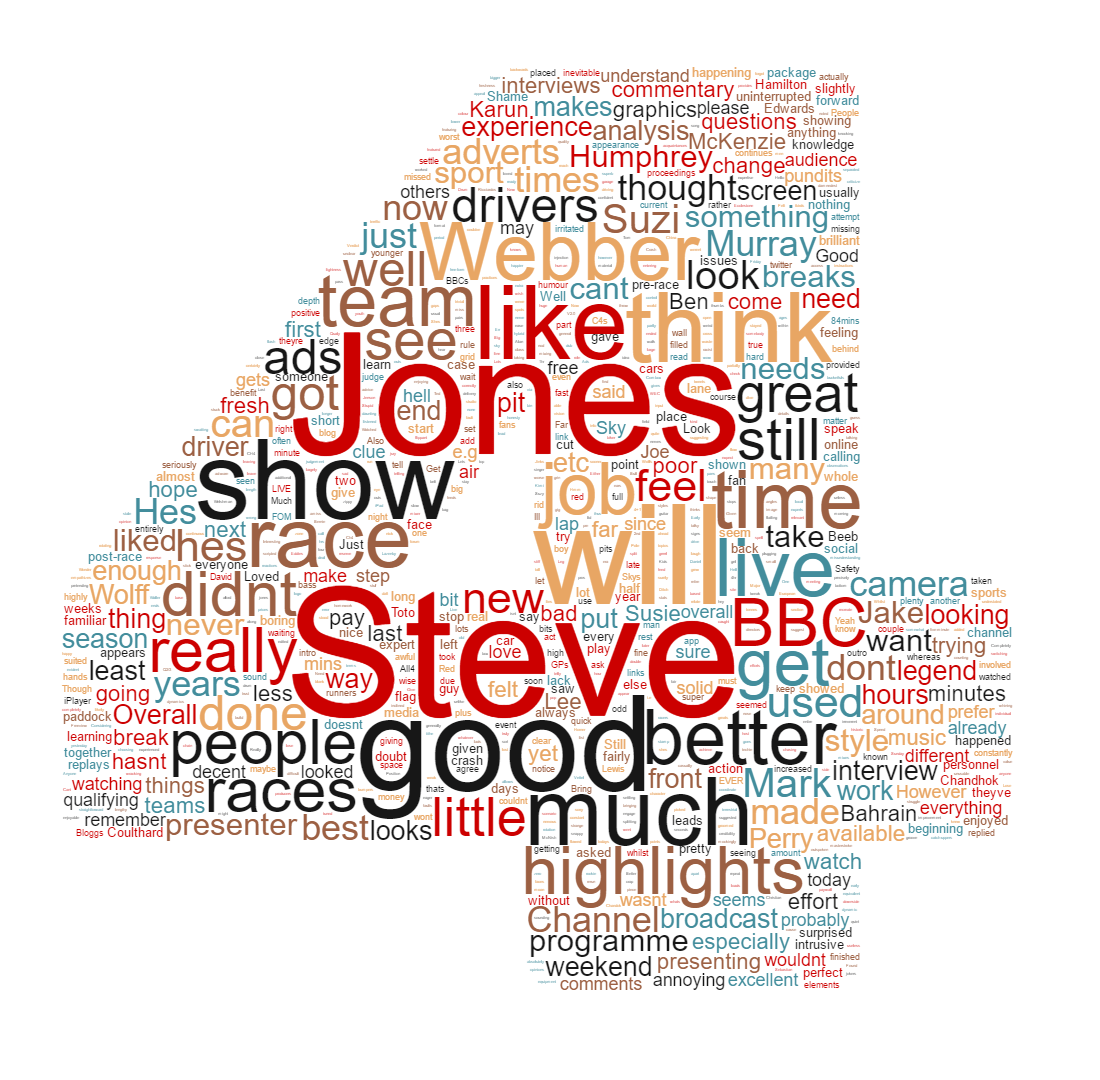
As always, the comments are worth reading aside from those highlighted above. Instead of ending this piece on one overall comment, I’m going to end it on something different, which is a word cloud, generated using Word Clouds of all 65 comments from the original piece. The bigger the word, the more times it was mentioned by readers.
A word cloud of what readers think of Channel 4’s Formula 1 coverage (as of April 2016).
There is an old adage that if you were to give two people a piece of paper and asked them to draw or design something, the outcome would be different. One may choose style over substance. One may go for a simplistic approach. One may choose to focus on a different portrayal in order to tell the viewer a different story.
The same can be said for the UK television coverage of the 2016 Bahrain Grand Prix qualifying session. Sky Sports F1 is led by Martin Turner, who has been producing their Formula 1 programming since the broadcaster started showing the sport in 2012. On the other side is Channel 4. Bahrain was Channel 4’s first ever live Grand Prix, picking up the television contract that the BBC surrendered at the end of 2015. Channel 4’s team behind the scenes is largely made up of former BBC staff. The likes of Mark Wilkin have moved over to Whisper Films to oversee Channel 4’s Formula 1 operation.
Both Sky and Channel 4 dedicated 55 minutes of build-up to qualifying until the World Feed kicked into gear, starting their respective broadcasts at the top-of-the-hour. This writer has watched both build-up programmes since the original airing, and the statistics make for fascinating reading.
Content
Channel 4
Sky Sports F1
Live
19 minutes, 12 seconds
20 minutes, 25 seconds
VT (Video Tape)
22 minutes, 46 seconds
23 minutes, 56 seconds
Commercial Breaks (including break bumpers)
13 minutes, 02 seconds
10 minutes, 39 seconds
The structure from a high level is similar with both broadcasters dedicating more time to pre-recorded material than live discussion. The only major difference surrounds advertising. Channel 4 spent around two and a half minutes more time in commercials than Sky. Channel 4 would have used their entire advertising usage in the Formula 1 build-up, with the additional time coming from break bumpers and sponsorship stings. Sky either cannot sell the ad-time, or choose not to given that they have revenue that comes from elsewhere (subscriptions).
Whilst the length of the pre-recorded material is similar for both broadcasters’, the make-up is significantly different. Sky’s 24 minutes of pre-recorded material was made up of 12 video packages coming in at an average of 1 minute, 50 seconds each. Only one of these pieces was over three and a half minutes in length: Ted Kravitz’s interview with Bernie Ecclestone was the longest VT that aired on either Sky Sports or Channel 4 during the Saturday programming. In comparison, Channel 4’s 23 minutes of material was made up of eight video packages. The average VT length for Channel 4 was 2 minutes, 50 seconds, a minute longer than Sky.
So, why the difference? When analysing the material, it is clear that Sky’s VT’s are reactionary and arguably more relevant to current events. Broadcasting every Grand Prix live means that you have to prepare more material, and Sky do this with shorter pieces that may not take as long to edit as Channel 4’s material. In contrast, Channel 4 can afford to spend time refining their content to ensure that the perfect package goes to air. Furthermore, based on the material from Bahrain, Channel 4’s packages are more memorable, whereas Sky is churning out material that may be forgotten in a few races time. It is almost certainly a budget issue too, as Sky have recently spent significant money on acquiring rights, meaning that they are trying to make their coverage as efficient as possible without losing the leading edge.
The longest five VT’s broadcast on either channel were:
Channel 4
Sky Sports F1
4 minutes, 15 seconds Red Bull Racing at the Circuit de Barcelona-Catalunya
5 minutes, 35 seconds
Ted Kravitz with Bernie Ecclestone
4 minutes, 02 seconds Murray Walker with Jenson Button
3 minutes, 18 seconds Advances to open-wheel racing (Martin Brundle)
3 minutes, 55 seconds Eddie Jordan with Bernie Ecclestone
3 minutes Fernando Alonso’s future (Rachel Brookes)
3 minutes, 52 seconds Lee McKenzie with Nico Rosberg
2 minutes, 10 seconds The evolution of qualifying (David Croft)
3 minutes, 30 seconds Qualifying (Lee McKenzie)
2 minutes, 03 seconds Australian Grand Prix re-cap
All five of Sky’s pieces that are listed would have been conceived and edited on the back of events that transpired during the Australian Grand Prix weekend. Three of those pieces would have been voiced within 24 or 48 hours of the Bahrain qualifying programme airing. On the other hand, three of Channel 4’s pieces would have been planned well in advance of the Australian Grand Prix. The Red Bull film in Spain was shot as soon as testing ended, whilst their two key interviews (Walker and Jordan) would have been planned around their respective schedules.
It is no coincidence that all of Channel 4’s films are around four minutes in length. For them (and Whisper Films), four minutes is probably a ‘sweet spot’ for television: you can tell a story of substance in that time frame without losing your audience. It is also, to a degree, personal preference: one producer may prefer longer shoots, another producer may prefer shorter, snappier pieces. As long as Sky have been airing Formula 1, they have always gone down the shorter route, again this is an editorially driven decision. Readers may remember the Max Verstappen film that the BBC aired in its entirety last year, coming in at eight minutes long, an extreme example of a longer TV piece.
Both broadcasters started their qualifying show talking about Fernando Alonso, who was undeniably the key subject heading into the weekend. The alternative was to talk about elimination qualifying and what may or may not happen, but given that qualifying had not yet happened, it made no sense to start the qualifying show with a prolonged discussion about the subject (although Sky did touch on it in their opening speech). It was at this point though where broadcasters veered into different editorial directions.
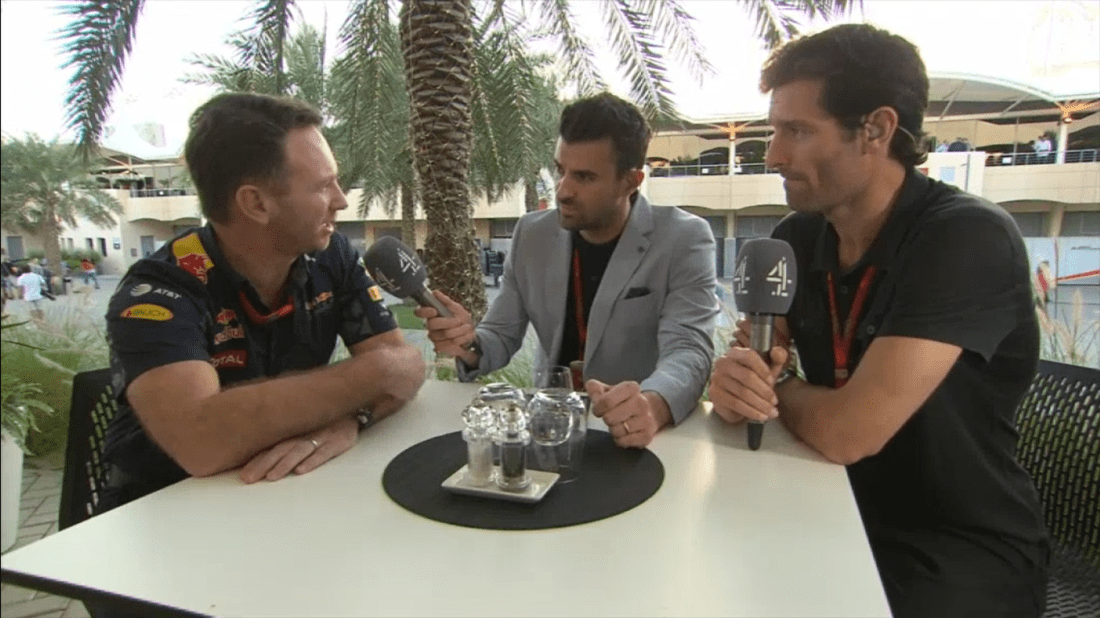
Throughout Channel 4’s Bahrain Grand Prix qualifying programme, the team positioned themselves at different vantage points. Here, Christian Horner talks to Steve Jones and Mark Webber from Red Bull Racing’s hospitality.
Channel 4 spent around two minutes talking about the Alonso incident, interspersed with clips, before conducting a live interview with Alonso later in the show. Sky went for an alternative stance, instead looking at Alonso’s second McLaren stint as a whole and questioning whether Alonso should retire. Eventually this led to a debate between Johnny Herbert and Martin Brundle about Alonso’s future. This was a strange stance to take, and I stand by that thought now given that Alonso had escaped a near 200 mph accident two weeks earlier. But either way, something led Sky down that editorial train. Was it sensationalist? To a degree, yes. It felt like creating a controversial opinion for the sake of a controversial opinion. Sky is not the first broadcaster to head down this path, and they will not be the last either.
Around both the Alonso accident and the derided qualifying format, Sky created some good VT material, including a look at how qualifying has evolved over the years. At just over two minutes in length, it was also one of them which could easily have been double in length with the opinions of those in the paddock about which system has worked the best. But, it was good for what it was, as was Martin Brundle’s piece looking at the advances to the open wheel racing car, again on the back of Alonso’s accident. Given Channel 4’s stance towards the human element in order to attract the casual viewer, I could not imagine them producing the piece that Brundle did, or for that matter the Sky Pad analysis that Paul di Resta and Ted Kravitz conducted.
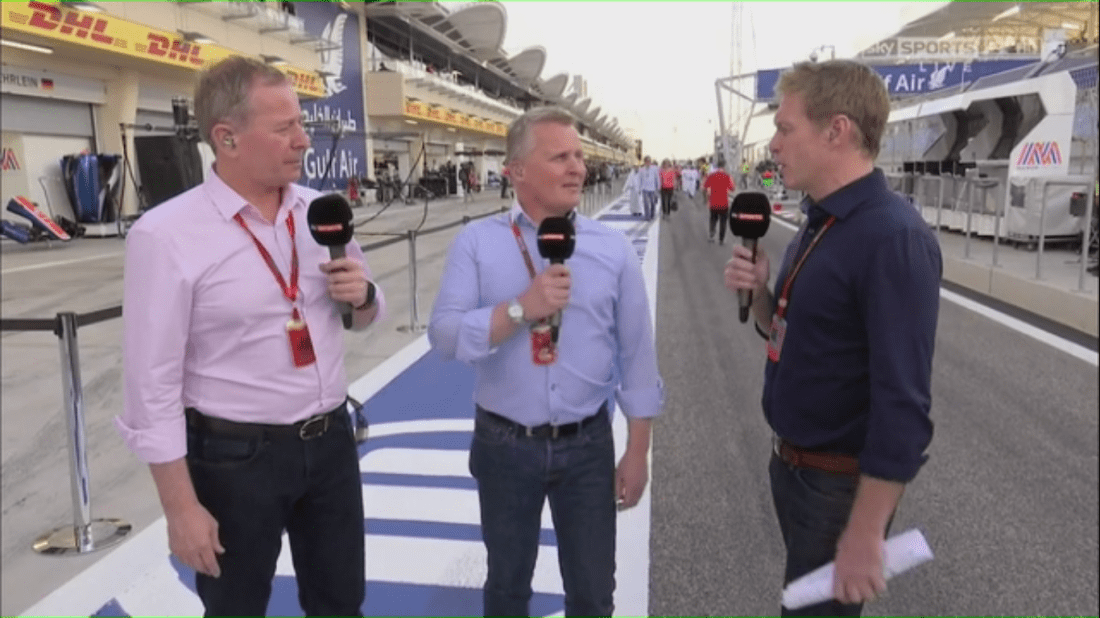
Sky Sports F1’s team of Martin Brundle, Johnny Herbert and Simon Lazenby in pit lane before qualifying for the Bahrain Grand Prix.
One aspect that Channel 4 have not taken from Sky is what I call ‘redundant’ pre-recorded material. Sky lead into ad-breaks with a VT of around 30 seconds to a minute: in the Bahrain qualifying session the VT’s focussed on ‘A to Z of World Champions’ and Paul di Resta’s Track Bites. I wish attention was paid elsewhere instead of on bite-sized VT’s of that nature. You could spend those 90 seconds of airtime extending and refining the other material already produced. In my opinion, the pieces mentioned in this paragraph are an invitation for the viewer to fast forward onto the next segment.
Evidence of Channel 4’s human element, which was emphasised during their media morning, was on hand throughout their qualifying programme. The material produced needs to be relatable to the viewer who is watching at home, whether they have been watching Formula 1 for ten years or ten days. I thought Lee McKenzie’s interview with Nico Rosberg struck this cord, as activity on and off the track was covered. Shots from Rosberg’s Instagram were shown on-screen in Channel 4’s house style, which worked brilliantly well and is a great example of how broadcasters can integrate social media into their product. The segment with Murray Walker and Jenson Button has been uploaded to the Channel 4 website in its raw 30-minute form, something that I love to see broadcasters doing. Sky have also done this with Ted Kravitz interviewing Bernie Ecclestone.
If Channel 4 remains committed to Formula 1, it will be fascinating to see their live programme evolve over the next three years. At the moment, we should count ourselves lucky: we have Sky who provide technical analysis and have their take on current events, and then we have Channel 4 who aim to dive into the human element and produce stunning visuals. We currently have the best of both worlds.
As the past few weeks, have shown: savour it, while you can.
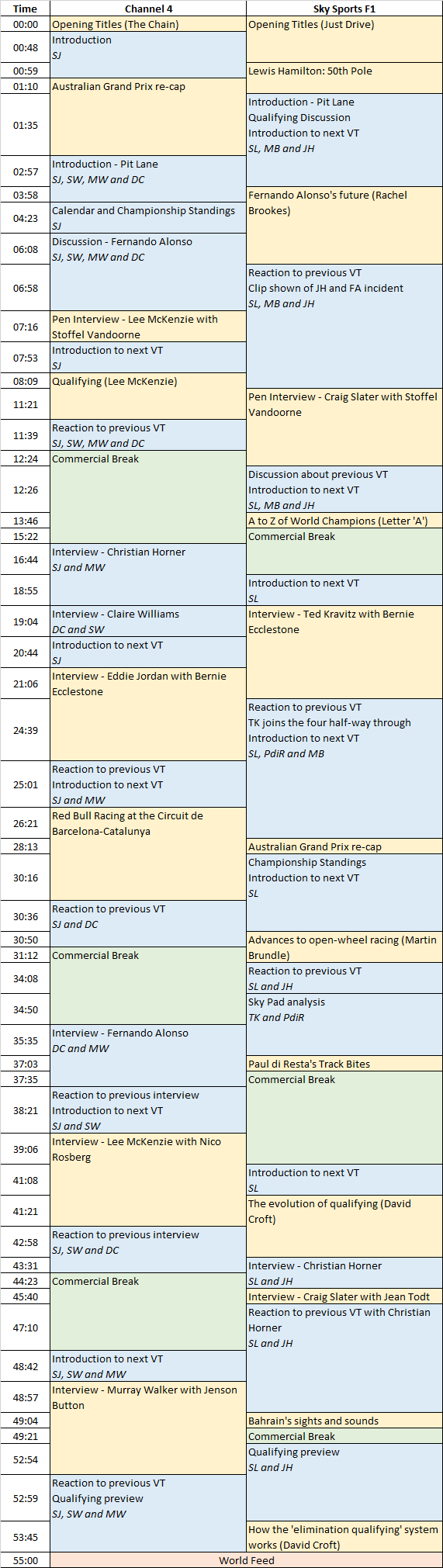
For a full plan of Channel 4’s and Sky’s Bahrain Grand Prix qualifying output, see the image below.


 Motorsport Broadcasting