F1 TV has this evening (Wednesday 9th May) launched for fans worldwide, with fans in the United Kingdom gaining access to Formula One Management’s (FOM) rich archive.
The over-the-top service comes in two forms: a Pro version where fans can watch live 2018 race action, and a basic Access version, where fans can access archive material. UK readers have access to that basic product, but not the premium level tier.
At launch, 72 races are available to watch in their entirety for viewers on a near worldwide basis:
2017 – Bahrain, Spain, Azerbaijan, Belgium, USA
2016 – Spain, Austria, Malaysia, Brazil, Abu Dhabi
2015 – Bahrain, Britain, Hungary, USA
2014 – Bahrain, Canada, Germany, Hungary, Abu Dhabi
2013 – Australia, China, Bahrain, Britain
2012 – Spain, Abu Dhabi, USA, Brazil
2011 – Monaco, Canada, Italy, Japan
2010 – Australia, Turkey, Canada, Belgium, Abu Dhabi
2009 – Australia, Germany, Belgium, Brazil
2008 – Britain, Italy, Belgium, Brazil
2007 – Canada, USA, Brazil
2006 – Bahrain, Turkey
2005 – San Marino, Monaco, Europe, Japan
2004 – Bahrain, USA, France, Belgium, Brazil
2003 – Australia, Malaysia, Brazil, Britain
2002 – Malaysia
2001 – Malaysia, Brazil, Austria
2000 – Germany
1999 – France, Europe, Malaysia
1998 – Belgium
1997 – Hungary
Every race from 2002 onwards has highlights on F1 TV, taken either from the DVD season review of the time, or more recently from highlights uploaded to the F1 YouTube channel.
The archive starts to shrink prior to 2002 with only a few archive races present, but this will no doubt increase over time. Outside of the documentaries, the earliest archive footage is from the 1997 Hungarian Grand Prix.
Each of the races covered runs from the start of the five-minute introduction, through to the end of the press conference, with UK commentary provided (ITV until 2008, BBC from 2009 to 2011, and Sky from 2012 onwards).
Alongside the race archive, F1’s over-the-top service also contains documentaries that Sky have aired on their UK channel since 2012, such as Legends of F1, Tales from the Vault and Architects of F1. However, these documentaries are only available to those outside of the UK and Ireland.
Fans in the UK can purchase F1 TV Access for £2.29 a month, or a discounted £17.99 across the whole year.
Better than anticipated for UK fans
When F1 TV was first announced in February, it was unclear whether UK fans would have any access to the over-the-top service. As it turns out, UK have access to the rich archive at least.
The full-length races that FOM have added are like those Sky have aired as part of their Classic F1 strand of programming, although there are some differences. Over time the number of classic races will increase, in the same way that WWE’s Network has grown substantially since launch.
Uploading every classic race from 1981 onwards in the very beginning would be bad business from FOM. The logical method to upload the races would be through a series of ‘drops’, based on the season or a given theme (i.e. every race in the 1999 season, or every Malaysian Grand Prix).
This way, F1 can promotion the uploads via their social media channels, driving attention towards the service. At some stage, F1 needs to strongly consider having a @F1TV social media presence to promote content, especially as the service matures. The launch so far appears to be deliberately low-key.
Every click gives F1 access to viewing statistics, including not only the video watched, but also how long the fan continued to watch the video for, helping FOM to influence future content additions further down the line. There are some key additions that need to occur (such as the ability to search based off tags and a no spoiler option).
It is great to see F1 TV off the ground, both Access and Pro, for those have access to the latter. Now, it is time to see the platform grow and mature…
Touted as being a revolution to the way fans watch Formula 1 around the world, F1’s new on-air package debuted at the 2018 Australian Grand Prix. After the first three races, is the sport living up the hype?
Even at this early stage in the season, there have been several notable changes on-screen to World Feed, although some mooted adjustments have yet to come to fruition.
Music
Historically, Formula 1’s opening sting five minutes each session did not feature the stars of the show. From 1994 to 2002, the sting featured many segments untangling to create the FIA Formula 1 World Championship logo, with a well-loved backing track.
The sting from 2003 to the end of 2017 went through several iterations (2003 to 2008; 2009 to 2011 and 2012 to 2017), predominantly featuring different coloured lines racing around in circles, eventually leading to the F1 logo. Whilst both fulfilled the individual briefs, neither introduced the characters that would feature in the next 90 minutes of action.
The 2018 version, created by Californian based Drive Studio, uses a cut of Formula 1’s new theme song from Brian Tyler, and is twice the length of yesteryear. Critically, the sting introduces the drivers to casual fans, with a fast pace to the theme song. Liberty Media’s mission was to bring the stars to the forefront, and the five-minute sting helps to fulfil that remit.
A minor drawback is that the introduction will need to change in the event of driver moves, so comes with an overhead for Formula One Management. Tyler’s theme has grown in stature so far this season. Some might argue the sting is not as impactful as previous iterations, but the purpose is different, and it satisfies Liberty’s intended direction perfectly.
There was a worry that music would begin to dominate the race broadcasts, but that fear so far is unfounded. Apart from brief interludes for the starting grid introduction and in pre-race parc ferme, music was absent from the race itself. The only interference has come with the replay swipe. The swipe features the sound of a V8 engine, too loudly and to the detriment of the broadcast.
Timing wall – team logo, numbers, and compounds
Last November, as part of the unveiling of Formula 1’s new logo. Wieden+Kennedy (W+K) published mock-ups of what the 2018 graphics set may look like, which raised cause for concern at the time. Like with the music, the concern was unfounded, although there are still drawbacks currently with the timing wall.
Now in its fifteenth year on Formula 1 television, the latest iteration of the timing wall clearly displays when drivers have moved up or down the order. In the race this is important: if two drivers switch positions the number of the driver that gained the position has their position highlighted in green; with red for the driver who lost out. A simple but positive change (even if it leaves me pulling hairs out at the director, sometimes).
Additional information displayed at regular intervals, such as the team logo and driver numbers. Both show the flexible and dynamic nature of the timing wall to switch between the two at given intervals, which will only help when FOM implements new features.
Tyre compound information is part of this puzzle, as an alternative option to the team logo and driver number, however seems to be less popular with FOM’s television director. The team logos and driver numbers help casual viewers, tyre graphics may confuse them. On the other hand, tyre choice can dictate the outcome of the race as we have already seen in 2018 and should receive preferential treatment.
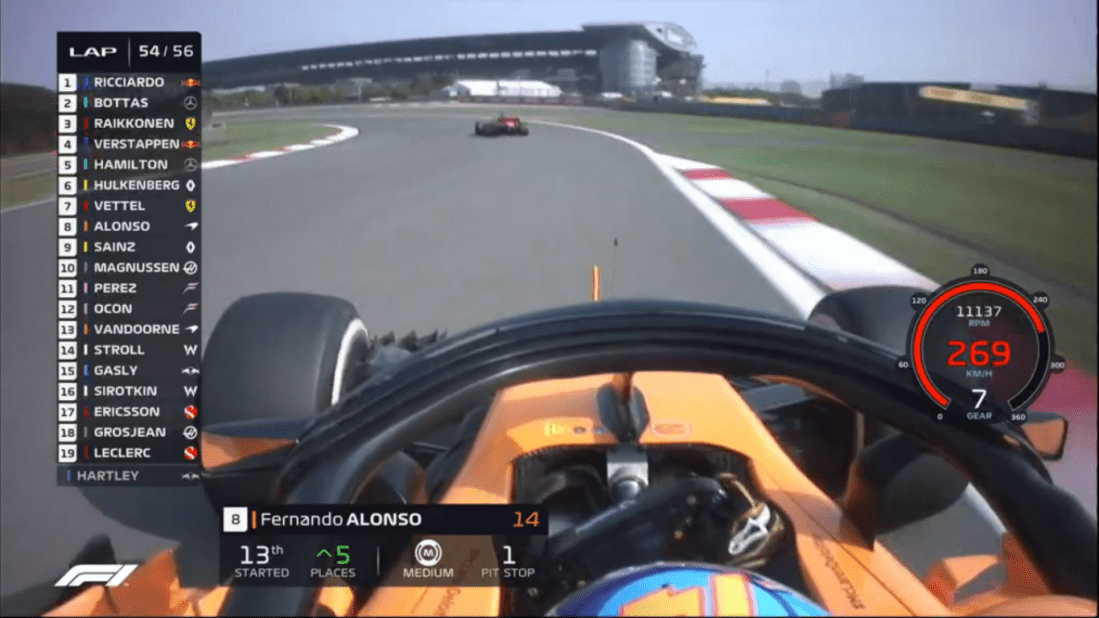
Riding on-board with McLaren’s Fernando Alonso during the 2018 Chinese Grand Prix.
As a racing fanatic, on the MoSCoW scale, tyre graphics are a must have, but ask a casual fan and they might give you a different answer. It is balancing the priorities. A secondary point is that the tyre graphics need to be accurate, which FOM have struggled with on occasion.
Font sizes and yellow flags
It is important with any kind of graphics set to have a uniform look across its on-air package, with the same font package used throughout and eligible font sizes. F1’s package breaks one of these.
There are two fonts on offer during Formula 1’s broadcasts. The first is a ‘broadcast safe’ font; the second is one of the fonts created as part of W+K’s suite of fonts. A major oversight is that W+K did not create a broadcast safe font, meaning that the graphics set resembles a half-way house where multiple remits are trying to be satisfied (the ‘a’ in W+K’s font does not look good on-screen).
Uniformity is critical throughout the package, and I feel that F1 has some way to go in this space, which is disappointing considering how well 2017’s graphics set fulfilled this (and that is not even accounting for Formula Two or GP3, both remain stranded in yesteryear).
Australia highlighted shortcomings that F1 could have avoided if adequate user testing occurred beforehand, on a variety of devices. In FOM’s defence the timing wall font, which was too small during the Melbourne race weekend, was quickly rectified starting with the Bahrain Grand Prix.
A second basic issue that slipped through the radar concerns the yellow flag graphics. The yellow flag graphic displays over the counter, effectively ‘hiding’ the counter. This becomes an issue when the Safety Car is deployed, as it means the lap counter goes missing for several laps. In China, Formula 1’s television director resorted to displaying the lap counter separately at the foot of the screen next to the F1 logo.
FOM also need to give drivers’ names suitable breathing room within the timing wall, like they did with previous iterations of the wall. Now, ‘Magnussen’ and ‘Hulkenberg’ both feel too squashed, which is a struggle to read if you are not sitting close to the monitor.
Halo impact
Failing to prepare, is preparing to fail. The Halo has been mooted since the events of the 2014 Japanese Grand Prix, and was first agreed in February 2016, although introduction of the device was eventually pushed back to 2018.
The Halo is a device focused on improving safety, aesthetics is a secondary consideration, with no room for experimentation. Could the device bring fans closer to the drivers, through cameras embedded within the Halo? Could the FIA embed a camera within the Halo looking directly at a driver; or a rotating 360-degree camera attached to the Halo?
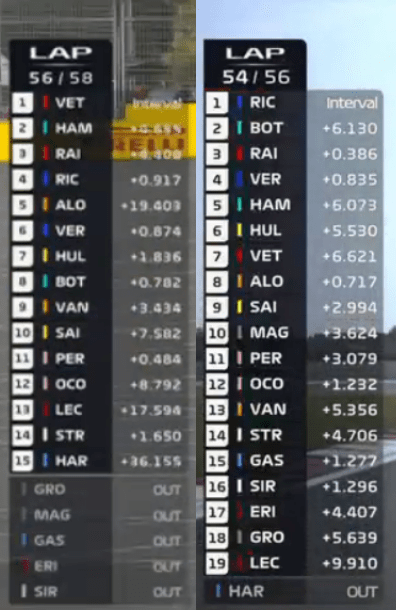
Formula One Management reacted quickly to complaints about the font size in the timing wall, switching from the left (Australia) to the right (China)
It appears Formula 1’s television team and the FIA did not discuss the potential impact the Halo would have on traditional on-board camera angles, such as the shoulder length and T-cam angles. This is a problem that Liberty Media have inherited, rather than one of their own doing.
There is also the possibility that the FIA refused (or would refuse) to budge in any instance, believing that the structural integrity of the Halo is of greater importance than enabling a better viewing experience for the television viewer. Nevertheless, after three races the Halo is not detracting from my viewing of F1 as much as I previously anticipated.
Even if the FIA were unwilling to change the Halo, it says a huge amount about the working relationship between the FIA and FOM that no tweaks occurred to the homologated 2018 car design (i.e. positioning of cameras year-on-year) to allow for a better television product.
Camera angles and direction
One of the ethos of Liberty Media heading into the new season was to make the cars look faster on-screen with closer camera angles, more akin to the F1 Digital+ days, and less focus on the advertising surrounding the circuit.
Based on the first three races, Formula 1’s direction this year will be an evolution and not a revolution. Expecting FOM to break old habits straight away is unrealistic, and besides, expecting the likes of virtual advertising to disappear is also unrealistic.
A variety of rumoured elements that would have impacted race direction, such as music (mentioned further up) and a race highlights package at the top of the hour, failed to materialise. That does not mean the initial reports were inaccurate: these were, according to the BBC, discussed during the F1 Broadcasters’ Summit in January. But negativity around the areas, along with other heavily commercialised aspects of the broadcast, resulted in their absence from Australia.
Anyone expecting a revolution might have been disappointed after Melbourne after the pre-season speculation. Nevertheless, FOM have made a few small, but notable steps to improve their race broadcast.
By staying with the old graphics package, the above screenshot from the opening Formula Two feature race of the season only serves to demonstrate the work Formula One Management needs to do with Formula 1’s new package to bring it to the standard of last year’s F1 package.
The race direction has improved, as demonstrated in the second half of the Chinese Grand Prix, with all the key action following the Safety Car period covered live. The decision to jump on-board with Daniel Riccardo as he positioned his car to overtake Valtteri Bottas was inspired. Similarly, we were on-board with Max Verstappen’s failed attempt to drive round the outside of Lewis Hamilton.
While the Halo is clearly present in the on-board angles used, the device does not deter from my enjoyment of the action. There is a greater emphasis from the television director on on-board angles in 2018 even with the Halo, and that is only a good thing in my view. The camera angles compared with 2017 are largely the same, although FOM have added angles to help capture the speed, such as on the apex of turn one in China, showing cars swoop in and out of shot.
There is always room for improvement: elsewhere in China the director during the first half should have looked further down the order to Fernando Alonso and Romain Grosjean for the action instead of focusing on the status quo up front. The On-Board Mix was showing this battle to a very small audience when the World Feed airing to millions was focussed on little action up front.
This was frustrating, as fans were ridiculing the race on social media before the Safety Car period because the director was not up to the job. If the director wanted to keep focusing on the leading drivers, I dare say that picture-in-picture was an option here.
Formula Two receives further attention from FOM
An early revolution in 2018 is the attention that Formula One Management is giving Formula Two, with a variety of on-screen additions. Previously, Formula 1’s World Feed treatment towards the championship has consisted of commentary over the feed, followed by podium interviews. This season’s efforts go a step further.
In the commentary box for 2018, Alex Jacques remains lead commentator alongside Davide Valsecchi, with Sky’s analyst Johnny Herbert joining for the Bahrain sprint race. For the first time, Rosanna Tennant provided additional support from pit lane, reporting on any news from the garages as well as interviewing the top three drivers in parc ferme.
Over on social media, Formula 1’s channels are giving the series more coverage, with Will Buxton on hand, helping fans connect to future talent. However, a gap remains on the highlights front.
Formula 1’s highlights are uploaded to YouTube on the same day, whilst Formula Two’s video reel is added to their website several days after the race. Clearly there is a huge gulf between the number of visitors that YouTube has daily compared with the Formula Two website, so ideally Formula Two’s highlights should also be uploaded to the F1 YouTube channel. A relatively simple change could make a huge difference to the championship, which Formula 1 needs to exploit to grow the popularity of the feeder series.
A major negative for me is that Formula Two and GP3 have retained the old graphics set, which feels like a duplication of systems. Moto2, Moto3 and MotoGP all use the same underlying set, coordinated with one another, and all make the migration from one set to another at a given time, so why are FOM unable to achieve this? It makes Formula Two, and GP3, look like the unloved bit on the side.
The edict to Wieden+Kennedy last year should have included Formula Two and GP3, in the same way Moto3 and Moto2’s package is identical to MotoGP, the only minor difference surrounds the logo (‘2’ and ‘3’ instead of ‘GP’).
Other bits and final thoughts
Although F1 TV Pro is not set to begin until Spain, Will Buxton’s presence has been felt in Formula 1’s online content, with a 30-minute Paddock Pass on Thursday previewing the race, and then a further 30-minute show on Sunday evening reviewing the race. Both videos round-up the interview pen pieces with drivers’ that Buxton has covered earlier in the day, with Buxton giving his views in between.
Whether FOM is using Buxton to his full potential compared with his NBC stint is up for debate, I suspect we will see more once F1 TV Pro gets off the line, so it is too early to come to any conclusions yet. Elsewhere on the social media spectrum, the Drivers’ Parade is now airing live on Facebook, which is great news for those that like to see the unedited interviews rather than the trimmed down versions that make Sky’s race day broadcast on a small delay.
In other teething problems, the live speed counter does not add anything to the live broadcast for me and does not appear to serve any purpose. It needs something additional added, as an example, perhaps as the speed increases, seeing other drivers’ top speed at that point may help. Lastly, the graphics set has some jarring colour clashes. The dark red for Sauber’s driver numbers, up against a black background, is one such example.
Overall, the on-air package is not as bad as I feared considering the Wieden+Kennedy mock-ups that appeared as part of the logo unveiling in November. The package unveiled in Australia has the potential to be an excellent package for Formula 1. But for that to happen, a variety of issues outlined above need to be addressed, and rectified.
Over the years, this site has tended to cover television coverage more than other forms of media, with weekly television schedules whenever there is a Formula 1 race on. The site also has a dedicated page covering all the key UK television and radio contracts.
But, alongside your traditional methods, many championships allow you to watch their action online. Here, we look at what each championship offers directly to the consumer, bypassing the broadcasters, or not as the case may be. This article is aimed at UK readers, but the information may be useful for overseas readers as well.
Note – This is an experimentation post and may not cover every single series out there. Please leave a comment if you find this useful and would like to see this repeated in future with updated information.
Dorna Sports (review)
The commercial rights holder for MotoGP and World Superbikes, Dorna Sports have over-the-top platforms for both. Every session, including support races, airs live on the over-the-top platform with a dedicated on-site team. Full-length replays are available if you missed the action first time round, with the fan able to view the action from a variety of on-board camera angles. Access to the respective platforms also unlock MotoGP’s and World Superbikes’ rich archive.
Available via desktop, Android and Apple devices, the MotoGP package is priced at £174.36 for the complete season, or £44.45 in four instalments. The World Superbikes offering is considerably cheaper than MotoGP at £60.98 for the season, or £13.00 per month. Even considering the smaller calendar, on a per-race weekend basis, the MotoGP price works out at £9.18, whilst the Superbikes offering is just £4.69, a sign of their respective popularity.
Formula E
Despite being one of the newer series in this list, surprisingly the electric Formula E championship does not have an over-the-top platform. Fans wanting to watch the action can find some live coverage on Formula E’s YouTube channel, but the availability depends on territory. UK fans can watch live practice on their YouTube channel, but no further than that.
The geo-blocking restrictions are lifted after the session for practice and qualifying, whilst full races are made available several weeks after the race, although one might argue that they have lost their value by that point in time. The lack of an over-the-top platform currently may come and bite them back in a few years’ time, especially considering the recent developments from Formula 1.
Formula One Management
Announced in February, Formula 1 has confirmed that their streaming service will launch ready for the Spanish Grand Prix in May. At launch, F1 TV Pro will be available via desktop and will only contain Formula 1 coverage; with other devices, and the appearance of the feeder series’ coming later in the year.
However, UK fans will not have access to the premium version due to the television agreements already in place. Barring some form of new arrangement between Formula One Management and Sky, do not expect UK fans to be able to access F1 TV Pro until 2025. F1 TV Access though, is another question…
GT Sport Organisation
GT Sport created and is responsible for the Euroformula Open and the International GT Open, both of which air live in the UK on BT Sport.
As with other championships on a similar footing, GT Sport live streams the action on their two YouTube channels, covering qualifying and the race: EuroFormulaOpen and GTOPENseries. English commentary comes from Ben Evans, who fans in the UK may recognise from BT Sport’s IndyCar coverage.
IndyCar
Unlike Supercars below, IndyCar does not currently offer an over-the-top product for overseas fans of the championship. Race Control only extends as far as live timing, but no visual imagery is involved. However, its social media offering is comprehensive, with live streaming of its feeder Indy Lights series, as well as live action from practice via their various outlets.
For fans without access to BT Sport, the full US race programme from either ABC, ESPN or NBC is uploaded to IndyCar’s YouTube channel around four days after the event. With IndyCar’s domestic rights in the US changing for 2019 in NBC’s favour, the streaming picture could change as well.
SRO Motorsports Group
Not to be confused with GT Sport’s portfolio of championships, SRO Motorsports Group is the commercial rights holder for several of the leading GT championships worldwide. If you are into GT racing, the GTWorld YouTube channel, operated by SRO, is the place to be.
It is on YouTube where SRO live stream the likes of the Blancpain GT Series and the British GT, for free. In addition, the Blancpain website plays host to live streaming of the GT Series.
Supercars
Not in Australia? No problem. The Virgin Australia Supercars streaming service SuperView gives fans outside of Australia the ability to live stream, rewind and replay every Supercars qualifying and race session in 2018. The restriction that previously applied to the Australian Grand Prix weekend was lifted for 2018, meaning that all events are now available on the service.
Priced at £32.80 based on the current conversion rate for the complete season, SuperView is a steal if you are looking to watch some motor racing action at your leisure throughout 2018. With 16 races across the year, the series costs UK fans just £2.05 per race weekend.
World Rally Championship (review)
From 2018, rally fans can view every World Rally Championship stage live. For £7.79 a month, or £77.98 for a complete year, fans can watch every stage either live or on-demand across a variety of devices.
However, you can only do that up and until the next rally comes along: there is no way to view the ‘All Live’ content once it disappears from the schedule a few days after the event finishes. Whilst the live element is great, WRC’s over-the-top product is still rough around the edges which is worth bearing in mind if you are unlikely to watch the action in a timely fashion. Nevertheless, WRC’s pricing structure remain extremely good value for money.
Are there any other major championships that have streaming capability that I have not mentioned? Have your say in the comments below.
Six of Formula 1’s outfits based in the United Kingdom have revealed their gender pay gap publicly. In the underlying data, all bodies reveal that a significant amount of work needs to happen to bring more women into the engineering landscape.
For the first time, UK companies with more than 250 employees are reporting their pay gap to the UK government. As Ferrari, Toro Rosso, and Sauber are based outside the UK, they are exempt from this. With less than 250 employees, Haas are also exempt. The figures reveal the pay gap at Formula One Management (FOM) amongst other organisations.
This percentage gaps above show the difference between the ‘middle paid woman’ and the ‘middle paid man’.
The median gender pay gap for Formula 1’s teams is 22.9 percent, as an example if a female earned £25,000, then a male would earn £30,725. Force India’s median pay gap is least significant at 14.8 percent, with Williams at the other end of the scale at 32.9 percent.
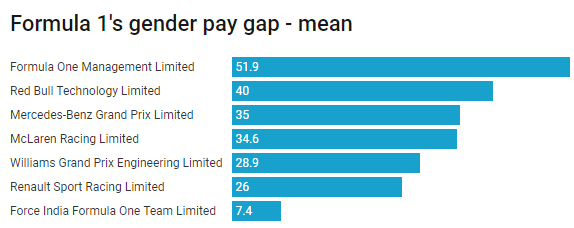
The mean gender pay gap, better known as the average pay gap, stands at 28.7 percent for Formula 1’s six teams in the UK. Red Bull has the biggest pay gap of the teams that revealed their data, with men earning on average 40 percent more than women.
The difference for Mercedes and McLaren circles around 35 percent range. There are two major outliers. Firstly, Force India is again the least significant, with an average pay gap of just 7.4 percent. Although the number of women at Force India overall is smaller in the lower quartile than other organisations, the difference between them and the other teams in this respect helps their gender pay gap overall.
Formula One Management’s mean gender pay gap stands at 51.9 percent, significantly higher than other sporting bodies such as the Football Association at 23.2 percent, and 23 percent for the Rugby Football Union. In other words, if a woman at FOM earned £20,000 across the year, a man would earn £30,380.
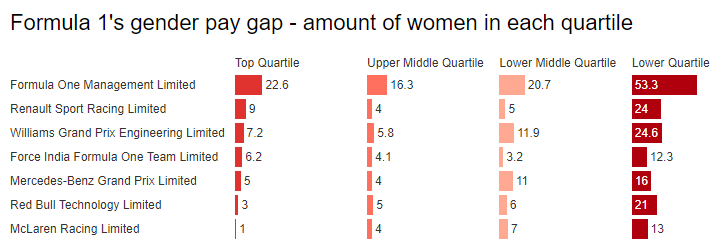
Although the proportion of women in the top quartile at FOM is higher compared with F1’s outfits, the fact that the lower quartile is filled with 53.3 percent of women means that the average is skewed in a similar manner. FOM’s average suggests that there are a small, but significant number at FOM that skews the gender pay gap overall.
The overall volumes above show that women at Formula 1 teams struggle to breakthrough to the top and middle quartile. McLaren’s figures are the most damming of the lot: only 1 percent of people at the team in the top quartile are women. Williams’ and Mercedes’ are the most balanced, but it is a very bleak picture for Formula 1.
What the data fails to reveal is whether jobs occupied by women in the lower quartile have progression paths through to the lower and upper middle quartiles. If they do, then it is possible that the percentages will move as time progresses, but it appears for every ‘lower middle quartile’ job vacancy, you may have four men and one woman vying for that role. It is also unclear if the data submitted includes contractors, as well as the two racing drivers.
Schemes such as Dare to be Different can only help, however there are still very steep barriers to overcome.
In addition to all the discussion around Formula 1’s new graphics suite, the past week saw a variety of broadcasting related announcements, covering both F1 and the IndyCar Series.
F1 documentary series to air on Netflix
Netflix are to air a ten-part documentary series in 2019 focusing on the inner surroundings of Formula 1. The deal between the two parties has been mooted for several months, with an official announcement coming on the Saturday of the Australian Grand Prix weekend.
Filming has already started, and will continue throughout the 2018 season, with the production team revealing “the intense fight for the heart, soul, and direction for the future of this multibillion-dollar business.” James Gay Rees, who was previously part of the making of Senna, and Paul Martin for Box to Box Films, are the executive producers.
The Netflix series builds on the foundations laid by Amazon’s Grand Prix Driver. The four-part Amazon series focused on McLaren’s pre-season exploits prior to Australia 2017, whereas the Netflix programming has a wider remit across the whole year. I enjoyed Amazon’s documentary, and if this is half as good as that, Formula 1 fans will be in for a treat.
Sean Bratches, F1’s Managing Director of Commercial Operations, said “Formula 1 is a global sport that we are actively repositioning from a motorsport company to a media and entertainment brand. This series will unleash a compelling vantage point to the sport that will delight fans and serve as a catalyst to entice new fans.”
Bela Bajaria, Vice President of Content for Netflix, said “This partnership with Formula 1 furthers our mission of working with world-class brands and production partners to produce best-in-class unscripted series. We can’t wait for this weekend’s Australian Grand Prix and to embark on an incredible season across the world.”
In a second announcement from Formula 1 last week, the organisation confirmed that coverage was returning to free-to-air broadcaster CCTV in China, with all qualifying and race sessions airing live on the network throughout 2018.
ESPN’s US coverage receives complaints
Bratches’ former home ESPN was subject to numerous complaints over the Australian Grand Prix weekend. The US broadcaster, which took over from NBC as rights holder for Formula 1, was expected to take Sky UK’s pre-race build-up show ‘On the Grid’. However, the show failed to make the air at the expected time, with a variety of technical issues.
ESPN released a press statement late on Sunday evening apologising for the difficulties. “We deeply apologise to Formula 1 fans for the technical issues that caused them to miss the first 20 minutes of the pre-race show for the Australian Grand Prix. We are sorry that our first F1 telecast did not go as smoothly as we would have liked but we are taking steps to prevent those same issues from occurring in the future.”
The secondary problem is commercial breaks. Formula 1 commentary in the UK is free-flowing, as Sky Sports air F1 uninterrupted, whereas ESPN in the US take commercials. This is a major issue if something happens whilst ESPN is on a commercial break.
Historically, US viewers had a dedicated commentary team for their audience meaning that the lead commentator could re-cap the action on return. Forcing Sky’s UK commentary team to do the same thing would disturb the flow for anyone taking the UK coverage uninterrupted and would provoke a backlash from UK viewers.
One approach would be to have Sky’s F1 presentation team (i.e. Simon Lazenby) do a voice over for US viewers leading back into the UK commentary at a given point, that way the commentary flow is untouched.
In further news, ESPN’s coverage of the Grand Prix rated lower than NBC’s coverage in recent years. According to Showbuzz Daily, ESPN2’s show failed to make the top 150 for original programmes on Saturday, recording under a 0.05 share in the adults 18 to 49 metric. Last year’s NBC coverage averaged 238,000 viewers, whereas 2016’s show averaged 222,000 viewers.
International television rights for IndyCar up for grabs
The IndyCar Series is heading to NBC from 2019, with their existing US agreement with ESPN and ABC Network coming to an end after this season, the two sides confirmed last week.
The three-year deal will see eight races, including the Indianapolis 500, broadcast on NBC’s main channel with the remaining races airing on NBC Sports Network.
In addition, NBC’s over-the-top platform, dubbed NBC Sports Gold, will offer an IndyCar package consisting of every race from the feeder series Indy Lights, plus all practice and qualifying sessions from the main series not broadcast on one of NBC’s linear television channels.
As part of the press release, NBC touted the fact that IndyCar’s viewing figures have grown in recent years with the broadcaster as part of the shared contract with ESPN/ABC. “We’re honoured to bring the Indianapolis 500, one of the most prestigious events in all of sports, to NBC, further enhancing NBC Sports’ Championship Season,” said Jon Miller, NBC’s President of Programming.
“We’ve seen consistent growth for INDYCAR on NBCSN in the past decade, and we hope to continue that growth throughout the series by leveraging the television, digital, production and marketing assets that make NBC Sports a powerful media partner.”
IndyCar officials have also confirmed that the international broadcasting rights for the series are up for grabs at the end of 2018. For UK fans, it helps clear up a few things. BT Sport have a deal to with ESPN’s international arm to air a range of content up to and including the end of 2022. Separately, IndyCar’s non-domestic rights sit with ESPN’s international arm.
ESPN International are the ‘middle man’ here, if that man changes then BT Sport will need to negotiate with the new ‘middle man’ if they want to continue to air IndyCar, unless IndyCar go direct to a broadcaster, for example Eurosport (see below).
Mark Miles, the CEO of IndyCar’s parent company Hulman and Company, said “We will now move to working on the international rights licensing right away. We’ve had a lot of those very early conversations to understand both from an agency perspective and individual broadcaster perspective who wants to talk to us.”
“[The NBC deal] does not preclude an ongoing involvement by ESPN International. Although with any result, I think it will change. There may be countries where we go direct to broadcasters in any major country with IndyCar interests. I see us being at the table, even if we go with a distributor or packager like ESPN International.”
“There are a number of agencies that would love to compete with ESPN International for whatever we’re willing to license as part of a package, and there are a number of countries where we’re already having direct conversations with broadcasters. It will be some kind of a mixed approach undoubtedly.”



 Motorsport Broadcasting