How Formula 1’s new weekend schedule will impact UK fans in 2018

Formula 1 has today announced a raft of changes to their weekend schedule, ahead of the 2018 Formula One season.

The changes include starting every race at ten minutes past the hour. Formula 1 says this change will cater for broadcasters, such as new American broadcaster ESPN, who wish to start their coverage at the top of the hour. Previously, broadcasters who joined on the hour, missed “the tension and emotion that characterize the minutes before the start of each Grand Prix.”

A second adjustment involves moving European race weekends, and the Brazilian Grand Prix back by one hour which, according to Formula 1 will allow the sport to reach a “wider TV audience [..] later in the afternoons, especially in the summer months.”

An unintended impact, which no one has mentioned, is that the later start time will result in the podium ceremony potentially running over the top of the hour, especially for races such as Hungary. Bad news for broadcasters who want F1 confined to a specific two hour time slot…

How do the changes impact UK fans?
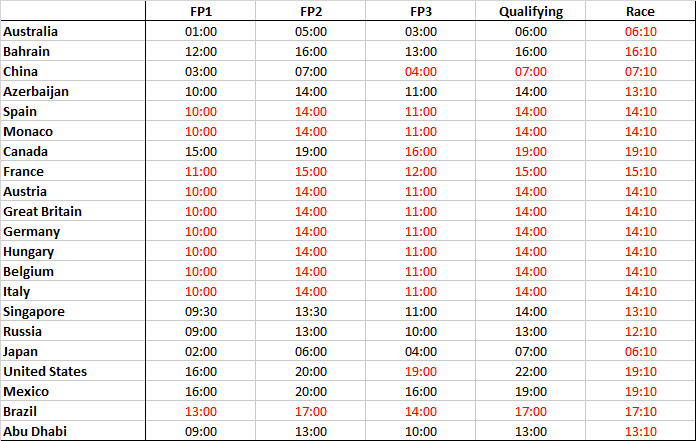
UK F1 2018 session start times
The times UK F1 fans can expect to see Formula 1 in 2018. Anything in red is a timing change compared with 2017.

It means that European races will start at 14:10, instead of 13:00, an arrangement which dated back to the late 1990’s. Monaco was historically the exception, races in the principality started at 14:30 local time, however this agreement ended following the 1997 season.

As predicted in December, the French Grand Prix has also moved to avoid clashing with England versus Panama in the football World Cup. The race will now start at 15:10 UK time, with the latter stages of the race clashing with Japan versus Senegal on BBC One.

Although not a timing change for this year, the switch of the Azerbaijan Grand Prix to late-April, has resulted in a minor clash with the Paris E-Prix. It means that the final moments of qualifying are likely to overlap with the start of the E-Prix, however thankfully for Formula E, that is the extent of the clashes.

For MotoGP, the Assen TT and British Grand Prix fall on the same day as Formula 1’s Austrian and Belgium rounds. In previous years, MotoGP has worked around F1’s scheduling, with the British MotoGP race starting at 15:30. However, Formula 1 may have done Dorna a favour. By moving their start-time to 14:10 UK time, it means the MotoGP main event could feasibly start at 13:00 UK time with no overlap, barring a red flag or other unusual circumstances.

Elsewhere, Channel 4’s highlights programming for the European rounds and Brazil may air an hour later, depending on what the contract between them and F1 states, starting at 19:00 instead of the usual 17:30 or 18:00 start time. Formula 1’s press release makes no reference to Formula Two or GP3, although one would hope that they benefit because of this change, and become more integrated into F1’s weekend activities.

 

News round-up: New F1 TV agreements finalised; OTT moves closer

The twist and turns of Formula 1’s television rights have continued since the start of the year, with the trend heading towards pay television.

In the first few moves after Liberty Media gained control of Formula 1 in 2017, free-to-air agreements were signed in France and Germany, suggesting that Liberty were re-evaluating the direction taken previously by Formula One Management (FOM). Since Christmas however, Formula 1 has signed two pay-TV deals, and a third is on the horizon.

Two new TV agreements, and a third looming
In Spain, Movistar+ have extended their contract to cover Formula 1 until 2020. The pay-TV operator will continue to cover every session. As part of the rights extension, FOM will “help Movistar+ to produce exclusive content for its distribution across their digital and social media platforms.” It is unclear whether fans in Spain will be able to watch any F1 action for free this season.

Over in Latin America, Fox Sports will broadcast the sport, after Canal F1, operated by Mediapro, closed at the end of 2017. The deal, which does not apply to Brazil, runs through until 2022. As part of the deal, the Mexican Grand Prix will remain live and free in Mexico and highlights of every race will be free-to-air. In both territories, FOM have retained “certain digital rights”, a pre-cursor to F1’s over-the-top service launching.

Worryingly, Formula 1 appears to be heading away from free-to-air in Italy. According to reports from Italy, free-to-air channel Rai made a financial offer to FOM that was “significantly weaker” than pay-TV counterpart Sky, which may see F1 leaving Rai with immediate effect. In Italy, Sky own a free-to-air station called TV8, so some races may air there, but this is unconfirmed.

Formula 1’s Managing Director for Commercial Operations, Sean Bratches has talked in the past about a 70/30 model for the sport moving forward, with around 30 percent of races on free-to-air television. Italy’s new deal may fit into that mould, Spain’s however does not.

As I have mentioned previously, shared contracts allow Formula 1 to continue to reach the masses. In countries such as Spain, over-the-top viewing should not become a replacement for free-to-air. A casual fan, who flicks over the channel to watch Formula 1 on free-to-air television, is unlikely to purchase F1’s over-the-top offering, even if it is cheaper than the pay-TV alternative.

There needs to be mechanisms in place to turn the casual fan into a dedicated fan. A free-to-air viewer can turn into an over-the-top subscriber, but the former must exist for the latter transaction to occur.

Meanwhile in over-the-top developments
Despite no official announcement, yet, Formula 1’s over-the-top service continues to move forward in the background. Former GP2 commentator and NBC pit lane reporter Will Buxton is all but confirmed, alongside a line-up that may feature James Allen, Johnny Herbert, and Rosanna Tennant.

One early left-field rumour was that Allen and Herbert would form the commentary team, but recent suggestions indicate that FOM will take the Sky Sports F1 commentary, made up of David Croft and Martin Brundle.

A survey distributed by Hall & Partners on behalf of Formula 1 last weekend suggested that only five countries will have access to the live over-the-top service at launch. They are USA, Mexico, Germany, France, and the Netherlands. You can add Spain and the rest of Latin America to that list based on more recent rights announcements.

The survey touted a wide range of features, such as on-board footage from every car, something first mooted towards the back-end of 2016, live coverage of feeder series’ Formula Two and GP3, and full access to the Formula 1 video archive.

With a limited user base at launch, I foresee a situation where the service starts off with a minimum viable product (in terms of present day and archive footage), but increases in size and depth as time goes on. Of course, you need to produce good content to draw subscribers in, but keeping costs under control is vital as well in the early years.

UK F1 schedule delays
There are a few reasons likely as to why Channel 4 and Sky Sports have yet to announce their 2018 coverage plans.

The first concerns the scheduling of the French Grand Prix, which clashes with one of England’s World Cup game. Whether there are discussions in the background to move the race to earlier or later that day I do not know, but F1 will have a low audience worldwide for the French round as it stands.

Another potential reason for the delay surrounds testing coverage. If Sky are indeed showing testing live, as mooted during their Abu Dhabi Grand Prix coverage last year, I would expect FOM to announce this first, followed on by Sky. And Sky will want to make such as announcement centrepiece in their 2018 press release. Movement should be imminent on this front.

Croft: Mini sectors risked “ruining the jeopardy” of F1 qualifying

At the start of the 2017 Formula One season, Formula One Management (FOM) added mini timing ‘loops’ to their graphics for the Australian Grand Prix qualifying session. However, mini sectors disappeared from television screens without trace for the remainder of the season. Speaking exclusively to this site at the Autosport Show, Sky Sports F1 lead commentator David Croft said that the graphic risked “ruining the jeopardy” of qualifying.

Each Formula 1 race track consists of three sectors, which are in turn split into mini sectors, FOM choosing to present mini loop information on-screen for the first time at the start of 2017. The new graphic enabled viewers watching around the world to see detailed splits for the driver in focus, such as Lewis Hamilton and Sebastian Vettel’s battle for pole in the Melbourne qualifying session. However, Croft amongst others did not see the appeal.

FOM graphic comparison - mini split with and without.png
With and without the mini sectors: on the left, FOM’s qualifying graphics, from the Australian Grand Prix, and later in the season from the United States Grand Prix.

“In the commentary box, you have Martin [Brundle] and I interpreting the timing screens for you, picking up where the stories are, building up the tension, using our vocabulary, helping you to become more involved and engaged in what is happening on the track,” Croft said. “Why do you need to see on a screen half way between the end of the second sector and the finish line whether someone’s going to get on pole or not? There is no tension involved in that.”

“It’s like going to see The Mouse Trap and half way through Act II someone telling you who did it, or someone spoiling Star Wars. Sometimes you’ve just got to keep the excitement, and have to keep the anticipation. You don’t open your Christmas presents on December 19th.”

Croft noted that he was not alone in his opposition to the new graphic. “I said to the guys at FOM when they brought this in, and Martin [Brundle] was of the same view, that you risked ruining the jeopardy of this. People can sit there and go ‘I need to know all of this information.’ It might be nice for a handful of people, but actually you’re spoiling the crescendo.”

“FOM took everyone’s feedback on-board, and made their own decision, which was to get rid of it. Have we missed them? I haven’t. If someone has missed them, tell me why.”


Looking ahead to 2018

Heading into 2018, there are several stories which promise to keep bubbling away during the next twelve months, some of which have significant relevance to UK readers.

new look Formula 1 will greet fans at the start of the 2018 season, both on and off the track. On track, we say hello to the Halo. Will the introduction of the cockpit protection system cause a ratings drop worldwide for F1, or will audiences continue to be enticed by the machinery on offer?

Off the track, F1 unveiled its new branding at the end of the Abu Dhabi Grand Prix, which will be rolled out across all forms of media at the start of 2018. How will fans react to the new visual on-screen look? Friendly, more playful is the intention, we wait to see if fans like what they see come Melbourne, if not earlier.

Also, Formula 1’s new over-the-top services are highly anticipated, which should launch in a number of countries. Sean Bratches publicly confirmed the service during the Abu Dhabi Grand Prix weekend, but early 2018 will see firm details unveiled, such as pricing and content. Will an entry level tariff allow F1 to reach new fans and markets? Will the platform make a noise to start with if the initial user base with access is low?

With an over-the-top network comes personnel. Will Formula One Management poach personnel from their existing broadcasters’, or bring new pundits into the sport? Will we see the likes of Will Buxton and Jason Swales (both part of NBC’s former F1 line-up) play a part?

In the UK, as readers are aware, Sky Sports hold exclusive television rights from 2019 to 2024, marking a significant shift in the market. However, is there appetite from them to sublet a highlights-only package to a free-to-air station, allowing Formula 1 to continue to reach the masses? As it stands, 2018 will be Channel 4’s third and last season covering Formula 1.

We should also in the first half of 2018 find out which UK broadcaster will air MotoGP from 2019 onwards. BT Sport’s contract expires at the end of 2018. They are expected to retain the rights, but it is not a nailed on certainty, and Eurosport could still steal back the premier motorcycling sport.

So many questions unanswered as we head into 2018. If you love your broadcasting news, do not change the channel…

Formula 1 to remain on free-to-air television in Germany

Formula 1 will remain on free-to-air television in Germany for the next three seasons, after Formula One Management (FOM) and RTL signed a new contract.

Historically, RTL and pay-TV broadcaster Sky Deutschland have shared television rights, with their existing deal expiring following the Abu Dhabi Grand Prix. This evening, RTL have confirmed that Formula 1 will remain on their network for the next three years, until the end of the 2020 season at least.

As part of their announcement, RTL also confirmed that Nico Rosberg and Timo Glock will join the network as pundits, replacing Niki Lauda, who stepped down from his duties at the end of the 2017 season.

Speaking on Tuesday, RTL’s Manging Director of Programmes, Frank Hoffmann said “We have made Formula One great here, it has thrilled an audience of millions and has become an important component of our brand. The owners of Formula 1 have an economic interest in the fact that the sport is seen by many people and we stand here as a free-TV broadcaster in general and RTL in particular.”

Ian Holmes, Formula 1’s Director of Media Rights, said “Germany is one of the most important countries for Formula 1, where motors sport has deep roots, and RTL Television has been a fantastic and loyal partner for many years.”

“The extension of the agreement comes as a natural consequence of such a strong and mutually fruitful relationship and will guarantee that our fans in Germany will continue to watch Grands Prix on free TV. The agreement is part of our strategy that aims to increase and strengthen television coverage on a worldwide basis, whilst tailoring it to the characteristics of each TV market.”

The pay-TV rights that Sky Deutschland previously held now hang in the balance, and it appears that Sky could well end up losing the television rights in Germany altogether to Eurosport, a fascinating development if it comes to fruition. One reason for the delay may be the change in management recently at Sky, with Martin Turner, who oversaw Sky’s F1 operation globally, including in Germany, leaving Sky during the Summer.

This is the third key market where Liberty Media have signed a television deal. In France, it was agreed to bring F1 back to free-to-air and air key races live on TF1 (a free-to-air station) from 2018, whilst in America, rights switched from NBC to ESPN, in a move aimed to boost Formula 1’s digital presence from 2018 onwards.

You cannot talk about trends with such a small data set, but you get the impression that Liberty are not signing rash pay-TV deals like their predecessor did.