A new era of Formula 1 begins in Melbourne

The 2017 Formula One season started in Melbourne this past weekend, with Ferrari’s Sebastian Vettel emerging as victor. On the broadcasting side, the ‘new’ Formula One Management (FOM) under the arm of Liberty Media made a step up in several areas. However, as was evident over the weekend, not everything was plain sailing for FOM…

Timing graphics tweaked
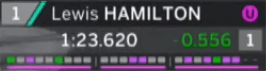
One of the biggest changes for 2017 is the introduction into the World Feed graphics of the individual mini timing ‘loops’. For those that are unaware, each of the three main sectors is split into mini sectors. This information has been available to teams for years, and as of last year was made available on the ‘Data’ feed. This year, FOM has integrated the loop information into the World Feed.
2017 Australian GP - new graphics
FOM’s new timing graphic.

To briefly explain the graphic above, the three horizontal purple lines cover your three traditional sectors; with each ‘blob’ above that representing a sub-sector. Purple means that a driver is fastest of all, green means that it is the drivers’ personal best and grey means no improvement. So, for sector one, Lewis Hamilton was fastest of all. However, within that sector, he was fastest only in one individual loop, setting a personal best in two other loops and failing to improve in the other loops.

During Friday practice, the graphics also displayed the drivers’ predicted time throughout the lap, along with ‘as live’ gap updates. FOM removed both of these features from Saturday onwards for reasons unknown (there is an argument that seeing the cumulative gaps in qualifying would dilute the spectacle as cars finish their qualifying lap). I am glad to see the timing loops integrated into the World Feed, if anything it shows that FOM are ahead of the curve in comparison to other series that have access to this information, which is great to see.

A neat addition during the weekend was the usage of infographics. Infographics helped explain in a non-technical language what key phrases meant, such as a ‘red flag’. Yes, regular readers to this site may know the sporting regulations inside out, but the first time viewer is unlikely to know, so it is important to have these explained on-screen in a non-offensive or obtrusive manner, which FOM perfected.

Improved track cameras show off the speed
Even with the faster 2017 cars on show, what was clear is that the FOM have made some slight, yet noticeable, changes to track cameras in order to capture the speed of the cars. The placing of some cameras was lower than in previous years on the Melbourne Grand Prix Circuit course.

The broadcast gave off a F1 Digital vibe from the late 1990s and early 2000s, which Formula 1 needs again. The picture will not be perfect overnight, and you can understand why Liberty Media will want to keep the balance between showing trackside advertising and capturing the speed of the cars. Technical issues aside, it felt like the direction was better in Australia than we have seen for a long time, with more focus on the cars and less focus on the surrounding advertising. The move to ultra HD for the majority of trackside cameras has helped.

There is a lesson as well in strategically positioning the cameras, the video which best shows off the speed of the cars is actually from a static fan camera on the entry of the turn 11 and 12 chicane. A video, shared on reddit, shows one of the Toro Rosso cars passing through the shot. Blink and you will miss it. It is an amazing piece of footage, demonstrating the change of direction, however the shot includes little sponsorship exposure and falls right on the other end of the spectrum, were FOM to use a shot like this in future races.

Failures blight World Feed coverage
On the negative, the World Feed graphics for the majority of the weekend were sub-standard, with numerous failures from the outset. Various sources have confirmed to this site that there was a major outage on the production side just nine minutes before the World Feed was due to go on air for qualifying. Initially, this meant that FOM only had access to pit lane cameras and the heli-cam, with only a limited set of graphics. Normal service was restored towards the end of Q1.

The race itself featured only a basic graphics set, and way below the usual output from the team. The direction was fine, but with no supplementary graphics such as the timing ticker at the foot of the screen, the race was difficult to follow at stages. An inferior product, especially one that fans have paid for through pay television in some instances, is unacceptable and resulted in some social media backlash.

As a fan, failures on the World Feed are frustrating. However, as someone who also works with IT systems (and has had to deal with failures on a much more localised scale), I sympathise with the team in Melbourne and in London. In the circumstances on Saturday, FOM did a fantastic job to get things up and running as quickly as they did, meaning that Q2 and Q3 went off without a hitch.

In IT, failures do happen. However, failures in recent years have been too frequent, compared to say the likes of Dorna’s MotoGP coverage. Maybe FOM’s production team would welcome a proposed ‘round zero’ from next year to ensure that their systems are up to the expected standards… a ‘round zero’ would not only test new ideas on the sporting front, but also ensure all the production systems are up and running as expected.

Social media rules relaxed
As reported throughout the pre-season across motor racing websites, Liberty Media have relaxed the social media rules for Formula 1’s teams and drivers. During an interview in Channel 4’s Australia qualifying programme, Sean Bratches, Formula 1’s Commercial Director, noted that prior to testing FOM had never issued any social media guidelines, which shows how just behind the curve the corporation were.

As they did in testing, teams have exploited the social media relaxation to varying degrees, with Red Bull, Williams and Mercedes heavily using social media to their advantage. Of note, Williams ran a few Facebook Live sessions, the first of which saw Paul di Resta and Karun Chandhok joined by Lance Stroll and Paddy Lowe on ‘Williams TV’. Every video for every team is a social media experiment as they learn more about the demographics of their audience, and which videos are more popular than others are.

FOM have been continuing to produce live social media programming through the Australian Grand Prix weekend, building on the content produced at last year’s Abu Dhabi Grand Prix and during testing. FOM streamed a live fans forum to social media on Saturday morning with David Coulthard hosting in front of the Melbourne crowd. Some of this may have been in the works prior to Liberty Media’s take over but arguably, change has occurred on a greater scale thanks to Liberty. Small steps, such as presenting the FIA World Drivers’ Championship on the starting grid help go a long way to giving the sport a more human element.

On all fronts, the genie is out of the bottle. There will be bad moves; there will be experiments that fall flat on their face, by both the teams and Liberty Media. Now is the perfect time for mistakes to happen when fans are generally accepting that change is happening, and are prepared to accept that there will be early bumps in the road. You would rather make mistakes now when these forms of communication are niche for Formula 1, working to establish common ground, themes and decision-making as the season progresses. I would much rather see risk taking over the next few races instead of an organisation that is clearly relaxing or unable to adjust, as was clearly the case with FOM in previous years.
Flashback: 2012 Australian Grand Prix

To celebrate the fifth anniversary of The F1 Broadcasting Blog, we are looking back at five races from the archive and chewing over them. Being a broadcasting site, these races are not being analysed from a racing standpoint, but instead from a media perspective.

The five races include Grand Prix from the BBC and ITV eras, crossing over from the Americas, into Europe and Australia. Some races picked are your usual affair, whilst others have major significance in Formula 1 history. I did think about looking at five ‘major’ races, but each race has equal merit from a broadcasting standpoint, irrespective of how great the race was.

The fifth and final race of the initial series keeps us in Australia, for very good reason. The 2012 Australian Grand Prix marked the start of a brand new era in Formula 1 broadcasting and was, partly, one of the drivers behind this site starting one month later. The race was the first that Sky Sports F1 covered.

This piece gives us an opportunity not only to look back at how Sky’s coverage started, but also to see what has changed and evolved since their inaugural race five years ago. On track, the 2012 season saw six World Champions on the grid: Schumacher, Hamilton, Vettel, Button, Alonso and Raikkonen. It was arguably the strongest field Formula 1 ever had. The key broadcast details can be found below:

  • Date: Sunday 18th March 2012
  • Channel: Sky Sports F1
  • Time: 04:30 to 09:15
  • Presenter: Simon Lazenby
  • Presenter: Georgie Thompson
  • Reporter: Ted Kravitz
  • Presenter: Natalie Pinkham
  • Commentator: David Croft
  • Commentator / Analyst: Martin Brundle
  • Analyst: Damon Hill
  • Analyst: Anthony Davidson

It was a stacked line-up to begin Sky’s coverage. Five out of the eight people listed above defected from the BBC, two of the eight were internal to Sky, whilst Damon Hill was the only person making a return to the TV broadcasting scene, having previously been part of F1 Digital+ in 2002. Sky’s Formula 1 channel launched on Friday 9th March, with a live studio show, followed by the Australian weekend one week later.

Pre-Race

Sky used stylish VTs in the opening minutes to cover the past greats for newer fans of the sport who may not be aware of the sport’s legacy. The channel set the scene for the season ahead; introducing fans to the various methods of watch Sky’s Formula 1 coverage, making it clear that they intend to cover the sport from all angles. Presenter Simon Lazenby introduced viewers to the rest of the team, with the crew stationed around Albert Park. Anthony Davidson and Georgie Thompson are in the Sky Pad, Ted Kravitz in pit lane and Natalie Pinkham in the paddock.

2012 Australian GP - grid graphics
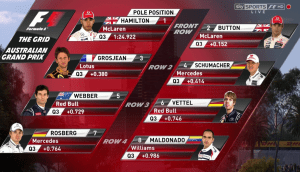
Sky’s qualifying grid graphics following their qualifying report.

Following the qualifying wrap-up is a discussion about HRT’s abysmal performance, the team having failed to make the 107 percent rule. Martin Brundle in particular was scathing of his assessment of them. Further discussion follows about the Mercedes concerning that innovative ‘F Duct’.

One feature that was prominent during the build-up was the usage of live driver interviews from the paddock. Our first is with Williams driver Pastor Maldonaldo (the timing of which slightly amused me given that it directly followed some promotion for Sky’s Legends of F1 series). Nevertheless, it is a good interview with comment given on his live qualifying performance. A paddock interview with Romain Grosjean followed later in the pre-race broadcast. It is not clear whether these interviews are actually live, the impression is that they are, but the timing is slightly suspect as Grosjean is not in his race gear at this stage.

However, if it makes for a more compact show, I am all for that approach. My only criticism of these is that the interviews are brief, which is unfortunate. There are more in-depth pit lane interviews with Christian Horner and Martin Whitmarsh. Whitmarsh says that the tyres look better which may “detract from the show and the challenge”, Whitmarsh also commenting on the relationship between Hamilton and Button in their third season.

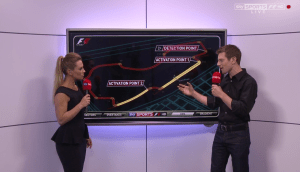
The Sky Pad segments are infrequent throughout the build-up, with Davidson and Thompson housed inside a miniature studio, making them feel detached from the rest of the programme. Neither Sky Pad segment is in great depth, showing that Sky did not know how to best utilise the tool at this stage, but this is very early in its development cycle. The analysis itself was great, with Davidson on top form already.

In 90 minutes time with the world watching with bated breath those five red lights will go out and the 2012 Formula One season will have begun. Many are saying it’s the greatest field ever assembled. Six world champions they and the rest of the grid gunning for one thing. To be called the best driver on the planet. – Sky presenter Simon Lazenby introducing the programme

Thompson introduced us to the track walk with Brundle and Hill focussing on the key parts of the circuit. Again, this feature shows off Sky’s virtual graphics (courtesy of New Zealand company Virtual Eye). The show flows well at this point, with Kravitz next up talking about the various strategies that could play out during the Grand Prix. Brundle notes that the tyres look a “bit too good and durable to me!”

Unlike the ITV races we have previously covered, there is a lot of ‘still to come’ and ‘coming up’ in Sky’s initial broadcast, with extensive promotion of Sky’s new ‘Legends of F1’ series and paid advertising from Hilton Honours leading in and out of adverts, along with Brundle’s Ferrari feature receiving attention. There is too much filler leading in and out of commercial breaks, resulting in shorter paddock discussion.

The Brundle piece at Ferrari’s Fiorano base featured contributions from John Surtees, Nigel Mansell and from Stefano Domenicalli. The feature was promoted too much by Sky, meaning that the viewer expected more than what was aired during the programme. As a feature, it was good but not memorable. Arguably, this segment should have been a standalone 30-minute programme in its own right. As Brundle said moments after the VT aired, he ran at Fiorano for 40 laps, so we should have seen a greater depth of footage instead of small snippets.

2012 Australian GP - Sky Pad
Anthony Davidson and Georgie Thompson overseeing the Sky Pad. Note the amount of white space…

On the other side of the break, there is a second recap of the grid, but the top ten this time is presented in a different format to previously with focus on the individual drivers, going from 10th to 1st using virtual animations. Brundle’s first grid interview is with the youngest driver on the grid, rookie Jean-Eric Vergne in the Toro Rosso.

The grid walk shows off how vibrant Formula 1 is, helped by the sunshine and blue skies beaming down onto the circuit. It is a great grid walk, with various voices heard from celebrities to drivers and onto the pit crew, from Leo Sayer through to Ciaron Pilbeam. The grid walk was unrestricted by the national anthem at quarter to the hour; drivers back in 2012 were not required to walk to the front of the grid. Thompson takes viewers through the various viewing options, with Sky Race Control available through the Red Button, iPad and online. There are a few interviews in pit lane before a further Sky Pad bit with Thompson and Davidson, and then, it is race time!

Race
One of Sky’s early changes was to show key interview snippets in a picture-in-picture format during the warm-up lap, I cannot remember whether Sky dropped this after the first race though.

Brundle and David Croft handled the start sequence well, with a lot of energy on display throughout a frantic opening phase of the Grand Prix. We also saw one of the classic Brundle phrases in relation to Sebastian Vettel, as the German fought his way past Nico Rosberg at turn nine, “and that’s the man they said can’t race in Formula 1, he can only win from the front apparently, I don’t think so!” Moments later, Maldondo successfully overtook Grosjean, but ended up whacking the Lotus in the process, eliminating the French driver from the race.

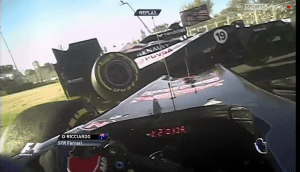
2012 Australian GP - Ricciardo helmet cam
Toro Rosso driver Daniel Ricciardo finds himself with a face full of Bruno Senna’s Williams.

FOM caught the majority of drama, but the opening laps also shows why you cannot be trigger-happy with replays in the early phases. Nevertheless, the replays did help to show what unfolded in the second half of the field at the start. The on-board footage, notably from the Red Bull and Ferrari drivers, showed how badly the Pirelli tyres were to handle towards the end of a stint, as showcased on various occasions with drivers struggling with understeer and oversteer. The on-board of Vettel also captured Schumacher heading off the circuit and into retirement.

The only commentary bugbear, which became clear early on, was a Sauber and Williams misidentification. Other than that, commentary was good, and more importantly, Croft and Brundle gelled, doing well to keep on top of the changing order during the pit stop phases. There was a ‘talk too much’ tendency at times more so in the early laps, but this brews back to Croft’s 5 Live days, radio commentary and television commentary are two different beasts, and it takes time to transition from one to the other.

I forgot how good this race was, to be honest! Australia’s Melbourne circuit has always shown off the speed of the cars, and this race is no exception as Button streaks off up front with Hamilton behind.

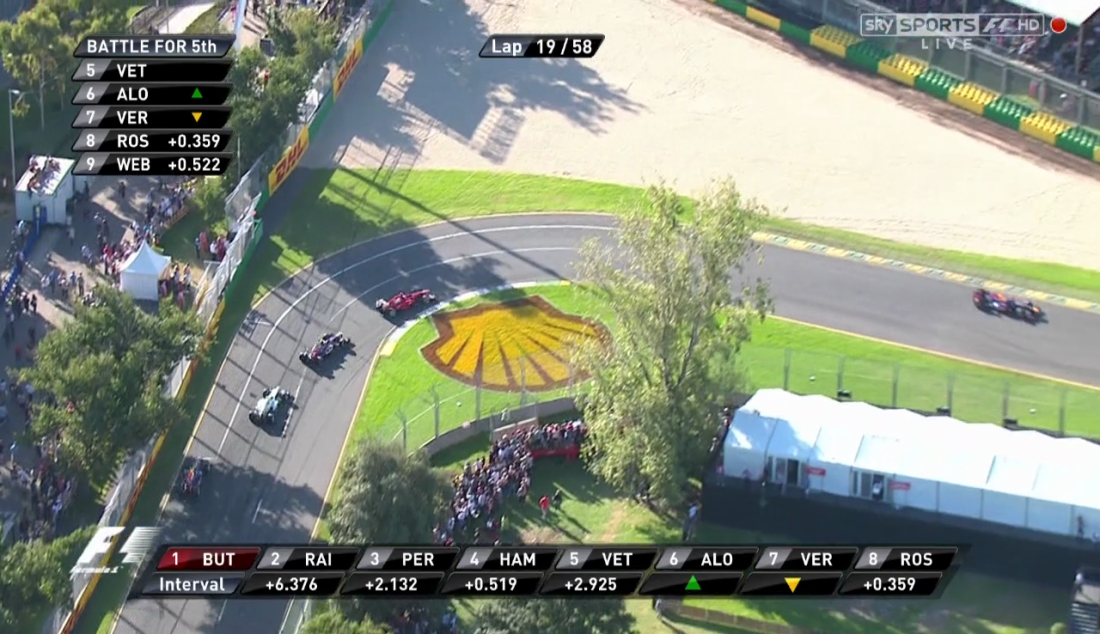
2012 Australian GP - helicopter.png
The helicopter shots at Melbourne: a beautiful picturesque scene panning over the Melbourne skyline, whilst also helping to show the various gaps during the first pit stop sequence.

The focus is on Sauber’s Sergio Perez, attempting a one-stop strategy against a two-stop strategy for the other leading runners. The artificial DRS overtakes do not detract from Perez’s brilliant race, which Brundle and Croft sell brilliantly.  At this point, Pinkham also gets a paddock interview with John Button, which is unfortunate timing as the Sauber of Kobayashi and Raikkonen bang wheels in a clean fight.

The longer this race lasts, the more I realise how weird the FOM graphics set looks from an alignment perspective. The graphics set is not 4:3 safe, nor are they fully 16:9 centric. It is a halfway house to appease both the old and new worlds. However, the graphics are more informative: the ‘ticker’ at the bottom of the screen helps decipher the gaps between various drivers, which becomes critical during the pit stop periods. FOM also use a ‘Previous Gaps’ graphics regularly to show the variation, as Jenson Button increases his lead over Lewis Hamilton up front.

Petrov’s stranded Caterham on the start-finish straight causes a Safety Car immediately after both McLaren’s pit. Vettel jumps up to second after his pit stop as a result with Maldonaldo exiting just behind Alonso.

I might be alone in this, but I don’t like this rule. It’s the luck of the draw, if the leaders have to get through some backmarkers on the restart, so what. They’re the best drivers in the world, let’s see them negotiating them. I think we should get rid of blue flags, you’ll hear me say that once every three races, passing backmarkers is a core skill of being a racing driver. We’ve wasted a lap, we should be racing now. – Brundle on the lapped cars may now overtake rule.

Attention focuses on the battle between Vettel and Hamilton for second, as Massa and Senna collide in an extremely clumsy accident. “At least it’s not Hamilton he’s crashing into this year,” jokes Croft. The two Red Bull cars separate Hamilton’s McLaren, as Brundle and Croft remind viewers of Webber’s difficult start to the race. There are several stories still unfolding in the last few laps, with drivers scrapping over the last few points.

Regrettably for Maldonaldo, having had his performance praised by Brundle and Croft throughout, the commentators’ curse strikes on the last lap, crashing out of fifth position. “It is Button’s day down under!” Croft declares. Behind the leaders is a mess, with cars moving positions both on and off the circuit. The FOM replays just about pick up what happened, which was very difficult with a lot going on in the background!

Post-Race
Under the Melbourne sunset, Button, Hamilton and Vettel take to the podium to celebrate the start of the 2012 season. Hill’s comments about McLaren are quite sad now given their current predicament, Hill referring to their “technical expertise”, also noting, “When they’re down, they get back up”. The first post-race interview is with John Button, describing his son’s win as “an incredible start to the season”.

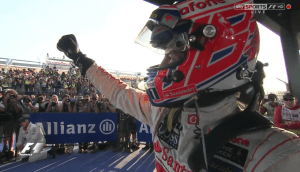
2012 Australian GP - Button
Winner.

Lazenby covers Sky’s Malaysian Grand Prix programming, including the GP2 Series before heading off for the first ad-break. Lazenby and Hill analyse the race with Whitmarsh, although it turns into more of a chat, with Hill and Whitmarsh bouncing thoughts off one another, which makes for great television I feel.

Some interviews from Pinkham in the pen are aired next, starting with Mark Webber in fourth position. We start to move towards the more relaxed setting of the paddock, as Lazenby covers the various ways to contact the team, including Twitter and e-mail (no #AskCrofty back then). The McLaren theme continues, with a brief VT covering Button’s key moments, although it does not amount to much as his race was relaxed! Some of the discussion that follows does ramble a little bit with it being ad-lib, but overall it is good post-race discussion. Brundle is holding the show together and at times appears to lead the questioning.

This year is a very special year in Formula 1, last year was also having five world champions, but having six world champions and so many competitive teams, it’s good to see that Formula 1 is in a great place right now and it’s a great sport to be a part of – McLaren’s Jenson Button speaking in the post-race press conference

The rest of the post-race broadcast follows a similar structure, with ample discussion given to Red Bull, Lotus and Williams, the team conducting interviews with Christian Horner, Eric Boullier and Adam Parr respectively. All three interviews are structurally similar, touching on the various sporting and technical elements for each team, including the blown diffuser ban in relation to Red Bull. Sky did not air any FOM material during these interviews, meaning that the paddock analysis suffered as a result.

Thompson and Davidson in the Sky Pad covered the analysis, analysing the start and then the Maldonaldo and Grosjean incident later on. It is clear that, like in the pre-show earlier, Sky were unclear on how to integrate the Sky Pad segments into the overall package, something that they have worked to perfect. Intertwined in this was further pen interviews with both McLaren drivers and a paddock walk with comment given on Sauber’s strong performance.

Attention turns back to pit lane as Sky’s team assemble around the McLaren garage to wrap up the show under the Melbourne sunset. Viewers are shown tweets on-screen, which is followed by a final word with Button. Four and a half hours after Sky’s programme started with Just Drive, it is left for Insomnia’s Faithless to play out coverage of Sky’s inaugural Formula 1 race.

News round-up: Sky linked with MotoGP; F1 App updates for 2017

In the news round-up, more speculation on where MotoGP could be going next, whilst the official F1 app is given an early Spring clean ready for the 2017 season.

Sky set to take MotoGP off BT Sport?
A report from Bikesport News has linked Sky Sports with MotoGP’s UK rights, which BT Sport currently holds until the end of 2018. In response to their report, Sky’s Euan Fordyce said, “I’m afraid we don’t comment on rights we don’t currently have, so we are unable to help on this occasion.”

I do not know what prompted the report, however given the amount of money BT Sport have splashed out to retain the UEFA Champions League and Europa League, it is not surprising to see Bikesport News’ piece.

Their piece does corroborate with what was reported on this site last month. It looks like the relationship between BT and Dorna is not as rosy as it could be, but I do not want to emphasise that point simply because media outlets reported the same on the BT/UEFA front, and we know what happened there…

Sky Sports were previously involved in MotoGP in the early 1990s under its previous mantra, with Keith Huewen and Julian Ryder providing commentary. The rights soon moved over to British Eurosport as Sky focussed on the Superbike World Championship

As of writing, there is no official news about who will be broadcasting MotoGP highlights in the UK, but expect some news on that front imminently.

Superbike action resumes
The World Superbike Championship was the first major international series to get back underway at the end of February live on Eurosport, and with it, there was a personnel change. Gregory Haines, who was lead World Superbikes commentator for Dorna in 2016, has moved over to Eurosport, succeeding Jack Burnicle as their World Superbikes commentator.

In the overnight viewing figures, the first round of the season from Philip Island peaked with 55k (6.2%) at 04:30 on Sunday morning (including VOSDAL) as the second Superbikes race of the weekend concluded. As a comparison, last year’s MotoGP race from the same track on BT Sport 2 averaged 126k (10.7%), peaking with 176k according to numbers supplied by Overnights.tv.

Elsewhere in the superbike world, ITV have extended their contract to cover the British Superbike series in highlights form until the end of the 2020 season.

F1 App updates for 2017
The official Formula 1 app has received an update ready for the 2017 season. Aside from an update to the user interface, there is no major change for readers. There was some confusion around whether the content will be different depending on location, however this site can confirm that users will receive the same content regardless of location.

On a related note, I mentioned last October that users in the Netherlands were testing a new version of an app featuring in-car footage during live sessions. This site understands that live in-car footage is still on the cards to feature, but at what stage during the season is unclear due to hurdles that need to be cleared. The delivery method also needs to be agreed with each broadcaster.

ITV F1 – twenty years on
ITV’s F1 coverage launched twenty years ago this week, with the 1997 Australian Grand Prix. As readers may have noticed, there has been a running theme so far throughout the year so far looking at various aspects of ITV’s coverage, including flashback pieces looking at past races (thanks to all who said that they would like to see these continue).

There is a lot of reading over here for those of you that fancy a trip down memory lane and want to relieve some more ITV F1 goodness.

“Post Bernie” F1 evolution begins with extra flexibility for testing

Formula 1’s teams and drivers have been given extra flexibility for testing, with Formula One Management (FOM), now under the ownership of Liberty Media, giving them the freedom to upload short videos to social media. The news was first announced through Motorsport Network’s portfolio of websites.

The new guidelines allow teams and drivers to film footage from the confines of the paddock and pit lane, and then upload it to social media. A variety of content has been uploaded within the past few days. Red Bull have produced multiple Facebook Live sessions with Christian Horner, Max Verstappen and Daniel Ricciardo from the paddock, something that was impossible under the previous regime.

Other teams, such as Mercedes, have recorded footage from pit lane of cars going at full speed down the start finish straight. The possibilities this opens up for teams, from a marketing perspective are endless with drivers now able to directly interact and record video for their fans straight from the circuit. The only team that is stuck in “the Bernie era” is Ferrari, who have yet to upload any video content from the circuit to social media.

FOM themselves have been doing new things. A lot of quick bite-sized video clips have been uploaded to social media. The key moments that were uploaded included a high-speed spin from Valtteri Bottas, caught from an exterior camera, and a camera looking back from Jolyon Palmer’s Renault capturing a spin at turn three. However, it also looks like that some broadcasters, such as Canal in Latin America, are airing footage that has not been uploaded to social media, such as on-board footage from Lewis Hamilton’s Mercedes.

By uploading these to social media, it unlocks a new audience, and future revenue stream. An audience that may have never watched Formula 1 may see this footage for the first time on social media, where videos can go ‘viral’, and hook them onto the sport, converting them to a fan. The idea of sharing new on-board footage on social media, let alone from testing, was unheard of just six months ago! It is a new world for the sport which is quite rightly being exploited.

With that in mind, it is mildly frustrating to see that Sky in the UK, despite being a pay TV broadcaster, is not taking advantage of FOM’s relaxations. The channel did not air Bottas’ spin during their round-up in Tuesday night’s broadcast, for example. One of my pet annoyances is to see five seconds of car footage in a 90-second feature. FOM’s current approach, with a full-round up at the end of each day narrated by Holly Samos, is geared towards the right audience. Whether Sky’s approach to testing is correct, when you compare it to that of other pay TV broadcasters, could be debated.

Overall, whilst FOM’s coverage of testing is clearly not on the scale of MotoGP or IndyCar, it is a natural step in the right direction for Formula 1. You could argue that we have lost content with no round-ups throughout the day, but the majority of fans are watching testing videos for the large part to see the cars in action, not to see talking heads.

Flashback: 2008 Australian Grand Prix

To celebrate the fifth anniversary of The F1 Broadcasting Blog, we are looking back at five races from the archive and chewing over them. Being a broadcasting site, these races are not being analysed from a racing standpoint, but instead from a media perspective.

The five races include Grand Prix from the BBC and ITV eras, crossing over from the Americas, into Europe and Australia. Some races picked are your usual affair, whilst others have major significance in Formula 1 history. I did think about looking at five ‘major’ races, but each race has equal merit from a broadcasting standpoint, irrespective of how great the race was.

We are heading down under for race four in the series, the start of a new Formula 1 season. Formula 1 aimed to put a controversial 2007 season behind it, with 2008 set to offer another close championship battle between McLaren and Ferrari. McLaren, led by Lewis Hamilton following Fernando Alonso’s exit, would fight both Kimi Raikkonen and Felipe Massa.

The journey starts with the 2008 Australian Grand Prix! ITV enhanced their Formula 1 offering for 2008 with live World Feed coverage of Friday practice via ITV.com, a welcome addition and the first time that UK viewers received live practice coverage since F1 Digital+ in 2002. The key broadcast details can be found below:

  • Date: Sunday 16th March 2008
  • Channel: ITV1
  • Time: 03:30 to 06:40 (re-run: 15:45 to 18:30)
  • Presenter: Steve Rider
  • Reporter: Louise Goodman
  • Reporter: Ted Kravitz
  • Commentator: James Allen
  • Commentator: Martin Brundle
  • Analyst: Mark Blundell

For 2008, ITV retained the same team as in 2006 and 2007, with Steve Rider continuing to lead the presentation line-up.

Pre-Race
The pre-show covered three main strands: McLaren’s expectations after turmoil in 2007, a preview of the new drivers and teams, and the rule changes that have come into effect for the 2008 championship. With an hour-long build-up, and only one commercial break, there is ample time to cover the three angles.

We join Rider in a scorching hot Melbourne situated outside the McLaren garage alongside Mark Blundell. The two talk about Hamilton’s early season prospects following a poor qualifying session for the Ferrari opposition, Blundell describing the hot conditions as “very tough for the boys out there.” In between, the VTs and interviews, Rider and Blundell discuss the various teams, with BMW Sauber’s strong performance getting a mention.

2008-australian-gp-allen-and-brundle
James Allen and Martin Brundle decipher the qualifying session.

Both Ted Kravitz and Louise Goodman voice the first feature as they run down the complete grid in a quick fire manner. It is a good way to introduce viewers to the new faces and revamped teams (Force India) on the grid in 2008 for those that do not follow the off-season gossip. This kind of feature has disappeared in recent years, as there is an expectation that viewers have followed Formula 1 in the off-season, which is not always the case.

Kravitz also talks through the rule changes for 2008, with the likes of Nico Rosberg and Hamilton giving their opinion on the new regulations, including the banning of traction control. “It’s lovely to see a car with opposite lock on, fantastic,” says Blundell, noting that it will be good to see drivers’ make mistakes.

Attention briefly switches back to McLaren with Anthony Hamilton and Pedro de la Rosa giving live interviews. The Hamilton interview does not bother me; it is short enough to be harmless in the context of the show, whilst de la Rosa gives good insight into the strategy for the race ahead.

James Allen voiced over the qualifying report, appearing in-vision at the start of his piece. ITV’s virtual grid graphics are lovely, scrolling down the grid row by row, with an instrumental version of ‘Lift Me Up’ in the background. Following some post qualifying interviews, Allen and Brundle recognise the “changing of the guard” that is taking place due to the new regulations, giving control back to the driver, with recognition for Toro Rosso’s Sebastian Vettel who has benefited as a result.

I enjoy it; it’s a challenge for everyone. This is real racing. I’ve been saying for years that I wished that the cars were like what they were in the Senna and Prost days and we’re slowly moving more towards that. Without traction control, it’s tricky. It’s hard work. – Lewis Hamilton speaking in a pre-race interview with Steve Rider.

There is some foreshadowing at two stages in the build-up around Honda. With Jenson Button on the cusp of a new three-year deal, Nick Fry states, “Our objective is to make him world champion.” Later on in the build-up, Dannii Minogue has a good bit of fortune telling, “Things are looking up [for Honda], I saw Ross [Brawn] with a smile on his face. This year and the next, they’ve got a long-term plan. The team morale has lifted; it’s wonderful to see because I’ve followed Honda for a long time.” Even this early on, there are signs of 2009 looking good for the outfit!

It is time for a lap of Melbourne, Brundle on top form with his voice over of Hamilton’s pole position lap. An excellent sit-down piece between Rider and Hamilton follows; it feels more down to earth than a present day Hamilton interview, with emphasis on technical detail. ITV’s cameras catch Hamilton chatting to mechanics with Rider and Blundell talking in the background about the mechanics camaraderie from both sides after the frayed relationships in 2007.

2008-australian-gp-kovalainen-and-hamilton
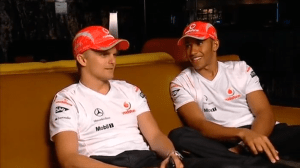
McLaren drivers Heikki Kovalainen and Lewis Hamilton chatting in an on-camera feature.

The next feature looks at the new venues on the 2008 calendar, Goodman at the location of the 2008 European Grand Prix. The comments in hindsight are amusing, a long-term contract, with an exciting layout. Err… Martin Brundle is out in Singapore. “I can see drivers adoring this race track,” is the comment made from Brundle. Nine years later, it is still on the calendar, Singapore a lot more loved than Valencia ever was.

A further feature on McLaren focusses on Ron Dennis after speculation that he might leave Formula 1 following the spy gate saga. The one piece of fluff that does make its way into the broadcast is a chat between Hamilton and Heikki Kovalainen, which focusses on the raw characters of the two drivers. Brundle’s grid walk rounds off the pre-show, but is one of the more difficult segments due to the warm weather conditions and it being race one of the new season, leaving Goodman to conduct most of the grid interviews.

Overall, it is a strong build-up to start ITV’s season, with McLaren the common denominator. Yes, the majority of VTs were dedicated to the team, but it was not repetitive, with each VT focussing on a different element. Rider and Blundell mentioned most of the leading teams, and gave credit where due. Next, it is race time!

Race
Allen sets the scene for the start of the 2008 season, with attention on the hot weather conditions. Within a minute, the first piece of team radio comes from Nick Heidfeld in his BMW, along with a nice graphic showing his key Formula 1 statistics, the same also appearing for Hamilton. The grid graphics on display are plain in terms of format, but do the job nicely, no jazz necessary.

2008-australian-gp-renault-pit-crew
A camera located on Renault mechanic Greg Baker as he is changing tyres during Fernando Alonso’s pit stop.

Tyre strategy discussion starts as the drivers head to the grid, with a white line down the middle groove denoting the soft tyre. Whilst tyre choice is important, it is not deemed critical enough for Formula One Management (FOM) to display in their on-screen graphics. “When the five lights go off, the 2008 championship will be under way… and it’s go in Australia!”

The start was confusing, with the World Feed failing to identify whether Massa had spun out of the race during a melee at turn one. Only after a multitude of replays did we identify who caused what, with five cars eliminated. Whilst the director focussed on the leading drivers in the early stages, FOM used replays to pick up overtakes not seen clearly by external cameras. A camera looking back from Nelson Piquet Jnr’s Renault captures Kazuki Nakajima overtaking him from some distance back.

A lot of on-board footage is shown from Raikkonen in the early stages, tracking his progress nicely through the field, a rarity to see so much on-board Ferrari footage on the World Feed compared to even five years earlier. Allen uses the quieter gaps to add context and ‘colour’ to the stories that have not been covered, such as Super Aguri’s takeover.

Raikkonen trying to distract [Honda’s Rubens] Barrichello rather than trying to overtake him, he’s getting frustrated. Isn’t it great to see the cars moving around, the drivers fighting the car, all the way through the corner, they cannot point the nose in any longer and floor the throttle, let the electronics worry about it and think about the next corner. They’ve got to drive these cars every metre of the race track, great news. – ITV co-commentator Martin Brundle

The Ferrari driver eventually gets past Barrichello in a move that FOM managed to miss live but like previously aired in the form of a replay. The ‘ticker’ is a key form of FOM’s product in 2008, but is too transparent to be useful compared to the rest of the graphics set. Also seen here is an early version of the driver tracker during the first pit stop phase as Hamilton regained lead with Kovalainen exiting the pits just in front of Raikkonen (who had not yet pitted).

Allen interrupts an interview between Goodman and Toyota driver Jarno Trulli half way through, as Massa’s front left tyre connects with the right rear of David Coulthard’s Red Bull! The latter retired immediately with a lot of damage, causing a second Safety Car. Straight away, we hear analysis from Brundle, who gives both perspectives on the incident from how Coulthard and Massa would have seen the accident, using his driving experience to good effect. Coulthard used some colourful language in his interview with Goodman to describe the incident!

2008 Australian GP - Glock.png
A collage of how Formula One Management caught Timo Glock’s violent accident live.

ITV did not miss much action during this race, with Safety Car periods helping. Ferrari’s day deteriorated, with Raikkonen taking a trip straight across the gravel attempting to overtake Kovalainen, and then spinning attempting to overtake Timo Glock in his Toyota, both incidents caught live by the director.

Shortly after, Glock was involved in a high-speed accident, causing the live camera to shake violently as the operator struggled to keep up with the speed and velocity of Glock’s car. The on-board shot of this would have been interesting to see, but was never aired (presumably the camera was not live at the time).

The Safety Car rules meant that Kovalainen and Alonso were unable to enter the pit lane as the Safety Car came back onto track, resulting in both cars exiting at the tail of the pack once both pit. Toro Rosso’s Sebastien Bourdais was briefly fourth before he retired with engine failure, Allen referencing his time in IndyCar where Safety Car periods are prominent. After a dramatic race, Hamilton wins! Heidfeld finished second in his BMW Sauber, with Rosberg third, the latter claiming his first ever podium.

Post-Race
Kravitz gets the first interview with Ron Dennis as the cars head into parc ferme. On this occasion, the podium room is full of joy, Hamilton jumping around and congratulating Rosberg as Allen and Brundle remind viewers of the relationship between the two.

Following the podium procedure, Rider and Blundell praise Hamilton’s performance, Blundell calling it “very mature” given the number of Safety Car periods. The two review the start from the various angles provided by FOM, also commenting on the strong performance of the Ferrari car when Raikkonen was in clear air, although Blundell described some of his moves as “absolutely unbelievable”.

2008-australian-gp-raikkonen
Ferrari’s Kimi Raikkonen discusses the race with the media.

ITV aired the complete English-speaking press conference, an unusual occurrence. The remainder of the post-race programme flies by, with the major incidents covered by Rider and Blundell. The two start with Massa and Coulthard’s crash, before moving onto the mid field runners such as covering Barrichello’s performance in his Honda. All of this is in quick fire fashion, but given the number of incidents in the race, this should not be a surprise.

By ITV standards, the post-race segment is long at around 30 minutes in length, even that amount of time is impossible to cover every story that happened in the race. Kovalainen joined Rider and Blundell live, Kovalainen giving his reaction to his battle with Alonso in the closing laps (Kovalainen accidentally hitting the neutral button).

Kovalainen and the presenters preview Malaysia, before Rider and Blundell wrap up the show to conclude the 2008 Australian Grand Prix!

Note from David: I’m coming to the end of this initial series of five races. Is there interest in having a flashback piece every month, or something of that nature? Please leave a comment if you would like to see more pieces after the fifth race. It is still a work in progress, so tweaks will be made along the way.