Channel 4’s output: The 2016 Verdict

So, you have your permanent team of five on-air personnel consisting of one presenter, two commentators and two pit lane reporters to take you around the world with other people diving in and out at regular intervals.

But that is only half the story. The other half is to actually make good Formula 1 television. From the VT’s to the air-time, how well did Channel 4 and Whisper Films perform in this space during 2016?

Practice
For their live races, every practice session was aired in full live on Channel 4 or More4 with Lee McKenzie presenting alongside Karun Chandhok. Ben Edwards was lead commentator alongside either Chandhok or Tony Dodgins. The commentary was the usual story of informed discussion commenting on various news pieces along with analysis from pit lane. The style was identical to what the BBC provided, which makes sense given that the audience for practice is small. Trying to change it up to cater for another audience wouldn’t go down well (as Sky found out within 15 minutes of starting their coverage in 2012).

One change Channel 4 did make compared to their predecessors for their live European races was to extend their practice three show. Their Saturday morning schedules typically consisted of:

09:55 – F1: Practice 3 Live
11:25 – F1: Documentary Special
11:55 – F1: Qualifying

Not only is this a great example of how to schedule properly, but it also gave McKenzie and Chandhok some flexibility after Saturday practice had ended. We were treated to paddock walks after the session, which was nice to see (even if it did result in an on-air interview with Flavio Briatore at one point). Chandhok’s knowledge meant that he can easily ad-lib without any issues and quickly change from one conversation to another when new guests arrive in shot. I’m hopeful Channel 4 will use more of Chandhok in 2017, with this format continuing.

Special Programming
In 2016, Channel 4 aired several specials surrounding Formula 1. The first was with Guy Martin as he put the F1 car in a series of tests against his Tyco BMW Superbike. Alongside that, there have been three ‘F1 Conversation’ programmes. This is similar to Sky’s F1 Legends programming with one of Channel 4’s presenters interviewing the stars. During 2016, Murray Walker interviewed Jenson Button, David Coulthard met Christian Horner and Lee McKenzie spoke to Mark Webber. It was nice to see some supplementary material appear.

The programmes were enjoyable to watch with Channel 4 producing more content than Sky in this space, the latter airing no new episodes of F1 Legends this year. The thing also with Channel 4’s documentaries is that a lot of editing work clearly went into the package, containing contextual archive footage whereas Sky’s documentaries this year of a similar nature (most recently The Brabham Boys) were difficult to follow as there were no obvious breathing points.

What Channel 4 didn’t do, besides the Guy Martin special was promote Formula 1 in any of their other programming. There are fewer opportunities for Channel 4 admittedly compared to the BBC’s opportunities across TV, radio and online. Nevertheless, it was disappointing to see no more buildup than usual to the British Grand Prix, for example with an on-location Sunday Brunch.

I can give the benefit of the doubt to Channel 4 here because of how quickly things came together at the start of the year, but the channel, Whisper and North One Television need to work out a strategy for tapping into Channel 4’s core 16 to 34 demographic more. Motor racing and sport does not traditionally skew young, which is problematical for the channel.

Qualifying and Pre-Race
Anyone who was familiar with the BBC’s scheduling of Formula 1 in recent years will have been pleased when they saw Channel 4’s Bahrain Grand Prix schedule and beyond. Channel 4’s live qualifying shows in 2016 was usually around two and a half hours long, with their race broadcast around three and a half hours long. The exceptions were Mexico (three hours in length) and Abu Dhabi (four hours and 40 minutes long).

The main difference from the outset were commercial breaks. With Channel 4 choosing to broadcast the race advert free, it meant that the qualifying and race broadcasts were littered with adverts during the pre and post-session segments. Personally, I don’t think this resulted in a disjointed format, because Channel 4 utilised the breaks to their advantage. They did not play a long promo into or out of ad-breaks. They utilised their air time in the best way possible. Every minute counted.

Steve Jones fronted the qualifying and race broadcasts, and as noted previously he did a good job in his debut season covering the sport. The build-ups were mainly of high quality, although the quality did dip in the second half of the season. For me, there were no real memorable features. That doesn’t mean that I didn’t enjoy the programming, it just means that there was no immediate ‘wow’ factor.

In previous years, the BBC produced some amazing features (such as Lee McKenzie with the Verstappen’s last season), but I didn’t quite get that feeling with Channel 4 this season. The BBC encountered issues in their first season of Formula 1 where the best features were front loaded at the start of the season, resulting in some lower key broadcasts at the back-end of the year which Channel 4 also had this year.

Whilst Jones was the lead presenter, it didn’t mean that he anchored every segment in the show. Channel 4 used David Coulthard or Mark Webber to anchor some parts of the build-up as the team split off into two parts. Most of the team, Jones would be alongside Susie Wolff or Eddie Jordan in pit lane with Coulthard and Webber interviewing someone in the paddock. The format worked well, because it meant that everyone was used adequately during the build-up.

The graphics complimented the pre-race conversation perfectly with some nice supplementary infographics alongside the usual championship standings. I loved the overall vibe of the programming, and I felt the graphics reflected Channel 4’s target audience more than anything else: it wasn’t the usual ‘safe’ bumpers that you would come to expect from a sporting broadcast but instead something designed for the new media generation. The #TitleDeciders break bumpers used throughout the Abu Dhabi Grand Prix weekend were cleverly done, I felt.

Post-Race
Sometimes ten months of brilliant work can be undone with one mistake. Whilst Channel 4 had a great first season, the scheduling for the Mexican Grand Prix was a huge own goal. When the schedules for the Mexican Grand Prix came out, I was surprised to see that there was no overrun scheduled for More4. With Channel 4’s new drama Humans starting, it meant that Formula 1 had to get off the air quickly. As it turned out, the 2015 Mexican Grand Prix was a tepid affair, and Channel 4 presumably expected the same in 2016.

Unfortunately, the last lap and the post-race podium antics were some of the most dramatic in recent memory. What Channel 4 did was something that I would associate from ITV back in the mid 2000s, quickly coming off the air and not following it up with overtime on More4 or E4. Considering how much post-race reaction the channel have dedicated to other races, it was a frankly bizarre decision not to schedule extra post-race coverage on More4. This is the only blot on their copy book, it is a major blot for me given that Mexico did not end in any normal way.

The other races saw the best part of an hour’s worth of reaction and analysis on Channel 4, partly to compensate for no F1 Forum, as Channel 4 doesn’t have a Red Button service. Overall, I enjoyed Channel 4’s post-race offering this season, the channel making the best use of the voices available. Because the structure was different, there was no viewer interaction through the likes of Twitter, in the same way Sky has #AskCrofty. But I didn’t feel like I missed that either, it wasn’t something I was clamouring for. The format was relaxed and what I would expect out of a post-race broadcast.

The BBC’s early forum programmes were a sit down and chat affair, whereas Channel 4 this season walked around the paddock for the majority of their post-race coverage. I do think there needs to be some kind of differential between them and Sky because there is nothing immediately obvious that separates their offering from Sky’s post-race offering. Sky largely copied the BBC’s 2011 format and have stuck with it since. Given Channel 4’s target audience, I do wonder if a sit-down style post-race paddock show is worth experimenting with in 2017 for one or two races. You can only find so many people walking around, whilst sitting in the paddock allows you to soak in the atmosphere and review the key moments at the same time.

One element that does need to be captured more is the post-race pit lane celebrations – a staple of early BBC years but have disappeared in the past few seasons.

Highlights
Channel 4’s live races were broadcast advert free for the duration of the race. This wasn’t the case for the highlights programming, which was broadcast with adverts every ten to fifteen minutes. As a result, some races had an extended highlights programme. Australia’s highlights programme was two and a half hours long, which allowed for ample pre and post-race build-up. The other races had two-hour highlights, which is good, until you account for the adverts.

All of a sudden a two-hour highlights programme is 95 minutes long without adverts. With a 50 to 60 minute highlights edit, this leaves you with around 15 minutes of build-up and around 15 minutes of post-race reaction, if you’re lucky. A two-hour slot was perfect for the BBC’s programming. On Channel 4, I’m not so sure. The pre-race section is fine, and had a few good features throughout the season, such as Lee McKenzie’s interview at home with Felipe Massa during their Brazilian Grand Prix coverage.

But their post-race coverage for their highlights show left a lot to be desired. The tricky business of fitting in adverts within a certain time frame meant that the post-race segment I felt was often left neglected. Again with the BBC, this wasn’t a problem as you have more air time to play around with, but with Channel 4, this was an issue and meant that viewers were short-changed by not getting all the post-race interviews and analysis. The highlights shows suffer without a proper wrap-up. A further 20-minute analysis segment on the website would suffice (the BBC notably tried this in 2012, but only tried it once).

Overall, the message for Channel 4 in 2017 is simple: evolution, not revolution. There is a lot in 2016 that worked. Undoubtedly a lot of what they did in 2016 followed the BBC mould. It is in 2017 where we should really start to see Channel 4’s new ideas breathe further life into their programming as Formula 1 heads towards a new era.

Formula 1’s UK viewing figures drop significantly year-on-year

The move of Formula 1 from the BBC to Channel 4, along with a familiar story at the front of the field, resulted in viewing figures dropping significantly between 2015 and 2016, overnight numbers show.

> Channel 4’s audience down 1.25 million compared with BBC’s coverage
> Sky increases year-on-year
> Combined audience likely lowest since 2006

The viewing figures in this article are overnight average audiences supplied by Overnights.tv for Channel 4’s and Sky Sports’ broadcasts, including Sky Sports 1, 2 and Mix where applicable. Sky’s numbers are for their three and a half hour broadcast covering ‘Pit Lane Live’ and the race itself from 12:00 to 15:30, or applicable.

Overnight viewing figures, otherwise known as Live + VOSDAL (Viewing On Same Day As Live) include anyone who watched the programming before 02:00 the next morning. For example, if you recorded the live race broadcast, but watched it at 18:00 on Sunday evening, you would be counted in the overnight viewing figures.

This article excludes on demand methods of viewing, such as All 4 and Sky Go. However, on demand viewing is expected to be down by some margin year on year, as a result of Formula 1’s move to Channel 4, and therefore away from BBC iPlayer.

Channel 4’s overnight viewing figures
In 2016, Channel 4 aired ten races live, with the other eleven covered in highlights form. Their race day programming across 2016 averaged 1.96 million viewers. Their live races averaged 2.18 million viewers, with their highlight shows averaging 1.76 million viewers. Clearly it can be argued that the highlights programming in unfavourable time slots have dragged Channel 4’s average audiences down.

The season highlight for Channel 4 was live coverage of the Mexican Grand Prix which averaged 2.89m (12.6%) from 18:00 to 21:00 in October, with the low light an audience of just 841k for the US Grand Prix highlights programme a week before. Disappointingly for the channel, audiences failed to grow in the latter half of 2016. Considering the context of the championship, the Malaysian Grand Prix underperformed as did the season ending Abu Dhabi Grand Prix.

“Our first year covering Formula 1 has been as exciting as the championship itself and the millions who have tuned in week in week out reflect that. It’s been gripping from start to finish and we can’t wait for the 2017 season to get under way.” – Stephen Lyle, Channel 4’s Commissioning Editor for Sport and Formula 1

Last year, the BBC’s coverage averaged 3.11 million viewers, meaning that Channel 4’s 2016 audience was down 36.8 percent. The drop is sharper than expected. Scheduling of the American fly away races did not help. There is a lot to be said for Channel 4’s promotion, or lack of, as the season progressed.

Across different demographics, the larger drops have been across the older audience, but nevertheless viewing has dropped across all demographics (although the 16-34 drop is smaller). It should be noted though that Channel 4’s Formula 1 programming thrashed slot averages across the year, and does show what Formula 1 can bring to a terrestrial television channel.

Channel 4’s programming recorded an average race day peak audience of 2.75 million viewers. Three races stood head and shoulders above the rest: Britain (3.89 million), Mexico (3.93 million) and Abu Dhabi (3.85 million). I think there will be disappointment that Channel 4’s Formula 1 programming did not break the 4 million peak barrier once. Nor did any other races get anywhere close to the peak figures mentioned above, the fourth highest peak was Bahrain (3.24 million).

Sky’s overnight viewing figures
Live coverage of the 21 races on Sky Sports in 2016 have averaged 669k from 12:00 to 15:30 or equivalent, up 4.9 percent on 2015. In a year of tough competition battling against the Olympics, Euro 2016 and the longest ever season, that is an impressive figure, showing tough resilience against the competition. Oddly, Sky’s coverage does rate better in the even-numbered years which is an interesting stat.

Since 2012, Sky’s coverage has averaged 709k, 640k, 790k, 638k and now 669k. So it has flip-flopped up and down. That’s probably not a good thing as there is no real trend other than stagnation. Sky has found their audience and simply halted there without being able to reach out further. Bear in mind too that 2016’s audience includes the various simulcasts on Sky Sports 1, 2 and Mix, whereas these simulcasts were not happening in 2012.

The highlight of Sky’s Formula 1 coverage in 2016 was a peak audience of 1.75 million viewers for the extended Brazilian Grand Prix, the second highest peak for a Formula 1 race on Sky only behind the 2014 United States Grand Prix. Strong numbers in the second half of 2016 helped Sky overcome its deficit that it faced year-on-year at the midway stage of the season where it looked like Sky was heading for a record low.

Overall, eight races increased their viewing figures for Sky year-on-year, whilst the remaining eleven races dropped (the other two were not on the calendar last year). You might be wondering how this results in an overall increase, but the title battle going down to the wire was significant for Sky: both Brazil and Abu Dhabi’s numbers doubled year-on-year which is very rare and shows how much broadcasters suffered when the championship race finishes early.

In my opinion, Sky’s figures are not good enough. If Sky are failing to increase their viewing figures now, will they be able to do so come 2019? Before we know it, 2019 will be here and Sky don’t look to be in a position where they can reach out to a breed of Formula 1 fans. That’s not good for the success of Formula 1 in this country.

Overall audiences
During 2016, a combined average audience of 2.63 million viewers watched Formula 1’s 21 races across Channel 4 and Sky Sports, a drop of 29.7 percent on 2015’s average audience of 3.74 million viewers across the BBC and Sky. By the overnight audience metric, it is the lowest audience for a Formula 1 season since records began in 2006. However, once consolidated audiences are calculated, it is likely that 2016 will jump above 2006. Nevertheless, viewing figures are down on last season. This was to be expected. No one knew by how much, though. The size of the drop might surprise some.

Most races were down around 35 percent, but there were some exceptions. The five best races year-on-year were Mexico (up 32%), Abu Dhabi (up 16%), Belgium (down 11%), Austria (down 19%) and Japan (down 26%). By the peak metric, the five best races year-on-year were Mexico (up 36%), Abu Dhabi (up 35%), Belgium (down 5%), Austria (down 12%) and Britain (down 15%). Mexico was up considerably as it was shown live on free-to-air television, whilst Abu Dhabi was the championship decider, and arguably should have been a lot higher than the peak audience of 4.99 million viewers that it recorded.

As referenced above, the peak audiences for three races were considerably higher than the rest, which I don’t think is a good thing. It suggests that the audience is being ‘trained’ to pick and choose what races they want to watch instead of tuning in to watch the complete season. One reason: 21 races is too much and the casual fan simply cannot commit to watching all 21 races.

Why did the British Grand Prix peak with 4.99 million viewers but the Hungarian race two weeks later peak with 4.16 million viewers? Historically, Hungary has been a few hundred thousand behind Silverstone when looking at the peak viewing audiences, not nearly a million viewers behind. It is questions like this that Channel 4 should be asking to try to work out where best to advertise Formula 1. Channel 4’s bill boards and cross channel advertising disappeared after a few races. Next season, these need to continue or be more spread out across the whole season.

Austria, Britain and Belgium did not disgrace themselves year-on-year which gave hope that audiences would hold up in the second half of the season. What followed was a spectacular drop, where audiences dropped five times in a row from 2.60 million in Belgium to 1.83 million in USA. At the same time, Nico Rosberg’s stranglehold on the championship took shape, recording four out of six wins in this period. Arguably, Rosberg stopped the momentum (from a UK ratings perspective) that had built up before the Summer break and the viewing figures support this theory.

On demand viewing likely to be down and final thoughts
The switch from the BBC to Channel 4 has meant that Formula 1 content is no longer available on BBC iPlayer. Figures from BARB for the week ending 27th November show that BBC iPlayer had nearly seven times more live streaming requests that All 4, and five times more on-demand requests. This will have impacted Formula 1’s on demand reach year-on-year, and probably resulted in a downturn year-on-year. The likes of Sky Go and Now TV will have trended upwards I imagine, but are both unlikely to negate the loss of BBC iPlayer. As of writing, there is no word on how BBC’s radio coverage performed compared with 2015, but I will update this site if figures are revealed.

As I’ve always said, any drop is disappointing. But to expect Channel 4’s figures to match the BBC’s from the outset was plain unrealistic. A drop of 36 percent was higher than I anticipated across the year, but not an immediate shock when the first few races started to come in. Some of that might be down to Channel 4, some of that down to the quality of the racing and the championship fight. Announcing that live Formula 1 was leaving free-to-air television from 2019 onwards after Channel 4’s very first race might have done more harm than good for the sport this season.

The aim for 2017 has to be to hold onto the existing audience, and build on it for the next generation. Whether that is easier said than done depends on how the 2017 season unfolds. Funnily enough, the person who was partly responsible for the audience decline throughout the year has now retired. If that results in a new championship battle between Lewis Hamilton and another contender, audiences could increase. The problem in 2016 was that Rosberg did not have a large UK fan base. He wasn’t Sebastian Vettel, who increased audience figures back in 2011. There is a lot of work to do to hook viewers onto Formula 1 in 2017, and the direction Mercedes go with their second driver could dictate the direction viewing figures head…

Sky and the BBC declined to comment.

overnights.tv-bannersF1

Mercedes continue to lead Formula 1’s social media landscape

With another championship battle going down to the wire between Nico Rosberg and Lewis Hamilton, it is no surprise that Mercedes continued to benefit massively on social media during 2016, analysis of the leading three social media websites show.

Hamilton is the second biggest motor sport star currently
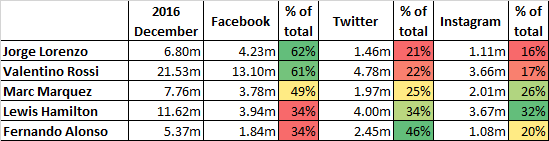
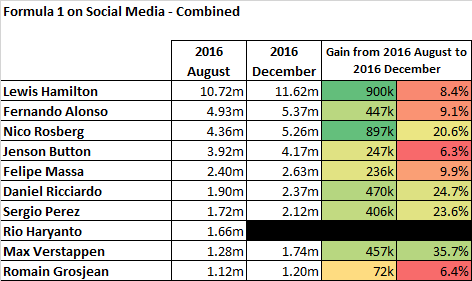
Across Facebook, Twitter and Instagram, Lewis Hamilton is the second biggest motor sport star out there currently. With a combined audience of 11.62 million followers, Hamilton is comfortably ahead of his nearest rival Fernando Alonso, who reaches 5.37 million accounts. In front of both Hamilton and Alonso is the MotoGP superstar Valentino Rossi, who reaches 21.53 million accounts. Rossi dwarfs Hamilton’s and Alonso’s numbers on Facebook, with 13.10 million accounts ‘liking’ Rossi through that service.

Marc Marquez and Jorge Lorenzo are both ahead of Alonso overall, with a reach of 7.76 million and 6.80 million accounts respectively. From a social media point of view, MotoGP has more superstars than Formula 1 currently and with neither Rossi, Marquez or Lorenzo retiring any time soon, that picture looks set to continue. It is one thing that Formula 1 has struggled to do: build superstars on social media. The reason for that is MotoGP’s large audience of Facebook, which Formula 1 is only starting to replicate (see below).

> September 2016: In conversation with Ian Wheeler (part one; part two)

Away from the MotoGP and Formula 1 comparisons, Nico Rosberg bows out with 5.26 million combined followers across Facebook, Twitter and Instagram. Losing three of the five biggest names on social media in 2017 will hurt Formula 1. Jenson Button in fourth can reach out to 4.17 million combined followers, whereas Sergio Perez who sits in seventh reaches out to 2.12 million combined accounts. That’s a sizeable difference. It takes time to build up the younger stars which is why the older stars are still up top. But that is where FOM and Liberty Media come into play by working with the teams, in the same way Dorna did with MotoGP’s outfits to build up a strong social media presence.

Red Bull utilise the power of Facebook Live whilst Mercedes use Rosberg’s exit to generate hits
Facebook Live is becoming increasingly important to reach out to new audiences, something Red Bull have exploited in the latter half of the season. More and more teams are using these tools, but clearly Red Bull are doing something right in this space as their combined audience jumped by almost a million accounts between August and December, jumping from 8.08 million to 8.95 million, an increase of 10.9 percent. Red Bull’s Facebook videos have a lot more views and interaction than Mercedes despite having a lot less ‘likes’. No other team can boast that activity aside from Mercedes, and it is clear fans are liking the antics of Daniel Ricciardo and Max Verstappen… for now.

social-media-december-2016-f1
Four of the leading ten drivers from 2016 will not be in Formula 1 next season, a big loss for Formula 1’s social media profile.

Nico Rosberg’s retirement sent shock waves across social media, with the BBC reporting over two million unique hits for its article on the subject. Whilst the news itself generated attention that Formula 1 would never usually see in the off-season, Mercedes capitalised on it brilliantly from a social media standpoint. A spoof advert appeared in AUTOSPORT Magazine, which in turn led to several ex-drivers and media personalities ‘applying’ for the role via Twitter!

It is difficult to stand out from the social media crowd without a coherent social media strategy. You get the impression that Formula 1 is really starting to get the handle of what content works on social media and what doesn’t. When looking into greater detail, it’s interesting to note how the follower profile differ between MotoGP’s leading riders and Formula 1’s leading drivers. The overriding conclusion is that MotoGP skews firmly towards Facebook with over 60 percent of its social media audience coming from that platform. In comparison, Formula 1’s social media is much more ‘thinly’ spread out between Facebook, Twitter and Instagram.

social-media-december-2016-motogp-vs-f1
How MotoGP’s leading riders and Formula 1’s leading riders perform across Facebook, Twitter and Instagram: a stark difference depending on the platform.

Are casual fans more likely to ‘like’ superstars on Facebook and monitor their activity there, rather than create a Twitter account and follow them via that medium? As previously mentioned on this site, the grower in this space at the moment is Instagram, which is eating slowly into Facebook’s market share where Formula 1 is concerned having gone from a combined following of 8.57 million accounts in December 2015 to 19.13 million accounts in December 2016 (all teams, drivers and official F1 included).

MotoGP has the largest presence overall
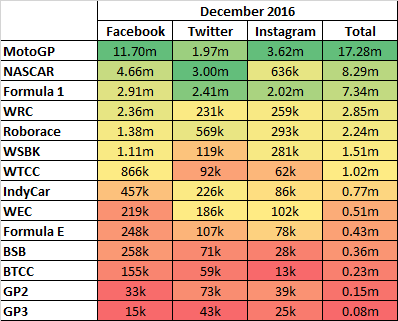
The official Formula 1 accounts across Facebook, Twitter and Instagram have a combined audience of 7.34 million, up 14.4 percent from August and up a massive 211.5 percent on December 2015. This time last year, their combined following was just 2.36 million, although the large increase is due to their Facebook migration back in March. Nevertheless, the numbers should help Formula One Management (FOM) see how important social media is to the Formula 1 brand. In Abu Dhabi, FOM did their first #F1Live broadcast on Facebook, which was a success story (more on this in the next few days).

However, the official MotoGP accounts across social media are followed by a combined audience of 17.28 million people, thanks to a large Facebook following, as noted above with Rossi, Lorenzo and Marquez. Behind MotoGP is NASCAR, which is helped by a strong Twitter profile. MotoGP, NASCAR and Formula 1 are the ‘big’ three motor sport series and this translates across to social media.

social-media-december-2016-series-by-series
A comparison of the leading motor sport series across Facebook, Twitter and Instagram.

At the other end of the spectrum, a combined audience of just 433,000 people follow the official Formula E channels, which puts it in line with the World Endurance Championship and the British Superbike Championship. The other point to note down the latter end of the table is the very small profile for both GP2 and GP3, showing why Liberty Media desperately need to integrate both series’ into Formula 1’s overall offering as they are firmly treated at the moment as a ‘bit on the side’.

Lastly, Roborace. A combined audience across Facebook, Twitter and Instagram of 2.24 million having never turned a wheel in anger during a real race. Fake followers? I think so…

Channel 4’s F1 team: The 2016 Verdict

Two months, 26 days and 18 hours. That is the length of time from the BBC’s Formula 1 television exit on Monday 21st December 2015 to the start of the Australian Grand Prix on Sunday 20th March 2016.

Putting a television programme together of a high-quality standard is an immensely difficult task. From the on-air team, through to the editorial team, creating the visual graphics, and so on. So, how did Channel 4 and production company Whisper Films perform in their first season covering Formula 1?

Jones impresses as lead presenter
For any broadcast, it is critical that the lead partner is up to standard and can steer the ship. Ask anyone who worked on Channel 4’s athletics coverage in 2011 about Ortis Deley and they will tell you how throwing someone into the deep end can undermine the reputation of an entire programme.

A motor racing presenter needs to be able to present in all conditions, outside the confines of a studio and into the heat of Malaysia or the soaking wet weather in Interlagos, whilst ad-libbing as guests appear or disappear with a moment notice. Before 2016, Steve Jones had never presented a live sporting event. When I found out that Jones was going to be presenter, I was surprised. An unusual and unexpected option. But, we can safely say an inspired choice. Nervous in Bahrain, Jones has evolved throughout the year into his own style.

Occasionally, his presenting comes across as ‘hammy’ but overall, I’ve enjoyed listening to him this year. Jones has been better than I imagined. Early indications are that Jones will remain with Channel 4’s team in 2017. The best part is that Jones does not imitate other presenters before him. He is not the next Jake Humphrey, or the next Suzi Perry. He is the first Steve Jones, and that is clear from his delivery. I hope we see Jones around for the next few years.

Jones was helped by those who provided expert opinion alongside him. I enjoyed seeing Mark Webber, David Coulthard and Eddie Jordan as pundits throughout the year. Webber and Coulthard have great rapport with one another, whilst Susie Wolff was a pleasant surprise as well.

The winning commentary formula continues
Whilst Channel 4 made changes on the punditry front compared with the BBC, one area they kept the same was commentary. Across the year, we heard some fantastic commentary calls, including one of the best modern-day commentary moments I think we have heard in a long time. It is critical that the lead commentator can concisely sell and get ‘over’ the key moments in the season. Ben Edwards’ commentary on Lewis Hamilton’s retirement in the Malaysian Grand Prix was a season defining moment with commentary to back it up:

Ben Edwards: Hamilton’s in trouble! Hamilton’s engine has blown! His race is run here in Malaysia! And when it looked like he was going to take the lead in the championship, would you believe it! He has never had a non-finish here.
Lewis Hamilton [Team Radio]: Oh no, no!
Ben Edwards: But he’s had a non-finish when it counts in Malaysia, only his second of the year!

Sometimes it is easy to over exaggerate the gravitas of a moment, but the commentary in the moment from Edwards was perfect. People don’t remember the 88 minutes of commentary in a football game where nothing happened and it is the same in Formula 1. The race defining calls have to be perfect, and this one was. You won’t get them all spot on, but the call in Malaysia was on the money. Similarly, Edwards and Coulthard conveyed the drama of Abu Dhabi well I felt.

The Edwards and Coulthard combination is now heading into season six. I enjoy the combination, but would appreciate hearing more of Mark Webber in the commentary box next season. Webber joined Edwards and Coulthard for commentary at Silverstone, but the three-team team was not repeated elsewhere. However, Channel 4 used Karun Chandhok and Lee McKenzie more during the race as the year progressed, which was a welcome change compared to how McKenzie has been used in the past. I hope we see more three-team commentary line-ups in 2017. I hear someone called ‘Jenson’ has a little experience in this area too…

Unfulfilled promises
When Channel 4 announced their line up in March, there were promises of a rotating line-up. This didn’t happen as much as I had hoped for throughout the season. Alain Prost was announced as part of their line up but only utilised properly in Spain (with a fleeting appearance in Abu Dhabi).

Nicolas Hamilton, Alex Zanardi and Bruno Senna were all announced but never appeared despite a fantastic VT being shown during the press morning with relation to Zanardi (he ended up appearing in a segment during Sky’s Mexican Grand Prix coverage). Senna appeared as part of Channel 4’s Brazilian Grand Prix opener, but no further. Considering how much Senna brought to Sky’s coverage in the early years, it was disappointing that he was not a regular part of Channel 4’s team.

The tip here is to only announce people who you intend to use on air regularly. Don’t announce stars who are unlikely to be around, as this will only annoy the watching punter. I did feel that the quality of the programming dropped slightly in the second half of the season, and adding a bit of variety would have helped in that respect, or even bringing Chandhok into the pre-race build-ups.

Channel 4’s 2016 live punditry line-up (excluding David Coulthard)
Bahrain: Mark Webber, Eddie Jordan, Susie Wolff
Spain: Alain Prost, Susie Wolff
Europe: Eddie Jordan
Britain: Mark Webber, Eddie Jordan, Susie Wolff
Hungary: Susie Wolff
Belgium: Mark Webber
Italy: Eddie Jordan
Malaysia: Mark Webber
Mexico: Mark Webber, Eddie Jordan
Abu Dhabi: Mark Webber, Eddie Jordan, Susie Wolff

It is a minor gripe, but one that should be noted, the last thing Channel 4 wants to happen is to head into ‘Skyfall’, that is the trap that Sky have fallen into in recent years of having the same standard line-up at every race weekend. Eventually, this becomes a turn off, which Channel 4 will be acutely aware of. I’m not suggesting that Coulthard and Webber were turn offs in Belgium and Italy, but more I’m thinking of ways to keep the programming fresh with new opinions.

Whilst Britain and Abu Dhabi unsurprisingly had the ‘hands on deck’ treatment, it is important not to neglect the rounds in between, which might have happened slightly this year. It was noted pre-season that Channel 4’s line-up would be adjusted depending on how the season progressed, but not many visible changes occurred. I won’t be surprised if this was unavoidable given the number of races in such a short period. There will probably be changes for 2017 if Channel 4 try to rope in the likes of Jenson Button, Felipe Massa and Nico Rosberg for a few appearances throughout the year.

Overall though, when you consider the amount of time Channel 4 and Whisper Films had to prepare for F1 2016, the channel and production company did a fantastic job to gather the team that they did for 2016. They will go into 2017 in better shape knowing what works and what doesn’t, which can only be a good thing for those watching their programming.

The second part of the 2016 Verdict looking at Channel 4’s programming will be posted around the 17th December.

Haryanto and Verstappen shine on social media

Whilst this site tends to focus on the efforts of Channel 4 and Sky Sports where Formula 1 is concerned, it is important to comment on what Formula One Management (FOM) has done so far during 2016. With that, we also turn to social media where there have been several shining lights.

Formula 1 is constantly trying to break into new territories, so when a racer from a new territory comes along, it is little surprise to see their follower counts skyrocket. Enter Rio Haryanto. At the half way stage of the 2016 season, Haryanto has amassed a combined reach of 1.66 million accounts across Facebook, Twitter and Instagram. A video posted by FOM on YouTube of his car rolling out the garage in pre-season testing has been watched over half a million times. These are massive numbers by F1’s standards, even with Haryanto’s Formula 1 exploits ending for the moment. Whether Formula 1’s popularity (beyond Haryanto) has increased in Indonesia though is unknown.

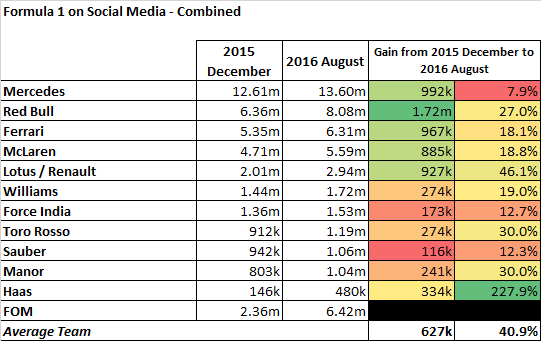
Max Verstappen has had a similar effect in the Netherlands, and his shock switch from Toro Rosso to Red Bull has helped the latter in the social media stakes. From a combined reach of 6.36 million accounts in December 2015 to a reach of 8.08 million accounts currently, this represents an increase of 1.72 million (or 27.0 percent), the largest for any team across the first half of 2016. Mercedes, McLaren, Ferrari and Renault all recorded gains of around 950,000 followers. Behind the leading five, Haas did not disgrace themselves, moving from a combined reach of 146,000 in December to 480,000 currently.

Social media - August 2016 - Figure 1
The Formula 1 social media statistics, covering Facebook, Twitter and Instagram, as of August 2016.

Mercedes again had the lowest percentage increase, but with their reach increasing by one million from 12.6 million to 13.6 million followers across the big three social media websites, they cannot complain. Force India and Sauber had a relatively poor first half of 2016, both teams only increasing their reach by less than 200,000 followers.

Verstappen on the march
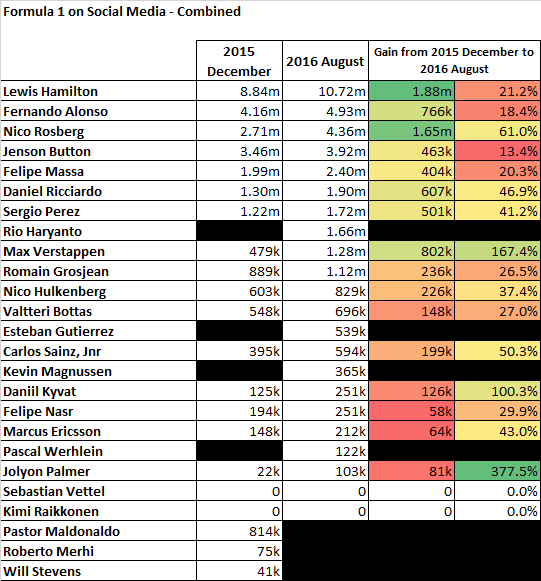
The surge that started in 2015 has continued into 2016. In July 2015, Verstappen’s accounts on Facebook, Twitter and Instagram reached 247,000 followers. Now, that number has quintupled to a reach of 1.28 million followers. That’s an amazing turn of form. What we don’t know, is where those followers are distributed. I suspect, unlike Haryanto, Verstappen’s followers are distributed more widely to the rest of Europe given the impact that he is likely to have on Formula 1 in the years ahead. Viewers watching this weekend’s Belgian Grand Prix weekend will have noticed a large Dutch contingent out in force.

Behind Verstappen and Haryanto in the impressive stakes is Nico Rosberg, who jumped from reaching 2.71 million accounts across Facebook, Twitter and Instagram at the end of 2015 to reaching 4.36 million accounts half way through 2016. It is likely that Rosberg will become the second biggest social media star in F1 by the end of 2016, surpassing Fernando Alonso. That is surprising in one sense given their respective personalities, but Rosberg’s strong form in the early races will have played its part in the growth numbers. Germany’s television viewing figures have bounced back slightly this year, so Rosberg is getting more support from home than previously.

Social media - August 2016 - Figure 2
The Formula 1 social media statistics, covering Facebook, Twitter and Instagram, as of August 2016.

Whilst ten drivers possess a reach of over one million followers, only half show significant growth (if we discard Haryanto): Hamilton and Rosberg lead by some margin, followed by Verstappen, Fernando Alonso, Daniel Ricciardo and Sergio Perez. Jenson Button, Felipe Massa and to a smaller degree Alonso have a stagnated follower base as Button and Massa start to ebb towards the end of their respective careers.

Instagram continues to grow at a faster rate than both Facebook and Twitter, jumping from a cumulative total of 8.57 million at the end of 2015 to 15.90 million currently. Their market share has increased from 12.8 percent to 18.1 percent as a result. Twitter’s slow down continues, but nevertheless increased from a cumulative total of 22.3 million to a healthy 27.5 million. Overall, the metrics are all up from the same time last year, and increasing at a faster rate which is good news for the sport moving forward.

Formula One Management… getting better?
Normally, I use the rule that if I’m complaining about things less, then chances are that it is actually getting better. I think that is the case with FOM’s television coverage! With tweaks to on-board camera angles and overall a greater sense of speed through different trackside cameras, things do appear to be moving in the right direction. Of course, the coverage has been let down by the outlandish team radio rules…

Team radio was first introduced to Formula 1’s television feed as part of the F1 Digital+ service. The service was introduced in 1996, coming to the United Kingdom in 2002 before closing at the end of that season. Broadcast to a niche audience, it quickly became clear how team radio would revolutionise Formula 1 viewing if rolled out to the globalised free-to-air feed.

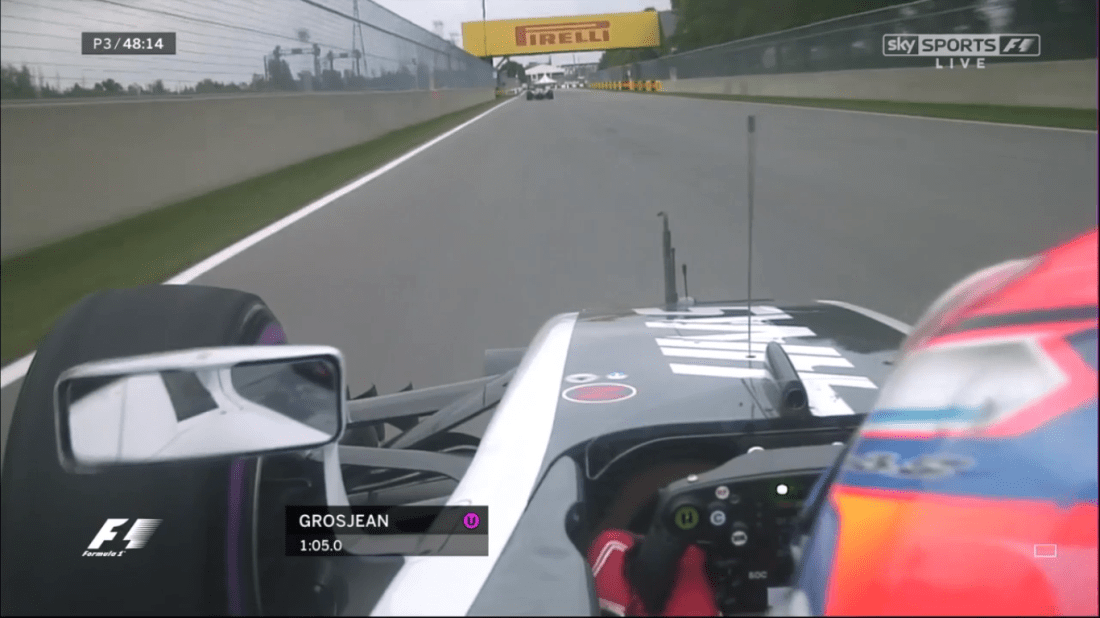
2016 Canadian GP - Grosjean
A welcome return: camera angles such as the above of Romain Grosjean’s Haas have not been seen since the 1990s, but have returned to Formula 1’s World Feed in the past few races, giving a greater sense of speed.

“Let Michael past for the championship, Rubens” was one such snippet that aired on the F1 Digital+ feed at the 2001 Austrian Grand Prix. Victory celebrations were also commonly broadcast on the F1 Digital+ feed, notably at the 2000 German and Japanese rounds of the championship, again both featuring Ferrari drivers.

Team radio became more widespread through the 2000s, with it being common place until the radio rules of late last year. I’m happy to see the ruling reversed, simply because the team radio offered a different opinion on the track action, a ‘third wheel’ shall we say. However, even after the reversal, it still feels like there is less team radio than in previous seasons. Have drivers been trained to talk less in the car, or are the fans hearing an extremely filtered version?

Staying with TV, FOM’s GP2 commentary line up of Alex Jacques and Davide Valsecchi has been a revelation this season. Jacques has come on leaps and bounds since we heard him at the start of 2015. Plucked out of nowhere, his style alongside Valsecchi’s strong enthusiasm means that fans are in for a treat whenever GP2 is live on-air.

https://www.youtube.com/watch?v=Tk9MUJ6_XPM

Elsewhere in the FOM spectrum, their social media efforts have improved compared with 2015. Helped by an influx of new faces such as ex BBC F1 video editor Tom Bowker, their social media platforms, including Facebook which launched in March, have played host to a lot more unseen archive footage than previously. Finally, it looks like the public is able to scratch at the surface of FOM’s video archive.

With 2.6 million ‘likes’ on Facebook, 2.2 million on Twitter and 220,000 on YouTube, F1 is building its digital fan base. Their Facebook page, which was launched in March, has been successful so far thanks in part to the migration of the 1.8 million people who already liked F1 related pages! FOM have not done anything though to go viral yet, in the same way that Formula E and the Ricciardo/Massa go-karting fun did. In fact, I do not think FOM have done anything in recent memory to go viral, whether they choose to do so to try and boost their profile, we shall see.

In the meantine, MotoGP remains four times as popular as Formula 1 on both Facebook and YouTube. The series recently hit 1 million subscribers on YouTube, rewarding fans with a full race copy of the 2015 Australian Grand Prix… for free! Of course, the nature of television deals mean that FOM may not be able to do that, but it shows what can be achieved. As always with F1, there is a long way to go to getting fans the level of access that MotoGP does with their fans.