MotoGP’s UK ratings rise year on year

2014 saw MotoGP move to pay television in the UK, with live coverage of the sport now on BT Sport, BBC having lost the rights the previous spring. ITV did get in on the act though, with free to air highlights airing on ITV4. So, how have things progressed since this time last year?

> Audiences record slight increase versus 2014
> BT Sport sees 40% increase
> ITV highlights drop, but still above BT

The picture at the end of 2013 was that around one million viewers on average were watching MotoGP on BBC Two. During the first half of 2013, an average of 1.15 million watched the series across the BBC and British Eurosport. That number excludes BBC iPlayer. All the numbers that follow are BARB overnight viewing figures as usual, and exclude the likes of ITV Player and BT Sport’s app. Does this mean we are missing a significant chunk of the audience? It is difficult to tell, but when you are playing with a low audience anyway, a audience of 50k for example watching the BT Sport app makes a fair difference to the numbers. Not a huge difference, but perhaps noticeable. Anyway, ITV and BT, being commercial broadcasters, do not realise the on demand numbers into the public domain.

Last year, BT Sport’s live coverage from 12:30 to 14:00 (or equivalent) for the first half of the season averaged 155k. At the time, I commented that the number was poor and I stand by that submission when you consider what the BBC was getting the year before. Okay, the reach of BBC Two is many magnitudes bigger than BT Sport 2, but either way I did not expect MotoGP to lose 80 to 90 percent of its audience. In comparison, BT Sport’s live coverage so far this season has averaged 218k, an increase of 41 percent year on year. Every live race that BT Sport has covered has rated higher than 2014. The biggest jump year on year was for Le Mans, which went from 112k in 2014 to 262k in 2015, and peaked with 330k (4.4%), which is BT Sport’s highest MotoGP peak to date.

There are many reasons why BT Sport’s coverage has increased considerably year on year. The first is related to the fact that their coverage has been presented on location for this season. It is no secret that viewers are more likely to be engaged in coverage when they can get closer to the action. The other is that BT Sport may have more subscribers than this time last year, but I’m not convinced that argument holds up as their Premier League coverage has not increased by anywhere near the same amount. Two words can sum up the main reason for the increase in my opinion: Valentino Rossi. I will admit to being openly biased here. I am a Rossi fan, and it is fantastic to see him winning again. No doubt that has converted some of the ITV highlights watching audience into watching BT Sport’s coverage live. It is just unfortunate then that the 41 percent increase represents an increase of only 63k and not something of a much bigger volume…

With the UEFA Champions League coming on board for BT, alongside the changes to their subscription packages, it will be interesting to see how MotoGP’s numbers are affected, if at all. Surprisingly, ITV4’s highlights numbers have dropped 11 percent. An average of 327k have watched Monday’s highlights programme so far this year, in comparison with 366k for the first half of 2014. I should note that ITV4 are repeating the MotoGP Highlights show a lot more this year, which may explain why the Monday airing has suffered as a result. As is usual practice for the blog, repeats are not included in the figures outlined (aside from +1 channels). The high number of Le Mans on BT Sport was not replicated on ITV4 – in fact, on the weekend, BT Sport 2’s live coverage beat ITV4’s highlights number: 262k for BT’s live MotoGP portion of the show versus 253k for ITV’s highlights. It is an interesting anecdote, and does indicate that the pendulum is swinging towards BT Sport. The audience for the first half of 2014 was split 70/30 in ITV4’s favour. That split has tightened up to 60/40, still in ITV4’s favour but significantly closer than before.

Overall though, the numbers remain low compared with 2013. Even taking into account BT’s ratings increase, a combined average of 545k for the first half of 2015 is still massively down on BBC Sport’s figures for 2013, albeit 5 percent up on the average of 521k for the first half of 2014. BT Sport should be very happy with their figures – momentum is on their side. The momentum needs to be replicated in ITV’s highlights show. And, for whatever reason, that just is not happening at the moment. Neither BT Sport or ITV responded to a request for comment from this blog concerning MotoGP’s viewing figures.

The 2014 mid-season MotoGP ratings report can be found here.

overnights.tv-bannersF1

Looking back at Formula E’s inaugural season

The 2014-15 Formula E season came to a thrilling climax on June 28th from Battersea Park in London, with Nelson Piquet, Jnr clinching the championship in a finale that could be described as the electric version of the 2008 Brazilian Grand Prix. Overall, the inaugural season has been a success, ten cities hosting eleven rounds. But what has gone well, what hasn’t gone well and what could be improved for season two? There are a lot of lessons that the championship could learn going forward, but also some things that they should be congratulated on.

Viewing figures and scheduling
According to overnight viewing figures from overnights.tv, the inaugural season of Formula E averaged 216k (2.6%) on ITV4 for their eleven race day programmes, with an average peak audience of 366k (4.1%). It is worth remembering that the championship decider was broadcast live on ITV to an audience of 700k (6.9%). Removing that number brings Formula E’s average down to 168k (2.2%), with an average peak of 285k (3.4%). Broadcasting the final race live on ITV’s main channel made a huge difference to the season average. The audiences for ITV4 have been solid, but they have not been spectacular. In my opinion, I don’t think ITV is all to blame for that.

Formula E: the future?

Some of Formula E’s scheduling decisions during season one were bad, some their own fault, and some beyond their own control as we saw with Malaysia being moved from October to November, thus creating a two month gap between rounds one and two. Their season two calendar unfortunately does not fill me with much hope. The Formula One season starts in April, and I had hoped that Formula E would take advantage of that fact. Instead, what the provisional calendar shows is an seven week gap between rounds three and four, with a further six week gap between rounds four and five, neither gap makes much sense. Formula E should capitalise on Formula 1’s absence with a race every three weeks (Christmas aside), if feasibly possible.

The season two problems are compounded by Battersea Park’s date currently showing as TBA. The calendar needs to be more compact, to get the viewers into a routine in the off-season. From ITV’s perspective, it is difficult to promote something that is not on regularly. There’s less incentive for ITV to broadcast races on their main channel with long gaps. As of writing, we don’t know whether ITV will be covering Formula E for season two. I assume the answer is yes, given that ITV’s Formula E presenter Jennie Gow has referenced Formula E in some of her tweets recently, in but this has yet to be confirmed to me. I would outline what I think ITV should do scheduling wise for season two, but I think it is worth waiting until official confirmation that they are actually screening season two live first…

Graphics and Direction
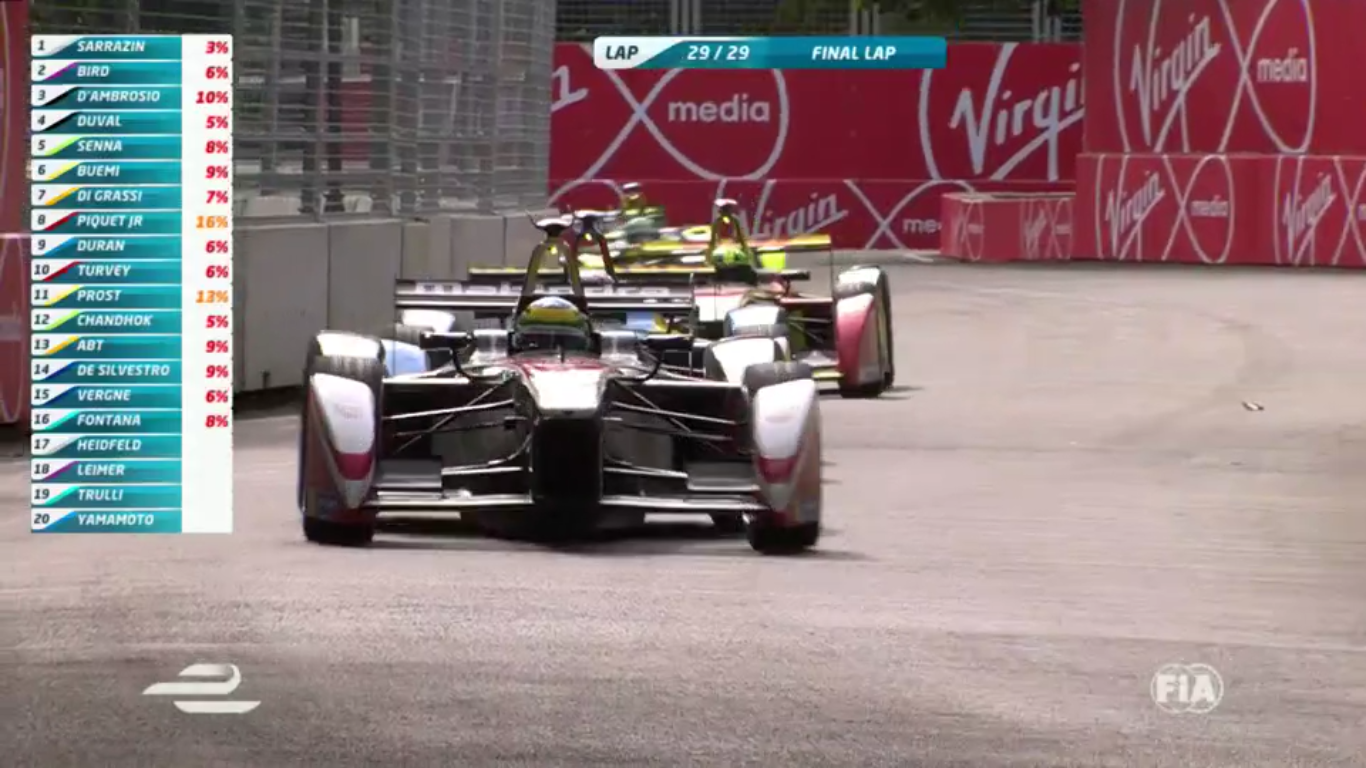
The World Feed for Formula E’s inaugural season was produced by Aurora Media, who packaged each session with their own broadcast crew, led by Nicki Shields, with Jack Nicholls and Dario Franchitti on commentary (more on that later). From a graphical perspective, the package was slick, and looked great in high definition. Unfortunately, the graphics did not stand up very well in standard definition, which was evident when I watched the races live on ITV4. The main timing graphics wall, which included the energy percentages, was superb. Easy on the eye, allowing the casual viewer to easily track the story of the race. Kudos to whoever came up with that idea for the percentages on screen, because it was executed fantastically. There were two graphics in my opinion which suffered from fatal flaws.

The first problem was the speedometer, which stayed the same for the entire season. The problem here was that too much information was being conveyed in a small amount of space. One of the core fundamentals of any user interface is that the user should be able to understand what it is telling you within around 10 seconds. When I’m looking at the speedometer, what exactly am I focusing on? And is that information important for the casual viewer? If the guy who watches every race struggles to understand or digest the graphic, then the casual viewer has no chance. It is good that this information is being provided to the viewer, but it certainly needs to be separated out to be made more useful (aka. separation of concerns).

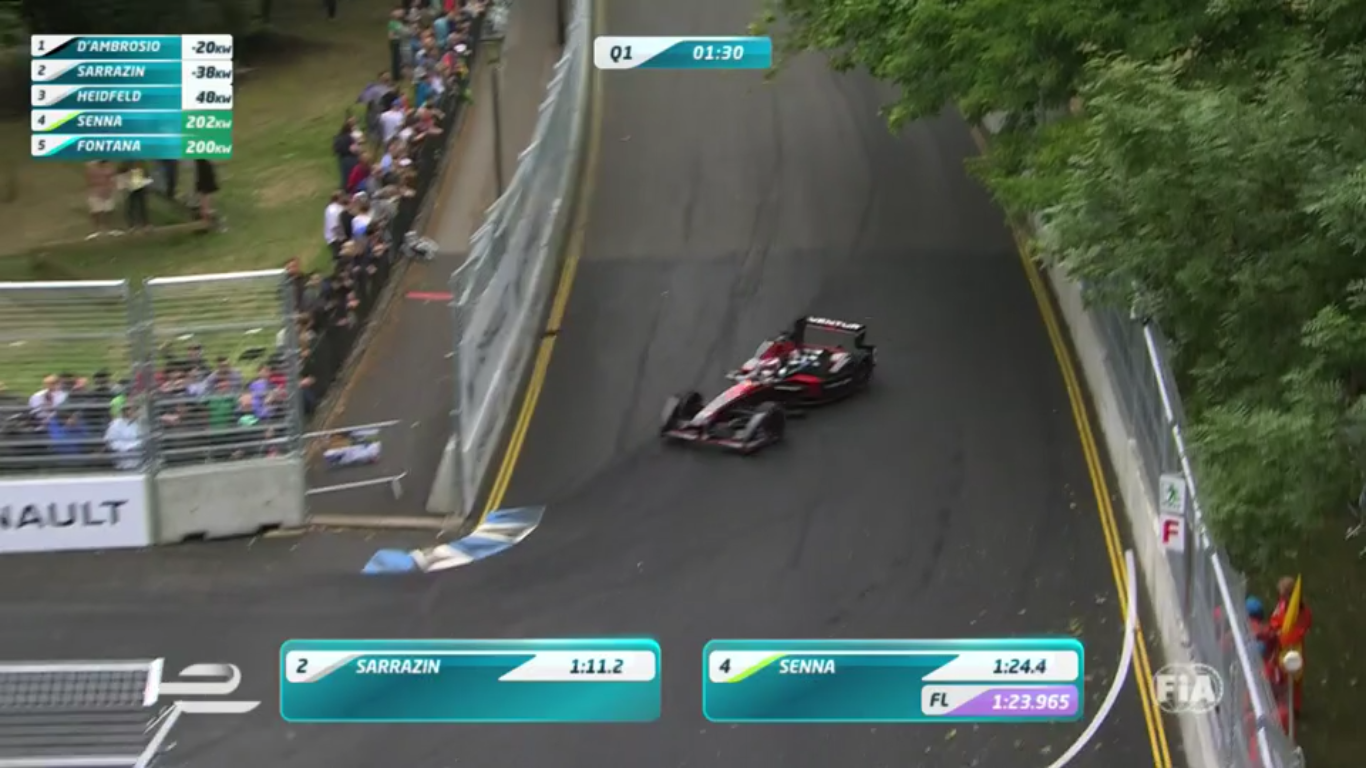
The qualifying kW output during the second 2015 London ePrix.

The second problem I found concerned the qualifying graphics. I also want to put this under the “let’s make the commentators job easier” category. The graphic itself is an addition to the timing wall, and normally sits to the right of it, which shows the amount of kilowatts that the driver is currently using. Normally, it is either 150 kW for a slower lap and 200 kW for a fast lap. The problem I have is that the graphic fluctuates considerably as the driver goes round the lap, sometimes even going into negative values. I mentioned this on Twitter a while back, and the reaction to the graphic seemed positive so it may be just me that feels this way.

Across the season, the direction was largely good, highlighted by the superb camera angles. I don’t think you can ever get tired of seeing Formula E cars leap over kerbs and hurl themselves towards the fence and the onlooking camera. One worry before the season was whether the camera angles would convey the speed well, however for me this was quickly dispelled with round one in Beijing, as described above. Not every round was perfect, I didn’t think the open airfield of Berlin portrayed the cars well, as it meant that the camera angles were not generally as close as previous rounds. But overall, it was good and for the most part it was clear that the team were learning as they went along, the pit sequence an example of something which improved significantly as the season progressed, helped by the aforementioned on-screen graphics.

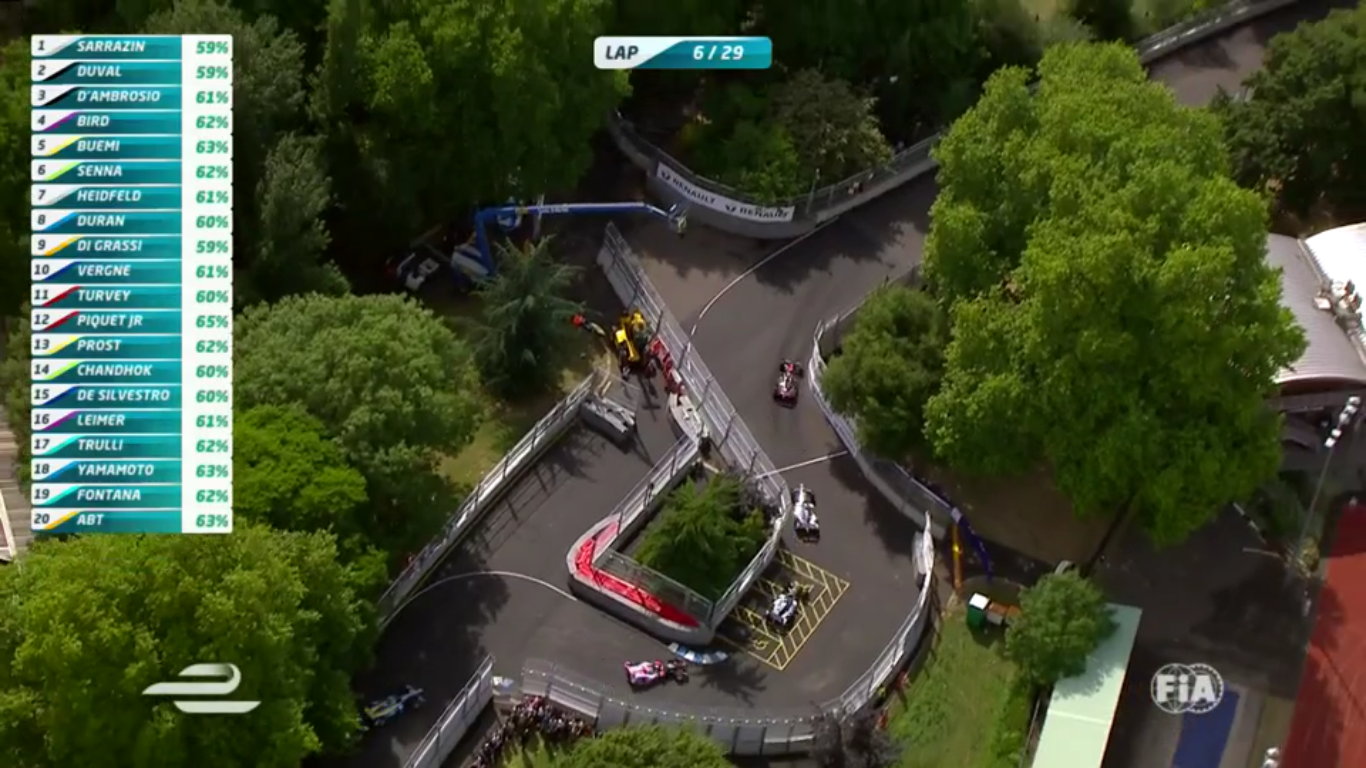
However, as with the graphics, there were two aspects about the direction that I wasn’t a fan of: cutaways and heli-cam. I can understand the occasional cutaway to Alain Prost or whoever in the pit lane. But as the season progressed, the cutaways felt more intrusive on the coverage, and also held onto the subject for far too long, some shots seemingly stuck forever. A separate issue was heli-cam. It works the majority of time in Formula 1 as it can help visualise the speed at places like Monza. But when the Formula E cars are slower than other single-seaters as it is, you really shouldn’t use any shots that highlights this fact. The heli-cam was used frequently in London, and I wasn’t a fan. I don’t like saying this, but the direction behind the restart of the second London race was a mess as a result.

Commentary, other bits and looking ahead
The commentary team of Jack Nicholls and Dario Franchitti does not need much explanation, nor analysis. Why? Because it was Nicholls and Franchitti that helped made Formula E what it became during season one. It would not be an exaggeration to say that Nicholls and Franchitti are currently the best motor sport commentary duo around. The young, energetic style of Nicholls alongside the veteran analysis from Franchitti is a fantastic combination, and one that I hope is maintained for season two. It certainly deserves to be.

A helicopter shot looking down at Battersea Park during the second 2015 London ePrix.

A few other bits to round off. Social media is good, with great use of Grabyo for instantly sharing clips from the race, which has paid off with famous stars sharing the clips. Weirdly though, there has not been much direct interaction with fans from Formula E themselves, in the form of Q&A’s and the like. Furthermore, I found that Formula E did not promote their own live streaming, which was incredibly bizarre. I mean, if you want someone to access the live streaming, surely you would provide a direct link to it? As I say, the social media content itself is great, but the interaction, not so. The website is okay, but it is not optimised for mobile browsing as far as I can see. Speaking of live streaming, if you didn’t have a direct link to it, chances are you would find it difficult to spot it. It is silly that the Video page, linked from the homepage, has none of the full sessions listed, but the Live Streaming page, not linked from the homepage, has every session listed. A goldmine if you want to grab new fans, if you ask me, which is not being exploited.

Season one for Formula E has gone incredibly well. Have they proved the naysayers wrong? I’d like to think so. The points I have outlined above will only serve to get better as time progresses. The cars will only get faster, the technology will become more mainstream and attract a bigger audience. Formula E has its baseline. But the race is not over. The chase for viewers is only just beginning. Please, just don’t do anything stupid. Keep it free and accessible, and you will attract more viewers.

Oh, and the segway is fantastic. Never forget the segway.

Looking at NBC’s Road to Mercedes

The F1 Broadcasting Blog tends to only focus on the programming that BBC Sport and Sky Sports produce in relation to Formula 1. Given that the blog is UK-centric, that’s perhaps not surprising. However, over in the States, one broadcaster produced some top quality content in 2014 that is definitely worth reviewing on the blog. Enter NBC Sports.

It was announced in October 2012 that NBC Sports would be taking over the rights to cover Formula 1 in America, succeeding the SPEED Channel in covering the sport. NBC’s coverage, plus the return of the United States Grand Prix, has meant that viewing figures have surged in the States. Whilst numbers are still relatively small, and have yet to break into the millions, the rise can only be seen as good news for the sport, which looks to exploit the American market further.

One aspect outside of the NBC F1 team’s control is the number of commercials, however what they produce is of course in their control. Alongside its usual Off the Grid programme, which goes behind the scenes during a race weekend, NBC have also produced two documentaries under the Road To strand. This began with the Road to Ferrari, and has since been followed by the Road to Mercedes. The Road to Mercedes documentary premièred on NBC Sports during the 2014 United States Grand Prix weekend and, as with Off the Grid, it was presented by Will Buxton and producer Jason Swales. Immediately this is a striking difference compared to other Formula 1 programming that readers may have watched: Swales is normally a producer, yet he presents some of NBC’s programming alongside Buxton.

Will Buxton and Jason Swales at Reims for the Road to Mercedes documentary.

The title of the programme might give a clue about what it is about, a journey from Silverstone, the home of the British Grand Prix to Hockenheim, the home of Mercedes and home to the German Grand Prix (for 2014, at least). The journey, done aptly in a Mercedes GL63 AMG, takes Swales and Buxton through several motor sport hotspots. After going over the ferry (which was not Buxton’s favourite point!) from England into France, the two take a trip to Reims, the first of several trips down memory lane. The imagery at this point is simply stunning, looking down the old, disused pit lane at Reims. Some of the shots really help put things into context between the modern and ancient. It beggars belief that the old pit lane is still standing after nearly fifty years, but it is.

As night dawned, France turned into Germany, and quickly Reims turned into the Nürburgring. “When I think of the Nürburgring, I don’t think of this,” says Swales. Of course, Swales is comparing the current Grand Prix circuit to the Nordschleife. Before going around that beast though, Buxton and Swales take the Mercedes road car around the modern Nürburgring along with a visit to the Kiemele museum in Ditzingen. The Kiemele museum aims to restore old Mercedes cars back to a usable state. Buxton notes that it takes the museum 3,000 hours to restore one car, a mammoth effort just to get it into working condition. It was not long before Buxton ended up behind the wheel of one of the many cars that Kiemele had restored!

Will Buxton as a passenger. Going round the Nordschleife. In the rain...
Will Buxton as a passenger. Going round the Nordschleife. In the rain

Next up, Buxton and Swales head to a Mercedes factory, in which we learn that producing a V8 engine takes only three and half hours – simply ridiculous and shows how sublime the work that Mercedes do is. A programme called the Road to Mercedes would not be complete without heading to Mercedes’ homeland: Stuttgart, which is where the Mercedes-Benz Museum is located. Buxton describes it best as “heaven”, with many classic motor racing cars on display. It was simply amazing to see the wide range of machinery. If you ever go to Germany, I get the impression that this is one place that must be on the ‘bucket list’ of places to visit.

The journey concludes at Hockenheim during the 2014 German Grand Prix weekend, in which Buxton gets a rare interview with Dieter Zetsche, the Head of Mercedes-Benz Cars. Following a recap of the race, it was clear that Hockenheim was not the final stop. Instead, it was back to the Nürburgring, except this time it was the Nordschleife in a Mercedes SLS. In the rain, with Nico Bastian driving Will Buxton around the monster of a track. Typically, Flight of the Valkyries can be heard in the background as Bastian tackles the beast and Buxton hangs on as best as he can! Again, like at Reims earlier, this produced some fantastic imagery as the Mercedes SLS snapped sideways on a few occasions.

“I feel sick,” Buxton exclaims as he gets out of the SLS. The programme is just one of many excellent programmes that the NBC Sports have produced in the past two years, showing that it is not just BBC and Sky that produce good Formula 1 programming.

Looking ahead to 2015

2014 has been a fascinating year in the world of motor sport broadcasting, from the launch of BT Sport’s MotoGP series to the launch of the Formula E series. 2015 looks like it will be another intriguing year with plenty of news lines heading into the New Year and beyond.

Something I was expecting to be announced last week did not happen. Normally, the BBC and Sky 2015 picks are revealed before Christmas, as has been the case previously. Presumably, the reason for the delay is because neither broadcaster expects Korea to appear in the finalised calendar. I would be surprised if there was a separate reason, but we shall see. The picks will need to be confirmed in the first few weeks of January, so that both sides can start publicity, in particular Sky where their exclusive races are concerned.

Another story that will be followed throughout the first few months of 2015 are the Premier League highlights rights, which went out to tender recently. The Guardian reported in November that ITV are going to bid for the highlights contract. It goes without saying that the Premier League highlights, through their Match of the Day brand, is the most important contract that BBC Sport currently hold. Any attempt to destabilise BBC Sport’s portfolio could have major consequences. The early rumour was that Wimbledon could be split between BBC and BT Sport, although this has been denied. Let us hope that any change does not effect the current BBC F1 package…

Formula One Management’s social media expansion is set to continue into 2015, with the relaunch of Formula1.com. What exactly will the new website bring? Furthermore, based on Marissa Pace’s recent comments, we may well see an official Formula 1 channel on YouTube in 2015. Elsewhere, BT Sport’s MotoGP coverage enters year two, and Formula E will be entering year two in September. From a UK perspective, I hope year two remains live on ITV, but we won’t know the answer to that question for many months yet. 2015 looks set to be another intriguing year on and off the track as Formula 1 heads into its second season with the V6 power units.

The best and worst of Sky’s F1 coverage in 2014

Sky Sports F1’s ratings have increased 23 percent on 2013, according to unofficial overnight viewing figures. Alongside this, the consensus amongst blog readers is that the product has improved on 2013, suggesting that things are definitely heading up for the team.

As with the BBC, there are areas of Sky’s product which have been superb. However, there are still a few points in my eyes which could be tweaked, or should be changed altogether.

Best
Revolutionary features
When it was announced that Sky Sports would be launching their own Formula 1 channel, they promised to push the boundaries of what would be possible with the coverage. That did not happen, in my eyes. Some of the features produced were longer in length than BBC’s, but not necessarily better (Martin Brundle driving a Ferrari one of the early examples). 2013 was not great for the team, but this season, they have taken a significant step forward where the quality of features are concerned. Normally, Sky’s pre-race build-up contains Martin Brundle’s grid walk, but Sky went down a different avenue at Monza.

For Italy, Sky went behind the scenes with Williams, tracing their every step from garage all the way to the starting grid. It was something that I had never seen before, it was superb television viewing. Sometimes, a viewer does not appreciate just how much effort goes into the start procedure, the feature with Williams and Brundle really brought the build-up into the viewers home and gave the viewer a perfect insight into what happens before the race begins. I hope we see more features like this during 2015.

Ted’s Notebook
Rain or shine, Ted Kravitz’s Notebook continues to be a cornerstone of Sky Sports F1’s coverage, both on TV and online. Kravitz’s Notebook began when he was with the BBC, although the quantity has increased in the past few years on Sky Sports F1. You could argue that quality is more important than quantity, normally, I would agree with that statement, but the Notebook is a different kettle of fish.

I don’t watch the Notebook for the best technically produced product, I watch it to see Kravitz going up and down the paddock giving the viewer information along with a mixture of gossip and behind the scenes information. It is completely different to the rest of the output on Sky Sports F1 which makes it stand out from the rest of the channel.

#AskCrofty
A great way of creating debate on social media, #AskCrofty has once again been an interesting read in 2014. Sometimes I laugh and despair at the questions asked, however I appreciate the openness of doing something of that nature over social media. In some instances, the questions have influenced their live TV broadcast, as the reaction to Adam Parr’s tweet in September showed. #AskCrofty led to David Croft doing a live show based on the hash tag at the end of the season, which was brilliant to watch, generating more reaction on social media than your typical episode of The F1 Show.

Worst
US Grand Prix build-up
I wanted to make this point a separate blog at the time, but sadly time constraints meant that I was unable to. The US Grand Prix build-up was probably Sky’s worst of the entire year. The actual features in a standalone context were good, with Johnny Herbert and Damon Hill trying out NASCAR and a selection of sports stars focussing on the psychology. The problem was that both features were completely out of place on a weekend when only 18 cars lined up on the grid. 90 percent of the programme was focussed on the Lewis Hamilton and Nico Rosberg title battle.

The entire race programme was simulcast on Sky Sports 1, in an attempt to capitalise on a Super Sunday football game prior to it and to bring some casual fans into the picture. You can understand from that perspective why Sky developed features to cater for those who may not be regular Formula 1 fans. I know they talked about Formula 1’s issues in the qualifying show, but even so, the issues facing Formula 1 on race day were brushed under the carpet as a result of the simulcast.

Punditry
With financial issues being a key talking point throughout the season as a result of the new formula, Sky have not been helped by having too many pundits that are former drivers. Whilst the Brundle piece with Peter Windsor debating potential changes for 2015 was a good feature later in the season, not having any ex team bosses or ex team personnel in their programming hurt them. Johnny Herbert and Damon Hill may be okay to talk about driver issues, but when it comes to issues off the track, the programming is hurt as a result of not having enough variety.

A separate issue to do with the punditry, but under the same banner concerns the bias surrounding Lewis Hamilton, which was noticeable during the US Grand Prix build-up as mentioned above, however the bias that Sky may have shown pales in comparison to that displayed in other countries in recent years.

VT’s
Sky have made some fantastic improvements, their programming feels more ‘fluid’ than it once did. Their features overall have improved as well. But there is something about the majority of their VT’s that does not click. Some of the VT’s come across as a ‘cartoon’-like in nature whilst the poetry aspect in the end of season VT seemed out of place. This is one area for me where Sky still languishes behind the BBC. I don’t feel as much connection with the VT’s that Sky Sports produce compared to the VT’s that BBC produce.

There are a few other points worth making, such as the scheduling, it would be great if GP2 was more integrated into the programming, but I think that boat sailed a long time ago. Overall, Sky Sports F1 has made some major strides forward in 2014, which has been reflected in the viewing figures. If there is a British driver in the 2015 championship race, there is no reason why the viewing figures cannot continue to improve, with the quality of Sky’s broadcasts improving alongside it.