A presenter’s perspective on patriotism in F1 broadcasting

The British Grand Prix this weekend marks round nine of the 2014 Formula One season. Realistically, two men walk into the race with any hope of winning this year’s Drivers’ Championship: Germany’s Nico Rosberg and Britain’s Lewis Hamilton. In one corner, you have RTL. In the other corner you have the BBC, whilst on both sides there are the respective Sky broadcasters. In two weeks time, we head to Nico Rosberg’s home land for the German Grand Prix. Traditionally, having a home driver performing well does boost viewing figures. The UK’s viewing figures jumped significantly from 2006 to 2008, and Germany’s ratings hit a crescendo in the early 2000’s thanks to Michael Schumacher’s domination.

Steve Rider was presenter of ITV’s Formula 1 coverage during that time period before coverage switched to BBC. Rider seen Fernando Alonso win his second championship, followed by Lewis Hamilton’s rise in 2007 and championship winning year in 2008. In his biography, Rider talked about the logic behind ITV taking a more patriotic approach when Hamilton came into the fold. “The growing attention on the sport was, of course, very welcome for a British broadcaster, but over the months to come ITV, and probably myself in particular, were accused of becoming obsessed with Hamilton, so that television coverage simply revolved around his prospects and performance. There was never an obsession and hopefully I never lost sight of editorial balance, but I would certainly plead guilty to arguing for Hamilton to be the dominant story, and enjoying the fact that he was driving the audience so strongly,” Rider explained.

As a commercial broadcaster, it should not be surprising to see Sky Sports in the UK getting behind Hamilton, just like ITV did. Sky would say that they are just reflecting the views of their viewing audience – although perhaps interestingly, a poll on The F1 Show last Friday suggested a split of 50/50 on who will win the championship. ITV were just as patriotic in 2007 and 2008, and were widely derided for it at the time across various outlets, as Rider alluded to above. In some instances, it was amusing and accepted, Ted Kravitz unravelling the British flag in front of the Brazilian crowd in 2008 will always remain a highlight for me, and a lighter moment. As a whole, I do not want Sky’s coverage turning into a mini version of The Lewis Hamilton Show. Despite my reservations, I can see the editorial stance for that happening, a British driver winning brings in higher audiences and potentially more advertising revenue, hence the change of focus that may occur. BBC tends to be more neutral where the programming is concerned, and I don’t think their coverage is an issue.

Whilst Rider’s point is valid, switching back to 2014, @SkyF1Insider‘s tweets from Canada came across as a little obsessed, to use the same word as Rider. @SkyF1Insider is an official, verified feed from Sky Sports. Early on in the race, showing their patriotism, or bias, the feed tweeted: “Come on Lewis. Turn it up – lets get this race ON!” Now, the question is, do we mind or care about that? Is @SkyF1Insider the views of someone on the Sky team being aired on an official channel to add to their coverage. It may be harmless, but it’s not exactly a neutral message halfway through the race, although it does add a human element to the feed, which is a popular subject at the moment in another part of the forest. The latter message was looking for a conspiracy theory, in my opinion, especially coming off what happened in Monaco: “I’m confused. A radio message went through to Rosberg telling him both cars were unfixable…. Lewis retired, Rosberg still leads…”

Aside from the Twitter messages, the other major grate where Sky is concerned surrounds Johnny Herbert, and feeling the need to refer to Hamilton as ‘our Lewis’ in Sky’s coverage. Rider, in his book, goes on to explain that, had ITV’s pre and post race coverage been broadcasting to the entire globe, the stance would have been different. “Certainly if our audience was global you should expect to hear more from Nick Heidfeld and Jarno Trulli, but the British story was Hamilton; ITV had the access, and after all those years standing on the sidelines politely applauding the relentless genius of Michael Schumacher, they were determined to deliver the story as comprehensively as possible,” notes Rider. I think it is worth concluding by saying that in reality the patriotism that the UK coverage provides is nowhere near as nationalistic compared to other countries, for example Germany.

Whilst I don’t live in Germany, nor consume any of their coverage, reading comments on various sites leads me to believe that Sky Sports F1 is actually quite mild in comparison to RTL’s over the top reporting for Schumacher, Sebastian Vettel and Rosberg. In a piece last month that I wrote, one such comment, left by Lukas, suggested that RTL’s coverage is significantly worse than Sky’s, with heavy bias towards Vettel and Rosberg. Different audiences perhaps willing to tolerate different amounts, and different emotions perhaps, the German audience may well appreciate the patriotism whereas the UK audience wants a wider variety from their coverage. I don’t know, but it is an interesting and emotive subject nevertheless.

Scheduling: The 2014 British Grand Prix

Following Formula 1’s return to Austria, it is time for the teams and drivers to head to where it all began. Silverstone, round nine of the 2014 season, the British Grand Prix! Both BBC and Sky as usual for Britain have live coverage throughout the weekend.

If you want to jump straight to the schedule, click the links below…

Thursday 3rd July
Friday 4th July
Saturday 5th July
Sunday 6th July
Wednesday 9th July
Classic F1

Sky have an extra edition of The F1 Show on Thursday evening, except this year it will be airing under the title The Grid Live. It looks like it will be the same format as last year with David Croft and Natalie Pinkham presenting, whilst the EPG says that Lewis Hamilton will be one of the guests on the show. Apart from that, it is your typical race weekend schedule with nothing else to note for Sky. Over on BBC though, Wimbledon for the second time in three years throws a spanner in the works. Like in 2012, Qualifying and the Race will be airing on BBC Two.

The Wimbledon Men’s final and the British Grand Prix clashing when the latter was on ITV wasn’t an issue because nothing would need to be displaced, except with Formula 1 now on the BBC, the two clashing is not ideal and should really have been avoided – the blame in this case lies in FOM’s hands. I doubt the Silverstone organisers are fairly impressed when they find the two events clashing, either. Cleverly though, and to BBC’s credit, in between practice and qualifying on Saturday and then also on Sunday afternoon following the F1, Racing Legends gets a repeat airing on BBC Two which is a good way to keep the audience around the F1.

Aside from the F1, there is the usual GP2 and GP3 action on Sky Sports F1 across the weekend, and over on BT Sport 2 there is live coverage of the Pocono IndyCar 500.

Thursday 3rd July
15:00 to 15:45 – F1: Driver Press Conference (Sky Sports F1)
18:00 to 19:00 – The Grid Live: Silverstone’s 50th (Sky Sports F1)
23:30 to 23:45 – F1: Gear Up for Britain (Sky Sports F1)

Friday 4th July
09:45 to 12:00 – F1: Practice 1 (Sky Sports F1)
09:55 to 11:30 – F1: Practice 1 (BBC Two)
12:00 to 12:50 – GP2: Practice (Sky Sports F1)
13:45 to 15:50 – F1: Practice 2 (Sky Sports F1)
13:55 to 15:35 – F1: Practice 2 (BBC Red Button)
15:50 to 16:30 – GP2: Qualifying (Sky Sports F1)
17:00 to 17:45 – F1: Team Press Conference (Sky Sports F1)
18:00 to 19:00 – The F1 Show (Sky Sports F1)
18:45 to 19:00 – Inside F1 (BBC News Channel)

Saturday 5th July
08:45 to 09:20 – GP3: Qualifying (Sky Sports F1)
09:45 to 11:15 – F1: Practice 3 (Sky Sports F1)
09:55 to 11:05 – F1: Practice 3 (BBC Two)
11:55 to 14:30 – F1: Qualifying (BBC Two)
12:00 to 14:35 – F1: Qualifying (Sky Sports F1)
14:35 to 16:05 – GP2: Race 1 (Sky Sports F1)
16:15 to 17:15 – GP3: Race 1 (Sky Sports F1)
18:45 to 19:00 – Inside F1 (BBC News Channel)

Sunday 6th July
08:05 to 09:05 – GP3: Race 2 (Sky Sports F1)
09:15 to 10:30 – GP2: Race 2 (Sky Sports F1)
11:30 to 16:15 – F1: Race (Sky Sports F1)
=> 11:30 – Track Parade
=> 12:00 – Race
=> 15:30 – Paddock Live
12:00 to 15:30 – F1: Race (BBC Two)
15:30 to 16:30 – F1: Forum (BBC Red Button)
18:00 to 20:00 – IndyCars: Pocono (BT Sport 2)
19:30 to 20:30 – GP Heroes: Sir Frank Williams (Sky Sports F1)

Wednesday 9th July
20:30 to 21:00 – Midweek Report (Sky Sports F1)

Classic F1 on Sky Sports F1
28/06 – 21:00 to 21:45 – 1994 British Grand Prix Highlights
29/06 – 21:00 to 22:45 – 2003 British Grand Prix
30/06 – 21:00 to 23:00 – 2008 British Grand Prix
01/07 – 21:00 to 23:00 – 2012 British Grand Prix (Sky commentary)
02/07 – 21:00 to 21:45 – 1986 British Grand Prix Highlights
03/07 – 21:00 to 21:30 – 1989 British Grand Prix Highlights
04/07 – 19:00 to 20:00 – 1970 Season Review
04/07 – 21:00 to 21:45 – 1981 British Grand Prix Highlights
05/07 – 21:00 to 21:45 – 1987 British Grand Prix Highlights
06/07 – 21:45 to 22:30 – 1988 British Grand Prix Highlights
07/07 – 21:00 to 21:45 – 1993 European Grand Prix Highlights
08/07 – 21:00 to 23:00 – 2006 Bahrain Grand Prix
09/07 – 21:00 to 21:30 – 1989 Italian Grand Prix Highlights
10/07 – 21:00 to 21:45 – 1985 Belgian Grand Prix Highlights
11/07 – 21:00 to 21:45 – 1995 Italian Grand Prix Highlights

As always, if anything changes, I will update this post.

Update on July 4th – Slight schedule change for tomorrow. World Cup highlights are now in between practice and qualifying on BBC Two, meaning that qualifying now is on air at 11:55.

Some points that the Commercial Rights Holder should promote

The job of the Commercial Rights Holder is to promote and showcase Formula 1 to the audience. With all the criticism of Formula 1 this year, along with artificiality being introduced (double points), how about the Commercial Rights Holder doing its job and putting some positive points out there into the public domain?

For reference, between 13:00 and 15:30 on Saturday, @F1 made three tweets, despite having a massive (by Formula 1’s standards) 830,000 followers, more than any team or F1 broadcaster, that they could have mentioned the sport to. As I mentioned in the linked article, @F1 should be the gateway to the sport. Instead of me banging on about the fact that they need a social media editor, let’s pretend I’m on day one of the job. I need content to fill the Twitter feed, and make it look interesting, approachable, and more importantly: ready, for the next generation. So here are four tweets from the Austrian Grand Prix that are cool all in their own way. If I was @F1, I’d be sharing these to my 830,000 followers straight away…

1. @OfficialSF1Team – 50 gear changes / lap times 71 laps = 3550 gear changes over the entire race. On average a gear change every 1.4s… – This is just one of them cool statistics in my eyes, and makes Formula 1 drivers seems human and not just robots behind a steering wheel on rails. Sauber though only have 200,000 followers, and that tweet is unlikely to go as far on an account of that size compared to one with four times a bigger reach.

2. @RedBullRacing – Behind the scenes: Wondering how many people it takes to make the #AustrianGP weekend possible? #projektspielberg – Accompanying the tweet was a really brilliant graphic showing just how many people are involved with a Formula 1 race weekend, beyond the 22 drivers. I haven’t counted them, but its in the region of 2,000 people. More importantly is the fact that it used a graphic. In social media land, using pictures such as the above can increase exposure by more than double, I know that from experience on the @F1Broadcasting Twitter account. With 500,000 followers, and that tweet having over 500 retweets alone, that tweet may have reached at least a million people, many of them may not be Formula 1 fans, yet will be fascinated seeing how much effort goes into a race weekend. With that in mind, it makes complete sense that none of @F1’s tweets have contained an image… that needs to change soon.

3. @PirelliSport – Discover the history of the #RedBullRing, host to the #AustrianGP! In our #F1 Infographic! – This is another great infographic, albeit a bit different to the Red Bull one above in that it is a little less colourful. Nevertheless, it is another way of presenting information. Whether we like it or not, where social media is concerned, not everyone is going to click through to website articles and read a 500 word piece, which means that FOM need to find other ways of presenting information to a social media audience. Pirelli’s tweet is a great way to present information where statistics are concerned, the graphic, whilst not bright in any way, presents the information in a readable way to an audience who will not want to read masses of text. More importantly, it gives newer fans some quick facts about the race alongside a diagram of the circuit.

4. @virtualstatman – The cars now barely 1s slower than the fastest ever laps of this track from 2003, set in the V10 era, during a tyre war – Let’s just look at that. 2003 – V10 Ferrari: 1:07.908. 2014 – V6 Williams: 1:08.759. If you wanted to use Michael Schumacher’s Q2 time from 2003, which was a 1:09.150, then Saturday’s Qualifying time was faster! To me, that looks like a bloody impressive statistic that should be publicised and bandied around by the Commercial Rights Holder. Sadly, unlike example #2, @virtualstatman has 4,700 followers and was retweeted 46 times. So in terms of readership, it will not hit as many people as example #2. However, that should not stop the Commercial Rights Holder retweeting that out to its 800,000 followers, in order to actively, and positively, promote this sport. You wouldn’t have thought so…

All of the four tweets above positively promote the sport, directly or indirectly. Which is something that has been rare across this season. Instead of positively promoting the sport, the Commercial Rights Holder has been doing the opposite, primarily because those running the sport are now thinking of more artificiality for 2015 such as standing restarts (in a very sad case of irony, four hours after this post went online, standing starts for 2015 became confirmed…). Not one fan has asked for that. Not one. Nor double points. If Formula 1 is going to move along the right track, then I’m afraid the Commercial Rights Holder needs to do its job and promote Formula 1 to the millions of potential fans out there instead of doing back handed high five’s via CGI over the World Feed.

Aside from social media, on the official Formula 1 website, there are some articles leading up to a race. But the problem I have with them, is that they not only sound robotic but also are not attributed to any author, unlike say AUTOSPORT. I know that I’m more likely to read an article if it is a journalist I trust writing it, however Formula 1’s website contains none of that. A minor point to some, an important point for others. You probably won’t find any humour on the site, or the Twitter page either. I’m not expecting laughs and giggles obviously, but something to bring the reader into the site instead of a monotone corporate sounding voice would be nice.

Of course for the above to be achieved, that means running a proper social media account, for one… the Commercial Rights Holder needs to do their job and start that today. They need to wake up. The time is now. Not six months from now. Not two months. Now. Today. Because they have already wasted enough time as it is by failing to be part of the social media wave. It’s about time the Commercial Rights Holder does what it is paid to do instead of resting on its laurels.

Warm weather and World Cup hurts Austrian Grand Prix

A warm, settled spell of weather in the UK, along with the continuing World Cup coverage, hurt Formula 1’s return to Austria, unofficial overnight viewing figures show.

Race
The race coverage across BBC Two and Sky Sports F1 had the lowest combined average of the season. Live coverage on Sky Sports F1 averaged 721k (9.6%) from 12:00 to 15:30. Highlights on BBC Two at 19:30 brought a further 2.45m (12.2%). BBC’s highlights peaked with 2.90m (14.4%) at 20:15. The combined average of 3.17m is the lowest since the 2013 United States Grand Prix.

It should consolidate to about 3.3m or 3.4m which will put it in line with the ratings for Austria recorded between 1997 and 2003, although I admit that you probably shouldn’t be making a comparison like that considering the many changes in Formula 1 and television since then. Preceding the race on Sky Sports F1, the Track Parade from 11:30 averaged 144k (2.3%), whilst post-race interviews and analysis during Paddock Live averaged 173k (2.0%).

Qualifying
The Qualifying programme, screened live on Sky Sports F1 from 12:00 to 14:35, averaged 442k (6.9%), a solid figure all considering for the channel. It was the highlights on BBC One that struggled, albeit thanks to the very early airtime. On air from 16:45 to 18:00, the coverage mustered 1.53m (13.6%). The share is the telling point here, there were viewers around however, they were watching the live World Cup coverage on ITV instead of the Formula 1.

A combined audience of 1.97m means that this is the third lowest figure of the season, only ahead of Australia and China. I think the main thing to take out of here is that the decision (or however the picks went) to have Austria as a highlights race was always going to work against the BBC as it meant that the highlights would go opposite a World Cup game. Why they didn’t put the Qualifying and Race highlights both at 19:00 on BBC Two, I don’t know.

Practice, GP2 and GP3 Series
Practice coverage over the weekend on Sky Sports F1 struggled, Saturday’s practice session averaged 70k (1.2%) from 09:45. Friday’s practice sessions were both under 50k, practice two averaging 43k (0.8%). It shows really that those that watch practice on BBC Two during their live weekends are not Sky Sports F1 viewers, the latter does not see any boost whatsoever for practice when they have exclusive coverage. GP2 and GP3 did not fare any better. GP2’s feature race on Saturday afternoon was the highlight, averaging 41k (0.6%). GP3’s highest rating was on Sunday morning for their second race, averaging 21k (0.4%).

The headline figures are not great for the F1. I do wonder if this should have been a BBC live race, thus guaranteeing no World Cup clash and probably half a million more viewers for both Qualifying and the Race. However, given that Canada and Britain were either side of Austria, they were left with little choice than to take Austria as a highlights race.

overnights.tv-bannersF1

2014 Austrian Grand Prix Qualifying: How F1 interacted with Twitter

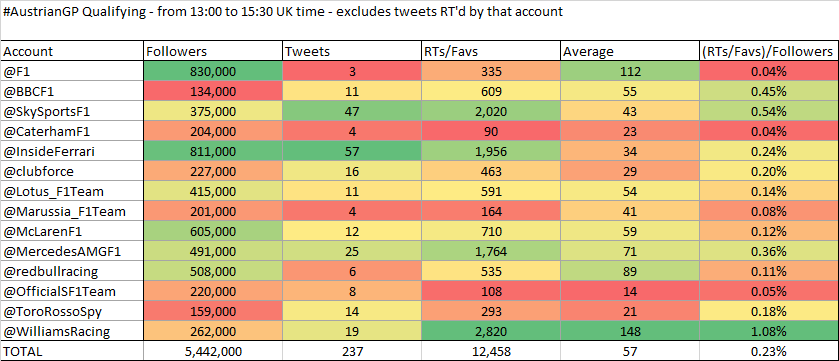
A few hours ago on Twitter, I posted an image looking at how Formula 1’s eleven teams along with the UK broadcasters interacted with followers across the 2014 Austrian Grand Prix Qualifying period, alongside post-session reaction. The tweet has so far between retweeted by 22 accounts and favourited by 11 accounts. I thought it would be a good idea to repost the image on here and highlight some important things that pop out when looking at this.

How Formula 1 interacted with Twitter during Qualifying for the 2014 Austrian Grand Prix.

For the purposes of this post, and as noted above, I have used the time period 13:00 to 15:30, so from the start of Qualifying to an hour and a half after the session. The image is fairly self explanatory, just two points to make: the average is the amount of retweets (RT) or favourites divided by the number of tweets made within that time period, whilst the latter column is the number of RT’s or favourites divided by the number of followers, as a percentage. Of course, people can RT and favourite accounts that they don’t follow, but there is no way to know exact numbers where that is concerned. It’s the first time I’ve tried to bundle a lot of statistics into one image, and no doubt there may be other ways to look at this, but thought it would be worth doing considering how social media where Formula 1 is concerned is a very popular subject at the moment! I’ve added some conditional formatting as well to give a clearer view of the situation.

Whilst Formula One Management’s (FOM) social media strategy has been under intense scrutiny as of late, their tweets can reach many people, however that requires them to actively tweet. An average of 112 accounts retweeted or shared their three tweets, the second highest of the list, and only behind @WilliamsRacing. Despite this, the percentage is the lowest of the 14 accounts listed, 335 interactions in total from nearly 1 million accounts is only 0.04% of their overall total. If @F1 chose to actively engage with their followers throughout an F1 session, then I would be painting a different picture. What is odd is that @F1TimingApp is clearly humanely ran. So why does one company operate two completely separate social media policies? They don’t need to accelerate @F1 fast, but why they are not interacting with their followers, I simply don’t know. What is there to lose?

Where there is a void from FOM, there isn’t from @BBCF1 and @SkySportsF1. The BBC story is interesting, as it started out as a BBC Radio 5 Live account before turning into a corporate BBC Sport account earlier this year. I’m personally not a fan of the style that the BBC F1 account uses now, but when you look at the numbers above, you cannot complain too much. I suspect the difference in the amount of tweets between them and Sky is because this weekend is a highlights weekend for them, so kept tweeting fairly low-key in comparison. On Sky’s side of things, I did in the past complain about their lack of interaction, however that has improved significantly since then, and the statistics show that their followers like what they are seeing – #AskCrofty is one particular feature after each Qualifying and Race session. I personally would like to see more of GP2 and GP3 on there, but from a F1 perspective, I think Sky have got it right. @SkyF1Insider on the other hand is a different kettle of fish for debate in another blog post…

Given that this is a look at Qualifying, unsurprisingly the tail-ender teams do not register significantly in this analysis, @Marussia_F1Team, @OfficialSF1Team and @CaterhamF1 the victims. Up front, all the credit goes to @InsideFerrari – 54 tweets during the two and a half hour time period! Okay, some of them are duplicates as there will be tweets in English and Italian, but it shows to me how they are desperately trying to push social media within Formula 1, more so than perhaps other teams. @RedBullRacing may have half a million followers, but with only six tweets during Qualifying today, its potential is not being maximised as much as it should be. Their sister team @ToroRossoSpy made more than double the amount of tweets as them despite having a much lower social media profile.

The @WilliamsRacing numbers really shows what happens when a team or driver claims victory, their pole position tweet as of writing has been retweeted over 1,000 times! Anyway, I thought this would be an interesting comparison to do. Okay, it is a very small sample of data, and only one session, but it is fascinating to see who is embracing social media and which parties need to improve – or in one case create – a social media strategy. All it requires is a few tweets to tap into the next generation of Formula 1 fans. They are ready and waiting. With over 830,000 followers for the official F1 account on Twitter, all the Commercial Rights Holder needs to do is reach them. And why wait?

Update on June 22nd at 17:50 – I’ve done a comparison between the statistics for Qualifying and the Race, which can be found here, and a race day chart including NBC Sports is here.