Scheduling: The 2020 Hungarian Grand Prix / Spanish MotoGP

The first triple header of the 2020 Formula One season concludes with the teams and drivers taking a 260-mile trip across the border from Austria into Hungary for the Hungarian Grand Prix.

The main change from a TV perspective this weekend is that Channel 4’s highlights programme airs an hour later, from 19:30 to 22:00. The change is likely to cover up gaps in Channel 4’s own programming schedule arising from the COVID-19 pandemic.

Unusually, the 5 Live schedule for F1 is blank, because every session is airing on the BBC website only, and there is no Preview schedule on BBC Radio 5 Live either, as Premier League football, FA Cup semi-finals and cricket pushes F1 down the BBC’s pecking order.

On the personnel front, Jenson Button is not with the Sky team in Hungary, but will be rejoining the team in Silverstone.

Over in Spain, the MotoGP season gets underway with a double-header at Jerez, as Marc Marquez looks to triumph once again.

For MotoGP, it is the first round of the year, however for Moto2 and Moto3 it is round two of the year after they managed to kickstart their season in Qatar back in March.

BT’s coverage comes from Triumph’s main base in Hinckley, with the usual team of Suzi Perry, Gavin Emmett, Keith Huewen, Neil Hodgson amongst those guiding viewers through the championship this year.

As with F1, some pay TV broadcasters are travelling to Jerez, however Dorna have prohibited all other journalists from the circuit itself.

For those that did not watch Moto2 or Moto3 from Qatar, keep an eye on MotoGP’s new graphics set for 2020 during the Jerez weekend.

Free-to-air highlights of MotoGP again air on Quest in a Monday evening time slot.

Elsewhere, in an interesting development, Sky Sports F1 are airing live coverage of the Ferrari Challenge series where possible this year, as they continue to grow their non-F1 motor sport portfolio.

It is not Sky Sports F1’s only acquisition recently: they are also airing extensive coverage of the GT World Challenge Europe Endurance and Sprint Cup championships this year for the first time.

Channel 4 F1
18/07 – 18:45 to 20:15 – Qualifying Highlights
19/07 – 19:30 to 22:00 – Race Highlights

Sky Sports F1
Sessions
17/07 – 09:30 to 11:50
=> 09:30 – Welcome to the Weekend
=> 10:00 – Practice 1
17/07 – 13:45 to 15:45 – Practice 2
18/07 – 10:45 to 12:10 – Practice 3
18/07 – 13:00 to 15:35 – Qualifying (also Sky Sports Main Event)
19/07 – 12:30 to 17:30 – Race
=> 12:30 – Grand Prix Sunday
=> 14:05 – Race
=> 16:00 – Chequered Flag
=> 17:00 – Notebook

Supplementary Programming
17/07 – 16:30 to 17:00 – The Story so Far
22/07 – 21:00 to 21:30 – Midweek Debrief

BBC Radio F1
All sessions are available live on BBC’s F1 website

MotoGP – Spain (BT Sport 2)
Also airs live on MotoGP’s Video Pass (£)
17/07 – 08:00 to 10:45 – Practice 1
17/07 – 12:00 to 15:00 – Practice 2
18/07 – 08:00 to 15:45
=> 08:00 – Practice 3
=> 11:00 – Qualifying
=> 15:00 – MotoE
19/07 – 07:15 to 14:30
=> 07:15 – Warm Ups
=> 08:45 – MotoE
=> 09:30 – Moto3
=> 11:00 – Moto2
=> 12:30 – MotoGP
=> 14:00 – Chequered Flag

MotoGP – Spain (Quest)
20/07 – 18:00 to 19:00 – Highlights

Ferrari Challenge – Catalunya (Sky Sports F1)
18/07 – 17:10 to 18:10 – Race 1
19/07 – 17:30 to 18:30 – Race 2 (tape-delay)

Formula Two – Hungary (Sky Sports F1)
17/07 – 11:50 to 12:40 – Practice
17/07 – 15:55 to 16:30 – Qualifying
18/07 – 15:35 to 16:55 – Race 1
19/07 – 10:00 to 11:05 – Race 2

Formula Three – Hungary (Sky Sports F1)
17/07 – 08:30 to 09:20 – Practice
17/07 – 13:00 to 13:45 – Qualifying
18/07 – 09:20 to 10:10 – Race 1
19/07 – 08:35 to 09:35 – Race 2

IndyCar Series – Iowa (Sky Sports F1)
17/07 – 22:30 to 23:30 – Qualifying 1
17/07 (Friday night) – 01:30 to 04:30 – Race 1
18/07 – 21:00 to 22:00 – Qualifying 2
18/07 (Saturday night) – 01:30 to 04:00 – Race 2 (also Sky Sports Main Event)

Porsche Supercup – Hungary (Sky Sports F1)
19/07 – 11:20 to 12:05 – Race

Virgin Australia Supercars – Winton
Also airs live on SuperView (£)
18/07 – 06:30 to 08:00 – Race 1 (BT Sport 3)
19/07 – 02:30 to 04:00 – Race 2 (BT Sport 2)
19/07 – 05:30 to 07:00 – Race 3 (BT Sport 2)

This post will be updated if details change.


Contribute to the running costs of Motorsport Broadcasting by donating via PayPal
BT to present MotoGP coverage from UK as championship outlines post-COVID-19 plan

BT Sport will present their MotoGP coverage from the UK when the championship returns to action in Jerez, Spain on Sunday 19th July, multiple sources have confirmed to Motorsport Broadcasting.

The broadcaster has implemented a decentralised remote production model during the COVID-19 pandemic, with special MotoGP programming looking at their best races airing live, on and off-air personnel dotted around Europe.

Having perfected that model, I understand that BT intend to continue using it, at least for the immediate future.

Readers who have watched BT Sport’s Premier League coverage so far will know that programming has aired live from their Queen Elizabeth Olympic Park base in London (see video below), instead of on-site at the relevant grounds as was the situation previously.

Financial implications are one reason behind BT Sport’s decision. Many broadcasters are looking to cut costs, as advertising revenue slumps.

Although both BT and Sky in the UK are pay TV broadcasters, BT is still a relatively immature player in the market, meaning that they are likely to be a bigger risk moving forward.

In addition, Motorsport Broadcasting understands that MotoGP’s main broadcasters, such as Canal+, Sky Italia and Servus will be joining Dorna out in Spain.

Plans circulated to all stakeholders by Dorna in a 30-page document earlier this month, a copy of which this site has seen, shows that MotoGP will continue to allow television crews to carry out key activities.

The championship is allowing broadcasters to interview riders on the grid, as well as in parc ferme after the race, and in pit lane, all at a social distance.

From a presentation perspective, MotoGP will continue to have its podium in the usual locations, but the podium itself will be wider in length to accommodate social distancing, with no dignitaries on hand to present the trophies.

No access for written media
In contrast to the above, Motorsport Broadcasting can reveal that MotoGP has prohibited written media from accessing the circuit.

Although the plans circulated by Dorna are at a championship-level, it does allow us to compare and contrast the FIM’s approach with their four-wheel counterpart, the FIA from a broadcasting perspective.

Dorna says that they will allow around 40 people from media organisations on-site for each round, with an additional 250 people from their own organisation, the latter number covering everyone involved with the Dorna production (including the logistical side of the event).

However, Dorna have opted to exclude all written journalists from attending the event, with only a small number of television broadcasters allowed access.

The document circulated says that “no other media will be permitted on-site (no journalists, no radio reporters, no websites).”

As thus, Dorna is developing systems to allow media to interview personalities remotely from home during the race weekend, including one-on-one interview slots and press conferences.

This contrasts with F1’s approach to the new season: F1 are allowing a small number of journalists covering a wide audience to attend their races.

I understand that attempts to get Dorna to move on this subject have failed, with written media unlikely to return to the MotoGP paddock until at least the Austrian Grand Prix on the weekend of Friday 14th August to Sunday 16th August.


Contribute to the running costs of Motorsport Broadcasting by donating via PayPal
Lockdown life: How broadcasters handled the COVID-19 pandemic

The COVID-19 pandemic has meant that all of us have had to adapt our working practices, some more so than others, everyone adjusting to the new normal.

For me, I am a public sector worker, with this site also one of my priorities. During a typical year, the site content would write itself to a degree: reacting to the action, giving my thoughts, and going behind the scenes, the list goes on.

During a pandemic, that becomes more difficult, and the enthusiasm wanes along the way. Balancing both the day job (where COVID-19 is a key focus), taking time out to do other things (gaming), as well as looking myself and my house (I live on my own) has meant that Motorsport Broadcasting did fall down the list of priorities.

Now, three months after the lockdown restrictions, motor racing is back on the agenda, and we are less than two weeks away from the start of the Formula 1 season. “Lights out, and away we go,” is not far away…

On the broadcasting front
Given my work priorities, I did not consume masses of motor sport content during the main lockdown, sticking to what I am familiar with, primarily in the UK space.

From a pay TV perspective, BT Sport and Sky Sports took different, but equally valid positions over the past three months.

BT focused on quality rather than quantity with their main MotoGP offering.

‘The Greatest Race’ aired on Sunday’s in a four-hour time slot, whittling down 16 of MotoGP’s best races to a final four, with BT’s viewers voting the 2009 Catalunya MotoGP battle between Valentino Rossi and Jorge Lorenzo as MotoGP’s best race.

Intertwined in the race edits each week were live interviews from an impressive calibre of MotoGP legends, such as Valentino Rossi, Sete Gibernau and Max Biaggi. BT’s own presentation team, led by Gavin Emmett, Suzi Perry, and Neil Hodgson, were on hand to ask the questions.

The new content presented a new spin on old classics, generating both social activity during the show, and news stories in the week following.

BT’s remote production model during the pandemic was a major success, not just for MotoGP but across their entire portfolio of shows, including their Early Kick Off football show, and we should applaud the whole team both in front and behind the camera their efforts.

In contrast, Sky opted to air a plethora of material during the pandemic for fans to digest, some hitting the mark perfectly.

At first post-Australia, the broadcaster aired little content, but quickly built it up into April, a wise decision in hindsight to avoid burn out straight away.

The F1 channel has since aired the Sky F1 Quiz, many Vodcasts, classic races in watch along form, as well as other content on the side, such as The Notebook feat. Ted Kravitz with a selfie stick.

Given the amount they aired, I doubt Sky expected everyone to watch every Vodcast and F1 Show, but from what I watched, they do exactly what they say on the tin, with a wide variety of guests from across the F1 landscape.

Irritatingly, the Vodcasts never turned up on Spotify, which was an opportunity missed in my view for those who go on post-work walks and would like a podcast to listen to (others are available, naturally).

A fixture on Wednesday evenings on Sky Sports F1 has been their Classic F1 watch along programming. Unlike their cricket and football counterparts, the F1 team went down the pre-recorded route, opting also to trim the race into a smaller edit.

The decision to air on Wednesday’s in my view was short-sighted: clashing with F1’s in-house classic races on their YouTube channel. Despite these forthcomings, like BT Sport with MotoGP, Sky’s decision to air these helped present a new spin on classic races, with guests relevant to that race.

For example, Sky re-aired the 2008 Brazilian Grand Prix, but with Felipe Massa and Rob Smedley as guests, getting their view on the events of that weekend.

I hope the channel repeats these over the forthcoming months: for reasons described earlier in this article, I did not watch all the classic races that Sky aired in watch along form.

Over the past few months, Sky have also released features that were due to air during the early pre-race build-ups, releasing interviews between Toto Wolff and Lewis Hamilton, a Hamilton feature on Monaco and segments filmed for the Australian Grand Prix (also At Home with Sky F1).

In the circumstances, we should be thankful for the content all parties have produced recently, irrespective of quality, to keep us going through this period.

…but what does it mean for the future?
Inevitably, broadcasters have had no choice but to speed up thought processes because of the pandemic.

As this site has covered for years, the industry has begun transitioning to remote broadcasting (or at least thinking about), without any loss of service or quality to the end viewer.

COVID-19 has resulted in the reprioritisation of long-term business objectives into immediate deliverables for the likes of F1.

In January, F1 touted sustainability as part of their Strategic Plan, wanting to “‘minimise the amount of equipment and people sent to each race.” A strategic vision has become a short-term reality.

If you are a broadcaster, who needs to save money (and quickly), why would you not go with the cheaper option if quality is unimpacted?

On an operational level, it may mean motor sport companies begin working on a much smaller footprint than before, with smaller offices, remote working, fewer flights, video conferencing, and so on.

Of course, it is bad news for those in the industry who like the travel associated with the job.

Unless there is a major shift in ideology, it is highly unlikely that broadcasters will revert to the 2019 ways of working, when the past few months has taught the industry that remote production can work.

From a broadcasting perspective, the ‘new normal’ is here, and it is here to stay…


Contribute to the running costs of Motorsport Broadcasting by donating via PayPal
Analysing the motor sport ecosystem and why coronavirus could cripple it

The coronavirus pandemic is disrupting motor sport in a way we have never seen before, impacting everyone involved in sport.

Collectively, the entire industry stands to lose a significant sum of money, and what the future holds is unclear. The longer this goes on, the worse the financial situation becomes, notwithstanding the fact that a global recession is likely because of the pandemic.

Who are the key players, and what are their role in the overarching ecosystem that is motor sport? Being a broadcasting site, naturally the focus is on broadcasting, although there is heavy linkage between broadcasting and the wider motor sport economy.

Speaking at the Black Book Motorsport Forum last September, Sky’s Head of Formula 1 Scott Young spoke about the delicacies of the ecosystem in a conversation around over-the-top broadcasting and pay television.

“Our investment is significant as one of the one of the investments that underpins F1, as all our rights do in every sport,” explained Young.

“I think that’s one of the differences between an OTT platform right now and major sporting broadcasters, like Sky and Eurosport, that actually invest a large amount of money that goes into those sports of which they need to help fund the teams to compete.”

“There’s an ecosystem in there that is quite delicate, and if you unravel it too quickly it can have some lasting effects,” he said.

Young quite clearly encapsulates the key themes of the ecosystem: the broadcasters, the rights holder, and the teams. If the system changes too quickly, the consequences could be catastrophic.

Coronavirus creates a gap in the chamber. The flow of money into the sport stops, meaning that money cannot flow back out the other end easily.

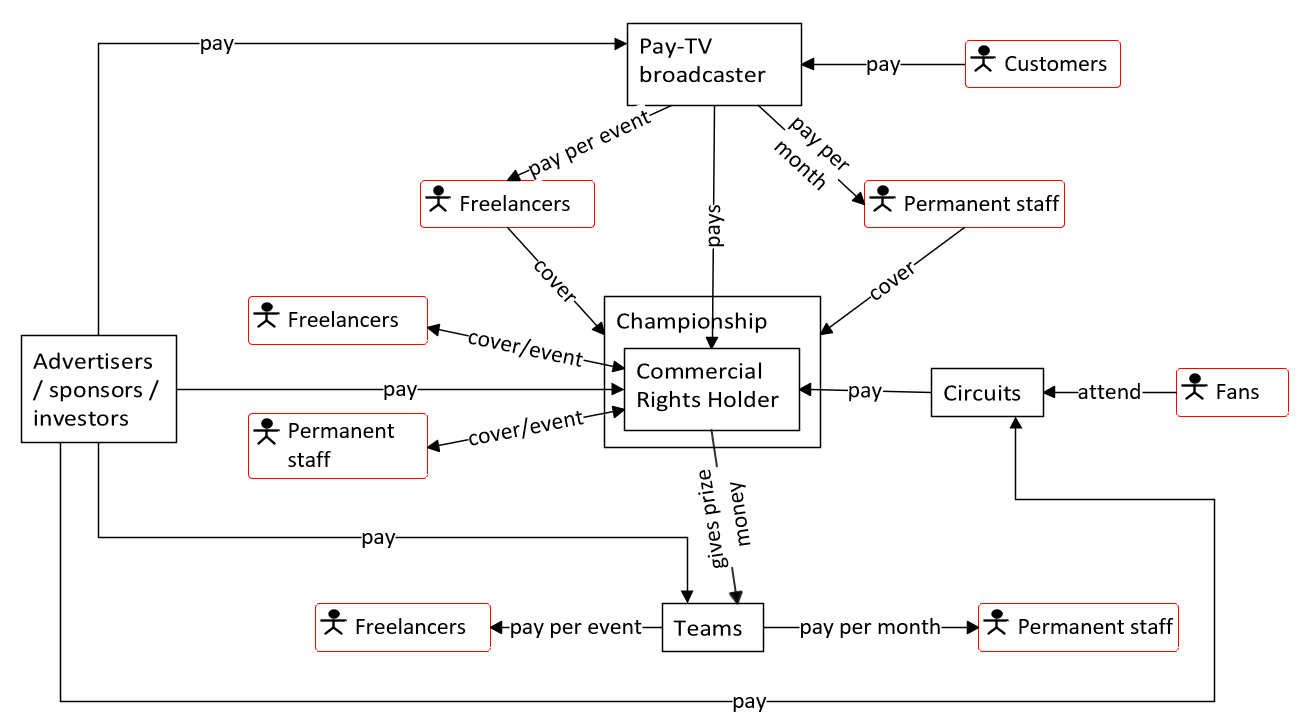
Who are the parties involved, and what are their roles? Let the below diagram explain, using Formula 1 and MotoGP as the key examples…

Motor sport ecosystem.png
A simplified view of the motor sport ecosystem.

Much of the above is stating the obvious, however it shows how the ecosystem joins up from one segment to another, from the customer paying the pay TV broadcaster their monthly subscription, all the way through to teams paying their staff.

The diagram is, I admit, a simplistic view of the landscape, but hopefully helps to show how some of the basic activities connect. There are many more inputs and outputs, the diagram only covers the main ones (although if you feel there is a major gap, please shout).

Motor sport ecosystem - branch 1.png
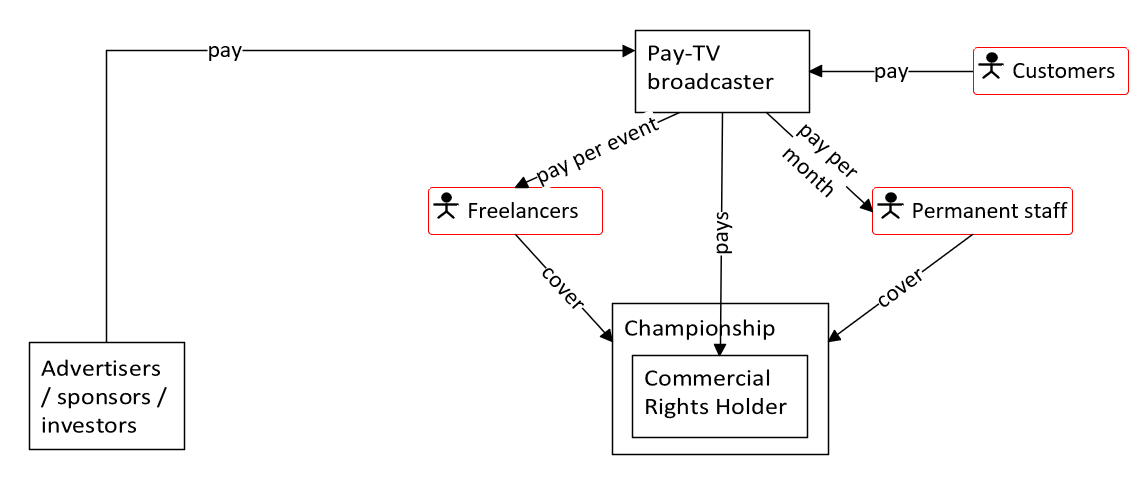
A simplified view of the motor sport ecosystem (branch 1).

Branch 1 – Pay TV > Commercial Rights Holder
Pay-TV broadcasters receive income from both their customers monthly, as well as from advertisers / sponsors who want to advertise during their programming. Not all motor sports air on pay-TV, but overall, that is the way.

Some have suggested that UK’s pay-TV broadcasters BT and Sky should refund subscribers of their sports channels during the coronavirus outbreak, however neither are planning to do so currently.

The income pay-TV broadcasters receive allows them to broadcast prestigious events, the broadcaster paying the relevant Commercial Rights Holder an agreed amount each season.

For MotoGP, the Commercial Rights Holder is Dorna, for F1 it is Formula One Management, for World Rally Championship it is WRC Promoter, and so on.

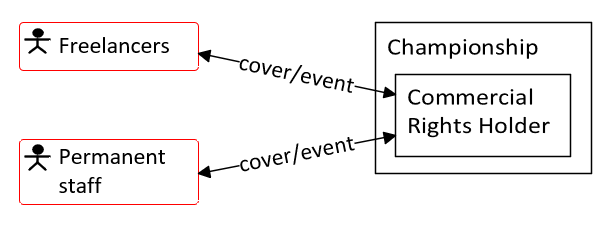
To attract subscribers, pay-TV broadcasters want to utilise the best talent, on and off-screen. For that, they use a hybrid of permanent in-house staff and freelancers.

Both bring their benefits: being a permanent member of staff gives you added security with a regular pay packet, but makes it unlikely that you can work on events not aired on their outlet.

Freelancers on the other hand may work F1 one weekend, MotoGP the next, and then Formula E the weekend after, each paid on a standalone basis. Three different broadcasters and production teams, but not a problem. That approach brings risks: any cancellation will result in a loss of income.

Motor sport ecosystem - branch 1.png
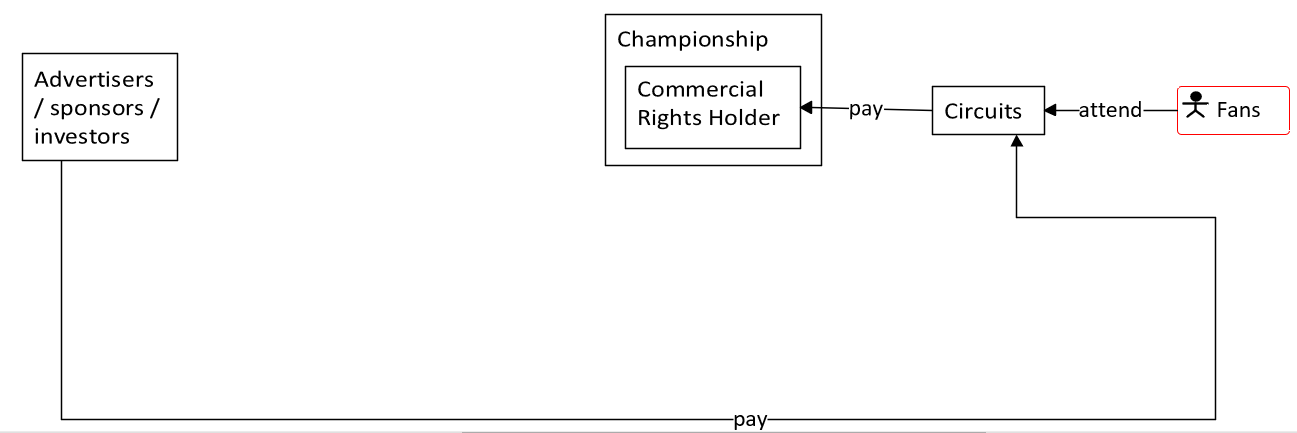
A simplified view of the motor sport ecosystem (branch 2).

Branch 2 – Circuit > Commercial Rights Holder
The second area is simpler. Fans pay money to attend the circuit to watch a race, the circuit pays the Commercial Rights Holder the fee for holding the race. Investors and sponsors may pump money into the circuit to improve facilities, increasing the prospects of holding major events there.

It sounds simple, until someone cancels the race, which is where the legal complications come in. Mark Hughes over on The Race summarises the situation in relation to the cancellation of the Australian Grand Prix.

In the event of the cancellation of a race, someone will lose money. Opting not to refund the fans is an untenable option. The organisers refund the fans, in which case the organisers lose money. Unless the Commercial Rights Holder waives the fee and takes the financial hit.

The worst-case scenario for a circuit is that they lose so much money, they go into administration and liquidation.

Circuits need money to keep operating outside of the F1 and MotoGP race weekends, they need to pay their own employees (not labelled in the diagram) to give one example. In the UK, the Rockingham Motor Speedway closed in 2018 after financial issues.

Cancelling one race might be okay, but would be enough to disturb the cashflow of the circuit. What happens though, if the Commercial Rights Holder opted to take the hit, saving the circuit, but putting themselves at jeopardy?

Motor sport ecosystem - branch 1.png
A simplified view of the motor sport ecosystem (branch 3).

Branch 3 – Commercial Right Holder > Staff
Like the pay-TV scenario above, the Commercial Rights Holder will pay people to run the World Feed for them all the weekend, both freelancers and permanent staff. The talent varies: from directors, to vision mixers, to replay operators, to camera operators, the list is never ending.

F1 has a mixture of freelance talent and permanent talent, same as above. Same positives, same negatives, same risks.

Motor sport ecosystem - branch 1.png
A simplified view of the motor sport ecosystem (branch 4).

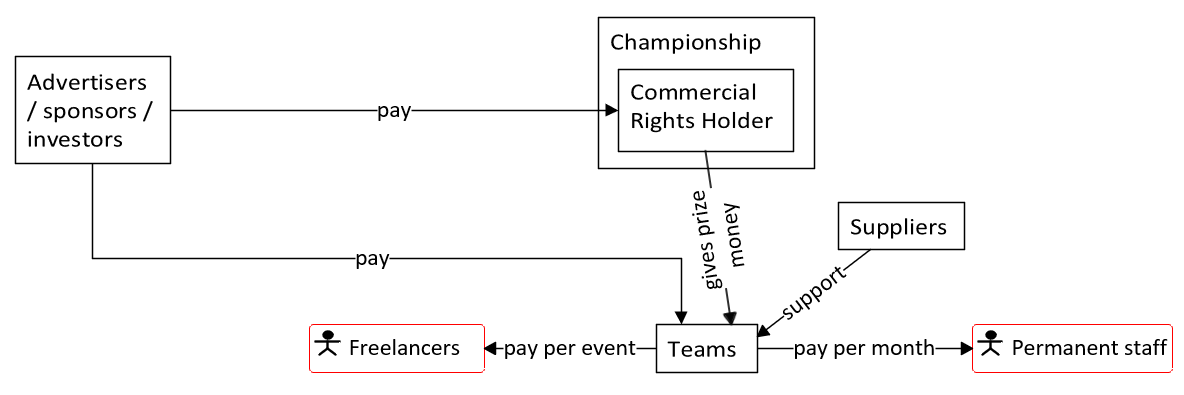
Branch 4 – Commercial Rights Holder > Teams
As well as receiving money off pay-TV broadcasters and circuits, the Commercial Rights Holder will receive money off advertisers, sponsors and investors, the Rolex’s of this world.

Pay-TV broadcasters may want compensation off the Commercial Rights Holder if races fall by the wayside, and the same applies for advertisers, whilst circuits may want their fees lowered.

If organisers cancel one race, most championships would be able to deal with it, however when multiple races disappear, the problem amplifies.

For hypothetical sake, assume the Commercial Rights Holder has buckled in the event of cancellation. They have waived the circuit race fee and given both advertisers and pay-TV companies some compensation. Unlikely, but let us continue the worst-case path.

But, hang on. The Commercial Rights Holder needs to the pay the teams their prize money, right? Well, yes. Oh. But, the Commercial Rights Holder has already lost money? Again, yes.

“Okay then, we will not give teams their prize money.” Good luck with that one.

Teams need to pay their permanent staff and freelancers, as well as suppliers, and need some form of income from both the Commercial Rights Holder and sponsors.

Suppliers are important here. Motor sport relies on thousands of small to medium-sized employers worldwide that rarely gets a mention. If any one of those suppliers go under, that could impact the team’s ability to go racing. Suddenly, we have a major problem…

The likes of Mercedes, Ferrari, Repsol Honda, will survive with minimal disruption. The likes of Williams in F1, and many outfits in MotoGP, Moto2 and Moto3, all the way down the motor sport pyramid I worry about.

I worry about the freelancers, inside and outside of broadcasting, who are out of work for at least the next month. I worry about championships who struggle to make a profit each year.

I appreciate this is a simplistic view of the world, and does not account for all factors (there are many indirect lines excluded).

The point I am getting at though is that the motor sport ecosystem will be seriously tested over the next few months, and the potential longer-term consequences for this sport do not bear thinking about…


Contribute to the running costs of Motorsport Broadcasting by donating via PayPal
Scheduling: The 2020 Australian Grand Prix

Update – both F1 and IndyCar have been cancelled for the foreseeable future.

An air of uncertainty surrounds motor sport as the Formula 1 paddock beckons on Melbourne, Australia for the start of the 2020 Grand Prix season.

As I write this article, the Australian Grand Prix is still set to take place on Sunday 15th March. However, the coronavirus outbreak means that nothing is certain, and that the details in this article are accurate as of right now, but could change rapidly in the days ahead.

On the broadcasting side, very little has changed in terms of personnel over the winter break, a stark contrast to twelve months ago.

Simon Lazenby continues to lead Sky’s coverage of Formula 1 in Melbourne, alongside the likes of Paul di Resta, Martin Brundle, Jenson Button, Karun Chandhok and David Croft.

Ted Kravitz remains with Sky for 2020, in what Motorsport Broadcasting understands will be a similar arrangement to 2019, with Kravitz part of Sky’s output for most of the 22 races this year.

Meanwhile, Steve Jones continues to steer Channel 4’s ship, with David Coulthard, Mark Webber and Ben Edwards again alongside the Welshman. Over on BBC Radio 5 Live, Jack Nicholls, Jolyon Palmer and Jennie Gow preside over events from Melbourne.

As reported earlier, close sources have indicated to this site that Sky will be presenting their output from Melbourne on-site, however the situation for Channel 4 and BBC is unclear.

On the scheduling front, Sky’s build-up for the 22 races extends to 130 minutes this season, which must be some kind of record. The change means that their live race day shows clock in at five and a half hours when also accounting for the Notebook.

There are other smaller changes to Sky’s schedule, namely Welcome to the Weekend moving from Thursday’s to Friday’s immediately before the first practice session.

Channel 4’s highlights programming also changes for 2020, moving back towards its previous ‘Extended Highlights’ format, as revealed exclusively by this site in January.

The free-to-air broadcaster can now air 60 minutes of the race itself, instead of 45 minutes as was the case last year.

Elsewhere, the IndyCar Series is back for its second season on Sky Sports F1, whilst the World Rally Championship heads to Mexico for round three of 2020.

Channel 4 F1
14/03 – 12:00 to 13:30 – Qualifying Highlights
15/03 – 14:10 to 16:40 – Race Highlights

Sky Sports F1
Sessions
13/03 – 00:30 to 02:45 (also Sky Sports Main Event)
=> 00:30 – Welcome to the Weekend
=> 01:00 – Practice 1
13/03 – 04:45 to 06:45 – Practice 2 (also Sky Sports Main Event)
14/03 – 02:45 to 04:30 (also Sky Sports Main Event)
=> 02:45 – Practice 3
=> 04:10 – Paddock Walkabout
14/03 – 05:00 to 07:30 – Qualifying (also Sky Sports Main Event)
=> 05:00 – Pre–Show
=> 05:55 – Qualifying
15/03 – 03:00 to 08:30 – Race (also Sky Sports Main Event)
=> 03:00 – Sunday Social
=> 04:00 – Grand Prix Sunday (also Sky One)
=> 05:05 – Race (also Sky One)
=> 07:00 – Chequered Flag
=> 08:00 – Notebook

Supplementary Programming
12/03 – 05:00 to 05:30 – Drivers’ Press Conference
13/03 – 07:30 to 08:00 – The Story so Far (also Sky Sports Main Event)
14/03 – 07:30 to 08:00 – The F1 Show (also Sky One and Sky Sports Main Event)
18/03 – 20:00 to 20:30 – F1 Weekend Debrief

BBC Radio F1
All sessions are available live on BBC’s F1 website
12/03 – 21:00 to 22:00 – Preview (BBC Radio 5 Live)
13/03 – 00:55 to 02:35 – Practice 1 (BBC Radio 5 Live Sports Extra)
13/03 – 04:55 to 06:35 – Practice 2 (BBC Radio 5 Live Sports Extra)
14/03 – 02:55 to 04:05 – Practice 3 (BBC Radio 5 Live Sports Extra)
14/03 – 05:55 to 07:05 – Qualifying (BBC Radio 5 Live Sports Extra)
15/03 – 04:30 to 07:00 – Race (BBC Radio 5 Live)

IndyCar Series – St. Petersburg (Sky Sports F1)
14/03 – 18:30 to 20:00 – Qualifying
15/03 – 18:30 to 22:00 – Race

World Rally Championship – Mexico (All Live)
Also airs live on WRC+ (£)
13/03 – 01:15 to 03:00 – Stages 1 and 2 (BT Sport Extra 1)
=> 02:08 – Stage 1
=> 02:31 – Stage 2
13/03 – 13:45 to 03:00 – Stages 3 to 12 (BT Sport Extra 1)
=> 15:08 – Stage 3
=> 16:16 – Stage 4
=> 17:14 – Stage 5
=> 18:12 – Stage 6
=> 21:35 – Stage 7
=> 22:43 – Stage 8
=> 23:41 – Stage 9
=> 01:21 – Stages 10 and 11
=> 02:14 – Stage 12
14/03 – 13:45 to 02:30 – Stages 13 to 21 (BT Sport Extra 1)
=> 14:58 – Stage 13
=> 16:01 – Stage 14
=> 17:08 – Stage 15
=> 20:56 – Stage 16
=> 21:59 – Stage 17
=> 23:08 – Stage 18
=> 00:38 – Stages 19 and 20
=> 01:26 – Stage 21
15/03 – 13:30 to 18:45 – Stages 22 to 24 (BT Sport Extra 2)
=> 14:38 – Stage 22
=> 15:56 – Stage 23
=> 17:18 – Stage 24

World Rally Championship – Mexico
13/03 (Thursday night) – 02:00 to 03:00 – Stage 1 (BT Sport 2)
14/03 (Saturday morning) – 06:00 to 06:30 – Day 1 Highlights (BT Sport 3)
14/03 – 17:00 to 18:00 – Stage 15 (BT Sport 3)
15/03 (Saturday night) – 04:30 to 05:00 – Day 2 Highlights (BT Sport 2)
15/03 – 17:00 to 18:30 – Stage 24 [Power Stage] (BT Sport/ESPN)
16/03 (Sunday night) – 03:00 to 03:30 – Day 3 Highlights (BT Sport 1)
17/03 – 22:30 to 23:30 – Highlights (ITV4)

Of course, the listings above are subject to change, so keep an eye on both this site and the official championship social channels for the latest up to date information.


Contribute to the running costs of Motorsport Broadcasting by donating via PayPal