After a dominant display in 2018, Marc Marquez looks to keep hold of the MotoGP crown, as the championship springs back to life in Qatar.
This year though, Marquez has a new partner at Repsol Honda in Jorge Lorenzo, a pairing that will be fascinating to watch as the season progresses. For UK fans, live coverage of the series remains on BT Sport.
On the free-to-air front, highlights of the championship move from Channel 5 to Quest, with the 60-minute show airing in an earlier time slot on Monday evenings.
Staying on tarmac, Formula E makes the jump to BBC Two for the Hong Kong E-Prix as part of their commitment to air one race on terrestrial television. In a throwback to ITV’s coverage of the series, Jennie Gow presents from the BBC’s Salford studios.
Jamie Chadwick and Marc Priestley are alongside Gow in the BBC studio, instead of Billy Monger as originally billed. Prior to the live airing, delayed coverage of qualifying airs via the Red Button for the first time.
To be honest, there is an argument that the Formula E World Feed on its own would have been a better approach, especially as the World Feed output has matured since ITV covered the series in its inaugural years. Saying that, adding a bit of colour to the broadcast is par for the course for BBC’s sporting output on linear television, so it is not too surprising.
Meanwhile, the IndyCar Series moves from BT Sport to Sky Sports F1 in a multi-year deal, with Sky covering qualifying and the race live. The expectation is that Sky are taking IndyCar’s World Feed without any bespoke wrap-around content. UK viewers will hear the likes of Leigh Diffey, Townsend Bell and Paul Tracy calling the action.
There is a lot of action across the weekend, with IndyCar overlapping with both MotoGP and the climax of Rally Mexico.
MotoGP – Qatar (BT Sport 2)
02/03 – 19:45 to 20:45 – Season Preview
08/03 – 10:30 to 18:15 – Practice 1 and 2
09/03 – 10:15 to 13:15 – Practice 3
09/03 – 14:00 to 16:15 – Qualifying
10/03 – 11:30 to 19:00
=> 11:30 – Warm Ups
=> 13:15 – Moto3
=> 15:00 – Moto2
=> 16:30 – MotoGP
=> 18:00 – Chequered Flag
Formula E – Hong Kong Shakedown, Practice and Qualifying also air live on YouTube…
09/03 – 07:45 to 08:30 – Shakedown (BT Sport 1)
09/03 (Saturday night) – 23:15 to 00:15 – Practice 1 (BT Sport 3)
10/03 – 01:45 to 02:45 – Practice 2 (BT Sport 3)
10/03 – 03:30 to 05:00 – Qualifying (BT Sport 3 and Eurosport)
10/03 – 06:00 to 07:30 – Qualifying Delayed (BBC Red Button)
10/03 – 07:30 to 09:30 – Race
=> live on BBC Two until 09:15
=> live on BT Sport 3
=> live on Eurosport 2
10/03 – 07:30 to 09:10 – Race: Voltage (YouTube)
IndyCar Series – St Petersburg (Sky Sports F1)
09/03 – 19:30 to 21:00 – Qualifying
10/03 – 16:30 to 20:30 – Race
World Rally Championship – Mexico (All Live) Every stage also live viaWRCPlus.com
07/03 – 16:45 to 18:15 – Shakedown (BT Sport Extra 1)
08/03 – 01:30 to 03:00 – Stage 1 (BT Sport Extra 1)
08/03 – 15:00 to 02:15 – Stages 2 to 9 (BT Sport Extra 3)
09/03 – 13:15 to 02:45 – Stages 10 to 18 (BT Sport Extra 1)
10/03 – 14:00 to 19:45 – Stages 19 to 21 (BT Sport Extra 2)
World Rally Championship – Mexico
08/03 – 02:00 to 03:00 – Stage 1 (BT Sport 3)
09/03 – 05:00 to 05:30 – Day 1 Highlights (BT Sport 2)
09/03 – 17:00 to 18:00 – Stage 12 (BT Sport/ESPN)
10/03 – 05:00 to 05:30 – Day 2 Highlights (BT Sport 3)
10/03 – 18:00 to 19:30 – Stage 16 [Power Stage] (BT Sport/ESPN)
11/03 – 16:00 to 16:30 – Day 3 Highlights (BT Sport 3)
11/03 – 19:00 to 20:00 – Highlights (5Spike)
Asia Talent Cup – Qatar (BT Sport 2)
09/03 – 13:15 to 14:00 – Race 1
10/03 – 10:30 to 11:30 – Race 2
Jaguar I-Pace eTrophy Series – Hong Kong (BT Sport 3)
10/03 – 00:15 to 01:15 – Qualifying
10/03 – 05:45 to 06:45 – Race
As always, I will update the schedule if anything changes.
Updated on March 5th with changes to the BBC’s Formula E line-up. Updated further on March 8th, with Quest’s MotoGP deal announcement.
The IndyCar Series will return to Sky Sports for the upcoming 2019 season in a multi-year deal, the broadcaster has confirmed, following the news earlier this week that BT Sport have lost the rights to the championship.
The single-seater series previously enjoyed a longstanding relationship with Sky, which ended following the 2012 season. Now, the series returns to Sky, however the series will air exclusively live on Sky Sports F1, a surprising move considering the reluctance to air IndyCar action on the channel in 2012.
Sky will air both qualifying and the race for each round on the F1 channel, the first time this level of coverage has been available to UK fans.
Steve Smith, Director of Content and Production at Sky Sports, said “The NTT IndyCar Series is one of the most thrilling competitions in motor racing, crowned by the world renowned ‘Indy 500’, and it’s great to be able to work with our new partners at NBC to bring it to a whole new audience here in the UK and Ireland.”
“Alongside our biggest ever season of F1, it will be part of an incredible line-up of motor racing on Sky Sports this year.”
Mark Miles, CEO of Hulman & Company, which owns IndyCar and Indianapolis Motor Speedway, said “We are pleased to reach a deal with Sky Sports to showcase the NTT IndyCar Series on the Sky Sports F1 channel for the next several seasons.”
“IndyCar values the commitment Sky and NBC have made to the series and the support of Comcast-NBCUniversal to help make this deal possible. We look forward to starting our season next week on Sky.”
World Feed only coverage expected I understand that Sky will be taking IndyCar’s World Feed, with no additional wrap-around or bespoke content, unlike in their previous iteration of coverage, when Sky provided extra studio coverage, typically fronted by Keith Huewen.
For those that watched BT Sport’s commercial free coverage, some may consider the move to Sky to be a downgrade, but airing the series on the F1 channel should open the series to a much wider audience, assuming Sky gives IndyCar promotion within their F1 coverage.
Prior to 2012, IndyCar was the only live motor racing show in town on Sky, and promotion was minimal as a result. IndyCar never benefited from Sky’s F1 coverage in 2012, with the F1 channel acting as an overflow station on two occasions, whereas this time round every race will air on the F1 channel.
It appears that Formula 1 themselves, now led by under Liberty Media, are happy for this to happen, whereas Formula 1 under Bernie Ecclestone’s ownership were reluctant back in 2012. It does make prospects for the Indianapolis 500 interesting, which falls on the same day as the Monaco Grand Prix, and features two-time F1 champion Fernando Alonso.
If given an appropriate level of cross-promotion, the 500 could benefit significantly. BT Sport’s coverage of Alonso’s Indianapolis 500 debut in 2017 peaked with 203,000 viewers, so Sky should be able to match that comfortably. I daresay Sky should provide some bespoke wrap-around coverage for the 500, but that might be a bridge too far.
Aside from the build-up for the 500, the chances of a direct clash with the F1 season is highly unlikely.
Multiple reasons behind Sky’s IndyCar deal Comcast now owns Sky, and has done so since the middle of 2018. In the US, IndyCar is airing on NBC in a new deal starting this season. Comcast also owns NBC, which is one reason this deal fits together nicely for all parties as noted in the quotes from both Sky and IndyCar.
Additionally, one of the suggestions touted by industry sources is that IndyCar may be part of a wider strategy to expand the scope of Sky Sports F1 to cover other motor sport championships, which is now possible with Liberty at the F1 helm. In my view, this is exactly how Sky should use the channel outside of live F1 weekends.
Of course, adding other championships to Sky F1 helps drive up subscriptions for those fans ‘on the edge’ of taking out Sky’s ‘best ever’ deal for the F1 channel which runs through March.
It is unclear whether BT Sport bid for IndyCar this season. What we do know is that their new contracts with MotoGP and the World Rally Championship kicked in from this season. Both are world championships, the latter coming with a significant increase in hours due to WRC All Live, which may have sealed IndyCar’s BT fate if there was no money lying round for the American based series.
The 17-round IndyCar Series season gets underway on March 10th in St. Petersburg, finishing on September 22nd in Laguna Seca.
BT Sport will not broadcast coverage of the IndyCar Series this season after losing the rights to the championship.
The series aired on Sky Sports as part of a longstanding relationship until the end of the 2012 season, with regular live studio coverage covering each race. As Sky ramped up their F1 involvement, IndyCar arguably suffered, and the series moved over to ESPN at the start of 2013.
IndyCar continued on ESPN, but under the BT Sport umbrella from August 2013 onwards. Whilst BT Sport’s agreement with ESPN’s international arm lasts until 2022, the decision by IndyCar to break away from ESPN and bring their international rights in-house placed BT Sport’s UK deal under threat.
This site can confirm that BT Sport have lost the rights to IndyCar with immediate effect. Writing on Twitter, BT Sport’s IndyCar commentator Tom Gaymor said “Unfortunately it looks like IndyCar will not be on BT Sport this year, no more information at the moment! I know a lot of you have been asking, so if it changes, I’ll let you know. I’m as disappointed as you are.”
Typically, IndyCar races average around 25,000 viewers, a figure that has remained relatively static in recent years. Most notably, IndyCar enjoyed its moment in the sun in 2017, when the appearance of Fernando Alonso at the Indianapolis 500 led to BT Sport’s coverage peaking with over 200,000 viewers, by far IndyCar’s highest UK audience in a generation.
For the IndyCar fans that have stuck with BT Sport’s coverage, the parting of ways between the two sides is a shame. Whilst BT Sport did not revolutionise IndyCar coverage as such (the budget remained small), what the motor sport team, led by Nick Kennerley off camera, did provide was a home for the series.
BT’s coverage was commercial free for the most parts with UK commentators Gaymor, Keith Collantine and Oliver Webb providing insight when their US colleagues were on commercial breaks. It is difficult to imagine another network doing the same thing as BT have done for the past few years.
However, if IndyCar’s new home does provide the championship with a wider platform, then overall this is a good move.
IndyCar have yet to announce a new broadcast partner for the UK. One possibility is that IndyCar finds itself back on Sky Sports. Comcast now owns Sky, and has done so since the middle of 2018. In the US, IndyCar is airing on NBC in a new deal starting this season. And Comcast also owns NBC…
I have reached out to IndyCar for further comment.
From print media, through to the small screen and now across multi-platform, James Allen is a name that is familiar with Formula 1 fans in the UK and beyond. Allen’s career has spanned multiple decades, but he was most famous as ITV’s lead Formula 1 commentator from 2002 to 2008 alongside Martin Brundle.
Now part of the Motorsport Network ship, I caught up with Allen during the Autosport Show weekend to look back at the three chapters in his broadcasting career to date. In the style of his own blog name, this post is ‘James Allen on…’ as he reflects on his story so far.
…the start of his broadcasting career
“My first broadcasting job in Formula 1 was in 1992. I had been working with Screensport, which was a forerunner of Eurosport, on their coverage of the Le Mans 24 Hours from 1990 and 1991. I got a call from ESPN, as their pit lane reporter couldn’t do the 1992 Hungarian Grand Prix, and we’d done Le Mans as a co-production between Screensport and ESPN the previous year. It was the race where Nigel won the championship, and I got a great interview with Nigel.
“I enjoyed myself very much doing the live pit lane work, so much so that ESPN offered me the job as broadcast reporter for 1993. ’93 was the season of Ayrton Senna and Michael Andretti as team mates, obviously Andretti being an American driver was exciting, so I was in the middle of all of that.
“I went to America to do Nigel Mansell’s second IndyCar season in 1994, Nigel and I got on really well. I spent a very happy year covering IndyCars and making the show for ITV working with Chrysalis, which went onto be North One.
“I carried on working with ESPN in Formula 1, until the BBC lost the UK rights in 1996 to ITV. ITV were looking for a production company from 1997 onwards, and I drafted part of the bid to win the production contract for Chrysalis, having worked with them on IndyCar, and that was the beginning of the ITV F1 adventure.”
…becoming pit lane reporter for ITV
“I’d done a lot of broadcasting before I became F1 pit lane reporter, I’d done Le Mans for two years running, which was 24 hours in the pit lane! It was much freer in those days, you could do whatever you wanted.
“There was a lot of scope for improvisation, I had a live camera with me, I could do anything I wanted with that live camera. I could interview anyone I wanted, doorstep anybody, it was a very deregulated environment back then. It did become progressively more difficult as the years went on, but it was great fun on the whole.
“I brought an American training to it, I’d spent four years by then working with really, really good sports TV directors and producers. I was very lucky to be mentored by some of the best US sports directors, so I knew exactly how to engage the audience, what kind of stuff they were looking for, how to think beyond the obvious, don’t just say what’s happened, but what that means for what happens next, and all that kind of thing. I was very lucky and brought that to the coverage on ITV.
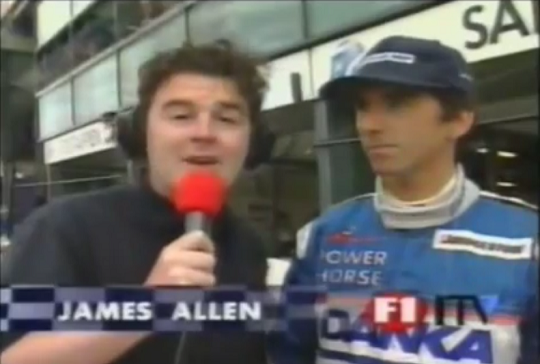
In ITV’s first live qualifying show at the 1997 Australian Grand Prix, James Allen interviews Arrows newest recruit and 1996 champion Damon Hill.
“Editorially I had worked at Autosport for two years, and prior to that I worked for Brabham with Martin Brundle, so I knew him very well from those days. Having worked on the inside of a Formula 1 team, I knew how that worked, how it operates, how it succeeds, how it fails.
“The pit lane role involved looking around for stories, looking around for insights. I’ve always been interested in providing insight and analysis wherever possible. I think the who, what, where and when is great, but I’ve always been interested in the how and the why.”
…his first F1 commentary
“I stood in for Murray when he bust his hip at the 2000 French Grand Prix, which was very useful because I was always the understudy, in case there was a ‘what if’ moment. I’d done a lot of commentary early in my career, Paris Dakar, Formula 3000, you name it, thousands of hours that hardly any people saw in the early satellite days. It was a great opportunity to commentate with Martin, to have a look at it and see how it sounded.
“I had a very intense post-French GP debrief with ITV’s Head of Sport Brian Barwick, who was very good to me and a very big influence on my career. He meticulously went through that commentary, what I’d done wrong, what I could have done better, what I done well, we spent hours going through it.
“It meant that the following year, when we did the transition where I did five races and Murray did the rest, I knew what I was trying to do. There was never any doubt in my mind about being commentator, it’s what I wanted to do since I was 15 years old.”
…succeeding Murray Walker
“It’s a double edge sword. On the one hand, the timing was good, plenty of other people would have liked to have followed on from Murray, but he kept going for a very long time. He and I worked very close together for the first four years [with ITV F1], and I drove him round Europe, he didn’t like driving in Europe so I always did the driving. We spent a lot of time together, which was wonderful, some very rich memories.
“It’s the job I always wanted to do, mass market, free-to-air TV in UK, Australia, South Africa, Canada, tens of millions of people watching, but on the flip-side he’s probably one of the most popular sports broadcasters there has ever been. You’re never going to be him, but nor should you ever try to be.
“I just said ‘listen, he has to stop’ because he’s 77 years old and can’t do this anymore, physically, it was taking its toll on him, and he wanted to go out on the top, so someone’s got to take over from him, and it might as well be me! I took it as a responsibility, I knew that there would be plenty of people who didn’t like it, I knew that there would have been people who did like it.
“Barry Davies, the football commentator whose daughter worked at Jordan at the time, said to me, ‘listen, you’re probably taking on the toughest job in sports broadcasting. If I can give you one piece of advice: stay philosophical, don’t listen to the people who cane you, and don’t listen to the people who think you’re the best thing since sliced bread, because you’re neither of those things. You’re neither a complete loser or the best thing since sliced bread, just somewhere in the middle, and be yourself’, and that was great advice, and that’s the way I played it for eight years.”
…commentating on motor racing
“What makes it tough is that there’s not one point of focus. If you commentate on a horse race, yes, you’ve got 20 horses, but they tend to focus on what is going on at the front because they all tend to be tightly packed together. If you are talking about a football match, or pretty much any ball sport, you basically follow what the ball does. Cycling is another one where you’ve got to talk about multiple narratives in one commentary, and it goes on for four hours.
Allen and Brundle here analysing the 2008 Australian Grand Prix qualifying session. Little did they know at this point was that 2008 would be ITV’s final year covering F1.
“I always looked at it in terms of a front race, a middle race and a back race. I would do it 60 percent front race, 30 percent middle race and 10 percent back race, so I gave a balanced narrative to the coverage. I always got on very well with Martin, he was very supportive. We had a lot of things that we wanted to try, we were always thinking about ‘let’s try this, let’s try that’, we never wanted to stay the same, we wanted to try to move forward. Having a racing driver like him alongside you means you’re always improving things with the broadcast coverage.
“We had some very difficult seasons to cover, ’01 was great, ’02 and ’04 were difficult, but a lot of people think that the 2005 to 2008 period is their favourite period in Formula 1. There was a lot of different winners, the cars were exciting to watch, and we had a great time.”
…ITV’s F1 exit
“We went out on a high with Lewis winning the World Championship. It was the only time in our twelve years of doing Formula 1 that we had a British champion crowned on our live coverage. It was a great moment, with 13 million watching, mass-market free-to-air TV, it was just fantastic.
“The contract we had with Formula 1 ran until 2010, and in my head, I was thinking I’d get to 2010 and do something else outside of commentary. I had a young family at that point with two young sons, and had been to every single race for 16 years. It was a little bit of a shock in ’08, when ITV decided to prioritise Champions League over Formula 1, and the BBC got the rights.
“But equally, I had also started exploring the digital media space with blogs, and so I went into that. I realised that there was a very good business to be had there, around the monetisation of blogs with sponsored brands and things. It was about leveraging my personal brand that I’d built up on the broadcast side on a blog, and then working with companies that wanted to attach themselves to it. That was like chapter two of the story, which was really interesting.
“Would I still have been commentating on Formula 1 on television in 2011 or 2012? No. I’m a bit restless, I do things for a while, then I feel like I want to move on.”
…his post-ITV exploits
“I did the blog thing, which you’re now doing very successfully, and then the BBC came knocking in 2012, to ask me if I wanted to be their F1 correspondent on 5 Live. The only reason I said yes was because I had never done radio, ever. Most people do it the other way round, they do radio first then go into television.
“The radio has been reinvented by the internet, you can really do a lot with radio, and I just wanted to see if I could do it, and actually, it’s much more difficult than television. I set myself a challenge, I really wanted to master this. I had four years in that role which I really enjoyed. I enjoyed working with the BBC radio network, trying to provide insights for people alongside running the blog and the business. Four years was just about enough, time to move on.
“I’m in the third chapter of my career now, which is building this unique vision we have at Motorsport Network. I’m in a management role, I manage 500 to 600 people in 21 countries. We’ve got the Autosport Awards, Autosport International, Autosport.com, Motorsport.com, all the digital media platforms.
“It’s a very interesting business, three different segments, media, experiences and eSports, we’re talking in the back of the Le Mans eSports truck. We’re the only ones that are across everything, it’s a unique project, no one has ever tried it before and will ever try it again. So far, it’s going well, it’s really difficult, it’s a big challenge, but I love it.”
The 2018 Formula One season has ended, and with it, brings down the curtain on the motor racing year.
On-track, it has been a year of generally good racing wherever you look. Whilst neither the F1 or MotoGP seasons went down the wire, the racing in both has been worth watching on many occasions this year.
Off the track, there have been many developments on the broadcasting front. Traditionally, the end of season verdict has stuck to the UK F1 view point, but we live in a motor sport world far greater than both the UK and F1, and with that in mind it makes sense to expand the scope of the verdict to encompass all elements of broadcasting.
Whether it has been the launch of F1 TV, or World Rally Championship’s All Live service, there has been plenty of movement in the online arena. Liberty Media have made their mark on Formula 1’s graphics set, whilst closer to home, 2018 was the last year of Channel 4’s current F1 contract, the broadcaster remaining in a reduced capacity, for 2019 at least.
Now, we want your opinion. Has something irritated you with this year’s motor sport coverage? Have I missed a revolution that this site should be covering? And what would you like to be different about the motor sport broadcasting scene in 2019? Are you planning to watch a new series next season?
As always, the best thoughts and views will form a new article closer to the festive period.


 Motorsport Broadcasting