In conversation with David Emmett

Ahead of the British round of the 2016 MotoGP championship, I sat down with David Emmett (@MotoMatters), talking all things MotoGP.

The interview covered a vast array of subjects, including testing, social media, and what MotoGP may look like post Valentino Rossi.

F1B: Thank you for this interview, just give us a brief overview of yourself. How did you get into MotoGP?

DE: My name is David Emmett; I work for MotoMatters. I did all sorts of stuff when I was much younger. I spent five years working as a translator, then worked as a technical editor. In 2005, I wanted to start a blog.  I wrote an entry saying “this is my blog” and I’m going to write my thoughts there, except I didn’t write anything at all for a year! Ahead of the 2006 season, I wrote a MotoGP preview and people were quite positive about it. Because it got so many positive responses, I continued writing about it. At the time I was working as a software developer looking at Content Management Systems and I did the two of them together for two years. In September 2008, I decided to quit my job as I was getting enough interest that I thought I could make a living from it. A few days after that the Lehman Brothers collapsed and the whole house of cards fell apart. I didn’t have a job, so had to make a go of it. I went to races, people read my stuff, liked my stuff. That’s how I ended up here. I grew up with motorcycles, my Uncle raced grass track in the 1970s and 1980s. When I was a teenage, I had a picture of a Yamaha RD350 hanging above my bed. So, that was it really.

F1B: You mentioned translating, it’s actually really important for a journalist to have some translator skills.

DE: It’s basically language skills. Just being able to make sense of stuff. You are trained as a writer, I also worked as a technical editor where you had to digest complicated technical information. It was the technical writers who were writing it, I was editing their copy so I had to make sure I could understand what they were trying to convey. You learnt a lot about communicating.

F1B: Interesting to know that you started blogging before blogging became popular.

DE: I don’t know; I would say blogging started to become a thing in the mid-2000s. I got in I wouldn’t say early, but I wouldn’t say late. One of the advantages of being old is that when you do things, quite often you’ve done things early just because you happen to be old enough to actually understand it.

F1B: Moving onto the current day, you guys are going to every race this season I assume.

DE: I’m going to about 12 of the 18 this season. I don’t go to the overseas races; I don’t go to Le Mans because it is shit. It’s a fantastic place to go for a 24-hour car race, I really want to go to that and I don’t like cars, I don’t own a car. The atmosphere at the track is awful, it is not a nice track. I don’t go to the Asian fly away races, I don’t go to Qatar because it is horrible, I don’t go to Argentina because it is almost impossible to get there.

F1B: Do you go to the pre-season tests as well?

DE: I go to at least one of the pre-season Sepang tests, especially the first one. The new bikes are being pulled out, riders have had the winter to go away and think. Immediately after Valencia, you have the post-season tests. You saw it at the end of the last year with [Valentino] Rossi, Rossi was so upset that his mind was not really on testing. What you see is that people are tired after 18 races, the season takes a lot out of them physically. The bike hasn’t really taken shape yet, the bike they roll out at Sepang is much closer to what they will actually be racing. It is about trying stuff, what works and what doesn’t. Testing is also boring. Those eight hours of track time, especially at Sepang because of the heat, they spend two hours on track. You’ve got a lot of time to talk to people which you don’t have at a race weekend because the race weekends are so intense.

F1B: There was a whole thing a few years ago where people wanted testing live.

DE: Testing is a bit like cricket, it is much more interesting when you listen to it on the radio or via the timing screens. You see much more of a story. The actual process of testing doesn’t have the intensity. It is much more difficult to understand because different people are doing different things. Testing highlights are really interesting, live coverage of testing is really, really boring. I remember in 2010 when Valentino Rossi switched to Ducati, they had live coverage of testing then and it rained in the morning. The track was wet, it was cold, nobody really wanted to go out. They sent one of the test riders out to go and circulate and to dry the track out. They were desperate for something to happen. I think they sent Rossi out for five laps and brought him back in again. There’s always pressure to create that content, but the content you are curating is not particularly memorable. There’s about seven hardcore MotoGP geeks that would sit there all day and watch it.

F1B: So, you’re going to 12 of the 18 races this season, tell us in a little bit more detail how you prepare for the races.

DE: To be perfectly honest, I don’t do a great deal of preparation. It is more of a continuous thing. You are thinking about what you are doing, and I try to watch the race from last year. I’ll go through the results of previous races, take a look at the race track, read a few press releases. This year Michelin have come in, new tyre manufacture, you read their press release to try and understand what they’re not telling you, what the story is, what they’re doing. For me, it is part of a larger narrative, it’s not a race weekend, it’s another chapter in the story of the season.

F1B: I’d assume it is a lot more intense for the TV guys considering they’re on air for seven hours.

DE: Oh yeah, absolutely. I wait for things to happen and then write about them afterwards.

F1B: I guess we can talk about Rossi and [Marc] Marquez, the approach [between TV and online] would be completely different.

DE: Exactly. I can go and talk to people. For example, the last race in Brno, all of the tyre issues. The TV guys are reacting immediately, they’re unprepared for it. They can do a certain amount of prep; they may have talked to people after warm-up, but I get the chance to talk to all of the riders first, talk to crew chiefs, talk to people from Michelin and then form an opinion. Because it is more reactive it requires less preparation, because I write 2,000 words in the evening, I have time to sit down and think about it.

F1B: How was Sepang last year?

DE: I wasn’t there. It was just really strange [the crash]. But I was talking to the rest of the media that were there, we were chatting via WhatsApp trying to figure out what was going on, what the atmosphere was like. It was very odd. Those are the times that you wish you were there, because then you can go around afterwards and actually talk to people. But then, being at home, it meant that I could watch that clip over and over. If I had been at the race, I would not have had time to sit down and watch it.  So instead, I sat down and watched those two laps for two hours trying to figure out the whole story.

F1B: And then the championship went to Valencia, where I think there was crazy behaviour from what I remember.

DE: Amongst the fans it was fine, there was nothing there. The fans were booing [Jorge] Lorenzo and Marquez, but then they often boo them so it was not that much different. There was some oddness, not really craziness. The fact that they scrapped the press conference was a mistake. I think Dorna got caught unawares by that as well, they were not expecting it all to happen with the CAS (Court of Arbitration for Sport) appeal against the penalty. That also made it a little bit more difficult as we were sitting around waiting for the outcome of this appeal.

F1B: This leads us nicely onto talking about MotoGP’s future. Part of that future is social media. Social media activity jumps when incidents like that happen, which can be a good thing.

DE: Absolutely. MotoGP and social media have a very long history. I’ve been on social media since 2009. At first, Dorna didn’t really know what to do with the internet. It has got slowly better and better, Dorna started to understand how the internet can help them. There’s lots of crap out on the internet, especially in the Spanish and Italian press writing any old thing, just to generate ‘hits’ and attraction. Dorna were very concerned and cautious about social media. That has changed over the years. In the last two or three years, Dorna have totally embraced it. For a long time, they spent most of their time chasing down video clips. Now what they’re doing, which I told them to do five years ago, is getting the content out their immediately. Using the Snappy.TV clips have been really, really good and they’ve been using those clips. If something dramatic happens, the first thing fans do at home is share that video clip. When MotoGP immediately shares that clip, everyone else shares that clip because it is in much better quality.

F1B: The Rossi and Marquez crash had 20 million views on Facebook, you can’t buy those numbers.

DE: It’s Donald Trump’s election strategy really, earned media instead of actually buying media. You just say something ridiculous and people report it.

F1B: What is the future post Valentino Rossi? What is going to happen to MotoGP?

DE: Quite honestly, it will be smaller. This is one of Dorna’s biggest concerns. One of the reasons they’ve changed a lot of the technical regulations is to try and create exciting racing and to create a structure where young riders come and grow their fans. You’re also seeing team structures, so the Marc VDS take young riders aged 12 or 13 from mini bikes all the way up to MotoGP, and that talent can be coached and helped along the way. There’s lots and lots of talent, the problem is: how do you replace an icon like Valentino Rossi? The honest answer is you don’t. What you have to do is mitigate the effect. So what you want when he goes is a stable, attractive product in place which will retain some of the existing fan base. The idea is people come and see Valentino Rossi, but they stay because they find MotoGP an interesting and exciting sport. Dorna are trying to figure out what the sport is. They’re not F1, they’re not champagne and glamour, but we are a little bit upmarket and a little bit edgy. It is trying to figure out what the brand of MotoGP is, what motor cycle racing is and how to sell it. One of the biggest problems they face is that MotoGP riders are now sportsmen or sportswomen. They’re professional athletes, which is a problem because they tend to be boring. They train, they race and they sleep, and that’s it. They’re not formed as humans. In the 1970s and 80s, Barry Sheene had a hole drilled on his helmet so he could have a cigarette through it. He could afford to do that because the sport was much less developed in terms of physical training. You can’t go out on a Saturday evening and get steaming drunk like the 80s. The boys and girls like to go out and have a party but it is much more controlled and restricted. Their partying is constrained by a strict training regime. This isn’t just MotoGP, it is also to an extent in F1 and a lot of other professional sports, they’re fairly dull. There’s the pressure of sponsors, the more money there is in the sport, the less freedom there is to be a maverick.

F1B: Where does pay-TV stand within all the MotoGP change and social media?

DE: Well pay-TV is the future of a lot of professional sports. Someone has to pay for it. Large public broadcasters are not prepared to pay large amounts of money; they can’t afford it. So, for example, it goes to BT Sport because BT are trying to flog broadband connections. So they can afford to spend money on the likes of football and MotoGP because they are linking their package together to sell broadband. That’s why it ends up on pay-TV, advertising revenues are changing. You can’t subsidise as much straight from advertising.

F1B: Is one of the concerns post-Rossi is that sponsors will leave, which will increase pay-TV deals exponentially again?

DE: To be frank, that’s going to be more of a problem for teams than for the sport and a lot of the sponsorship people are working very much on building relationships. So, for example, Phillip Morris, the tobacco people still sponsor Ducati. It’s just you don’t see Marlboro anywhere, but they use it as a way to build relationships. They’re doing it very differently. Sponsors are using teams to build relationships, making them less reliant on a particular figure to entertain their clients and to do business.

My thanks go to David Emmett for spending the time with me on the above interview.
Haryanto and Verstappen shine on social media

Whilst this site tends to focus on the efforts of Channel 4 and Sky Sports where Formula 1 is concerned, it is important to comment on what Formula One Management (FOM) has done so far during 2016. With that, we also turn to social media where there have been several shining lights.

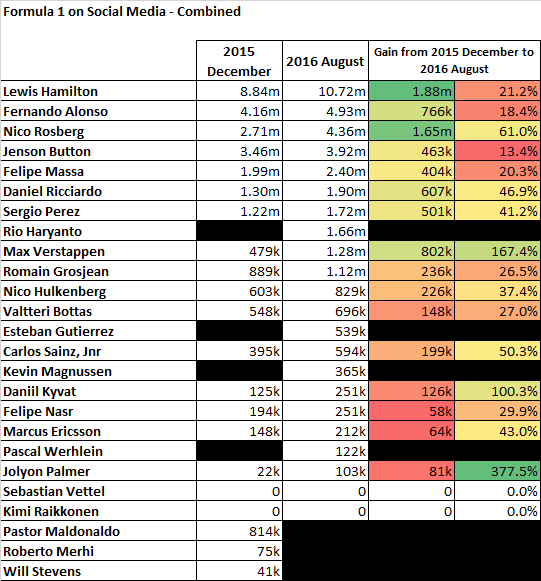
Formula 1 is constantly trying to break into new territories, so when a racer from a new territory comes along, it is little surprise to see their follower counts skyrocket. Enter Rio Haryanto. At the half way stage of the 2016 season, Haryanto has amassed a combined reach of 1.66 million accounts across Facebook, Twitter and Instagram. A video posted by FOM on YouTube of his car rolling out the garage in pre-season testing has been watched over half a million times. These are massive numbers by F1’s standards, even with Haryanto’s Formula 1 exploits ending for the moment. Whether Formula 1’s popularity (beyond Haryanto) has increased in Indonesia though is unknown.

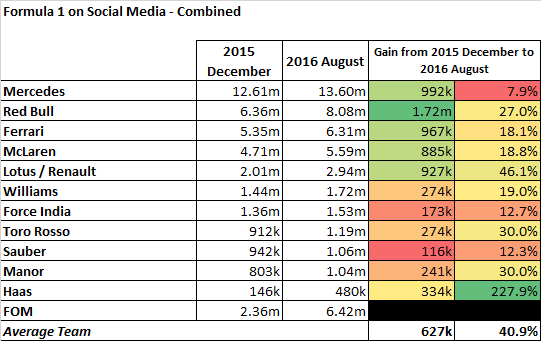
Max Verstappen has had a similar effect in the Netherlands, and his shock switch from Toro Rosso to Red Bull has helped the latter in the social media stakes. From a combined reach of 6.36 million accounts in December 2015 to a reach of 8.08 million accounts currently, this represents an increase of 1.72 million (or 27.0 percent), the largest for any team across the first half of 2016. Mercedes, McLaren, Ferrari and Renault all recorded gains of around 950,000 followers. Behind the leading five, Haas did not disgrace themselves, moving from a combined reach of 146,000 in December to 480,000 currently.

Social media - August 2016 - Figure 1
The Formula 1 social media statistics, covering Facebook, Twitter and Instagram, as of August 2016.

Mercedes again had the lowest percentage increase, but with their reach increasing by one million from 12.6 million to 13.6 million followers across the big three social media websites, they cannot complain. Force India and Sauber had a relatively poor first half of 2016, both teams only increasing their reach by less than 200,000 followers.

Verstappen on the march
The surge that started in 2015 has continued into 2016. In July 2015, Verstappen’s accounts on Facebook, Twitter and Instagram reached 247,000 followers. Now, that number has quintupled to a reach of 1.28 million followers. That’s an amazing turn of form. What we don’t know, is where those followers are distributed. I suspect, unlike Haryanto, Verstappen’s followers are distributed more widely to the rest of Europe given the impact that he is likely to have on Formula 1 in the years ahead. Viewers watching this weekend’s Belgian Grand Prix weekend will have noticed a large Dutch contingent out in force.

Behind Verstappen and Haryanto in the impressive stakes is Nico Rosberg, who jumped from reaching 2.71 million accounts across Facebook, Twitter and Instagram at the end of 2015 to reaching 4.36 million accounts half way through 2016. It is likely that Rosberg will become the second biggest social media star in F1 by the end of 2016, surpassing Fernando Alonso. That is surprising in one sense given their respective personalities, but Rosberg’s strong form in the early races will have played its part in the growth numbers. Germany’s television viewing figures have bounced back slightly this year, so Rosberg is getting more support from home than previously.

Social media - August 2016 - Figure 2
The Formula 1 social media statistics, covering Facebook, Twitter and Instagram, as of August 2016.

Whilst ten drivers possess a reach of over one million followers, only half show significant growth (if we discard Haryanto): Hamilton and Rosberg lead by some margin, followed by Verstappen, Fernando Alonso, Daniel Ricciardo and Sergio Perez. Jenson Button, Felipe Massa and to a smaller degree Alonso have a stagnated follower base as Button and Massa start to ebb towards the end of their respective careers.

Instagram continues to grow at a faster rate than both Facebook and Twitter, jumping from a cumulative total of 8.57 million at the end of 2015 to 15.90 million currently. Their market share has increased from 12.8 percent to 18.1 percent as a result. Twitter’s slow down continues, but nevertheless increased from a cumulative total of 22.3 million to a healthy 27.5 million. Overall, the metrics are all up from the same time last year, and increasing at a faster rate which is good news for the sport moving forward.

Formula One Management… getting better?
Normally, I use the rule that if I’m complaining about things less, then chances are that it is actually getting better. I think that is the case with FOM’s television coverage! With tweaks to on-board camera angles and overall a greater sense of speed through different trackside cameras, things do appear to be moving in the right direction. Of course, the coverage has been let down by the outlandish team radio rules…

Team radio was first introduced to Formula 1’s television feed as part of the F1 Digital+ service. The service was introduced in 1996, coming to the United Kingdom in 2002 before closing at the end of that season. Broadcast to a niche audience, it quickly became clear how team radio would revolutionise Formula 1 viewing if rolled out to the globalised free-to-air feed.

2016 Canadian GP - Grosjean
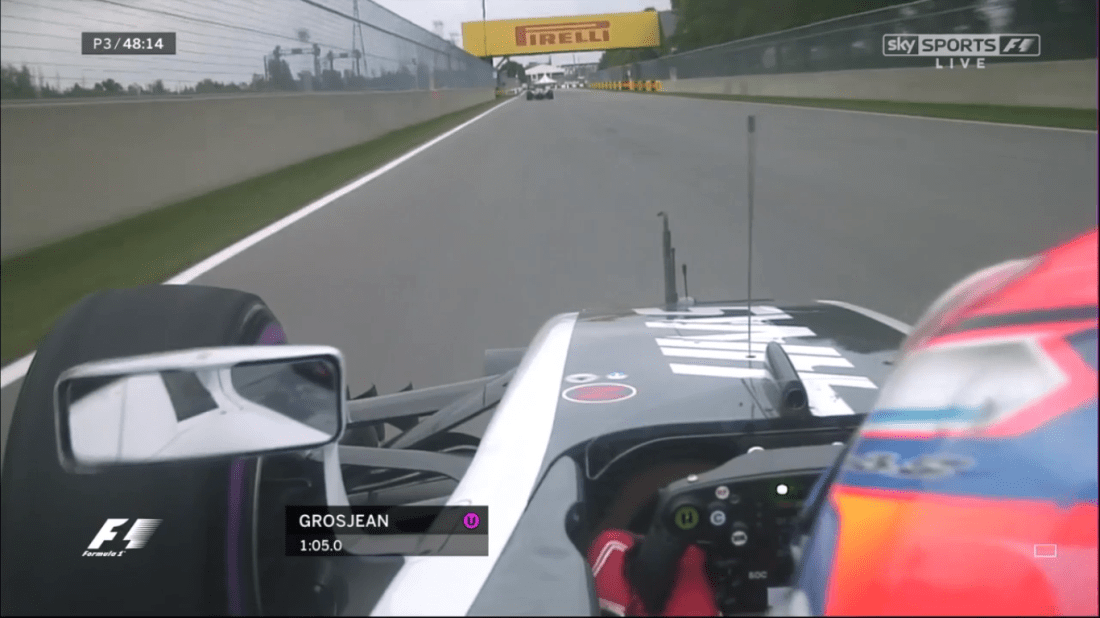
A welcome return: camera angles such as the above of Romain Grosjean’s Haas have not been seen since the 1990s, but have returned to Formula 1’s World Feed in the past few races, giving a greater sense of speed.

“Let Michael past for the championship, Rubens” was one such snippet that aired on the F1 Digital+ feed at the 2001 Austrian Grand Prix. Victory celebrations were also commonly broadcast on the F1 Digital+ feed, notably at the 2000 German and Japanese rounds of the championship, again both featuring Ferrari drivers.

Team radio became more widespread through the 2000s, with it being common place until the radio rules of late last year. I’m happy to see the ruling reversed, simply because the team radio offered a different opinion on the track action, a ‘third wheel’ shall we say. However, even after the reversal, it still feels like there is less team radio than in previous seasons. Have drivers been trained to talk less in the car, or are the fans hearing an extremely filtered version?

Staying with TV, FOM’s GP2 commentary line up of Alex Jacques and Davide Valsecchi has been a revelation this season. Jacques has come on leaps and bounds since we heard him at the start of 2015. Plucked out of nowhere, his style alongside Valsecchi’s strong enthusiasm means that fans are in for a treat whenever GP2 is live on-air.

Elsewhere in the FOM spectrum, their social media efforts have improved compared with 2015. Helped by an influx of new faces such as ex BBC F1 video editor Tom Bowker, their social media platforms, including Facebook which launched in March, have played host to a lot more unseen archive footage than previously. Finally, it looks like the public is able to scratch at the surface of FOM’s video archive.

With 2.6 million ‘likes’ on Facebook, 2.2 million on Twitter and 220,000 on YouTube, F1 is building its digital fan base. Their Facebook page, which was launched in March, has been successful so far thanks in part to the migration of the 1.8 million people who already liked F1 related pages! FOM have not done anything though to go viral yet, in the same way that Formula E and the Ricciardo/Massa go-karting fun did. In fact, I do not think FOM have done anything in recent memory to go viral, whether they choose to do so to try and boost their profile, we shall see.

In the meantine, MotoGP remains four times as popular as Formula 1 on both Facebook and YouTube. The series recently hit 1 million subscribers on YouTube, rewarding fans with a full race copy of the 2015 Australian Grand Prix… for free! Of course, the nature of television deals mean that FOM may not be able to do that, but it shows what can be achieved. As always with F1, there is a long way to go to getting fans the level of access that MotoGP does with their fans.

Formula E learns how to go viral with #LeapOfFaith

There were two major social media highlights of the past few months for me, one of which showed how to go viral, whilst the other really showed the personality of two popular drivers away from the racing circuit.

#LeapOfFaith takes off…
To reach a new, diverse audience, you have to take creative risks. You have to be prepared to try out new things. If the audience is not receptive to said ‘new things’, you simply move in a different direction and add it to your ‘lessons learnt’ list. It gives you an idea of what works and what doesn’t. Formula E’s latest stunt was designed to go viral, and it did exactly that.

The stunt, filmed around the time of the Mexican ePrix in early March, saw Damien Walters backflip over a Formula E car travelling at speed. As of writing, the main video on Formula E’s YouTube channel has had over 5 million hits. When you combine that with Facebook, Twitter and other social media platforms, the combined reach of the video will be in excess of 10 million hits, an excellent achievement for Formula E’s digital media team. It shows that thinking outside of the box does work, and can bring attention to their channels, which I feel is a lesson that all in the world of motor sport can learn, including Formula 1.

However, here is the crux for why I don’t think you will see F1’s digital media team do videos like that, and it is not because they are not creative or anything of that sort. How many people will have watched the #LeapOfFaith and thought “I must check out some of Formula E’s other videos” or “I might watch Formula E next weekend”? I’d hazard a guess and say that it was less than 1 percent. Instead, for the vast majority of those that stumbled across the video, they probably thought it was “cool” and moved on.

I’m not trying to undermine the idea behind the video by saying that, because I thought it was awesome, but I do not see it significantly affecting Formula E’s growth. Mind you, every little helps and every opportunity to grab a new viewer is a good opportunity and I applaud Formula E for producing #LeapOfFath.

…Formula 1 drivers show off personality with fun and Q&A sessions…
There have been a few examples recently where personality has been on show in the world of Formula 1. Aside from Fernando Alonso’s live on-screen jibe at Johnny Herbert during Sky Sports F1’s Bahrain Grand Prix practice coverage, the Chinese Grand Prix saw a heated back and forth debate between Sebastian Vettel and Daniil Kvyat over the driving standard of the latter at the start of the race. The debates have been intertwined with fun and Q&A sessions along the way.

Probably the best show of personality this season away from the race track comes from Felipe Massa and Daniel Ricciardo. Back at Massa’s home in Monte Carlo, his son and Ricciardo engaged in a go-karting race. In what was a close run contest from start to finish, with plenty of nail-biting moments, it was the youngster who won by the smallest of margins. The fun and games between Massa and Ricciardo was live streamed on Facebook. Like #LeapOfFaith above, this too went viral amassing nearly 5 million views. Of course, one was designed to go viral whereas the other was some fun between two mates. But we need videos like that, they are memorable and for good reason too.


On the more scripted side, Sky Sports F1 have been engaging in some fan question and answer sessions, so far with Lewis Hamilton and Rio Haryanto (the former also doing a Twitter Q&A in recent weeks). Including all play backs, these two have had 270,000 and 60,000 views respectively. This is a wider Sky Sports strategy to conduct question and answer sessions on social media as opposed, which is how these two have come about. You only need to look at the swathe of videos that Sky Sports upload to Facebook to realise that. I would be surprised if Formula One Management (FOM) have got involved in either of these Q&A sessions. Scripted or not, from a fan perspective, it has been great to see personalities on-show so far during 2016, something I hope continues throughout the year.

…but what hasn’t gone viral?
There have been many fantastic and dramatic moments so far in the 2016 Formula One season. Alongside the aforementioned Vettel vs Kvyat squabble in China, we had Fernando Alonso’s horrifying crash in Australia and the major turn one accident in Russia. There’s been a lot of pin-points so far this year that could have gone ‘viral’. You can produce the greatest videos in the world, but there is no substitute for current action as that inevitably drives traffic. Formula 1 has probably lost out in excess of 15 to 20 million views across Facebook, Twitter and YouTube so far in 2016, I daresay more than that.

Take a look at MotoGP’s social media video portfolio on Facebook and YouTube. We’re talking short-form bite-size content: around 20 seconds long on Facebook and one to two minutes on YouTube. The reason for the lack of 2016 Formula 1 video content on FOM’s social media channels is the current television broadcasting contracts as we all know, but it just illustrates the potential reach that Formula 1 is losing hand over fist on a now bi-weekly basis.

Elsewhere, the lack of an on-screen hashtag still confuses and bemuses me, both in equal measure. I’m surprised Formula E still hasn’t successfully embedded it into their graphics set. So simple, but proving to be a challenge at the same time. Formula E have also launched a new website, which is designed for best use on phone or tablet device. It feels slim line, and is extremely different to say the Formula 1 and MotoGP websites. As a desktop user, I personally prefer the F1 and MotoGP sites, both of which look more professional than the Formula E site. Round the edges, the Formula E website does not look as smooth either, but this should improve over time as bugs are ironed out.

How social media reacted to F1’s “elimination style” qualifying session

Social media can be your best friend. It can bring new viewers to your product as an event builds to a crescendo. In the UK, you only need to look at television programmes such as The Great British Bake Off or The X Factor as examples of this over the years. On the other hand, social media can be your worst enemy. Unfortunately, Formula 1 fell into the latter category today.

Of course, we are talking about the elephant in the room. Elimination qualifying. Qualifying has its exciting moments, but you can’t expect every minute to be exciting, irrespective of what format you bring in. In the old days of one-hour qualifying, the first 20 minutes would be empty, but nine times out of ten, the format built up to a fantastic conclusion. I think it is fair to say that most people were prepared to give the new format a chance. The end result was a lot different to what I expected. Today, Formula 1 got it wrong.

This isn’t the place about talk the what and the why of the new format, what is worth talking about on here is the broadcasting and social media element. What social media brought this morning was instant reaction to the format, as it unfolded.

All times below are UK:

05:38Sky F1 Insider: Very excited to see the new Qualy format are you?
05:47Adam Cooper: This will be a fascinating session. Will be interesting to see what happens if the VSC comes out at a critical time.
06:00 – Q1 begins.
06:07 – Q1 eliminations begin, but the countdown graphics do not show immediately.
06:08
Byron Young: Almost everyone in the press room talking – a real buzz in the room. First time in a long time.
06:10Andrew Benson: Knock-out countdown is on the timing screens but not on the TV. Seems a bit of an oversight.
06:12 – Countdown graphics make an appearance.
06:16F1 Broadcasting: Countdown not really needed for final elimination given that the driver can finish their lap but sensible graphic. Like it.
06:16 – Q1 ends.
06:18Dimi Papadopoulos: I like the new format? Lots of action!
06:18Racecar Engineering: Q1 – that was utterly awesome. Super entertaining. Teams misread it a bit it seems.
06:19Glenn Freeman: In the spirit of making a snap judgement, new-style Q1 is rubbish. Less action, if anything, other than the first few mins.

That was the reaction to the first part of qualifying. A mixed response, but positive feelings in there as well. Watching at home, I did feel like some teams got timing badly wrong, which was somewhat strange in itself for a sport which times itself to perfection. Moving onto the second part:

06:24 – Q2 begins.
06:28 – Byron Young: On first experience I’ve got to say that was quite fun. Will it be the same when it all settles down and the ‘panic’ factor disappears?
06:32Glenn Freeman: Cars being eliminated while sat in the pits. How is this better than what we had before?
06:38F1 Broadcasting: Problematical now at the end of each session where there is an empty track and not a crescendo build up any more. Not sure about this.
06:38Marc Priestley: So as predicted, teams happy to settle for P9/10 & free tyre choice over running at end of Q2.
06:39 – Q2 ends.
06:42Adam Cooper: I tweeted the other day that those in 9th and 10th would ‘stick’ and take the free tyre choice for the start and look what happened…
06:42Joe Saward: General feeling in Media Centre is new qualifying is rubbish…

Quite clearly, as Saward’s tweet shows, things are heading downwards. The main issue here is that both Force India’s decided not to go out, leaving three minutes at the end of Q2 of dead-air. The further issue that became apparent was that viewers were spending time looking at the timing wall rather than watching the cars. Q3 was almost ‘anti qualifying’:

06:46 – Q3 begins.
06:55Glenn Freeman: F1 qualifying – even worse than I thought it was going to be. To those who came up with this system – hang your heads in shame.
06:55Simon Lazenby: Hmmmmm.
06:55F1 Broadcasting: If anyone in F1 has sense, this system will be quickly trashed and no one will remember it ever existed.
06:57Byron Young: Not a single car in the track with three minutes to go. That’s shameful. I can see fans getting up to go!
06:57Joe Saward: The strategists said nothing would happen in the last few minutes. They were right. Who invented this daft structure?
06:57F1 Fanatic: Another triumph for Ecclestone and his Strategy Group cohorts (sarcasm).
07:00 – Q3 ends.
07:01Jon Noble: Don’t forget that at Barcelona testing, teams agreed plan to revert Q3 to how it was last year. But it never went back to F1 Commission…
07:03F1 Broadcasting: Remind me. Who said qualifying was a problem in the first place? Because the fans certainly didn’t.

Within Q3, the reaction turned completely negative. The above is just a snapshot, but the negative reaction was widespread. Formula 1 launched their new Facebook page on Wednesday, and three days later their comment feeds are littered with negativity about the new qualifying format. It was even worse at the track, where the fans in the stands had no timing wall to look at on the big screens. If Formula 1 wants to do the right thing, then the format has to be changed for Bahrain, without question. Whether we go back to the 2015 format, or something else.

There will certainly be pressure from broadcasters to change the format after today. As regular readers will know, 2016 marks a new broadcasting deal in the UK with Channel 4 taking over the BBC. Channel 4 want to bring a new, younger audience to Formula 1. The new qualifying format risks undermining the fantastic publicity work that the broadcaster has carried out in the past few weeks. They can work around today’s problems in their highlights edit later today. But, if this format remains for Bahrain, Channel 4 will have a real issue: casual viewers are not going to watch a new qualifying format that has been lambasted. That in turn has a knock-on effect for their race day programming… and so on and so forth.

Broadcasters’ will not like what they have seen today. And neither do the fans…

Formula 1 finally launches on Facebook

A year after Twitter, YouTube and Instagram, but better late than never: Formula 1 finally has an official page on Facebook!

The page, which has been verified by Facebook, made its first post earlier today. The launch comes fifteen months after Marissa Pace, Formula One Management’s Digital Media Manager, confirmed plans for a Facebook page. So far, the page has posted video content, including archive footage from both the 1999 and 2002 Australian Grand Prix.

It is fair to say that this has been a long time in the making. If 2015 was a big year for Formula One Management from a social media perspective, it looks like 2016 will be even bigger.

Update on March 16th at 18:40 – Facebook is in the process of migrating all the likes from the old Formula 1 fan page (which, for those familiar, would have just contained the generic Wikipedia description with no content) into the official page. As I write this, the official page has 322,795 likes. Two hours ago, that number was around 20,000 likes… it is pretty clear that Facebook are merging all the likes from the old page into the official page. The old page had 1.8 million likes, so if the official page has 1.8 million likes within the next few hours or so, we know why. I strongly doubt this is a case of FOM buying followers.

Update on March 16th at 19:50 – This is definitely Facebook transferring the likes over. The official page has jumped through the half a million barrier now as a result. You know they are real likes as well. In my case I can see that some other people I know are now liking the official version having previously liked the fan page. Also, FOM have prohibited sites from embedding videos externally, which page owners have the right to do.

 This post will be updated in forthcoming days.