Some details about BT Sport’s MotoGP coverage for the 2015 season are beginning to filter through.
Abi Griffiths and Craig Doyle will be sharing presenting duties again for the 2015 season. Griffiths noted on Twitter that she will be flying out to Qatar on Wednesday, meaning that coverage from Qatar at least will be presented on-site. This was also the case last year though when Melanie Sykes presented, so we will see what happens regarding the remainder of the year.
The rest of the team is the same: Keith Huewen will partner Julian Ryder in the commentary box, whilst Neil Hodgson and Gavin Emmett will be back as reporters. Iwan Thomas is returning, presenting a programme called The Chequered Flag that will air in the hour following the MotoGP race on BT Sport. It will be repeated multiple times after the original showing. MotoGP Tonight is not listed in the schedules for Tuesday 31st March, nor is its counterpart Motorsport Tonight. It is unclear whether the show has been axed, although we’ll soon find out when the schedules for the following week come out.
Update on March 28th – James Toseland is with BT this weekend, so I’ve removed that bit from the article. Also, confirmation from Gavin Emmett in their qualifying show that Craig Doyle and Toseland will be on-site at every race this season, which is great to see and presumably means that the studio has been dumped for 2015.
FairFX is to sponsor Sky Sports F1’s coverage for the remainder of the 2015 Formula One season, it has been confirmed. The travel company will sponsor their coverage across TV, mobile and online. FairFX will follow blackcircles.com, Santander, Rolex and Shell in sponsoring Sky F1.
Ian Strafford-Taylor, who is FairFX’s chief executive, said: “We are delighted to have agreed this partnership with Sky Media to sponsor Formula 1, on Sky Sports. The massive global following of Formula 1, combined with the innovation and cutting-edge technology it represents is a perfect fit for FAIRFX, which uses smart digital technology to deliver better value and service to over 400,000 global travellers and holidaymakers. As channel sponsor we will be able to reach a much wider audience for our products more quickly.”
I can’t speak for anyone else, but I had never heard of FairFX until this press release. Given that the sponsorship deal was not concluded earlier, it appears that Sky have struggled to find a sponsor for the coverage, in a similar way that ITV did back in 2006, with Swiftcover eventually becoming their sponsor from round four that season.
The Formula 1 paddock heads from Australia to Malaysia for round two of the season. Round two is the first live race for the BBC this season, with coverage airing on BBC One as usual.
Elsewhere, the 2015 MotoGP championship begins on BT Sport. In the second year of their exclusively live contract, as of writing, no details about their coverage have been officially announced, I’ve compiled what we know so far here. As revealed on this blog earlier this year, ITV4 will again be broadcasting highlights on Monday evenings. Also beginning is the IndyCar Series live on ESPN, an agreement which will run through to 2022.
NOTE: Clocks go forward one hour on Sunday 29th March, with the change from Greenwich Mean Time to British Summer Time. The times listed are for GMT on Saturday and before; BST for Sunday and afterwards…
BBC F1 BBC TV – Sessions
27/03 – 01:55 to 03:35 – Practice 1 (BBC Two)
27/03 – 05:55 to 07:35 – Practice 2 (BBC Two)
28/03 – 05:55 to 07:05 – Practice 3 (BBC Two)
28/03 – 08:00 to 10:30 – Qualifying (BBC One)
28/03 – 14:00 to 16:00 – Qualifying Replay (BBC One)
29/03 – 07:00 to 10:30 – Race (BBC One)
29/03 – 10:30 to 11:30 – Forum (BBC Red Button)
29/03 – 14:00 to 16:00 – Race Replay (BBC One)
BBC Radio – Sessions
27/03 – 01:55 to 03:35 – Practice 1 (BBC Radio 5 Live Sports Extra)
27/03 – 05:55 to 07:30 – Practice 2 (BBC Radio 5 Live Sports Extra)
28/03 – 05:55 to 07:05 – Practice 3 (BBC Radio 5 Live Sports Extra)
28/03 – 08:55 to 10:05 – Qualifying (BBC Radio 5 Live Sports Extra)
29/03 – 07:30 to 10:00 – Race (BBC Radio 5 Live)
BBC News Channel
27/03 – 18:45 to 19:00 – Inside F1
28/03 – 18:45 to 19:00 – Inside F1
Sky Sports F1 Sessions
27/03 – 01:45 to 03:50 – Practice 1
27/03 – 05:45 to 08:00 – Practice 2
28/03 – 05:45 to 07:15 – Practice 3
28/03 – 08:00 to 10:45 – Qualifying
29/03 – 06:30 to 11:15 – Race
=> 06:30 – Track Parade
=> 07:00 – Pit Lane Live
=> 07:30 – Race
=> 10:30 – Paddock Live
Supplementary Programming
26/03 – 07:00 to 07:30 – Driver Press Conference
26/03 – 20:45 to 21:00 – Paddock Uncut: Australia
27/03 – 08:00 to 08:45 – Team Press Conference
27/03 – 10:00 to 11:00 – The F1 Show
01/04 – 20:30 to 21:00 – Midweek Report
MotoGP – Qatar (BT Sport 2)
26/03 – 15:00 to 19:45 – Practice
27/03 – 14:45 to 19:00 – Practice
28/03 – 14:30 to 18:30 – Qualifying
29/03 – 16:00 to 20:00 – Races
29/03 – 20:00 to 21:00 – Chequered Flag
MotoGP – Qatar (BT Sport Xtra)
29/03 – 13:50 to 16:00 – Warm Up
With the German Grand Prix looking increasingly likely to disappear from the 2015 Formula One season, a few people have wondered whether this will affect the current BBC and Sky picks for this season.
As it stands, the BBC are set to broadcast ten live races out of the twenty on the calendar, with the mid-season schedule looking like this:
– June 21st – Austria (Red Bull Ring) – Sky
– July 5th – Britain (Silverstone) – BBC and Sky
– July 19th – Germany (TBA) – Sky
– July 26th – Hungary (Budapest) – BBC and Sky
– August 23rd – Belgium (Spa) – BBC and Sky
– September 6th – Italy (Monza) – Sky
If the German Grand Prix disappeared, then the BBC would be left with three consecutive live races, and with more than 50 percent of the races live (10 out of 19). Neither of those two statements has been true since the current contract came into effect at the beginning of 2012.
However, a BBC spokesperson has confirmed to The F1 Broadcasting Blog that the 2015 picks will not change if the German Grand Prix is removed from the calendar. The spokesperson said “If Germany (and it is an ‘if’ at this stage) comes out of the calendar, it won’t affect what we show as the picks are done at the start of the season. So if Germany goes we will have 10 lives from a total of 19 races.”
Last weekend, at the 2015 Australian Grand Prix, Formula One Management (FOM) unveiled a new graphics set, which on the whole has been well received by blog readers. Inevitably, comparisons will be made between this set of graphics and previous iterations. But which set is your favourite? Here is a look at each graphics set, along with a poll at the bottom of this post.
I’ve made a conscious decision to leave out any of the graphics set from before 1994, as my knowledge of what happened before then in this area is limited. I also don’t know whether there was a consistent graphics set used for complete years, or whether it was the decision of each of the local hosts. What I do know though, is that from 1994, things became a lot more consistent.
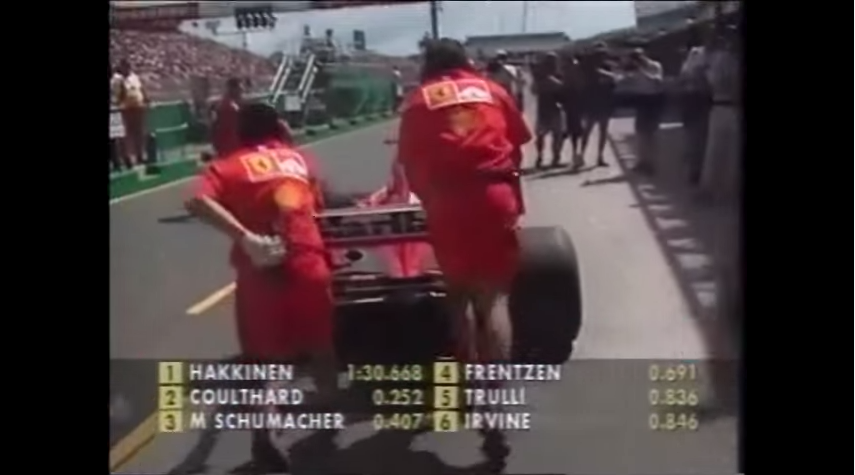
1994 to 2003
Anyone who began watching Formula 1 in the late 1990’s will remember this graphics set fondly. Probably dubbed as the classic graphics set, the World Feed graphics were standardised for the beginning of 1994 and remained in place for a decade.
The classic graphics set on display during the 2000 Australian Grand Prix Qualifying session.
For its time, the graphics did their job perfectly, but towards the end, the graphics set had outlived their welcome as viewers wanted more data and detail, especially those that had returned to the World Feed from the defunct F1 Digital+ platform. Plus, it is fair to say that those graphics would be unsuitable in a widescreen era, and unusable in a three-part qualifying session if not tweaked significantly.
1996 to 2002 – F1 Digital+
Whilst the majority of the world were accustomed to the classic graphics set seen above, a small portion of the audience who subscribed to the F1 Digital+ service across Europe (and in the UK through Sky during 2002) received a different graphics set, which was arguably ahead of its time.
The F1 Digital+ graphics set in action during practice for the 2002 United States Grand Prix.
Those who watched via the standard World Feed did see the F1 Digital+ graphics set once, during the 2002 United States Grand Prix, but apart from that, it was hidden away on the pay-per-view service. Once the service collapsed, the graphics were never seen again, although the collapse of the service was what probably led to the World Feed graphics getting an overhaul for the beginning of the 2004 season.
2004 to 2009
The 2004 to 2009 graphics set was notable given the number of new features that came with it, such as the timing tower, which I don’t believe was included in the F1 Digital+ set. This was also the first graphics set that made heavy use of the three lettered abbreviations that are now commonplace in motor sport. What I don’t know is whether these were FOM innovations within motor racing, or a trend that began elsewhere – anyone who watches football will know that abbreviations have been around for decades.
The no flash, more modern graphics set on display during qualifying for the 2006 Australian Grand Prix.
Items such as the rev-counter, which commonly appeared on F1 Digital+, soon became integrated into this graphics set. As with every graphics set, the set was adjusted as time progressed, but the basic template remained the same throughout. As FOM made the transition to widescreen for the 2007 season, the graphics set remained within the 4:3 safe area until they were replaced at the end of 2009. It may not have been the flashiest graphics set ever, however it did its job fine.
2010 to 2014
All of the previous graphics set up until 2010 had featured straight lines, either horizontally or vertically. The graphics set introduced at the 2010 Bahrain Grand Prix went for a more slanted approach, this was presumably done so it matched the slanted aspect of the F1 logo. Yes, the graphics did look ‘sexier’ than previous versions, but did it provide anything that the previous versions did not? Well, not really.
A picture of FOM’s graphics set, as seen during Q2 at the 2013 Japanese Grand Prix.
When I compared Dorna’s MotoGP graphics with FOM’s graphics in October 2013, I concluded that “if you are looking for something easy on the eye, then FOM wins, but if you want a data driven set, then Dorna with their MotoGP graphics is a clear winner.” Like the previous version, this set of graphics went through multiple iterations from 2010 until 2014, but the overall vision remained the same, with not much changing under the surface during the course of those five years.
2015
And so, we come to 2015. The year in which FOM have appeared to rip up anything that existed beforehand and start fresh. The inspiration behind the minimalist approach stems from the way design is heading currently, with big brands going down that route. FOM are only following the trend, and I think they have made the right decision. I’m a really big fan of what we saw over the weekend.
The new graphics set on display during practice two at the 2015 Australian Grand Prix.
Of course, there are always room for improvements with any graphics set, but these are minor tweaks rather than a fundamental flaw in the design. In the poll currently running, 68 percent of you say that you like the new graphics, which is a huge step in the right direction. But, where does the 2015 graphics set stack up for you historically? Do you like the minimalist approach, or do you wish we could travel back in time to the 1990’s and get the ‘black and yellow’ colour scheme back? It is time to have your say in the poll below and as always your views and opinions are welcome.



 Motorsport Broadcasting