F1’s UK audience figures rise in 2021, but series sees worldwide dip

Formula 1’s UK audience figures rose to their highest level in around four to five years as the titanic battle between Max Verstappen and Lewis Hamilton came to a climax, however, audience figures dipped worldwide, analysis from Motorsport Broadcasting shows.

The consolidated UK data, released by BARB, includes viewers who watched the Grand Prix within seven days of the original transmission across TV, PC, smartphone, and tablet (defined by BARB as ‘four-screen viewing data’), the body no longer splitting these out into separate components.

A small number of historical data points are missing; however, these are not statistically significant enough to impact the overall trajectory.

In addition, this analysis excludes the Russian Grand Prix, as Sky’s figures for that weekend are unavailable, but does include the shortened Belgian Grand Prix.

Sky’s figures rise to highest ever level…

On race day, Sky split their programming into three or four blocks, depending on weekend.

Their build-up normally lasts 85 minutes, with the race segment lasting 135 minutes. The ‘Chequered Flag’ programme follows the podium for 60 minutes, whilst Ted’s Notebook sometimes wraps up proceedings.

Across a mix of Sky Sports F1, Sky Sports Main Event and Sky Showcase, an average audience of 1.59 million viewers watched the 22 races live on Sky during 2021, their highest ever audience for Formula 1.

Year-on-year, Sky’s figures increased by 25.7% from 1.27 million viewers in 2020, the fourth consecutive year that Sky’s F1 audience has increased.

For the first time, over 2 million viewers watched an F1 race live via one of Sky’s television channels. The season started well in Bahrain, with an average of 1.94 million viewers watching the race, peaking above the 2 million mark.

Later in the year, 2.11 million viewers watched a dramatic Saudi Arabian Grand Prix unfold, with 2.30 million opting to stay with Sky for the season decider in Abu Dhabi. The latter figure excludes those who decided to watch Sky’s broadcast on Channel 4.

At the other end of the spectrum, the Dutch Grand Prix was Sky’s lowest rated of 2021, averaging just 1.12 million viewers.

Competition from other channels was easier than usual, with no Premier League football, however the race followed the farcical Belgian Grand Prix one week earlier, which may have invertedly caused a dip.

Sky’s wrap around programming felt the benefit of the championship battle, with their pre-race build-up increasing by 13.9% year-on-year, while their post-race analysis increased by 31.1%, both double their 2018 averages.

Unsurprisingly, both Britain and Italy saw larger post-race audiences, thanks to Hamilton and Verstappen’s on-track incidents, with 407,000 viewers sticking around for the Silverstone post-race analysis and 448,000 viewers sticking around for the Monza debrief.

The new F1 Sprint format also performed well, with an average of 739,000 viewers watching Hamilton charge through the field in Brazil, the figure including Sky’s extensive wrap-around programming.

Sky gained an extra competitive session because of the change, with the displaced Friday qualifying session performing strongly. Both the Italian and Brazilian qualifying programmes averaged 470,000 viewers, comfortably above Sky’s usual practice average.

…as Channel 4’s audience continues to drop…

While Sky benefited from the intense championship battle, Channel 4 saw no obvious benefit, outside of the Abu Dhabi decider.

Highlights of 20 races on the free-to-air broadcaster (excluding Silverstone and Abu Dhabi) averaged 1.50 million viewers, down 14.4% of the 2020 average of 1.75 million viewers.

Including Silverstone and Abu Dhabi, the 23 races on Channel 4 averaged 1.63 million viewers, down on the equivalent 2020 figure of 1.80 million viewers. An average of 3.36 million viewers watched the season decider live on Channel 4.

The return of USA and Mexico to the F1 calendar hurt Channel 4’s average, both bringing in less than a million viewers after 7 days of consolidation, in part thanks to their late night time slot on Sunday.

Channel 4’s weak average was compounded by the fact that five of the European based races (France, Styria, Belgium, Netherlands and Turkey) averaged under 1.50 million viewers compared with one race (Abu Dhabi) in 2020.

Nevertheless, there were some positive numbers in amongst the overall decline for Channel 4, with the Emilia Romagna, Hungarian and Italian rounds drawing in close to 2 million viewers for their 150-minute highlights packages.

An average of 1.97 million viewers watched as Hamilton and Verstappen collided for the second time in 2021 at Monza, a slight increase on an equally dramatic 2020 Italian Grand Prix, which brought in 1.88 million viewers.

…but the overall UK picture is positive…

Unsurprisingly, Hamilton versus Verstappen drew in the viewers in 2021.

3.22 million viewers watched across Sky Sports and Channel 4, an increase of 5.1% on 2020 average audience of 3.06 million viewers, bringing audience figures back to a level last seen in 2016 and 2017.

However, the 2021 average dropped slightly at end of season compared with the mid-season figure of 3.24 million viewers.

As referenced both the USA and Mexican rounds performed poorly on Channel 4, with Sky’s live audience failing to offset the Channel 4 drop. The lack of increase may also suggest audience fatigue crept in as the season progressed.

For example, the Qatar Grand Prix averaged 3.15 million viewers, 1,000 viewers fewer than the Emilia Romagna Grand Prix, despite the championship battle having stepped up considerably by that point.

The season finale in Abu Dhabi was the most watched race of 2021, with 5.66 million viewers watching live across Channel 4 and Sky Sports, this figure including some of the pre-race build-up and post-race wrap-around.

Overnight data showed that a peak of 7.4 million viewers watched as Verstappen overtook Hamilton to win the F1 title.

Saudi Arabia, Britain and the season opener in Bahrain also drew strong audiences. The inaugural race in Saudi averaged 3.88 million viewers, F1’s highest average at that time since the 2018 US Grand Prix.

Channel 4’s and Sky’s F1 audiences continued to converge, with a 49:51 split between the two broadcasters.

Assuming Sky’s audience figures remain strong this season, it is increasingly likely that they will become the dominant F1 broadcaster, from an audience share perspective, in the UK moving forward.

…as F1 faces a worldwide audience dip

While Formula 1’s audience increased in the UK thanks to the championship battle between Hamilton and Verstappen, worldwide the sports average audience dropped significantly.

An average of 70.3 million viewers watched each race, a decrease of 20% on 2020’s average of 87.4 million viewers, and down on the 2019 figure of 91 million viewers.

F1 says that the decrease is due to a change in broadcast rights in Germany and Brazil. For markets where broadcast rights have remained identical, audience figures increased by 13% to 60.3 million viewers, which F1 says is the best figure since 2013.

Taking the figures at face value, this implies that where broadcast rights changed hands between 2020 and 2021, F1’s average audience dropped by 24.1 million viewers, from 34 million viewers in 2020 to 9.9 million viewers in 2021.

SeasonCumulative Audience% y-o-yAverage Audience% y-o-yRaces Held
20181.76 billionn/a83.7 millionn/a21
20191.92 billion9%91.5 million9%21
20201.49 billion-23%87.4 million-5%17
20211.55 billion4%70.5 million-19%22
Source: Formula 1 press releases / Motorsport Broadcasting analysis

The drop is significant for F1, but unsurprising in some ways. F1 themselves highlighted in their 2019 data release that Brazil and Germany were two of their top markets, a statistic that will have since changed two years later.

While not impacting the whole of 2021, it is likely that the closure of Fox Sports in Asia also dented F1’s average across the season. F1 needed to find new homes in territories such as Hong Kong, Singapore and Malaysia after Fox closed its doors in early Autumn.

The fact that F1’s figures have increased for territories where the TV rights have stayed the same is good, but it fails to account for the overall worldwide drop that F1 has experienced. Like Formula 1, Formula E also used their cumulative audience data to hide a race-by-race drop.

Over on F1’s digital platforms, analysis by this site shows that the amount of people watching F1’s race highlights packages on YouTube has increased by 41% year-on-year, from an average of 5.24 million viewers in 2020 to 7.38 million viewers in 2021.

Both the cumulative TV audience and unique audience increased by 4% and 3% respectively year-on-year to 1.55 billion viewers and 445 million viewers, reflecting the longer calendar compared with 2020.

Contribute to the running costs of Motorsport Broadcasting by donating via PayPal. If you wish to reproduce the contents of this article in any form, please contact Motorsport Broadcasting in the first instance.
Falling in love with WRC’s hybrid era through All Live

A new season of the World Rally Championship began last month, as a titanic battle between the two Sebastien’s unfolded. Loeb battled Ogier, with Loeb eventually coming out on top.

All the action aired live on WRC’s over-the-top platform All Live for the fifth season running.

One avid watcher of the weekend’s events, Carl Dolan, who works on F1 as a TV Sound Supervisor and himself a former national rally driver, sent in his thoughts on how well All Live worked…

If you, like me, think the greatest drivers in the world have names like Seb, Ari, Colin, Walter, Carlos or even Malcolm, then you probably know that a new era has just started in the World Rally Championship.

The 2022 season started with the introduction of the exciting new Rally1 hybrid cars during last month’s Rally Monte Carlo. I was glued to my device all weekend watching Sebastien Loeb’s masterful display live as he swept the field aside in his beautiful looking Ford Puma.

Rallying – or ‘rally’ as some would now seem to say – is a notoriously difficult sport to cover, with its own very special set of challenges. If the action is constantly on the move, then how do you follow it?

You could send the cars round a special side-by-side track, or let them race around a loose surface circuit, but then it becomes racing or rallycross. To do this belies the very essence of what rallying is about, as the drama really takes place in the remote forest tracks of Finland, or on the tight, twisty roads above a Principality, and not on a synthetic race track.

The revolution, televised

For years the technology has not existed to do rallying justice on the small screen. Trailblazing the coverage was down to legendary filmmaker Barrie Hinchliffe. Starting in the late 60’s, Barrie produced some amazing, evocative films that captured the sport perfectly.

He was a cinematographer who understood that he was telling stories about people and that the cars were just a vehicle for that. He knew that running around a forest with only a single 16mm camera meant it was difficult to directly cover the actual sporting contest.

For instance, watching a Ford rally mechanic take the axle of an unsuspecting holiday maker’s Capri is a golden piece of TV.

Slowly technology moved on but even on BBC’s Rally Report in the 80’s & 90’s – getting the pictures back to Chester, editing them and getting it on-air in time was a logistical nightmare. What we needed was live coverage from inside every car, in those days a distant dream!

But now the technology is well and truly here. WRC’s over-the-top (OTT) All Live coverage has finally captured what we always wanted to see. Cutting live between multiple on-board cameras, helicopters, stage side cameras; mix that in with live splits & stage times and follow that with immediate driver reaction interviews at the end of each stage and you have yourself a great recipe. Now the action really does unfold in front of you.

> How All Live is changing the face of rallying (foundations, planning, production)

Not since I listened on my scanner to stage times crackling in from the plane above me in Wales on the RAC, have I felt so in touch with what is happening on the ground. And you are there for everything. Seeing Gus Greensmith’s reaction live when teammate Loeb failed to beat his stage time and so grabbing his first WRC stage win was fabulous TV, capturing the human side of the sport again!

With Becs Williams and Julian Porter offering enjoyable and insightful commentary, the two really helped capture the weekend’s action.

Re-thinking the basic concepts

Going forward, I think it is time to rethink even some of the basic concepts. For instance, centralised Service Parks and clover looping stages were brought in to help TV coverage but maybe it is time to go back to longer events; or chase cars fettling cars live by the side of the road?

Rallying’s popularity declined a little when the sport became TV friendly, but if you change a sport for TV then the very sport itself can suffer. Television should cover a sport not control it.

However, rallying’s ‘of the moment’ nature means it is perfect for modern day social media and OTT content. The event unfolds over a weekend, so people with busy lives can dip in and out as they wish. With stage times arriving minute by minute, data hungry platforms, such as Twitter work well during the weekend.

The World Rally Championship has a bright future with the new hybrid era. The cars look and sound amazing, the backdrops are beautiful and now we have the delivery platform to enjoy it on.

Currently only three manufacturers – Toyota, Ford & Hyundai – are fully committed to Rally1 but others must surely be watching with interest. For me, rallying represents the most direct link from motorsport to road car technology and with rallying taking the lead with hybrid technology, the future looks more sustainable here than elsewhere.

It will also be interesting to see how much influence the new FIA president, himself a former rally driver, will have on the future of the series.

Now I must ring up my Toyota dealer and find out if there is any news on when my own WRC inspired Yaris GR4 is being delivered!

The next round of the 2022 World Rally Championship season, Rally Sweden, takes place across the weekend of February 24th to 27th. Live coverage of every stage airs via WRC’s All Live platform and BT Sport, with highlights airing on ITV4 on Wednesday 2nd March.

Contribute to the running costs of Motorsport Broadcasting by donating via PayPal. If you wish to reproduce the contents of this article in any form, please contact Motorsport Broadcasting in the first instance.

From T4 to Formula E: why Vernon Kay feels as comfortable with the latter as the former

Formula E’s World Feed presenter Vernon Kay says he feels as comfortable with the team as he did during his early presenting days when part of the T4 broadcast team.

Kay joined the on-site team at the start of the 2017-18 season, presenting Channel 5’s offering before becoming part of the English-speaking feed alongside Nicki Shields, Jack Nicholls and Dario Franchitti.

The role was Kay’s first gig within motor sport, following in the footsteps of fellow T4 presenter Steve Jones, who began presenting Channel 4’s F1 offering in 2016.

Speaking to Motorsport Broadcasting ahead of this weekend’s season opener in Diriyah, Kay said that the sport can feel “intimidating,” but that the team have helped him get to grips with Formula E.

“It is an intimidating space when you’ve got all these motor sport nerds,” Kay jokes. “And let’s be honest, motor racing drivers know absolutely everything.”

“You ask me a Family Fortunes question and I’ll give you the top answer any day. But if you ask me what gearbox was in Ayrton Senna’s car in 1983, I am lost! They’ll tell you the answer straightaway.”

“Having people like Jack and Dario with a wealth of motorsport experience, holding your hand and taking the mickey, it really helps.”

“I think we’re a really good team. I feel comfortable, if anything I feel as comfortable in this Formula E team as I did in the T4 team. And that’s where we’re at.”

The transition from entertainment to sport

Prior to Formula E, Kay presented a variety of entertainment shows across the BBC and ITV, including a celebrity version of Family Fortunes for nine years.

In the run up to his first Formula E race in 2017, Kay sought advice from Jones on what to expect, while Kay also gives credit to Jake Humphrey, who followed a similar route into sports presenting.

The three of them made their transition into motor sport from the entertainment world, which Humphrey began in 2009 when he became BBC’s Formula 1 presenter.

“I think there’s a little bit of credit to be given to the hard work that Jake Humphrey put in,” he believes.

“He was the Newsround presenter and then he’s hosting Formula One, and you’re like hang on a minute, ‘how can the kid from Newsround host Formula One?’ But then, Jake smashed it.”

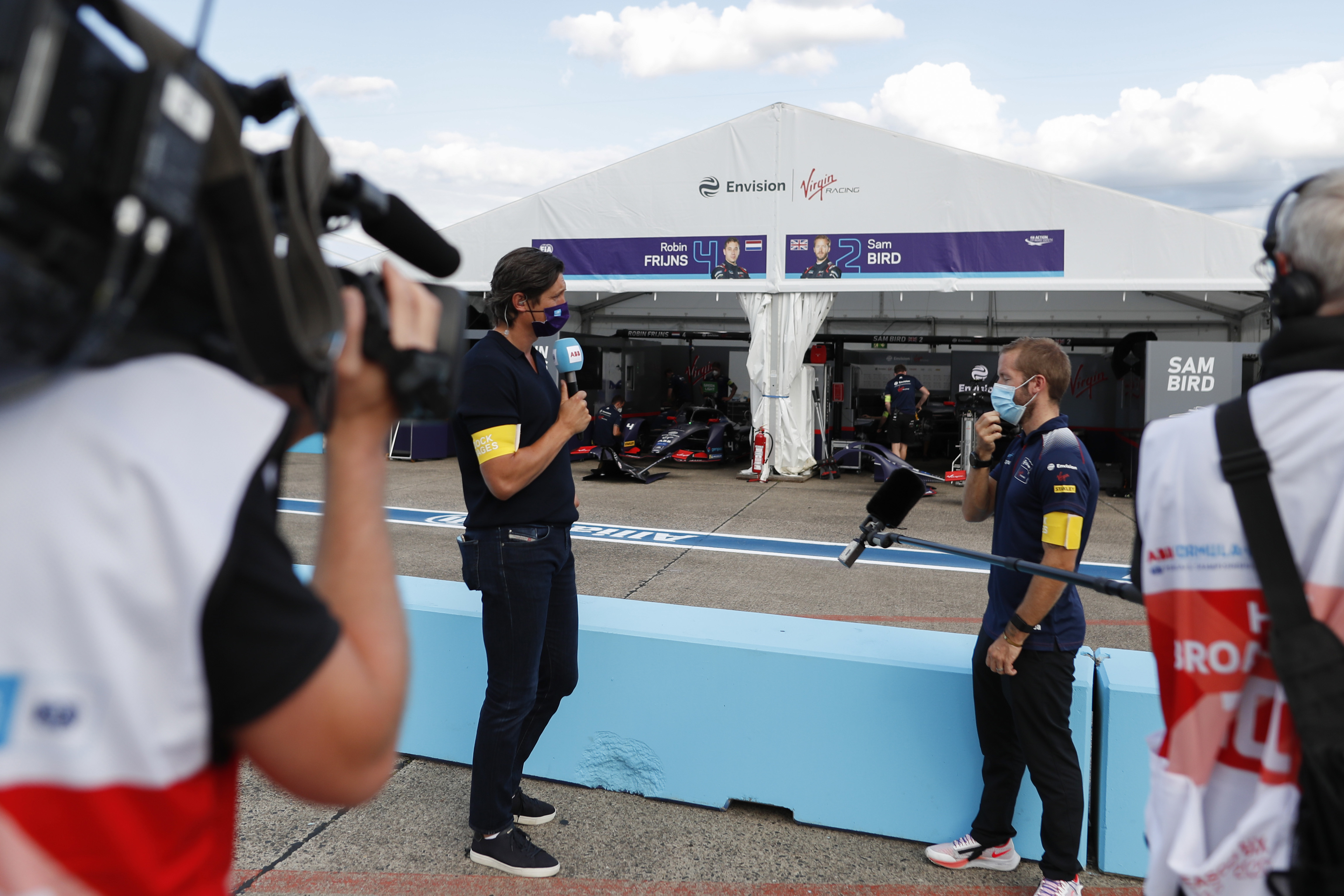
BERLIN TEMPELHOF AIRPORT, GERMANY – AUGUST 04: TV Presenter Vernon Kay interviews Sam Bird (GBR), Envision Virgin Racing during the Berlin ePrix I at Berlin Tempelhof Airport on Tuesday August 04, 2020 in Berlin, Germany. (Photo by Sam Bloxham / LAT Images)

“And in my opinion with his iPad, he redefined sports broadcasting as we know it in the UK, and he did a sterling job and he teed up for people like Steve and then myself.”

“Sport is much more difficult [to present than entertainment] because it’s more reactive. You’re the producer and the director, as well as the host, in my opinion on sport.”

“Steve told me a couple of helpful things before I got into Formula E, which have carried me along. I said Steve, ‘What’s it like?’ ‘It’s going to blow your mind!’ And it did.”

“My first race was in Hong Kong, and I’ll be honest with you, I shat myself. And from that race on, I just thought, wow, this is mad!”

Formula E has a ‘good foundation’ to build on with new Channel 4 deal

Kay believes that the championship now has a ‘good foundation’ to build on because of the new deal with Channel 4, hoping that being on the same station as Formula 1 will only help the series moving forward.

“For me personally, it’s nice to be back on Channel 4, as that’s where I kind of started my career. To have a terrestrial broadcaster that is going to give Formula E to the nation I think it’s really important, with six British drivers in the field.”

“I think to get this deal over the line, both parties have worked really hard.,” he tells me during a media event in London.

“It’s not yet [a teenager], and that’s what people forget. I think sports fans want their sport instantaneously and it’s like, just let it grow and develop. We’re growing and developing as the technology is getting better and more efficient.”

“It’s really exciting times, and especially during the Channel 4 deal, where you’ll get to see the Gen2 car, but also the crossover to the Gen3 car, so it will be a huge compare and contrast. We’ll get to see what we’ve done, and then we’ll get to see the future.”

“I think now that we’ve got a strong base with a good foundation, we can really push and promote Formula E. It’s also nice to be with the same broadcaster that airs Formula One.”

“It means that Channel 4 have a motor sport fanbase, and hopefully, there’ll be some crossover because in my opinion, if you like sport, you like any sport.”

Contribute to the running costs of Motorsport Broadcasting by donating via PayPal. If you wish to reproduce the contents of this article in any form, please contact Motorsport Broadcasting in the first instance.

Channel 4 to air Formula E in multi-year agreement

Channel 4 will broadcast Formula E live in a new ‘multi-year’ deal; series organisers have confirmed.

The broadcaster takes over from the BBC as the series’ exclusive free-to-air home. The BBC aired races in recent years via their Red Button service and online platforms, with a handful of races also airing on BBC Two.

The agreement with Channel 4 builds on the decision last season to air the London E-Prix double header live on the free-to-air station.

As part of the new deal, most races in Asian and European time zones will air live across Channel 4 and All4, with the remaining races, including the season opener in Diriyah next Friday, airing on Channel 4 Sport’s YouTube channel.

Based on the current schedule for the 2021-22 season, fans can expect around 10 of the 16 races to air on Channel 4’s linear channel, a significant increase on the BBC’s previous commitment.

Eurosport remain in the picture alongside Channel 4 as part of the new agreement, continuing their existing offering. Live coverage of the new look qualifying session will air via Channel 4 Sport’s YouTube channel, while race highlights will air on Channel 4.

Formula E in the UK – at a glance
2014-15 – ITV
2015-16 – ITV
2016-17 – Channel 5
2017-18 – Channel 5, Eurosport
2018-19 – BBC, BT Sport, Eurosport, Quest
2019-20 – BBC, Eurosport, Quest
2020-21 – BBC, Eurosport, Quest
2020-21 [London only] – BBC, Channel 4, Eurosport
2021-22 – Channel 4, Eurosport

Formula E says that UK fans will “have the opportunity to see more live races in Season 8 than in any previous season.”

As with their F1 offering, Bristol Street Motors will sponsor Channel 4’s coverage, while the Formula E presentation team consisting of Vernon Kay, Nicki Shields, Dario Franchitti and Jack Nicholls, return for the eighth season.

Pete Andrews, Channel 4’s Head of Sport, said “Formula E is a fantastically exciting sport and this deal is wonderful news for sports fans. We’re proud to be showcasing a sport with sustainability at its heart and one that plays such an important role in seeking to combat the climate crisis.”

Aarti Dabas, Formula E’s Chief Media Officer, added “We are delighted to build on our relationship with Channel 4 as the exclusive free-to-air home of the ABB FIA Formula E World Championship here in the UK.”

“The multi-year partnership with Channel 4 is great news for fans across the UK and for the continued growth of our sport. Last season saw more fans around the world tune into our live race programming than ever before.”

“With Channel 4 established as the regular free-to-air home for Formula E in the UK, we look forward to better serving our passionate fanbase while attracting new fans to the excitement of all-electric street-racing.”

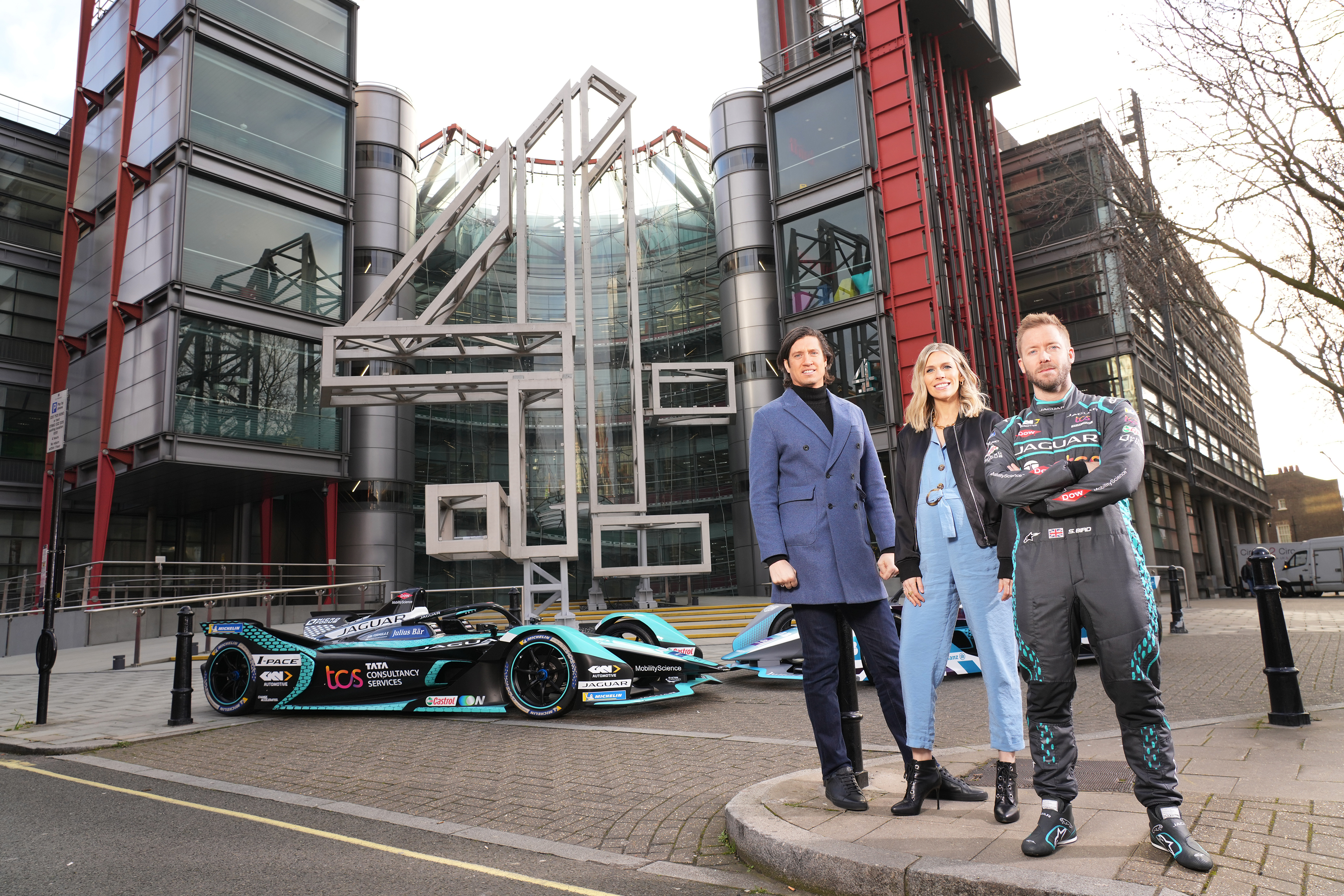
Vernon Kay and Nicki Shields outside Channel 4’s HQ in London with British driver Sam Bird, who races for Jaguar.

Channel 4 agreement not a “box ticking” exercise

Speaking to Motorsport Broadcasting, Channel 4’s Commissioning Editor for Sport, Joe Blake-Turner confirmed that races will air ad-free on Channel 4, and that additional documentary content will air via All4 and Channel 4’s YouTube channel, emphasising that the broadcaster is in this “for the long haul.”

“We’re not doing this as a box ticking exercise,” he tells me. “We’re in it for the long haul, we want to help grow the sport and give it the platform which perhaps it hasn’t had consistently to date down the years.”

“I think Formula E appeals on different levels. It’s a natural bedfellow for our existing motor sports. It sits alongside Formula 1 as the leading single-seater format, and it helps build up our narrative across the year of top-class motor sport.”

“On a separate level, one of our jobs as a channel is to help drive change in the world, and the sustainability message behind Formula E is important. And I think, more than anything, it is just a good, exciting watch.”

Blake-Turner hopes Channel 4’s main sports offering will help “complement” the big attractions that Channel 4 have aired, such as Emma Raducanu’s victory in the US Open and the F1 title decider. Blake-Turner, who was part of ITV’s Formula E production team during their first season, has seen Formula E evolve over the past 7 years, taking the opportunity to bring Formula E to Channel 4 last July.

“We were very happy to take that opportunity, to put the London race on, giving the British viewers and fans a chance to see it.”

“It was an amazing occasion both from the sporting point of view, but also the staging of it. It looked spectacular and cool, inside, and outside, it was just brilliant.”

“I was personally lucky enough to work on the first season of Formula E when it was on ITV, I was at Battersea Park for that, but just to see how Formula E has evolved from those, relatively humble beginnings to where it is now, it’s exciting to see where it’ll go from here.”

Positive move for Formula E as series looks to regain ground in UK

Formula E has struggled to gain traction in recent years in the UK. The series started off life on ITV4, but has since moved from Channel 5, to the BBC, and now back to Channel 4.

In the case of Channel 5 and the BBC, neither of those outlets were willing to give the series a consistent slot on free-to-air television, something that Channel 4 appears to be willing to try, for most races at least.

In the run up to London last year, Formula E’s senior leaders made it clear to this site that the lack of channel consistency was a problem for them.

“It’s a good question because we’re definitely looking at a more consistent channel strategy in the UK and other markets,” Dabas told this site last July.

“And when I think of the channel strategy, I know that every race currently we are like, is it on BBC Red Button, is it on network, is it on Quest. It’s hard.”

Thursday 27th January
14:55 to 15:40 – Practice 1 (Formula E’s YouTube)

Friday 28th January
10:25 to 11:10 – Practice 2 (Formula E’s YouTube)
12:30 to 14:15 – Qualifying (Channel 4 Sport’s YouTube)
16:30 to 18:30 – Race 1 (Channel 4 Sport’s YouTube)
=> also on Eurosport 2 from 16:50 to 18:00

Saturday 29th January
10:25 to 11:10 – Practice 3 (Formula E’s YouTube)
12:30 to 14:15 – Qualifying (Channel 4 Sport’s YouTube)
16:30 to 18:15 – Race 2 (Channel 4)
=> also on Eurosport 2 from 16:50 to 18:00

Full scheduling details for the 2022 Diriyah E-Prix. Scheduling details correct as of Tuesday 25th January and are subject to change.

Channel 4’s audience figures for the London E-Prix double header last July were solid, in the context of the lack of promotion, and it considered a one-off experiment by both parties.

An average of 382,000 viewers tuned in for the second race of the London weekend. While the figure was lower than W Series from Silverstone a few weeks earlier, Formula E did not have F1 as its lead in, unlike the W Series broadcast.

Following the London race, The Race reported that Formula E “surpassed the expectations of the C4 management team,” which this new deal between the two parties confirms.

Formula E has struggled with momentum not just in the UK, but worldwide in recent years. From a UK perspective, arguably the slide started when their Channel 5 deal started to go astray, and series organisers will be hoping that this latest deal with Channel 4 changes that.

Contribute to the running costs of Motorsport Broadcasting by donating via PayPal. If you wish to reproduce the contents of this article in any form, please contact Motorsport Broadcasting in the first instance.

Scheduling: The 2022 Rally Monte Carlo

A new era begins for the World Rally Championship this weekend, as the championship moves to hybrid-power cars for the first time, under the Rally1 banner.

Sebastien Ogier fended off competition from Elfyn Evans to win his eighth championship last year.

While Ogier will be part of the Monte Carlo season opener, Ogier is not competing in a full season, meaning it is all to play for in the hybrid era.

WRC’s over-the-top platform All Live returns for its fifth season, allowing fans to see all the rallying action live.

New for 2022, the platform also allows fans to watch its European companion, the European Rally Championship live, for £99.99 across the whole year.

As usual, the All Live offering, including studio analysis and service park coverage, will air across BT Sport’s platforms, including their Red Button service and online platforms.

Free-to-air highlights will continue to air on ITV4 in the week following each event.

The usual broadcast team returns to cover the action, with Becs Williams leading the commentary line-up for All Live viewers throughout the event, alongside the likes of Julian Porter, Molly Pettit, and Kevin Piper.

Thursday 20th January
08:30 to 09:30 – Shakedown (BT Sport Extra 1)
17:30 to 18:30 – Pre-Show and Ceremonial Start (BT Sport Extra 1)
19:00 to 21:30 – Stages 1 and 2 (BT Sport Extra 1)
=> 19:00 – Stage 1 (also on BT Sport 2)
=> 20:30 – Stage 2

Friday 21st January
06:00 to 18:30 – Stages 3 to 8 (BT Sport Extra 1)
=> 08:14 – Stage 3
=> 09:17 – Stage 4
=> 10:35 – Stage 5
=> 13:16 – Stage 6
=> 14:16 – Stage 7
=> 15:37 – Stage 8
23:15 to 23:45 – Day 1 Highlights (BT Sport 2)

Saturday 22nd January
04:45 to 19:00 – Stages 9 to 13 (BT Sport Extra 1)
=> 07:15 – Stage 9
=> 09:00 – Stage 10
=> 10:15 – Stage 11
=> 13:00 – Stage 12
=> 14:15 – Stage 13
01:00 to 01:30 – Day 2 Highlights (BT Sport 1)

Sunday 23rd January
05:30 to 12:45 – Stages 14 to 17 (BT Sport Extra 1)
=> 07:45 – Stage 14
=> 09:00 – Stage 15 (also on BT Sport 2)
=> 10:00 – Stage 16
=> 11:00 – Stage 17 (also on BT Sport 2)
02:00 to 02:30 – Day 3 Highlights (BT Sport 3)

Wednesday 26th January
20:00 to 21:00 – Highlights (ITV4)

Full scheduling details for the 2022 Rally Monte Carlo. Scheduling details correct as of Wednesday 19th January and are subject to change.

If scheduling details do change, this article will be updated.

Contribute to the running costs of Motorsport Broadcasting by donating via PayPal. If you wish to reproduce the contents of this article in any form, please contact Motorsport Broadcasting in the first instance.