The famous endurance race returns, it is time for the 24 Hours of Le Mans!
Forming part of the 2018-19 World Endurance Championship season, the race airs live across Discovery Network’s portfolio of channels. The complete race airs live on Eurosport, with supplementary live coverage also airing on Quest TV, as has been the case for the past four years, helping Le Mans reach a wider audience. However, ITV4’s coverage does not return this year.
Eurosport are upping the ante, with what they are claiming is to be their biggest Le Mans production to date. Jennie Gow switches from Formula 1 to endurance racing, joining the Eurosport team in pit lane alongside Sam Hancock.
It is a different feel to the Eurosport line-up this year, with one of their staple figures, Martin Haven moving to WEC’s in-house team. Carlton Kirby and Mark Cole lead Eurosport’s commentary, joined by Le Mans winners Eric Hilary, Benoit Treluyer, Henri Pescarolo, and Tom Kristensen.
Outside of the traditional television spectrum, qualifying and the race airs live via WEC’s app for £8.99. Alongside Haven are WEC regulars Toby Moody and Allan McNish, joined by Karun Chandhok, Peter Dumbreck, and Julian Porter.
Wednesday 13th June (Eurosport)
15:00 to 19:10 – Practice
20:45 to 23:10
=> 20:45 – Extra
=> 21:00 – Qualifying 1
Thursday 14th June (Eurosport)
17:45 to 23:10
=> 17:45 – Extra
=> 18:00 – Qualifying 2
=> 20:15 – Extra
=> 21:00 – Qualifying 3
Saturday 16th June
08:00 to 09:00 – Warm Up (Eurosport)
12:00 to 23:59 (Eurosport)
=> 12:00 – Build-Up
=> 12:45 – Legends of Le Mans Highlights
=> 13:00 – On the Grid with Tom Kristensen
=> 13:45 – Race
13:30 to 15:00 – Race Start (Quest TV)
22:00 to 23:00 – Saturday Evening (Quest TV)
Sunday 17th June
00:00 to 14:35 (Eurosport)
=> 00:00 – Race
=> 08:00 – Highlights of the Night
=> 14:15 – Extra
10:00 to 14:30 – Race Conclusion (Quest TV)
As always, the post will be updated if anything changes.
First held in 2014, Coventry’s annual MotoFest event has grown with each passing year, now a firm fixture on the calendar for those that live in the city, including myself.
From 2014 to 2017, organisers held parade laps using a portion of the city’s Ring Road. With a change in law last year bringing motor sport back to the UK’s towns and cities, organisers took advantage of this, adding a sprint time trial event to the Moto Fest bill.
But, what would the city, which is also UK City of Culture for 2021, look like from a broadcasting point of view if it ever aired on television? Where would you place the cameras? I had a bit of fun across the two-day event, filming the machinery from various vantage points around the Ring Road based course.
I should note that the organisers did not ask me to write this, I have had no contact with them, just thought that this would make for an interesting piece of the site, and it falls into the broadcasting bracket very nicely.
So, how did I get on? Pleasingly, the result is a 90 second ‘directors cut’ lap of the 2018 Coventry MotoFest course! 30 minutes of footage from 18 different angles cut into a short edit. It is not intended to be perfect.
A few years ago, during University, I did gain an Adobe Premiere Pro certificate, but for this I jumped into DaVinci Resolve, which in terms of look and feel in my view is easier to use than Premiere Pro.
I filmed this on my Nexus 6P, no specialist camera, just me and my (un)steady hands. Resolve’s stabiliser function was my best friend for most of the clips! I had a good idea of where to get the best angles, but sometimes I used my instinct if an opportunity presented itself.
Some areas were restricted, such as the tunnel, whilst viewing areas down at the far end of the circuit were also limited, preventing me from poking my Nexus through the railings! Maybe I should have done my own recce…
Once I had narrowed the clips down to the chosen ones, it was a matter of making sure they cut in and out at the right moment, road markings as well as my own knowledge guiding the process.
The cars in each clip were different, which resulted in different tones, so it was vital to correct that and attempt to equalise the audio in the editing process. Some of the sound is also taken from the preceding or following clip, as portions of it turned out to be unusable.
Being an event on public roads in a city centre, some cars were not taking break neck speeds around the course, so one or two clipsp may look slightly slower than those around them, but that is the luck of the draw.
Whilst I have corrected the key things in the first version, one thing caught me out and that was the sun, which eagle-eyed watchers will notice suddenly re-appear at around 28 seconds in. I want to do colour correction, across the whole film but that is a longer task for the future.
Currently, Coventry MotoFest does not look like UK’s version of Monte Carlo, but a bit of colour enhancements will change that. Maybe…
Formula 1 heads across the ocean to North America for its annual June trip: the Canadian Grand Prix!
The race airs exclusively live on Sky Sports, with late night highlights the order of the day for Channel 4.
Lee McKenzie continues to wind down her Formula 1 commitments and focus on other sports, this time presenting rugby for Channel 4. McKenzie is missing several races this Summer with Wimbledon also on the agenda.
Elsewhere, Formula E heads to Switzerland for the very first time, as racing returns to the country for the first time since 1954. Note that the race takes place on Sunday evening, clashing with the first part of Sky’s build-up for the Canadian Grand Prix.
The BBC is airing a documentary looking at the electric series on its news channel on Friday evening called Driving Change. Part of a wider strand of programming from Radio 1’s Newsbeat team, the documentary looks at how Formula E is helping people make the shift to electric cars.
With Jack Nicholls on Formula E duty, Alex Jacques steps back into Nicholls’ shoes as BBC’s 5 Live F1 lead commentator.
Channel 4 F1 Sessions
09/06 – 22:55 to 00:25 – Qualifying Highlights
10/06 – 22:40 to 00:40 – Race Highlights
Sky Sports F1 Sessions
08/06 – 14:30 to 16:50 – Practice 1 (also Sky Sports Main Event)
08/06 – 18:45 to 20:50 – Practice 2
09/06 – 15:45 to 17:15 – Practice 3
09/06 – 18:00 to 20:35 – Qualifying
=> 18:00 – Pre-Show
=> 18:55 – Qualifying
10/06 – 17:30 to 22:10 – Race
=> 17:30 – Pit Lane Live (also Sky Sports Main Event)
=> 18:30 – On the Grid (also Sky Sports Main Event)
=> 19:05 – Race (also Sky Sports Main Event)
=> 21:30 – Paddock Live
Supplementary Programming
06/06 – 20:30 to 21:00 – The F1 Report: Preview
07/06 – 16:00 to 16:30 – Driver Press Conference
07/06 – 20:45 to 21:00 – Paddock Uncut
09/06 – 20:35 to 21:10 – The F1 Show
13/05 – 20:30 to 21:00 – The F1 Report: Review
BBC Radio F1
08/06 – 14:55 to 16:35 – Practice 1 (BBC Radio 5 Live Sports Extra)
09/06 – 18:55 to 20:05 – Qualifying (BBC Radio 5 Live Sports Extra)
10/06 – 18:30 to 21:00 – Race (BBC Radio 5 Live)
Formula E – Zurich (online via YouTube)
10/06 – 07:55 to 08:55 – Practice 1
10/06 – 10:25 to 11:10 – Practice 2
Formula E – Zurich
08/06 – 21:30 to 22:00 – Driving Change (BBC News)
10/06 – 12:45 to 14:10 – Qualifying (5Spike)
10/06 – 16:30 to 18:15 – Race (Channel 5)
10/06 – 16:45 to 18:15 – Race (Eurosport 2)
British Touring Car Championship – Oulton Park (ITV4)
10/06 – 11:15 to 18:00 – Races
Euroformula – Spa
09/06 – 13:00 to 14:00 – Race 1 (BT Sport 2)
10/06 – 12:15 to 13:15 – Race 2 (BT Sport 3)
IndyCar Series – Texas 600 (BT Sport/ESPN)
10/06 (Sunday morning) – 01:00 to 04:00 – Race
International GT Open – Spa
09/06 – 14:00 to 15:45 – Race 1 (BT Sport 2)
10/06 – 13:15 to 14:45 – Race 2 (BT Sport 3)
World Rally Championship – Italy Every stage live via WRCPlus.com 07/06 – 18:00 to 19:00 – Live: Stage 1 [Ittiri Arena Show] (BT Sport 1) 08/06 – Day 1 Highlights
=> 22:30 to 23:00 (Motorsport.tv)
=> 23:30 to 00:00 (BT Sport 2) 09/06 – 07:30 to 08:30 – Live: Stage (BT Sport 1) 09/06 – 15:00 to 16:00 – Live: Stage (BT Sport 1) 09/06 – Day 2 Highlights
=> 21:30 to 22:00 (BT Sport 3)
=> 22:30 to 23:00 (Motorsport.tv) 10/06 – 08:30 to 09:30 – Live: Stage (BT Sport 1) 10/06 – 11:00 to 12:30 – Live: Stage 19 [Power Stage] (BT Sport 1) 10/06 – Day 3 Highlights
=> 21:30 to 22:00 (BT Sport 1)
=> 22:30 to 23:00 (Motorsport.tv) 12/06 – 19:00 to 20:00 – Highlights (Channel 5)
World Superbikes – Brno
08/06 – 08:40 onwards (Eurosport 2)
=> 08:40 to 09:30 – SBK: Practice 1
=> 11:25 to 12:15 – SBK: Practice 2
09/06 – 09:00 to 14:00 – Qualifying and Race 1 (Eurosport 2)
10/06 – 10:00 to 14:00 – Support and Race 2 (Eurosport 2)
13/06 – 20:00 to 21:00 – Highlights (ITV4)
The schedule above will be updated if anything changes.
Typically, sporting events take place in confined spaces, such as football, tennis, and cricket. Motor racing in unique in its nature, it is unlike any other sport. Vehicles, on both two and four wheels, race around a large perimeter under timed conditions in the name of sport.
The latter is a greater logistical challenge than the former, on all fronts, including broadcasting the event.
In stadium-based sports, it is near impossible for the television director to miss the key action. The trajectory of the football determines what the director does next, a rule that applies for every single football match irrespective of whether it is the biggest game in the world, or the local Sunday league game down the road.
When you break it down like that, directing the UEFA Champions League final between Liverpool and Real Madrid is no different to directing the League 2 play-off final between Exeter and Coventry (notwithstanding the commercial requirements for both events). Both contain largely the same parameters.
A freelancer could direct a football match one week and a three-hour tennis game the next, without having specialist knowledge of either event.
In contrast, motor racing requires cameras at every corner to track the cars or bikes around the circuit. A director needs specialist knowledge of the track, the series, and the battles likely to emerge, which is an attribute you are unlikely to learn overnight.
“With motor sport, once you’ve gone around one corner, the cameras have got to be ready to pick up on the next corner, and so on,” explains Richard Coventry, who is British Superbikes’ television director.
“If someone makes a mistake, or goes to the wrong bike, then we’ve got to correct it and pick up further down the line. Motor sport is more difficult I would say to cover than field sport, although on a football match you can have upwards of twenty cameras, but you wouldn’t use them all in the same way.”
“In football, you could stay on the same shot for three or four minutes, it’s impossible to do that at a motor racing circuit unless you place a camera high-up at Knockhill!”
From local hosts to centralisation
Formula 1 races were produced by the local television broadcaster of the time up until the mid-2000’s.
The BBC directed the British Grand Prix until 1996, with ITV taking over from 1997. The direction varied dramatically from race to race. ITV were ahead of its time, others focused on the home town stars further down the field, and some simply struggled to cope with the ever-changing F1 world.
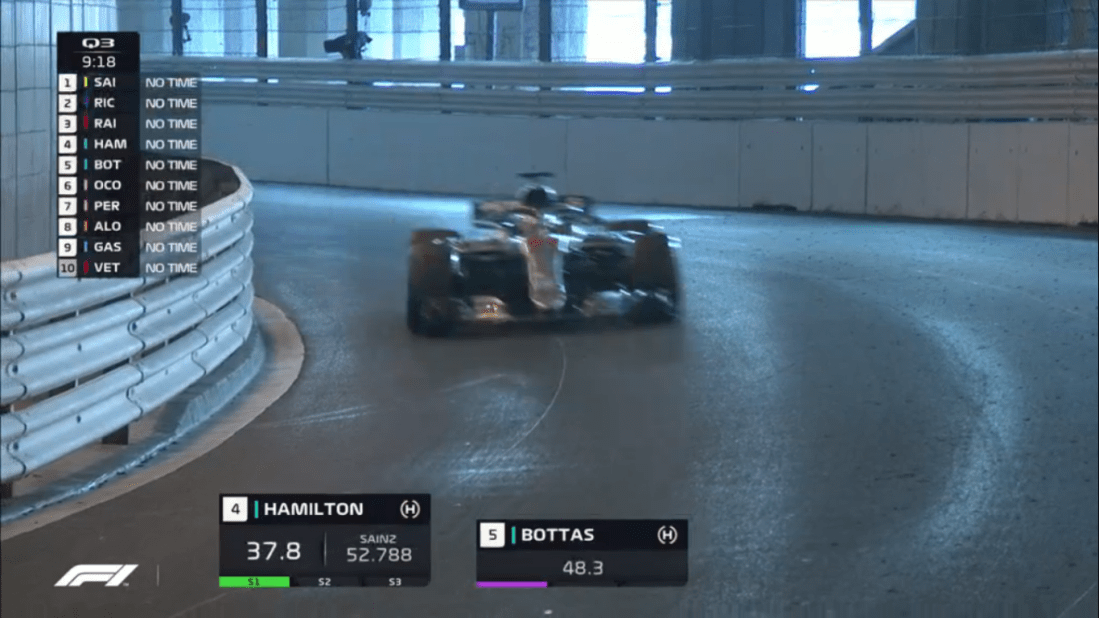
Looking towards Mercedes driver Valterri Bottas from the new camera position towards the end of Monaco’s tunnel.
Standards improved as Formula One Management wrestled control away from local broadcasters, giving fans a consistent view of the product throughout the year. The Japanese Grand Prix was the penultimate race to fall out of local control, Fuji Television last produced the race in 2011. One race though has remained with the local broadcaster: the prestigious Monaco Grand Prix.
Tele Monte Carlo continues to produce the Monaco round of the championship, meaning that the level of expertise on-hand is lower than at the other twenty races in the calendar. This has always been an issue but has become exasperated in recent years as FOM have centralised production.
Is it no coincidence that some consider Monaco to be one of the worst races in the calendar for action? Without turning this into a piece about the racing: yes, Monaco does not feature as much overtaking as other races on the calendar, due to the nature of the street circuit, which has been the case for years.
But, when fans have called as race ‘boring’, you need to ask what draws them to that conclusion. Formula 1 attracts in excess 50 million viewers worldwide per race, all of them watching the same World Feed. Fans can only judge the race based upon the angles the producer chooses to air.
We assume that the production team have chosen the best angles, based on the expertise of those around them. Most of the time, FOM does the job well, because they have the experts there. TMC however do not cover the sport throughout the year in the same way FOM does, and therefore do not have as many experts on-hand.
For all the criticism I do give FOM, their direction generally feels well-defined, whereas TMC’s product throughout the years during the Monaco Grand Prix weekend is rough around the edges.
On their Fan Voice site (login required), FOM have outlined how the split between them and TMC works. TMC are responsible for “directing the world feed, choosing where the cameras and microphones are, selecting which subject to follow, doing all the replays.”
In turn, FOM are responsible for “onboard cameras and all [of the] trackside infrastructure are our bag, as is all the official timing, the graphics.” The site also talks about the barriers this presents, such as the inevitable language barrier.
The Monaco problem
The problems for TMC encompass the entire weekend. Starting with practice and qualifying, TMC missed crucial laps, with Daniel Ricciardo’s initial lap record omitted from the World Feed, commentators having to refer to the timing screens to try to build the excitement level.
Following qualifying, it was clear where the two main storylines sat heading into the race. The first: would Ricciardo hold on to claim the victory that slipped away from him in 2016; and secondly, how far would Ricciardo’s team-mate Max Verstappen climb through the field?
From the very first lap, the trajectory of the direction went south. The timing graphics displayed a yellow flag symbol, indicating danger, following a collision between a Force India car and Toro Rosso driver Brendon Hartley.
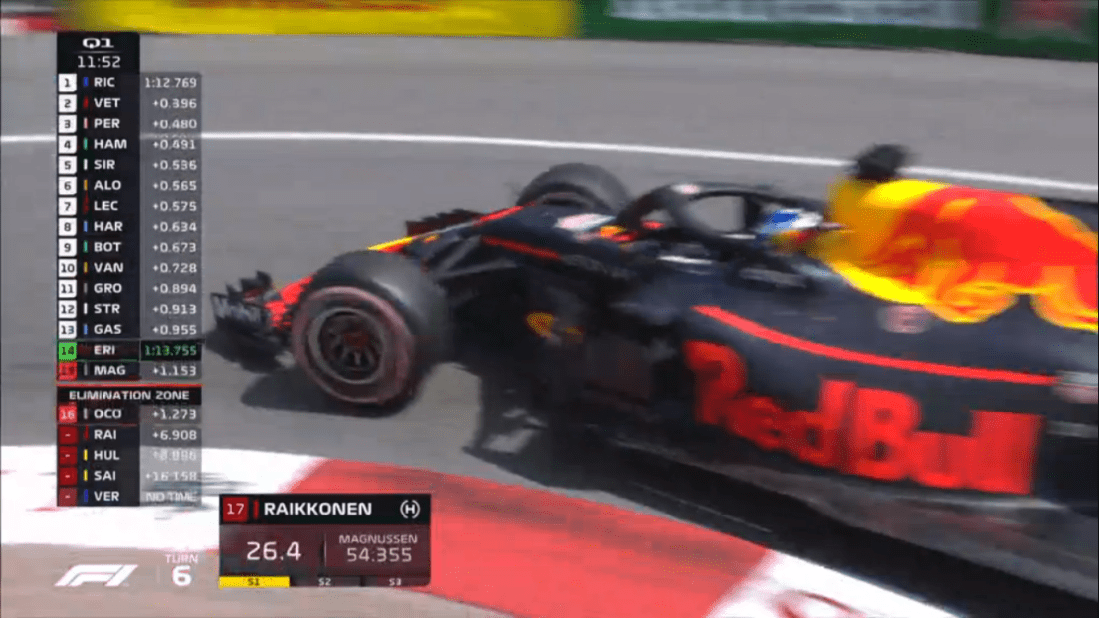
Daniel Ricciardo tackles Monaco’s Loews hairpin. This shot is fine, but the camera angles before and after are the same long distance shots as yester-year, with a focus on the surrounding advertising.
The symbol remained on-screen for the duration of the first lap, but TMC did not switch away from the leading contingent (although team radio from Hartley was played into coverage). At any other event, FOM would have jumped on-board with Hartley to show the viewers the extent of the damage, but not here. TMC’s World Feed output also did not capture the damage initially, FOM choosing to show this footage on its pit lane channel following its absence from the main feed.
It felt like the director was reluctant to switch attention away from the front-runners and towards Verstappen, failing to capture his moves on Ericsson and Hartley live. The on-screen timing graphics falling over at several points during the Grand Prix did not help, although it is unclear whether the blame here lies with FOM or TMC. But either way, it added to the poor presentation of the race, as a fan, I found it frankly frustrating to watch.
The timing pages should guide the production team towards the next on-track action, but TMC were seemingly not using this as a basis, something that became increasingly apparent in the latter stages as they failed to show how the likes of Esteban Ocon closed on the front-runners with relative ease. TMC failed to portray the sense of jeopardy that Monaco is meant to present.
On a brighter note, TMC were on-board Charles Leclerc’s Sauber as his brakes failed, smashing into Hartley’s Toro Rosso; whilst the introduction of a camera angle towards the end of the tunnel provided fantastic shots throughout the race weekend.
However, the ‘now available for live’ camera on the inside of Loews hairpin, was poor. The actual camera angle is good, but in the context of the camera angles before and after, switching from a camera angle with a car predominately in shot, to another predominately on advertising was jarring.
A good motor racing director can turn an average race into something watchable and engaging. A bad director on the other hand can persuade viewers to turn off an average race, and there is no doubt in my mind that TMC leans into the latter category.
Compared with motor racing, there are less variables with directing a football or tennis game, which makes the job of directing a motor race more critical than other sporting events.
If Liberty Media wants Monaco to receive a better rapport from fans watching the show, one step it desperately needs to take is to wrestle control off TMC, and to bring control of the Monaco World Feed in-house.
Daniel Ricciardo’s victory in the Monaco Grand Prix peaked with just over four million viewers, overnight viewing figures show.
Race
Live coverage of the race aired across four different channels on Sunday afternoon: Channel 4, and three of Sky’s channels.
Channel 4’s live programme, encompassing the build-up and the race itself from 13:00 to 16:30, averaged 2.15m (24.9%). The audience increased by 188,000 viewers compared with 2017’s average audience of 1.96m (23.8%) across a slightly shorter time slot. All of Channel 4’s race day broadcasts so far this year have recorded year-on-year increases.
Combined, Sky’s coverage averaged 721,000 viewers across Sky Sports F1, Sky One and Sky Sports Main Event. Last year’s programme aired across the F1 channel and Sky Sports Mix to an audience of 591k (7.2%), so yesterday’s audience increased year-on-year by 130,000 viewers.
Breaking Sky’s audience down, the F1 channel averaged 477k (5.6%) from 13:00 to 16:30 compared with 425k (5.2%) last year. Sky One averaged 167k (1.9%) across the same time slot, whilst 111k (1.2%) watched Main Event from 14:05 to 16:30, a shorter time slot than the other two Sky channels.
Sky’s average of 721,000 is their highest of the season so far, showing that simulcasting does make a difference to their total audience. Spain was an exclusive race for Sky last time out, which aired only on the F1 channel, whilst Monaco, simulcast across two different Sky channels, also aired on Channel 4.
The race started with 3.55m (41.0%) at 14:10, compared with 3.09m (37.0%) at 13:00 last year, so already at race start an extra half a million viewers were watching. The gap year-on-year remained around half a million viewers throughout, the trend relatively static.
A peak audience of 4.06m (42.5%) watched Ricciardo win the race at 15:50, a strong increase compared to last year’s peak audience of 3.53m (40.2%). At the time of the peak, 3.04m (31.8%) were watching Channel 4’s broadcast, with 1.02m (10.7%) watching across Sky’s three channels. The split was 75:25, compared with 76:24 at the time of the peak last year, suggesting that Sky One had little to no bearing on Channel 4’s audience, for the race at least.
The combined average audience of 2.87 million viewers is the highest average audience for Monaco since 2015, an increase of 12.5 percent on last year’s average of 2.55 million viewers. The race in 2016, which Channel 4 aired in highlights form, averaged 2.78 million viewers.
The combined peak audience of 4.06 million viewers is also the highest for Monaco since 2015, an increase of 14.9 percent on last year’s figure of 3.53 million viewers, and up 7.7 percent on 2016.
Qualifying and Analysis
Channel 4’s audience was equal compared with last year’s qualifying session. Live coverage from 12:55 to 15:45 averaged 1.14m (16.7%), compared with 1.14m (15.5%) across a shorter time slot last year. Their programme peaked with 1.73m (23.1%) as Ricciardo claimed pole, compared with 1.75m (21.7%) last year.
The additional viewers year-on-year came through Sky One’s simulcast. Live coverage on Sky Sports F1 averaged 267k (3.8%), versus 277k (3.8%) last year, whilst Sky One’s simulcast averaged 75k (1.1%). The combined Sky peak of 610k (8.5%) at 14:35 across two channels compares with 491k (5.9%) for just the F1 channel last year.
The combined average audience of 1.48 million viewers is a marginal increase on last year’s figure of 1.42 million viewers, with the combined peak audience of 2.33 million viewers an increase of 104,000 viewers year-on-year.
However, whilst the Monaco Grand Prix continues Formula 1’s excellent period from a viewing figures perspective, with no signs of slowing down, the Grand Prix was not the most watched sporting event over the weekend.
The big news story is that the UEFA Champions League final on Saturday evening between Liverpool and Real Madrid peaked with a massive 4.71m (25.8%) on BT Sport 2 alone, believed to be the biggest ever audience for a sporting event in the UK on pay television. The audience does not include the 1.8 million viewers that watched via BT’s digital platforms or YouTube, or the millions further that watched in pubs.
The 4.7 million viewers include those that watched the match for free on Virgin Media channel 100 and may take up a fair proportion of that figure. I mention the figure because it shows the lengths that BT went to, to ensure that the match reached the widest possible audience. The alternative would have been a ‘token gesture’, but BT again for the Champions League final went the distance to stream the final on YouTube.
Reality is that, events such as the Champions League are very rare: a match such as Saturday’s would have peaked with close to 15 million viewers on BBC or ITV. Divide that by three and you get to BT’s figure from Saturday. Divide the highest F1 peak from the BBC days by three, and you see why Sky struggles to break the two million peak mark for F1 (they have never done so).
Although Sky’s season high audience is a very good number for them, it is still relatively small money in the grand scheme of things, and they have failed to erode the current Channel 4 free-to-air audience for Formula 1.
Indianapolis 500 drops, but still respectable
The 2018 Indianapolis 500 peaked with 91,000 viewers on BT Sport 1 yesterday evening. Live coverage from 15:30 to 21:00 averaged 32k (0.26%). From 16:30 to 21:00, last year’s equivalent slot, the race averaged 38k (0.30%), unsurprisingly a substantial drop on last year’s audience of 129k (0.91%) when there was major attention on Fernando Alonso.
Of more interest is that this year’s audience tripled compared to 2016’s average of 12k (0.09%). The peak audience of 91k (0.64%) came at 19:05, also a major increase on the 2016 peak figure of 31k (0.16%). If anything, it shows that some of last year’s audience did return for this year’s race, even if it never hit the heights that it did last year.
The 2017 Monaco Grand Prix ratings report can be foundhere.


 Motorsport Broadcasting