Analysing Formula 1’s new on-air package

Touted as being a revolution to the way fans watch Formula 1 around the world, F1’s new on-air package debuted at the 2018 Australian Grand Prix. After the first three races, is the sport living up the hype?

Even at this early stage in the season, there have been several notable changes on-screen to World Feed, although some mooted adjustments have yet to come to fruition.

Music
Historically, Formula 1’s opening sting five minutes each session did not feature the stars of the show. From 1994 to 2002, the sting featured many segments untangling to create the FIA Formula 1 World Championship logo, with a well-loved backing track.

The sting from 2003 to the end of 2017 went through several iterations (2003 to 2008; 2009 to 2011 and 2012 to 2017), predominantly featuring different coloured lines racing around in circles, eventually leading to the F1 logo. Whilst both fulfilled the individual briefs, neither introduced the characters that would feature in the next 90 minutes of action.

The 2018 version, created by Californian based Drive Studio, uses a cut of Formula 1’s new theme song from Brian Tyler, and is twice the length of yesteryear. Critically, the sting introduces the drivers to casual fans, with a fast pace to the theme song. Liberty Media’s mission was to bring the stars to the forefront, and the five-minute sting helps to fulfil that remit.

A minor drawback is that the introduction will need to change in the event of driver moves, so comes with an overhead for Formula One Management. Tyler’s theme has grown in stature so far this season. Some might argue the sting is not as impactful as previous iterations, but the purpose is different, and it satisfies Liberty’s intended direction perfectly.

There was a worry that music would begin to dominate the race broadcasts, but that fear so far is unfounded. Apart from brief interludes for the starting grid introduction and in pre-race parc ferme, music was absent from the race itself. The only interference has come with the replay swipe. The swipe features the sound of a V8 engine, too loudly and to the detriment of the broadcast.

Timing wall – team logo, numbers, and compounds
Last November, as part of the unveiling of Formula 1’s new logo. Wieden+Kennedy (W+K) published mock-ups of what the 2018 graphics set may look like, which raised cause for concern at the time. Like with the music, the concern was unfounded, although there are still drawbacks currently with the timing wall.

Now in its fifteenth year on Formula 1 television, the latest iteration of the timing wall clearly displays when drivers have moved up or down the order. In the race this is important: if two drivers switch positions the number of the driver that gained the position has their position highlighted in green; with red for the driver who lost out. A simple but positive change (even if it leaves me pulling hairs out at the director, sometimes).

Additional information displayed at regular intervals, such as the team logo and driver numbers. Both show the flexible and dynamic nature of the timing wall to switch between the two at given intervals, which will only help when FOM implements new features.

Tyre compound information is part of this puzzle, as an alternative option to the team logo and driver number, however seems to be less popular with FOM’s television director. The team logos and driver numbers help casual viewers, tyre graphics may confuse them. On the other hand, tyre choice can dictate the outcome of the race as we have already seen in 2018 and should receive preferential treatment.
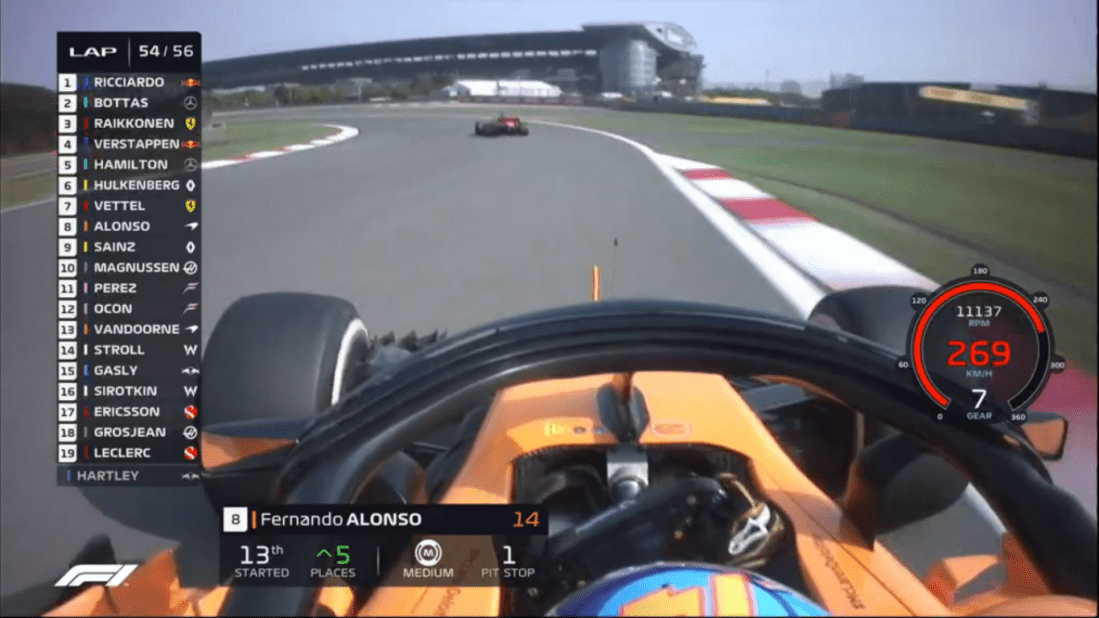
2018 Chinese GP - Fernando Alonso.png
Riding on-board with McLaren’s Fernando Alonso during the 2018 Chinese Grand Prix.

As a racing fanatic, on the MoSCoW scale, tyre graphics are a must have, but ask a casual fan and they might give you a different answer. It is balancing the priorities. A secondary point is that the tyre graphics need to be accurate, which FOM have struggled with on occasion.

Font sizes and yellow flags
It is important with any kind of graphics set to have a uniform look across its on-air package, with the same font package used throughout and eligible font sizes. F1’s package breaks one of these.

There are two fonts on offer during Formula 1’s broadcasts. The first is a ‘broadcast safe’ font; the second is one of the fonts created as part of W+K’s suite of fonts. A major oversight is that W+K did not create a broadcast safe font, meaning that the graphics set resembles a half-way house where multiple remits are trying to be satisfied (the ‘a’ in W+K’s font does not look good on-screen).

Uniformity is critical throughout the package, and I feel that F1 has some way to go in this space, which is disappointing considering how well 2017’s graphics set fulfilled this (and that is not even accounting for Formula Two or GP3, both remain stranded in yesteryear).

Australia highlighted shortcomings that F1 could have avoided if adequate user testing occurred beforehand, on a variety of devices. In FOM’s defence the timing wall font, which was too small during the Melbourne race weekend, was quickly rectified starting with the Bahrain Grand Prix.

A second basic issue that slipped through the radar concerns the yellow flag graphics. The yellow flag graphic displays over the counter, effectively ‘hiding’ the counter. This becomes an issue when the Safety Car is deployed, as it means the lap counter goes missing for several laps. In China, Formula 1’s television director resorted to displaying the lap counter separately at the foot of the screen next to the F1 logo.

FOM also need to give drivers’ names suitable breathing room within the timing wall, like they did with previous iterations of the wall. Now, ‘Magnussen’ and ‘Hulkenberg’ both feel too squashed, which is a struggle to read if you are not sitting close to the monitor.

Halo impact
Failing to prepare, is preparing to fail. The Halo has been mooted since the events of the 2014 Japanese Grand Prix, and was first agreed in February 2016, although introduction of the device was eventually pushed back to 2018.

The Halo is a device focused on improving safety, aesthetics is a secondary consideration, with no room for experimentation. Could the device bring fans closer to the drivers, through cameras embedded within the Halo? Could the FIA embed a camera within the Halo looking directly at a driver; or a rotating 360-degree camera attached to the Halo?
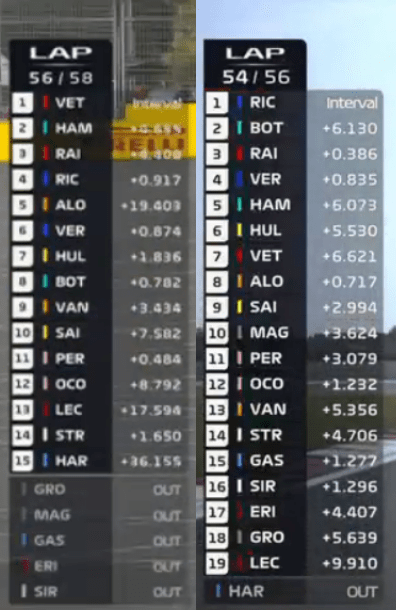
F1 timing wall - 2018 Australia vs 2018 China
Formula One Management reacted quickly to complaints about the font size in the timing wall, switching from the left (Australia) to the right (China)

It appears Formula 1’s television team and the FIA did not discuss the potential impact the Halo would have on traditional on-board camera angles, such as the shoulder length and T-cam angles. This is a problem that Liberty Media have inherited, rather than one of their own doing.

There is also the possibility that the FIA refused (or would refuse) to budge in any instance, believing that the structural integrity of the Halo is of greater importance than enabling a better viewing experience for the television viewer. Nevertheless, after three races the Halo is not detracting from my viewing of F1 as much as I previously anticipated.

Even if the FIA were unwilling to change the Halo, it says a huge amount about the working relationship between the FIA and FOM that no tweaks occurred to the homologated 2018 car design (i.e. positioning of cameras year-on-year) to allow for a better television product.

Camera angles and direction
One of the ethos of Liberty Media heading into the new season was to make the cars look faster on-screen with closer camera angles, more akin to the F1 Digital+ days, and less focus on the advertising surrounding the circuit.

Based on the first three races, Formula 1’s direction this year will be an evolution and not a revolution. Expecting FOM to break old habits straight away is unrealistic, and besides, expecting the likes of virtual advertising to disappear is also unrealistic.

A variety of rumoured elements that would have impacted race direction, such as music (mentioned further up) and a race highlights package at the top of the hour, failed to materialise. That does not mean the initial reports were inaccurate: these were, according to the BBC, discussed during the F1 Broadcasters’ Summit in January. But negativity around the areas, along with other heavily commercialised aspects of the broadcast, resulted in their absence from Australia.

Anyone expecting a revolution might have been disappointed after Melbourne after the pre-season speculation. Nevertheless, FOM have made a few small, but notable steps to improve their race broadcast.

2018 Bahrain F2 race
By staying with the old graphics package, the above screenshot from the opening Formula Two feature race of the season only serves to demonstrate the work Formula One Management needs to do with Formula 1’s new package to bring it to the standard of last year’s F1 package.

The race direction has improved, as demonstrated in the second half of the Chinese Grand Prix, with all the key action following the Safety Car period covered live. The decision to jump on-board with Daniel Riccardo as he positioned his car to overtake Valtteri Bottas was inspired. Similarly, we were on-board with Max Verstappen’s failed attempt to drive round the outside of Lewis Hamilton.

While the Halo is clearly present in the on-board angles used, the device does not deter from my enjoyment of the action. There is a greater emphasis from the television director on on-board angles in 2018 even with the Halo, and that is only a good thing in my view. The camera angles compared with 2017 are largely the same, although FOM have added angles to help capture the speed, such as on the apex of turn one in China, showing cars swoop in and out of shot.

There is always room for improvement: elsewhere in China the director during the first half should have looked further down the order to Fernando Alonso and Romain Grosjean for the action instead of focusing on the status quo up front. The On-Board Mix was showing this battle to a very small audience when the World Feed airing to millions was focussed on little action up front.

This was frustrating, as fans were ridiculing the race on social media before the Safety Car period because the director was not up to the job. If the director wanted to keep focusing on the leading drivers, I dare say that picture-in-picture was an option here.

Formula Two receives further attention from FOM
An early revolution in 2018 is the attention that Formula One Management is giving Formula Two, with a variety of on-screen additions. Previously, Formula 1’s World Feed treatment towards the championship has consisted of commentary over the feed, followed by podium interviews. This season’s efforts go a step further.

In the commentary box for 2018, Alex Jacques remains lead commentator alongside Davide Valsecchi, with Sky’s analyst Johnny Herbert joining for the Bahrain sprint race. For the first time, Rosanna Tennant provided additional support from pit lane, reporting on any news from the garages as well as interviewing the top three drivers in parc ferme.

Over on social media, Formula 1’s channels are giving the series more coverage, with Will Buxton on hand, helping fans connect to future talent. However, a gap remains on the highlights front.

Formula 1’s highlights are uploaded to YouTube on the same day, whilst Formula Two’s video reel is added to their website several days after the race. Clearly there is a huge gulf between the number of visitors that YouTube has daily compared with the Formula Two website, so ideally Formula Two’s highlights should also be uploaded to the F1 YouTube channel. A relatively simple change could make a huge difference to the championship, which Formula 1 needs to exploit to grow the popularity of the feeder series.

A major negative for me is that Formula Two and GP3 have retained the old graphics set, which feels like a duplication of systems. Moto2, Moto3 and MotoGP all use the same underlying set, coordinated with one another, and all make the migration from one set to another at a given time, so why are FOM unable to achieve this? It makes Formula Two, and GP3, look like the unloved bit on the side.

The edict to Wieden+Kennedy last year should have included Formula Two and GP3, in the same way Moto3 and Moto2’s package is identical to MotoGP, the only minor difference surrounds the logo (‘2’ and ‘3’ instead of ‘GP’).

Other bits and final thoughts
Although F1 TV Pro is not set to begin until Spain, Will Buxton’s presence has been felt in Formula 1’s online content, with a 30-minute Paddock Pass on Thursday previewing the race, and then a further 30-minute show on Sunday evening reviewing the race. Both videos round-up the interview pen pieces with drivers’ that Buxton has covered earlier in the day, with Buxton giving his views in between.

Whether FOM is using Buxton to his full potential compared with his NBC stint is up for debate, I suspect we will see more once F1 TV Pro gets off the line, so it is too early to come to any conclusions yet. Elsewhere on the social media spectrum, the Drivers’ Parade is now airing live on Facebook, which is great news for those that like to see the unedited interviews rather than the trimmed down versions that make Sky’s race day broadcast on a small delay.

In other teething problems, the live speed counter does not add anything to the live broadcast for me and does not appear to serve any purpose. It needs something additional added, as an example, perhaps as the speed increases, seeing other drivers’ top speed at that point may help. Lastly, the graphics set has some jarring colour clashes. The dark red for Sauber’s driver numbers, up against a black background, is one such example.

Overall, the on-air package is not as bad as I feared considering the Wieden+Kennedy mock-ups that appeared as part of the logo unveiling in November. The package unveiled in Australia has the potential to be an excellent package for Formula 1. But for that to happen, a variety of issues outlined above need to be addressed, and rectified.

Scheduling: The 2018 Azerbaijan Grand Prix / Paris E-Prix

Host of a thrilling race last year, the Baku Street Circuit returns in an earlier slot on the 2018 Formula One calendar.

Because of the domino effect surrounding France, it means that Baku takes the slot previously taken by Russia, with Russia moving into the late-September slot held by Malaysia; Malaysia of course no longer on the calendar for 2018.

The race weekend airs live on both Sky Sports and Channel 4. Eddie Jordan returns to Channel 4’s line-up for the first time in 2018, whilst Lee McKenzie returns after missing Bahrain and China.

Elsewhere, Formula E returns, but the race is only live on 5Spike this weekend. Channel 5’s main station at the same time is airing live coverage of the Premiership Rugby, whilst Eurosport’s duties are split between the World Snooker Championship and cycling’s Tour of Romandy.

If Formula 1’s qualifying session overruns slightly, it will also clash with Formula E’s race. The Paris round is due to get underway at 15:04 UK time, with F1 qualifying running from 14:00 to 15:00.

Channel 4 F1
Sessions
27/04 – 09:55 to 11:45 – Practice 1
27/04 – 13:55 to 15:35 – Practice 2
28/04 – 10:55 to 12:25 – Practice 3
28/04 – 12:55 to 15:45 – Qualifying
29/04 – 12:00 to 16:30 – Race
=> 12:00 – Build-Up
=> 12:40 – Race
=> 15:55 – Reaction

Sky Sports F1
Sessions
27/04 – 09:45 to 11:55 – Practice 1 (also Sky Sports Main Event)
27/04 – 13:45 to 15:50 – Practice 2
28/04 – 10:45 to 12:15 – Practice 3
28/04 – 13:00 to 15:45 – Qualifying
=> 13:00 – Pre-Show
=> 13:55 – Qualifying
29/04 – 11:30 to 16:10 – Race
=> 11:30 – Pit Lane Live
=> 12:30 – On the Grid
=> 13:05 – Race
=> 15:30 – Paddock Live

Supplementary Programming
25/04 – 20:30 to 21:00 – The F1 Report: Preview (also Sky Sports Mix)
26/04 – 12:00 to 12:30 – Driver Press Conference
26/04 – 20:45 to 21:00 – Paddock Uncut
28/04 – 15:45 to 16:20 – The F1 Show
02/05 – 20:30 to 21:00 – The F1 Report: Review

BBC Radio F1
26/04 – 21:30 to 22:00 – Preview (BBC Radio 5 Live)
27/04 – 09:55 to 11:35 – Practice 1 (BBC Radio 5 Live Sports Extra)
27/04 – 13:55 to 15:35 – Practice 2 (BBC Radio 5 Live Sports Extra)
28/04 – 10:55 to 12:05 – Practice 3 (BBC Radio 5 Live Sports Extra)
28/04 – 13:55 to 15:05 – Qualifying (BBC Radio 5 Live Sports Extra)
29/04 – 13:00 to 15:00 – Race (BBC Radio 5 Live)

Formula E – Paris (online via YouTube)
28/04 – 06:55 to 07:55 – Practice 1
28/04 – 09:25 to 10:10 – Practice 2

Formula E – Paris
28/04 – 10:30 to 12:00 (Eurosport 2)
=> 10:30 – Preview
=> 11:00 – Qualifying
28/04 – 10:45 to 12:10 – Qualifying (5Spike)
28/04 – 14:30 to 16:20 – Race (5Spike)
28/04 – 16:35 to 18:00 – Race Delayed (Eurosport 2)
29/04 – 11:40 to 12:45 – Highlights (Channel 5)

British Touring Car Championship – Donington Park (ITV4)
29/04 – 10:40 to 18:20 – Races

Formula Two – Azerbaijan (Sky Sports F1)
27/04 – 07:55 to 08:55 – Practice
27/04 – 11:55 to 12:35 – Qualifying
28/04 – 08:55 to 10:10 – Race 1
29/04 – 10:05 to 11:05 – Race 2

World Rally Championship – Argentina
Every stage live via WRCPlus.com
26/04 – 23:00 to 00:00 – Live: Stage 1 (BT Sport 1)
28/04 – Day 1 Highlights
=> 09:30 to 10:00 (Motorsport.tv)
=> 12:30 to 13:00 (BT Sport 2)
28/04 – 13:00 to 14:00 – Live: Stage 10 (BT Sport 2)
28/04 – 18:00 to 19:00 – Live: Stage 14 (BT Sport/ESPN)
29/04 – Day 2 Highlights
=> 09:30 to 10:00 (Motorsport.tv)
=> 12:30 to 13:00 (BT Sport 2)
29/04 – 13:00 to 14:00 – Live: Stage 16 (BT Sport 2)
29/04 – 16:00 to 17:30 – Live: Stage 18 [Power Stage] (BT Sport/ESPN)
30/04 – Day 3 Highlights
=> 09:30 to 10:00 (Motorsport.tv)
=> 09:30 to 10:00 (BT Sport 1)
01/05 – 19:00 to 20:00 – Highlights (Channel 5)

As always, the above will be updated if anything changes.

Chinese Grand Prix continues F1’s upward trajectory

The Chinese Grand Prix continued Formula 1’s positive start to 2018, overnight UK viewing figures show.

Race
It was a clean sweep on race day, with both Sky and Channel 4 recording year-on-year increases, across both the average audience and peak audience metrics.

Live coverage of the race, which Sky aired across its F1 and Main Event outlets, averaged 494k (12.1%) from 06:00 to 09:30, a slight increase on last year’s audience of 484k (13.2%). It is Sky’s highest audience figure for China since 2015, when the race averaged 589k (15.2%).

The slight drop in share for Sky’s coverage of the race maybe a result of the BBC’s coverage of the Commonwealth Games, resulting in a higher number of viewers watching television at breakfast time.

Sky’s coverage on the F1 channel averaged 335k (8.3%), with Main Event adding a further 159k (3.8%). I should note that last year’s coverage aired exclusively on the F1 channel, but the impact of a simulcast in the breakfast slot is small regardless.

Daniel Ricciardo’s victory peaked with a healthy 847k (13.4%) at 08:45, a 4.1 percent increase on last year’s peak audience of 813k. At the time of the peak, 541k (8.5%) were watching via the F1 channel, with 305k (4.8%) watching via Main Event, a split of 64:36.

Later in the day, Channel 4’s highlights programme averaged 1.88m (17.6%), a massive 23.8 percent up on last year’s average of 1.52m (18.5%). The audience share is lower as total television audience during Formula 1’s time slot was up by 2.4 million viewers year-on-year.

There are various reasons why the total audience can fluctuate massively year-on-year: the weather, Bank Holiday weekends, football matches, other sporting competition not just on free-to-air but elsewhere, and so on. There is an argument as a result to say that their audience should have been even higher than what it actually was.

However, Channel 4’s audience is the highest for China in the three years that they have been covering Formula 1, so it is a very solid number. A peak audience of 2.48m (20.6%) watched Ricciardo’s victory on Channel 4, also a substantial increase on last year’s peak audience of 2.05m (22.3%).

The combined average audience of 2.37 million viewers is an increase of 18.6 percent on last year’s average of 2.00 million viewers. Compared with 2016, the average audience is up by 12.1 percent, making it the highest rated Chinese Grand Prix since 2015, when the race averaged 3.56 million viewers. Similarly, the combined peak audience of 3.32 million viewers is the highest since 2015, up 15.9 percent year-on-year.

Qualifying and Analysis
For the third race in a row, viewing figures for qualifying dropped compared to 2017.

Live coverage of qualifying aired across Sky Sports F1 and Main Event to an audience of 188k (5.1%) from 06:00 to 08:45. 140k (3.9%) watched via the F1 channel, with the remaining 48k (1.2%) watching via Main Event. This was the earliest time slot for qualifying in China since 2014. Back then, Sky’s exclusive coverage of qualifying averaged 236k (7.1%).

Channel 4’s highlights programme aired from 13:00 to 14:30, with 840k (11.0%) tuning in, a decrease on last year’s audience of 861k (13.9%). The combined average audience of 1.03 million viewers is likely to be the lowest for a Saturday qualifying session since the mid 2000’s.

The audience trends so far in 2018 are very interesting. The great news for Formula 1 is that all three races have increased their audience year-on-year, with Bahrain and China recording three-year highs. Given the events of Baku last year, I think we should expect a small year-on-year decrease for Azerbaijan, but nothing dramatic.

You would expect qualifying to follow the trend, except the numbers for qualifying show that viewing figures are dropping for the third consecutive season, even in the face of increases for the race programming. The format of qualifying has been the same for 2006, and you do wonder if the time for change is coming, as mooted in some quarters.

As always, the UK is just a very small snippet of the overall F1 picture, but it would be fascinating to see if the same viewing trends are happening worldwide.

The 2017 Chinese Grand Prix ratings report can be found here.

overnights.tv-bannersF1

A quick-fire guide to your motor racing streaming services for 2018

Over the years, this site has tended to cover television coverage more than other forms of media, with weekly television schedules whenever there is a Formula 1 race on. The site also has a dedicated page covering all the key UK television and radio contracts.

But, alongside your traditional methods, many championships allow you to watch their action online. Here, we look at what each championship offers directly to the consumer, bypassing the broadcasters, or not as the case may be. This article is aimed at UK readers, but the information may be useful for overseas readers as well.

Note – This is an experimentation post and may not cover every single series out there. Please leave a comment if you find this useful and would like to see this repeated in future with updated information.

Dorna Sports (review)
The commercial rights holder for MotoGP and World Superbikes, Dorna Sports have over-the-top platforms for both. Every session, including support races, airs live on the over-the-top platform with a dedicated on-site team. Full-length replays are available if you missed the action first time round, with the fan able to view the action from a variety of on-board camera angles. Access to the respective platforms also unlock MotoGP’s and World Superbikes’ rich archive.

Available via desktop, Android and Apple devices, the MotoGP package is priced at £174.36 for the complete season, or £44.45 in four instalments. The World Superbikes offering is considerably cheaper than MotoGP at £60.98 for the season, or £13.00 per month. Even considering the smaller calendar, on a per-race weekend basis, the MotoGP price works out at £9.18, whilst the Superbikes offering is just £4.69, a sign of their respective popularity.

Formula E
Despite being one of the newer series in this list, surprisingly the electric Formula E championship does not have an over-the-top platform. Fans wanting to watch the action can find some live coverage on Formula E’s YouTube channel, but the availability depends on territory. UK fans can watch live practice on their YouTube channel, but no further than that.

The geo-blocking restrictions are lifted after the session for practice and qualifying, whilst full races are made available several weeks after the race, although one might argue that they have lost their value by that point in time. The lack of an over-the-top platform currently may come and bite them back in a few years’ time, especially considering the recent developments from Formula 1.

Formula One Management
Announced in February, Formula 1 has confirmed that their streaming service will launch ready for the Spanish Grand Prix in May. At launch, F1 TV Pro will be available via desktop and will only contain Formula 1 coverage; with other devices, and the appearance of the feeder series’ coming later in the year.

However, UK fans will not have access to the premium version due to the television agreements already in place. Barring some form of new arrangement between Formula One Management and Sky, do not expect UK fans to be able to access F1 TV Pro until 2025. F1 TV Access though, is another question…

GT Sport Organisation
GT Sport created and is responsible for the Euroformula Open and the International GT Open, both of which air live in the UK on BT Sport.

As with other championships on a similar footing, GT Sport live streams the action on their two YouTube channels, covering qualifying and the race: EuroFormulaOpen and GTOPENseries. English commentary comes from Ben Evans, who fans in the UK may recognise from BT Sport’s IndyCar coverage.

IndyCar
Unlike Supercars below, IndyCar does not currently offer an over-the-top product for overseas fans of the championship. Race Control only extends as far as live timing, but no visual imagery is involved. However, its social media offering is comprehensive, with live streaming of its feeder Indy Lights series, as well as live action from practice via their various outlets.

For fans without access to BT Sport, the full US race programme from either ABC, ESPN or NBC is uploaded to IndyCar’s YouTube channel around four days after the event. With IndyCar’s domestic rights in the US changing for 2019 in NBC’s favour, the streaming picture could change as well.

SRO Motorsports Group
Not to be confused with GT Sport’s portfolio of championships, SRO Motorsports Group is the commercial rights holder for several of the leading GT championships worldwide. If you are into GT racing, the GTWorld YouTube channel, operated by SRO, is the place to be.

It is on YouTube where SRO live stream the likes of the Blancpain GT Series and the British GT, for free. In addition, the Blancpain website plays host to live streaming of the GT Series.

Supercars
Not in Australia? No problem. The Virgin Australia Supercars streaming service SuperView gives fans outside of Australia the ability to live stream, rewind and replay every Supercars qualifying and race session in 2018. The restriction that previously applied to the Australian Grand Prix weekend was lifted for 2018, meaning that all events are now available on the service.

Priced at £32.80 based on the current conversion rate for the complete season, SuperView is a steal if you are looking to watch some motor racing action at your leisure throughout 2018. With 16 races across the year, the series costs UK fans just £2.05 per race weekend.

World Rally Championship (review)
From 2018, rally fans can view every World Rally Championship stage live. For £7.79 a month, or £77.98 for a complete year, fans can watch every stage either live or on-demand across a variety of devices.

However, you can only do that up and until the next rally comes along: there is no way to view the ‘All Live’ content once it disappears from the schedule a few days after the event finishes. Whilst the live element is great, WRC’s over-the-top product is still rough around the edges which is worth bearing in mind if you are unlikely to watch the action in a timely fashion. Nevertheless, WRC’s pricing structure remain extremely good value for money.

Are there any other major championships that have streaming capability that I have not mentioned? Have your say in the comments below.

Scheduling: The 2018 Chinese Grand Prix / Rome E-Prix

The Chinese Grand Prix plays host to round three of the 2018 Formula One season from the Shanghai International Circuit.

Sky Sports F1’s coverage sees the return of Anthony Davidson for the first time this season. In what might be a first for their coverage, every on-track session is simulcast live on Sky Sports Main Event.

Over on Channel 4, Louise Goodman is the super substitute this weekend for Lee McKenzie. McKenzie returns to Channel 4’s output in Azerbaijan. Aside from the race starting ten minutes later, Saturday’s on-track action takes place one hour earlier than last year.

Formula E heads to Rome for the first time, with the action airing live on 5Spike and Eurosport. In Channel 5’s defence, the race clashes with live coverage of the Premiership Rugby, hence why Formula E finds itself on Channel 5’s sister station again.

Elsewhere, the Euroformula and International GT series’ return to BT Sport for the start of the 2018 season.

Channel 4 F1
Sessions
14/04 – 13:00 to 14:30 – Qualifying Highlights
15/04 – 14:15 to 16:30 – Race Highlights

Sky Sports F1
Sessions (also Sky Sports Main Event)
13/04 – 02:45 to 04:50 – Practice 1
13/04 – 06:45 to 08:50 – Practice 2
14/04 – 03:45 to 05:15 – Practice 3
14/04 – 06:00 to 08:45 – Qualifying
=> 06:00 – Pre-Show
=> 06:55 – Qualifying
15/04 – 05:30 to 10:10 – Race
=> 05:30 – Pit Lane Live
=> 06:30 – On the Grid
=> 07:05 – Race
=> 09:30 – Paddock Live

Supplementary Programming
11/04 – 20:30 to 21:00 – The F1 Report: Preview (also Sky Sports Mix)
12/04 – 08:00 to 09:00 – Driver Press Conference
12/04 – 20:45 to 21:00 – Paddock Uncut
14/04 – 08:45 to 09:20 – The F1 Show (also Sky Sports Main Event)
18/04 – 20:30 to 21:00 – The F1 Report: Preview

BBC Radio F1
12/04 – 21:30 to 22:00 – Preview (BBC Radio 5 Live)
13/04 – 02:55 to 04:35 – Practice 1 (BBC Radio 5 Live Sports Extra)
13/04 – 06:55 to 08:35 – Practice 2 (BBC Radio 5 Live Sports Extra)
14/04 – 03:55 to 05:05 – Practice 3 (BBC Radio 5 Live Sports Extra)
14/04 – 06:55 to 08:05 – Qualifying (BBC Radio 5 Live Sports Extra)
15/04 – 06:30 to 09:00 – Race (BBC Radio 5 Live)

Formula E – Rome (online via YouTube)
14/04 – 06:55 to 07:55 – Practice 1
14/04 – 09:25 to 10:10 – Practice 2

Formula E – Rome
14/04 – 10:45 to 12:10 – Qualifying (5Spike)
14/04 – 14:30 to 16:15 – Race (5Spike)
14/04 – 13:45 to 16:15 (Eurosport)
=> 13:45 – Qualifying
=> 14:45 – Race
15/04 – 11:50 to 12:50 – Highlights (Channel 5)

British Superbikes – Brands Hatch
14/04 – 15:30 to 18:00 – Qualifying (Eurosport 2)
15/04 – 13:00 to 18:00 – Races (Eurosport 2)
18/04 – 20:00 to 21:00 – Highlights (ITV4)

Euroformula – Estoril
14/04 – 14:00 to 15:00 – Race 1 (BT Sport X2)
15/04 – 12:00 to 13:00 – Race 2 (BT Sport 1)

European Le Mans Series – Le Castellet (Motorsport.tv)
15/04 – Race
=> 10:45 to 13:00
=> 15:00 to 16:00
=> 18:00 to 19:30

IndyCar Series – Long Beach (BT Sport/ESPN)
15/04 – 21:00 to 00:00 – Race

International GT Open – Estoril (BT Sport/ESPN)
14/04 – 15:00 to 16:45 – Race 1 (BT Sport/ESPN)
15/04 – 13:00 to 14:30 – Race 2 (BT Sport 1)

World Superbikes – Aragon
14/04 – 09:00 to 14:00 – Qualifying and Race 1 (Eurosport 2)
15/04 – 10:00 to 13:00 – Race 2 (Eurosport 2)
17/04 – 20:00 to 21:00 – Highlights (ITV4)

The above will be updated if anything changes.

Update on April 13th – As several people have pointed out, it is FOM’s feeder series commentator Alex Jacques in the 5 Live commentary box today. Jacques will remain there for tomorrow, with Jack Nicholls returning for the F1 race on Sunday.