Haryanto and Verstappen shine on social media

Whilst this site tends to focus on the efforts of Channel 4 and Sky Sports where Formula 1 is concerned, it is important to comment on what Formula One Management (FOM) has done so far during 2016. With that, we also turn to social media where there have been several shining lights.

Formula 1 is constantly trying to break into new territories, so when a racer from a new territory comes along, it is little surprise to see their follower counts skyrocket. Enter Rio Haryanto. At the half way stage of the 2016 season, Haryanto has amassed a combined reach of 1.66 million accounts across Facebook, Twitter and Instagram. A video posted by FOM on YouTube of his car rolling out the garage in pre-season testing has been watched over half a million times. These are massive numbers by F1’s standards, even with Haryanto’s Formula 1 exploits ending for the moment. Whether Formula 1’s popularity (beyond Haryanto) has increased in Indonesia though is unknown.

Max Verstappen has had a similar effect in the Netherlands, and his shock switch from Toro Rosso to Red Bull has helped the latter in the social media stakes. From a combined reach of 6.36 million accounts in December 2015 to a reach of 8.08 million accounts currently, this represents an increase of 1.72 million (or 27.0 percent), the largest for any team across the first half of 2016. Mercedes, McLaren, Ferrari and Renault all recorded gains of around 950,000 followers. Behind the leading five, Haas did not disgrace themselves, moving from a combined reach of 146,000 in December to 480,000 currently.
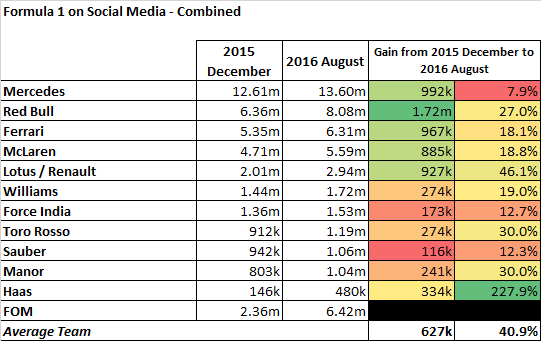
Social media - August 2016 - Figure 1
The Formula 1 social media statistics, covering Facebook, Twitter and Instagram, as of August 2016.

Mercedes again had the lowest percentage increase, but with their reach increasing by one million from 12.6 million to 13.6 million followers across the big three social media websites, they cannot complain. Force India and Sauber had a relatively poor first half of 2016, both teams only increasing their reach by less than 200,000 followers.

Verstappen on the march
The surge that started in 2015 has continued into 2016. In July 2015, Verstappen’s accounts on Facebook, Twitter and Instagram reached 247,000 followers. Now, that number has quintupled to a reach of 1.28 million followers. That’s an amazing turn of form. What we don’t know, is where those followers are distributed. I suspect, unlike Haryanto, Verstappen’s followers are distributed more widely to the rest of Europe given the impact that he is likely to have on Formula 1 in the years ahead. Viewers watching this weekend’s Belgian Grand Prix weekend will have noticed a large Dutch contingent out in force.

Behind Verstappen and Haryanto in the impressive stakes is Nico Rosberg, who jumped from reaching 2.71 million accounts across Facebook, Twitter and Instagram at the end of 2015 to reaching 4.36 million accounts half way through 2016. It is likely that Rosberg will become the second biggest social media star in F1 by the end of 2016, surpassing Fernando Alonso. That is surprising in one sense given their respective personalities, but Rosberg’s strong form in the early races will have played its part in the growth numbers. Germany’s television viewing figures have bounced back slightly this year, so Rosberg is getting more support from home than previously.
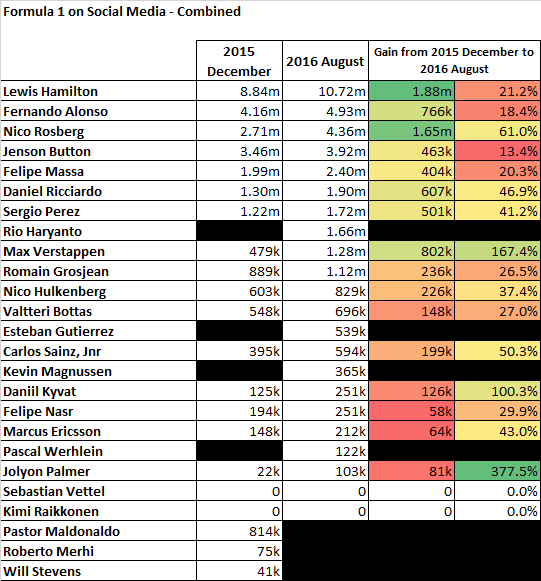
Social media - August 2016 - Figure 2
The Formula 1 social media statistics, covering Facebook, Twitter and Instagram, as of August 2016.

Whilst ten drivers possess a reach of over one million followers, only half show significant growth (if we discard Haryanto): Hamilton and Rosberg lead by some margin, followed by Verstappen, Fernando Alonso, Daniel Ricciardo and Sergio Perez. Jenson Button, Felipe Massa and to a smaller degree Alonso have a stagnated follower base as Button and Massa start to ebb towards the end of their respective careers.

Instagram continues to grow at a faster rate than both Facebook and Twitter, jumping from a cumulative total of 8.57 million at the end of 2015 to 15.90 million currently. Their market share has increased from 12.8 percent to 18.1 percent as a result. Twitter’s slow down continues, but nevertheless increased from a cumulative total of 22.3 million to a healthy 27.5 million. Overall, the metrics are all up from the same time last year, and increasing at a faster rate which is good news for the sport moving forward.

Formula One Management… getting better?
Normally, I use the rule that if I’m complaining about things less, then chances are that it is actually getting better. I think that is the case with FOM’s television coverage! With tweaks to on-board camera angles and overall a greater sense of speed through different trackside cameras, things do appear to be moving in the right direction. Of course, the coverage has been let down by the outlandish team radio rules…

Team radio was first introduced to Formula 1’s television feed as part of the F1 Digital+ service. The service was introduced in 1996, coming to the United Kingdom in 2002 before closing at the end of that season. Broadcast to a niche audience, it quickly became clear how team radio would revolutionise Formula 1 viewing if rolled out to the globalised free-to-air feed.
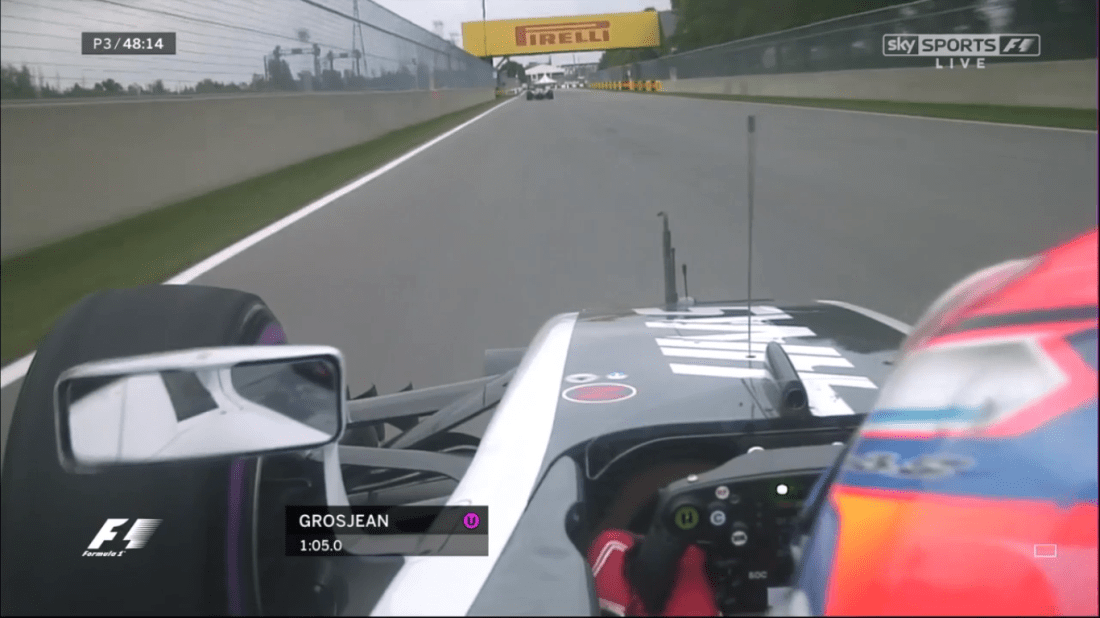
2016 Canadian GP - Grosjean
A welcome return: camera angles such as the above of Romain Grosjean’s Haas have not been seen since the 1990s, but have returned to Formula 1’s World Feed in the past few races, giving a greater sense of speed.

“Let Michael past for the championship, Rubens” was one such snippet that aired on the F1 Digital+ feed at the 2001 Austrian Grand Prix. Victory celebrations were also commonly broadcast on the F1 Digital+ feed, notably at the 2000 German and Japanese rounds of the championship, again both featuring Ferrari drivers.

Team radio became more widespread through the 2000s, with it being common place until the radio rules of late last year. I’m happy to see the ruling reversed, simply because the team radio offered a different opinion on the track action, a ‘third wheel’ shall we say. However, even after the reversal, it still feels like there is less team radio than in previous seasons. Have drivers been trained to talk less in the car, or are the fans hearing an extremely filtered version?

Staying with TV, FOM’s GP2 commentary line up of Alex Jacques and Davide Valsecchi has been a revelation this season. Jacques has come on leaps and bounds since we heard him at the start of 2015. Plucked out of nowhere, his style alongside Valsecchi’s strong enthusiasm means that fans are in for a treat whenever GP2 is live on-air.

Elsewhere in the FOM spectrum, their social media efforts have improved compared with 2015. Helped by an influx of new faces such as ex BBC F1 video editor Tom Bowker, their social media platforms, including Facebook which launched in March, have played host to a lot more unseen archive footage than previously. Finally, it looks like the public is able to scratch at the surface of FOM’s video archive.

With 2.6 million ‘likes’ on Facebook, 2.2 million on Twitter and 220,000 on YouTube, F1 is building its digital fan base. Their Facebook page, which was launched in March, has been successful so far thanks in part to the migration of the 1.8 million people who already liked F1 related pages! FOM have not done anything though to go viral yet, in the same way that Formula E and the Ricciardo/Massa go-karting fun did. In fact, I do not think FOM have done anything in recent memory to go viral, whether they choose to do so to try and boost their profile, we shall see.

In the meantine, MotoGP remains four times as popular as Formula 1 on both Facebook and YouTube. The series recently hit 1 million subscribers on YouTube, rewarding fans with a full race copy of the 2015 Australian Grand Prix… for free! Of course, the nature of television deals mean that FOM may not be able to do that, but it shows what can be achieved. As always with F1, there is a long way to go to getting fans the level of access that MotoGP does with their fans.

Sorrell: Virtual Reality will transform Formula 1 “big time”

Sir Martin Sorrell, the chief executive of WPP and a member of the current Formula One Group board of directors, has given a wide-ranging interview to the official Formula 1 website, which is well worth a read. Sorrell, 71, is expected to earn a whopping £70 million this year.

Sorrell’s interview on the F1 website talks about a number of issues, including television audiences, Sky’s Formula 1 coverage and virtual reality. Sorrell speaks highly of live sporting events: “…despite streaming, despite the rise of tablets and smartphones – all the implications which in theory would make linear TV less important – live sporting events are extremely powerful. But it’s not the event alone – it’s also what’s surrounding it.”

Where the UK is concerned, I have always insisted that television is king. Overall, television audiences are declining slowly as the devices Sorrell mentions continue their surge. But, for the large sporting events, such as the upcoming European football championships and the Rio Olympics, television is the driver to these events. However, the reason those events are so popular is because they are easily accessible and free to the widest possible audience. The viewer does not need to download X app on Y device, the event is there ready to view without anything extra to do. If you hid either the Olympics or European championships behind a pay wall, audiences would plummet.

I find it odd that Sorrell talks highly about live events bringing people together in “powerful” ways, yet skirmishes over Sky’s Formula 1 audience: “When Sky UK started to broadcast there was an argument that audience would come down because it is pay TV. But the actual quality of the production and the use of technology and the engagement of the viewer is much better than it ever was. The product is simply better.” The product may be “simply better” with innovations such as the Sky Pad, but it comes at a price to the consumer. The cost for the consumer results in a diminishing audience, meaning that the live event is less powerful than in previous years. If you are reaching fewer people, you cannot make your voice heard as loudly as you once did before.

“Virtual Reality for Formula One could be fantastic – driving the car! In the Ridley Scott film ‘The Martian’ you can do that. I have lifted off in the space craft from the surface of Mars, walked in space and looked down into deep space and got terrified, with the headphones and the goggles. The technology is already incredible and will improve massively in the next few years. Think about what you could do. And there are some – Bernie and others – who are embracing new technologies.” – Sir Martin Sorrell, speaking to the official Formula 1 website

Sorrell sells the concept of Virtual Reality being part of Formula 1 in the future. Sorrell says “I said before that I believe that Virtual Reality will hit it big time. I know that some of my colleagues disagree, but I believe in it.” In the context of consuming Formula 1, I don’t see Virtual Reality being the next big thing. It works brilliantly in video games, but with Formula 1 I’m not as convinced, in the same way I was unconvinced about the hype over 3D a few years ago. Virtual Reality, whilst the technology is amazing, is a niche market. I would go as far as saying that less than 5 percent of Formula 1’s audience would be interested in Virtual Reality.

Sorrell also talks about generating interest from “other [income] models” aside from “getting a flat fee for broadcasting rights”, a statement that also feels odd given that Sky and FOM signed a near £1 billion broadcasting contract less than three months ago. The other model Sorrell refers to is presumably an over-the-top model where consumers are purchasing video content off FOM to watch at their leisure. Given the fees Sky paid, over-the-top is bound to be in conjunction with Sky as opposed to against Sky.

Lastly, Sorrell says that the fast growing markets (BRICS and Next Eleven) are key. For those wondering, those two groups cover Brazil, Russia, India, China, South Africa, Bangladesh, Egypt, Indonesia, Iran, Mexico, Nigeria, Pakistan, the Philippines, Turkey, South Korea and Vietnam. So, expect a lot more movement in those countries over the next five to ten years.

News round-up: Verstappen shines on Pauw, 3D graphics from FOM make appearance

Alongside the pieces I posted a few weeks ago, there are a fair few smaller things that I want to mention, which I will do over the course of the next two round-up’s. First up, analysis looking at Sky’s “35 million” digital reach and ESPN’s movement in the Formula 1 online world.

Verstappen continues to shine in his homeland
The rise of Max Verstappen continued in the Netherlands following his win at the Spanish Grand Prix. Verstappen appeared on late-night chat show Pauw on Friday night on NPO1. To put the appearance into context for UK readers, it is the equivalent to Lewis Hamilton appearing on The Graham Norton Show on BBC One.

Verstappen’s appearance on Pauw averaged a strong 1.18m (27.1%) from 23:02 to 23:57 according to ratings bureau Kijkonderzoek. Pauw has typically averaged around 750,000 viewers over the past few weeks, so Verstappen’s appearance boosted numbers by over 50 percent. I’m surprised no one has started a rumour about the Dutch Grand Prix yet…

ESPN increases Formula 1 coverage
One website that has increased its Formula 1 presence this year is ESPN. The website now features video round-ups fronted by Jennie Gow and Maurice Hamilton alongside written content from a variety of writers. Given that ESPN have no Formula 1 rights, it is a strong website and worth a visit if you have not done so already.

On the subject of website reporting, the BBC F1 website has adapted. Despite not being able to publish content with Formula One Management (FOM) video material, the team has still uploaded content featuring Jack Nicholls, Allan McNish and Tom Clarkson. Eagle eyed viewers will have noticed that the recent videos from Russia and Spain were filmed with the relevant back drops in sight, but outside of the FOM perimeter zone. The BBC cannot film inside a circuit during a Formula 1 race weekend, but there is nothing stopping them from filming 50 meters outside of the circuit, as they are doing so at the moment.

Producing a good supplementary magazine show
Now that we are five races into the 2016 Formula One season, it is a good chance to talk about Sky’s revamped programming line-up. Axed is the studio editions of The F1 Show, with all other episodes reduced to 30 minutes in length. As a result, the F1 Report airs every week instead of bi-weekly. The changes to The F1 Show during race weekends have been a welcome change, making it easier to catch up on practice coverage with a shorter, snappier show.

The F1 Report has not changed from a content perspective meaning that the viewer is short-changed year-on-year. The show is clearly produced on a shoe-string budget and that is one of the issues I have with the show. It is odd that Sky have for years produced brilliant supplementary shows to their football coverage such as Sunday Supplement and Goals on Sunday yet have failed to produce one good, stable supplementary magazine show for their Formula 1 coverage that hasn’t required multiple changes. We’re in season five and the supplementary magazine show is now in iteration three or four.

Yes, their football coverage covers multiple layers across multiple leagues on a much larger scale than F1. But F1 has: on and off track across multiple series (GP2 and GP3) which Sky should be driving people towards. The opinions and voices on The F1 Report so far in 2016 have not been strong enough to persuade me to watch every week. Besides, if I want to get general opinions, I can read AUTOSPORT or Motorsport.com. You do get the occasional good guests who are worth listening to, such as Will Buxton, but these are far and few between. Sky’s failure though came far, far earlier in the chain by repeatedly failing to exploit the studio episodes of The F1 Show.

FOM share 3D graphics with Sky
Viewers who watched the horrifying accident between Fernando Alonso and Esteban Gutierrez at the Australian Grand Prix via any of Sky’s outlets would have probably also watched 3D graphics of the incident. The footage, provided by FOM and based on GPS data, was used by Sky in Italy, Germany and the United Kingdom to analyse the accident. The traces showed that Gutierrez crucially braked earlier than Alonso, contributing to the accident. Channel 4 did not air the 3D footage during their highlights show, either because of time constraints or because they did not have access to the footage.

To date, I believe this is the first and last time we have seen 3D footage from FOM based on GPS. I was expecting FOM to produce something in Spain as a result of the Mercedes crash on lap one, but alas, nothing was aired. With or without 3D footage, it should be noted that the Sky Pad analysis we saw from Anthony Davidson was fantastic on both occasions. Davidson is comfortably one of Sky F1’s best assets, and is someone who Sky should try to keep for as long as possible going forward.

Counting viewers and readers
Every time I see a statistic, my first thought is to wonder how it is calculated, especially when it comes to audience figures. Sky Sports recently celebrated their 25th anniversary and mentioned this statistic: “35 million+ unique users of SkySports.com and Sky Sports apps.” How accurate is that figure?  Being a data junkie, a few questions come to mind.

Is that a worldwide figure or UK only figure? If it is the former, then the UK figure will be lower by a fair amount. Although the statement says ‘unique’, is that strictly true in that one person may use Sky Sports services in various different ways (iPad, Android, desktop, laptop, work phone to name just a few). So can a figure across multiple devices truly be classified as unique? Just because 20 million people use iPad and 15 million use Android, that does not mean 35 million people use iPad or Android, as there will be overlap in people who use iPad and Android.

I’m intrigued to know what unique means in this instance, I suspect the reality is that there is a significant amount of double counting involved to arrive at that figure. Beware if you see that figure used in public in future to defend the Sky UK’s exclusive Formula 1 deal from 2019…

No further discussion about Sky’s 2019 deal
Surprisingly since the announcement about the aforementioned deal, we have had little comment from those in the business (I exclude journalists here). No one, to my knowledge, has publicly commented on it from the teams’ perspective. We have had a brief comment from FIA president Jean Todt who, speaking at a presser during the Bahrain Grand Prix weekend said that he is “not happy that F1 is disappearing from free-to-air TV in key markets.” Apart from that, no public comment.

On the back drop of Sky’s 2019 deal, but not linked, the digital team at Sky pulled an article offline about the GPDA statement concerning the governance of Formula 1. I requested comment from Sky, unfortunately an official line from them was not forthcoming, despite the best efforts of this writer to press on the issue.

Formula E learns how to go viral with #LeapOfFaith

There were two major social media highlights of the past few months for me, one of which showed how to go viral, whilst the other really showed the personality of two popular drivers away from the racing circuit.

#LeapOfFaith takes off…
To reach a new, diverse audience, you have to take creative risks. You have to be prepared to try out new things. If the audience is not receptive to said ‘new things’, you simply move in a different direction and add it to your ‘lessons learnt’ list. It gives you an idea of what works and what doesn’t. Formula E’s latest stunt was designed to go viral, and it did exactly that.

The stunt, filmed around the time of the Mexican ePrix in early March, saw Damien Walters backflip over a Formula E car travelling at speed. As of writing, the main video on Formula E’s YouTube channel has had over 5 million hits. When you combine that with Facebook, Twitter and other social media platforms, the combined reach of the video will be in excess of 10 million hits, an excellent achievement for Formula E’s digital media team. It shows that thinking outside of the box does work, and can bring attention to their channels, which I feel is a lesson that all in the world of motor sport can learn, including Formula 1.

However, here is the crux for why I don’t think you will see F1’s digital media team do videos like that, and it is not because they are not creative or anything of that sort. How many people will have watched the #LeapOfFaith and thought “I must check out some of Formula E’s other videos” or “I might watch Formula E next weekend”? I’d hazard a guess and say that it was less than 1 percent. Instead, for the vast majority of those that stumbled across the video, they probably thought it was “cool” and moved on.

I’m not trying to undermine the idea behind the video by saying that, because I thought it was awesome, but I do not see it significantly affecting Formula E’s growth. Mind you, every little helps and every opportunity to grab a new viewer is a good opportunity and I applaud Formula E for producing #LeapOfFath.

…Formula 1 drivers show off personality with fun and Q&A sessions…
There have been a few examples recently where personality has been on show in the world of Formula 1. Aside from Fernando Alonso’s live on-screen jibe at Johnny Herbert during Sky Sports F1’s Bahrain Grand Prix practice coverage, the Chinese Grand Prix saw a heated back and forth debate between Sebastian Vettel and Daniil Kvyat over the driving standard of the latter at the start of the race. The debates have been intertwined with fun and Q&A sessions along the way.

Probably the best show of personality this season away from the race track comes from Felipe Massa and Daniel Ricciardo. Back at Massa’s home in Monte Carlo, his son and Ricciardo engaged in a go-karting race. In what was a close run contest from start to finish, with plenty of nail-biting moments, it was the youngster who won by the smallest of margins. The fun and games between Massa and Ricciardo was live streamed on Facebook. Like #LeapOfFaith above, this too went viral amassing nearly 5 million views. Of course, one was designed to go viral whereas the other was some fun between two mates. But we need videos like that, they are memorable and for good reason too.


On the more scripted side, Sky Sports F1 have been engaging in some fan question and answer sessions, so far with Lewis Hamilton and Rio Haryanto (the former also doing a Twitter Q&A in recent weeks). Including all play backs, these two have had 270,000 and 60,000 views respectively. This is a wider Sky Sports strategy to conduct question and answer sessions on social media as opposed, which is how these two have come about. You only need to look at the swathe of videos that Sky Sports upload to Facebook to realise that. I would be surprised if Formula One Management (FOM) have got involved in either of these Q&A sessions. Scripted or not, from a fan perspective, it has been great to see personalities on-show so far during 2016, something I hope continues throughout the year.

…but what hasn’t gone viral?
There have been many fantastic and dramatic moments so far in the 2016 Formula One season. Alongside the aforementioned Vettel vs Kvyat squabble in China, we had Fernando Alonso’s horrifying crash in Australia and the major turn one accident in Russia. There’s been a lot of pin-points so far this year that could have gone ‘viral’. You can produce the greatest videos in the world, but there is no substitute for current action as that inevitably drives traffic. Formula 1 has probably lost out in excess of 15 to 20 million views across Facebook, Twitter and YouTube so far in 2016, I daresay more than that.

Take a look at MotoGP’s social media video portfolio on Facebook and YouTube. We’re talking short-form bite-size content: around 20 seconds long on Facebook and one to two minutes on YouTube. The reason for the lack of 2016 Formula 1 video content on FOM’s social media channels is the current television broadcasting contracts as we all know, but it just illustrates the potential reach that Formula 1 is losing hand over fist on a now bi-weekly basis.

Elsewhere, the lack of an on-screen hashtag still confuses and bemuses me, both in equal measure. I’m surprised Formula E still hasn’t successfully embedded it into their graphics set. So simple, but proving to be a challenge at the same time. Formula E have also launched a new website, which is designed for best use on phone or tablet device. It feels slim line, and is extremely different to say the Formula 1 and MotoGP websites. As a desktop user, I personally prefer the F1 and MotoGP sites, both of which look more professional than the Formula E site. Round the edges, the Formula E website does not look as smooth either, but this should improve over time as bugs are ironed out.

Motor racing prepares for the future with technical enhancements

As the 2017 Formula One season starts to take shape with the sport’s stakeholders thrashing out the technical regulations, on the broadcasting side movement continues to be made in both Formula 1 and beyond.

Changes are coming…
There will be two significant changes in 2017 for viewers watching Formula 1. For the first time ever, Formula 1 will be broadcast in 4k resolution (Ultra HD) from 2017. The news was announced at the time of Sky’s new rights deal back in March. It is not the first time a motor sport event has been broadcast in 4k: BT Sport aired the British MotoGP last season in ultra HD. The 2017 announcement with relation to Formula 1 has not yet been mentioned via any of Formula One Management’s (FOM) outlets, namely their website or social media channels.

Despite this, as the Sky press release mentioned every race will air live in 4K next year. It will be interesting to see how much demand there is for 4K content. FOM’s current circuit cameras are configured for 4K, meaning that there will be only World Feed. In comparison, BT Sport usually have two commentary teams for the events they air in ultra HD, the British MotoGP was one example of this last year.

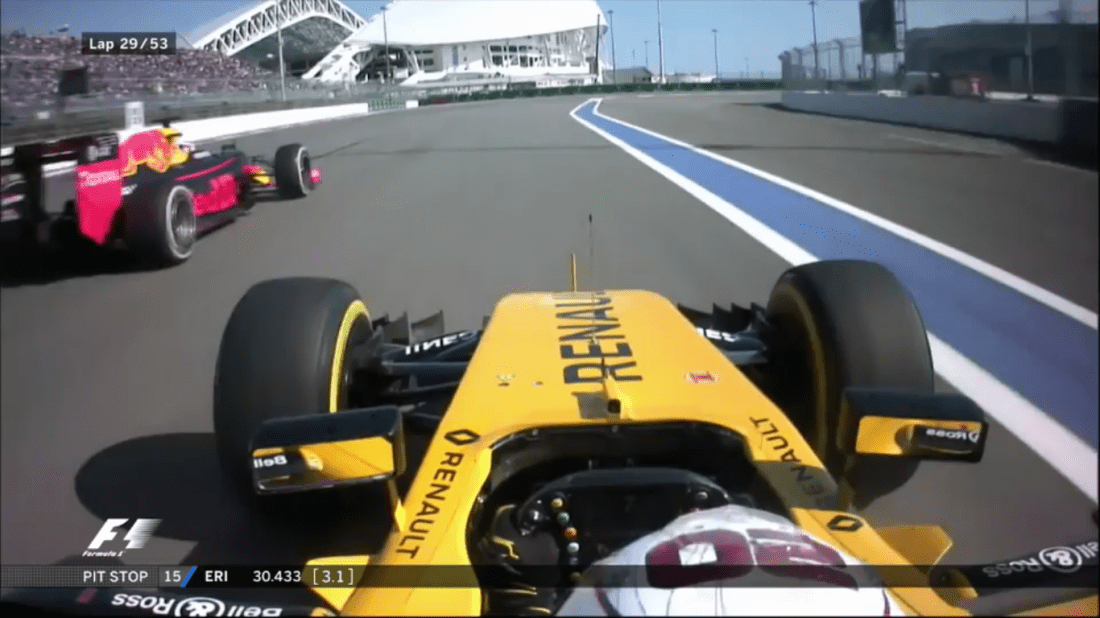
2016 Russian GP - Magnussen on-board
On-board with Renault’s Kevin Magnussen at the 2016 Russian Grand Prix. Just how different may the t-cam angle look in 2017?

The second major change that will be noticed worldwide is the change to the T-camera. Probably the most well-known and used on-board camera, the introduction of a cockpit protection system (Halo, Aeroscreen or something else) means that the perspective this camera gives will be radically different. Unfortunately, we did not see any on-board cameras from Daniel Ricciardo’s car during his Aeroscreen demonstration during practice one at the Russian Grand Prix, but I’m hopeful we will see on-board shots in forthcoming races.

An Aeroscreen like solution does provide opportunities to bring in new camera angles. The most logical one is a camera looking back towards the driver, which should be closer than ever before. If you wanted to be clever, you could have a camera embedded within the Aeroscreen that rotates around the top rim. I’m sure there’s many more, but if Aeroscreen was made mandatory, there certainly are a lot of ways that FOM could try to use the system to get closer to the driver in the future.

…say hello to drones and virtual reality…
Before the 2017 season gets underway though, there is at least one new innovation we will see in Formula 1 this year. According to Joe Saward, the Italian Grand Prix will play host to drones, with the hope that it will “create better coverage”. I’m intrigued to see how this goes, although there are some very obvious safety aspects to take into account, as Saward himself mentions in the link above.

Elsewhere, 360 degree videos and virtual reality is the thing doing the rounds at the moment, in both Formula 1 and Formula E. 360 degree videos are not new though, and in fact have been around for several years, dating back to at least 2012. Nevertheless, Formula E has managed to get the jump on Formula 1 by offering 360 degree highlights of races from a selection of on-board camera angles. To my knowledge, we have not yet had 360 degree videos during an F1 race weekend, the closest we have come so far is this video from Sky’s virtual reality studio that was released in March.

Alongside Formula E’s 360-degree movement is the announcement that was made in March that the series has teamed up with Virtually Live, with the intention to broadcast races live in virtual reality in the near future. Virtually Live’s CEO Tom Impallomeni said: “Formula E aims to represent a vision for the future of the motor industry, serving as a framework for R&D around the electric vehicle, while Virtually Live is building a revolutionary, immersive virtual reality technology allowing everyone to experience the magic of live sports and events from anywhere in the world.”

…FOM and Dorna roll out new graphics
There have been some subtle graphical changes rolled out this season so far from FOM. Ignoring the elimination qualifying ‘countdown’ graphic that we will hopefully never see again, the main changes are around pit stops and tyre choices. The pit stop graphic is the most effective change, with added detail compared with 2015. There is more emphasis on tyre choices, which are embedded within the pit stop strip, as well as the stint length that the tyre lasted.

2015 vs 2016 F1 pit graphics.png
A comparison of Formula One Management’s 2015 (top) and 2016 (bottom) pit stops graphics.

The tyre graphics as a whole have been tweaked out of necessity for the new tyre rules for the 2016 Formula One season. With three tyre compounds available, it means six possible options are available (new and used). FOM use a filled-in tyre to show that it is a new tyre at the start of the stint. An unfilled tyre, like the graphic above shows, means that some laps had already been completed on that tyre before the current stint started – in the case above with Hamilton, this would have been during qualifying.

I understand why FOM may have wanted to add the new and used aspect to the graphics, but, is the graphic useful if it has to be explained to casual viewers at every race? I’m not so certain. After a few laps a tyre is no longer new. This feels like over complexity to a degree. I like the graphic, I just wonder whether it was necessary though in the first place.

ESPN have taken a page out of FOM’s book with their new IndyCar graphics for the 2016 season. The graphics, only available to domestic viewers when ESPN are covering the action live, can be seen here. The graphic set uses a similar layout to historical IndyCar graphics but with a modern, flat look, bearing similarities to the graphics Formula 1 introduced at the beginning of 2015.