Young guns spark up social media

The youngest line-up on the grid in 2015 of Max Verstappen and Carlos Sainz not only made an impact on the track, but they also made an impact off it as Toro Rosso jumped up the social media standings. Analysis from The F1 Broadcasting Blog shows that, across Facebook, Twitter and Instagram, the team is close to overtaking Sauber whilst recording higher increases than the likes of Williams and Lotus since July. That was not the only social media story in the latter half of 2015.

Overall, the 2015 Formula One season was disastrous for McLaren, with an unreliable Honda engine down on power affecting their performance throughout the season. Their social media highlight was generated by the average fan from off the street. #PlacesAlonsoWouldRatherBe quickly became a trend following the Brazilian Grand Prix qualifying session and was a moment of light relief during what was a sombre weekend due to events outside of the paddock. McLaren’s performance on the track hurt their social media following off the circuit. McLaren started the Summer with 4.37 million accounts following them across the three main social media platforms, climbing to 4.71 million accounts as the season came to a close, an increase of 7.6 percent. Only Mercedes, Manor and Lotus recorded a lower percentage increase during the second half of 2015, showing that McLaren’s poor on track performance had a negative impact when it came to a social media meaning that they were unable to further exploit the McLaren brand name.
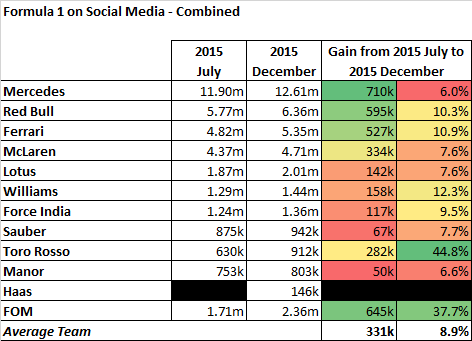
The Formula 1 social media statistics, covering Facebook, Twitter and Instagram, as of December 2015.

Mercedes’ percentage increase of 6.0 percent is the lowest of any team in the field, but when you’re coming from a high user base in the first place, a lower percentage increase than the midfield teams should be expected. An increase from 11.90 million to 12.61 million accounts following their activities is still a sizeable increase for the Brixworth based team. McLaren’s poor performance not only affected the brand following, but also adversely affected Fernando Alonso and Jenson Button’s following. Button’s following increased 9.9 percent compared with the Summer, however Alonso’s percentage increased only 3.9 percent, from a combined audience of 4.00 million to 4.16 million. Those are not good numbers for what is supposed to be one of Formula 1’s biggest drivers, and is further proof of why Formula 1 needs a successful McLaren as soon as feasibly possible.

Is Max Verstappen the future?
Alonso’s raw increase of 156,000 from July to December was the eighth highest in the field, again across Facebook, Twitter and Instagram. Up front you had Lewis Hamilton and Nico Rosberg, the latter recording an increase of a whopping 1.21 million followers largely due to a huge uplift in Instagram numbers. Hamilton’s numbers will only surge further as he tries to break America. Behind the Mercedes drivers you had Button, Daniel Ricciardo and Felipe Massa. No major surprises there, Ricciardo continung to get a boost from his fantastic 2014 season. In sixth position, and ahead of Alonso, enter Verstappen. At the half-way stage of the 2015 season, a combined audience of 247,000 were following Verstappen’s activities. That number climbed to 479,000, a whopping increase of 94.1 percent! Facebook led the way from a percentage perspective for Verstappen, increasing from 57,000 to 118,000. Of course, these numbers are miniscle in comparison to Lewis Hamilton, whose increase of 1.21 million since the Summer dwarfed the majority of the field. But a year or two from now? If Verstappen continues to perform on the circuit, then who knows. Based on the latter half of this season, I would expect Verstappen’s combined audience to quickly surpass one million in early-2016.

We should not forget Carlos Sainz, Jnr and the Toro Rosso team as a whole in the Verstappen puzzle. In the second half of 2015, Sainz’s following has increased 44.6 percent from 273,000 to 395,000. The reason Sainz has fallen behind Verstappen is because the Dutchman has surged ahead on Facebook, whereas Sainz’s increase since the Summer has been relatively slow in comparison. Toro Rosso is the only big surprise from a team perspective, jumping by 282,000 followers from July to December, an increase of 44.8 percent. I suspect as soon as either Verstappen or Sainz switch teams then Toro Rosso’s following will stagnate again. Either way, they have made enough of an impression to climb over the back of Sauber’s gearbox and has, for the moment, given them an identity.

The Formula 1 social media statistics, covering Facebook, Twitter and Instagram, as of December 2015.

All social media outlets have grown in size and stature versus July, but it was Instagram who jumped the biggest, with their Formula 1 reach growing from a cumulative total of 5.34 million to 8.57 million, an increase of over three million accounts. As a result, Instagram’s Formula 1 market share on social media increased from 9.0 percent to 12.8 percent at the expense of both Facebook and Twitter. Bear in mind that all numbers presented in this piece are a combined count, there is no way to work out distinct people across different social media sites. What we do know is that 2.29 million people follow Lewis Hamilton on Instagram, so the distinct count of accounts that follow F1 related accounts on Instagram is probably around the ~5 million range.

We come to the end of another season though where I place the URL https://www.facebook.com/F1 in the middle of a post and I get the result “Page not found.” To see that heading into 2016 is immensely disappointing and frustrating. Why there is such a barrier towards creating exciting, innovative and groudbreaking content for Facebook users, I do not know. We knew Facebook would come later than Twitter and Instagram in terms of content, Marissa Pace, part of the Formula One Digital Media team told us that this time last year. And at a time when Formula 1’s viewing figures are dropping as the population exploits new and emerging technologies, having a presence on Facebook is more critical in my opinion than ever before. The now infamous #SepangClash between Valentino Rossi and Marc Marquez during this year’s MotoGP championship was viewed 15 million times on Facebook. You cannot buy numbers like that, and you cannot let opportunities like that slip through your figures. The longer Formula One Management waits to exploit Facebook, the harder their task becomes, it is as simple as that. #SepangClash was also a fantastic example of on the spot thinking from Dorna’s social media team, instantly creating that hashtag to drive conversation across every platform: TV and online. It was successful, and it kept MotoGP in the spotlight between Sepang and Valencia. Something for F1 to learn should a big on-track clash occur in 2016.

Whilst Facebook is yet to come, the team at FODM have done some fantastic work creating content for both Twitter and Instagram. Really, this season has been what you should expect from those platforms, with discussion based talking points, fan voting and video content being posted, the video content in conjunction with SnappyTV. Understandably, there has not been video content posted ‘live’ yet given the agreements FOM have with broadcasters’. Over on YouTube, archive footage is the clear winner, something that is became more apparent as the season progressed. This reminds me of when BBC returned to Formula 1 in 2009. Fans made it clear to the BBC that they wanted archive footage, and the same message is being put to FOM now.

Most watched videos on Formula 1’s official YouTube channel
1. 639,000 – The Fastest Lap in F1 History: Montoya at Monza (uploaded 3 months ago)
2. 582,000 – Top 5 Overtakes Of The Last 5 Years (uploaded 4 months ago)
3. 428,000 – F1’s Greatest Lap? Ayrton Senna at Donington 1993 (uploaded 8 months ago)
4. 324,000 – Your Favourite Belgian Grand Prix – 1998 Chaos & Carnage in Spa (uploaded 3 months ago)
5. 299,000 – Your Favourite Monaco Grand Prix – 1992 Senna v Mansell (uploaded 6 months ago)

The question for FOM going into 2016 has to be, how do they exploit their archive without treading on broadcasters’ toes? Of course, FOM own any footage filmed inside a race track, but putting extensive archive highlights online may rub broadcasters’ up the wrong way. I do think there is middle ground though, and certainly one that should be investigated. I think there is a market for creating 20 minute highlight packages of past classic races for the YouTube market. All of FOM’s videos so far have been ‘bite size’, clocking in at under five minutes. The benefit of creating longer highlights packages now of archive races will help them later, if they were to go down the ‘F1 Network‘ route sometime. Again, with viewing figures from the traditional viewing methods dropping, the potential for an over the top network has to be considered within the next few years.

In terms of their social media following, Formula One Management’s two accounts on Instagram and Twitter respectively have increased from a combined audience of 1.71 million in July to 2.36 million, an increase of 37.7 percent. In comparison to the teams (see the first figure in this post), that is a huge increase and shows how important it is for FOM to have a profile on social media. Instagram is the main factor in the increase, jumping 395,000 followers despite a much lower base than Twitter. The good news is that Formula 1 teams, drivers and media are exploiting Instagram more than previously, and that is replicated in the numbers. Whilst Formula One Management smashed into social media in March, at the same time the team also relaunched the official Formula 1 website. The relaunch seems to have been successful, the old version of the website let us not forget was horrendously behind the times from what you would expect out of a modern-day site.

The biggest part of the website relaunch was F1 Access. The main difficulty in the early days was that the website version of F1 Access failed to link to the app version of F1 Access. To be honest, I have not purchased F1 Access. I know it is only £2.29 a month, but as of writing I haven’t heard anyone shout from the rooftops about it. Is there anything in F1 Access that, as a fan, I desperately need to get my hands on? I suspect not, and until there is a compelling reason for me to subscribe to F1 Access, I can’t see myself subscribing anytime soon. Looking ahead to 2016, I think FOM to some degree can continue to do what they are currently doing on Twitter and Instagram. Some exploration needed in relation to YouTube, and a kick-start needed on Facebook sooner rather than later.

Were Mercedes “blacklisted” from the World Feed during the Japanese Grand Prix?

The Japanese Grand Prix saw a return to the usual status quo, with Mercedes back on top form as Lewis Hamilton cruised to victory.

But on the broadcasting side of things during the World Feed coverage that Formula One Management (FOM) produce, something looked odd: the noticeable lack of coverage given to either Mercedes car during qualifying or the race. Deliberate or just a coincidence? Conspiracy theories abound as to the reason why. AUTOSPORT, amongst other media outlets, are reporting that Mercedes are going to query it with Bernie Ecclestone. It is not the first time that a team has been “blacklisted” from FOM’s World Feed, most notably Force India during the 2012 Bahrain Grand Prix qualifying session.

First points first, the direction was abysmal, probably the worst of the entire year to date. I’ve complained about the direction before with relation to virtual advertising and missing changes for the lead, but today was a different kettle of fish. Which is sadly saying something considering Fuji TV hosted the Japanese Grand Prix feed prior to 2012, famously concentrating their coverage on local stars such as Kamui Kobayashi and Takuma Sato. Incidents today included a static camera for around half a minute and a camera on Sergio Perez’s car that served no purpose at all. I don’t know if the same crew does Singapore and Japan, I assume it is the same people, but that may be one reason why the direction was worse than usual.

During qualifying, Mercedes were rarely shown during Q1 and Q2, whilst their fastest laps were not aired on the World Feed. The race itself started with Lewis Hamilton overtaking Nico Rosberg. The only two camera angles we had were from far distance, neither onboard was featured in the World Feed coverage, although they were broadcast during the post-race shows.

Mercedes were only really shown immediately before and after pitstops (as the above graphic shows), alongside team radio. It is difficult to “blacklist” a team who are running at the front of the field and who will obviously play a pivotal part in the race. I don’t think “blacklist” is an appropriate word given that they were actually featured, but it does feel like that there was a concentrated effort to feature either car as little as possible. We did see a Mercedes pass through shots on multiple occasions, but they were never the main focus, pitlane aside.

In my opinion, there was definitely an effort to not show Mercedes as much as possible. Clearly someone has done something to annoy Bernie in the past seven days…

Update on September 27th at 17:50 – I’ve updated the above to add a bit more context. I notice that the BBC are noting that Mercedes are not FOM’s (or Ecclestone’s) only issue. Whilst they say that the Mercedes issue is down to their refusal to supply Red Bull, they are also reporting that Ecclestone is “in dispute with the teams about the display of sponsor logos in the garages.” This explains why we never saw any garage shots of team members observing the action, instead FOM choosing to use a fly-by overhead camera during the weekend. At the end of the day, it is the viewers that lose out here, and why, I’m not entirely sure. So we can see another Rolex logo in the garage? I think Ecclestone and FOM need to look at the definition of “over exposure”, because that is seriously what they are doing if that is what they are thinking about.

Update on September 28th at 19:30 – Bernie Ecclestone says no. Speaking to a German newspaper, Ecclestone said that the new approach was decided “a couple of weeks ago”, with the intention of showing more of the midfield teams. So, evidently he is denying that there was a Mercedes blackout.

News round-up: Formula E expands European reach; Questing not coasting

There have not been too many major news stories in the broadcasting landscape to report on recently, but there have been a few intriguing issues bubbling under the surface worth mentioning on the blog.

Formula E expands European reach, but UK deal remains a mystery
It was confirmed today that Eurosport would be broadcasting seasons two and three exclusively of Formula E in Germany, Poland, Sweden, Norway, Denmark and Finland, with the channel also broadcasting non-exclusive content in Iceland. The announcement is significant, as it allows Formula E to reach far more people than what it currently does in those territories, thanks to the Germany deal being a free-to-air one. Ali Russell, Formula E’s Director of Media and Strategic Partnership said that the deal “reinforces our outreach across key target markets in Europe alongside other existing deals.”

Whilst significant, the news is not necessarily surprising. As noted previously, Eurosport are owned by Discovery Communications who have a minority investment in Formula E. It is important to state that Eurosport’s Formula E deal does not cover the UK as, to quote Ben Constanduros, there are other deals in place which prevent it. As of writing, nothing has been publicly announced regarding where Formula E’s second season will be broadcast in the UK. 60 percent of you think ITV will broadcast season two live. We continue to wait for an official announcement on the situation.

WEC and WTCC gain UK free-to-air coverage
Good news for UK fans of the World Endurance Championship and the World Touring Car Championship, free to air highlights of both series are coming. Continuing the same theme as above, Quest TV, who are under the same umbrella as Eurosport and therefore Discovery, will begin airing a one-hour show with immediate effect.

The WEC programme will be presented by Toby Moody, airing on the Tuesday after each race weekend. The first WTCC highlights show aired last night and is currently available to watch on Quest On Demand, presented by Neil Cole. The development follows Quest TV’s successful coverage of the 24 Hours of Le Mans earlier this year. This is only good news for both championships, as it allows them to increase their foothold and bring in a bigger audience. I won’t be surprised if Formula E highlights turn up on Quest for season two, even if the live action is covered elsewhere. Anything that increases a motor sport series audience is good news in my view.

BT’s MotoGP ratings bounce back
A thrilling two rounds of MotoGP from Silverstone and Misano resulted in mixed viewing figures on BT Sport, overnight viewing figures showed. Silverstone peaked with 209k (2.3%), only marginally up on last year’s number of 205k (2.4%). Bank Holiday was the main reason for that number, however it was still a slight surprise when you consider that the trend so far this year has been of increases on a significant scale.

Misano fared much better than Silverstone, averaging 242k (2.8%) from 12:30 to 14:00, peaking with 317k (3.6%) at 13:40. A sign of how well Misano did is that this year’s MotoGP average is higher than last year’s peak number of 211k (2.6%). I would have expected Scott Redding and Bradley Smith’s podium finishes, along with the inclement weather, to boost ITV4’s highlights number. What we actually saw was a year-on-year drop. An average audience of 335k (1.5%) watched ITV4’s programme this past Monday, compared with 357k (1.6%) for last year’s Misano highlights programme.

Elsewhere…
Formula 1 celebrates one year of having a proper Twitter account this weekend with the Singapore Grand Prix. Technically, the F1 account on Twitter has been live since August 2009, but the proper interaction that you would actually expect from an account began last September. In the past year, their reach on Twitter has increased 62 percent from 937k to 1.52m, a fairly hefty jump, overtaking MotoGP in the process.

Over in America, great news for the IndyCar Series which witnessed a 70 percent jump in NBC Sports Network’s numbers between 2014 and 2015. Some of that has to be natural growth, but there is another part which is no doubt a result of piggybacking off Formula 1’s recent success over there. It’ll be interesting to see how much influence Alexander Rossi has on viewing figures. Okay, he is unlikely to trouble the points scores given the car he is in, but it may move NBC’s F1 numbers up further a notch or two.

overnights.tv-bannersF1

The best of the 2015 Belgian Grand Prix

Across an entire Grand Prix weekend, the BBC F1 and Sky Sports F1 teams produce around eleven hours of extra content, in addition to the Formula One Management (FOM) World Feed that they, along with all the other broadcasters, have access to. There’s a fair bit of content that probably will not get watched by fans outside of that particular race weekend, probably because the segment is no longer relevant or the VT is just… bad.

However, there are also features that the broadcasters produce each race weekend that do deserve a second watch. The purpose of this piece is to talk about those features for readers who may have missed them first time around. A VT takes a significant amount of time to put together. From getting the perfect shot, to getting the filming location correct for the feature and onto making sure the sound levels are all correct. It takes a lot to put a good feature together. It takes even more to put together something that goes above and beyond those levels.

BBC F1
Interviewer: Lee McKenzie
Personnel: Jos Verstappen; Max Verstappen
Dates: July 14th and 15th, 2015 (1, 2)
Link: BBC website

Lee McKenzie's feature with Jos and Max Verstappen was easily the highlight of BBC's Belgian Grand Prix coverage...
Lee McKenzie’s feature with Jos and Max Verstappen was easily the highlight of BBC’s Belgian Grand Prix coverage…

Max Verstappen has been one of the revelations of the 2015 Formula One season so far. The BBC piece on him felt like it could have been produced by the Top Gear team it was that impressive. The length of the VT allowed the subject, in this case both Max and Jos, to be explored in detail. For me, this was probably one of the best pieces that the BBC have produced in a long time. There was something special and enjoyable about it that is rarely replicated in F1 broadcasting. The piece was split into three distinctive sections. First, a look at Max’s racing career growing up. Second, a more personal look at Max’s life so far, with more of an input from Jos, and lastly Max racing around in go-karts. It was a fabulously produced piece, and one that clearly had a lot of planning – from the initial concept to final execution on screen.

An honourable mention also to the piece that Lee McKenzie did with Fernando Alonso, which is also worth a watch. Note that the Alonso piece is geo-blocked because it contains FOM footage, whereas the piece with the Verstappen’s is not geo-blocked as no FOM footage is present.

Sky Sports F1
Interviewer: Martin Brundle
Personnel: Stoffel Vandoorne
Link: Sky Sports website

...whilst Martin Brundle gave us a great insight into what lies in Stoffel Vandoorne's future
…whilst Martin Brundle gave us a great insight into what lies in Stoffel Vandoorne’s future.

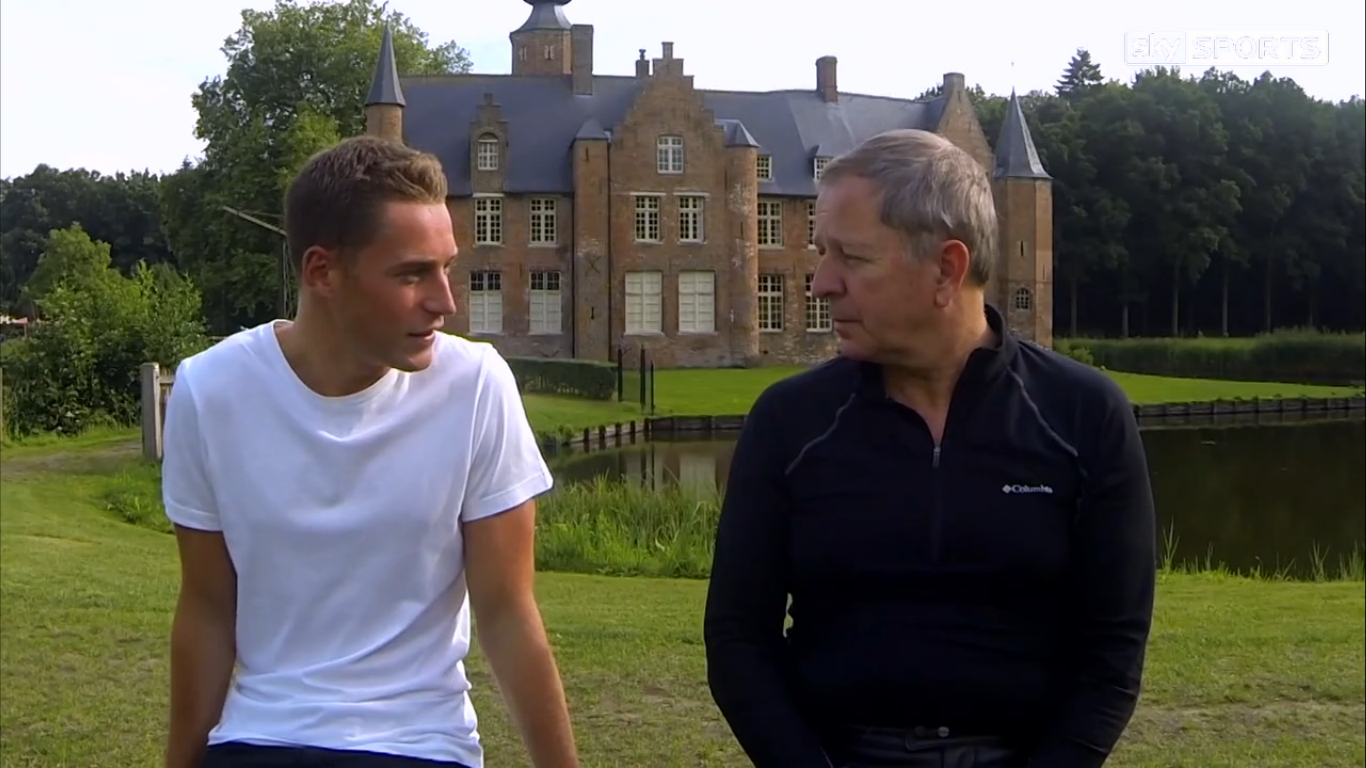
Staying in the same vein as the BBC’s Verstappen piece, Sky Sports used the Belgian Grand Prix as an opportunity to interview Stoffel Vandoorne. As with the BBC piece, we were treated to beautiful shots this time in the August sunshine. There were some big talent in the other Sky pieces, notably the team did a feature with Idris Elba in the snow at Spa. The casual viewer may remember that Elba piece better than the Vandoorne segment from an enjoyment perspective, but the Vandoorne feature is more important in the long run.

On occasion, broadcasters focus too much on the past and present, but fail to look ahead to the future. Barring any mishaps, Stoffel Vandoorne will be a major name in Formula 1 in a few years time. It is important that viewers are introduced to future characters early in their career, so that viewers can build a relationship with them, and see the young man turn into a champion one day (hopefully, they say). The piece between Vandoorne and Brundle sets the tone for the future. It builds a storyboard, and that storyboard with Vandoorne has only just begun.

Whilst BBC and Sky produced some great television during the Belgian Grand Prix weekend, you cannot overlook the fact that FOM’s Digital Media team are producing more content that will no doubt make the end of season DVD review. I won’t go into as much detail as above, but one piece I’d strongly recommend watching is a piece with Fernando Alonso talking about the challenges of Eau Rouge. Yes, a piece of that nature has been done multiple times over the years. But cleverly, I felt that FOM managed to put a different spin on things here. With some great graphics and archive footage, this stood out to me as one of the best Eau Rouge pieces that I’ve seen in a long time.

Dissecting Bernie Ecclestone’s latest BBC F1 quotes

There are multiple websites this morning reporting quotes attributed to Bernie Ecclestone, made yesterday during the Belgium Grand Prix weekend, with relation to the current BBC and Sky deal that is due to expire at the end of 2018.

The quotes, which can be attributed to the Telegraph, AUTOSPORT or the Daily Mail, have Ecclestone saying: “I hope [BBC] continue. We’re not interested in the money, we’re interested in entertaining the public and doing a service. That’s what we’re there for. I think it would be good [to continue as we have at the moment]. It’s works at the moment, so there’s no reason why it should change. Sky have done a super job. They’ve lifted the level and lifted the BBC up.”

In relation to whether BT Sport are interested in Formula 1, Ecclestone said: “Let’s see. They’ve not been in to see me, but then even if they had I wouldn’t tell you.” The quotes were made in response to the news that RTL have extended their current deal in Germany to cover both 2016 and 2017. The price quoted by the Daily Mail for the RTL deal is 25 million per season (I’ve adjusted this sentence, Karol296 in the comments section notes that this is €25m, which is £18m, a bargain). The Daily Mail also say that it is £25 million per year for the current BBC deal, although I have in the past put that number at between £15 million and £20 million. You won’t find any information about the exact number in the public domain, but both RTL and BBC are definitely paying less than previously.

All three websites have also reported a factual inaccuracy. The current BBC and Sky deal does not expire as the end of 2017 as the three websites note. It expires at the 2018, as the BBC say themselves on their website. Where 2017 comes from, I have no idea, but I would have thought ‘end of 2018’ is a basic fact in the story. By bringing that date forward a year, you are changing the complexion of the story somewhat. I talked about what could happen in the future last month. If BBC want to stay in Formula 1, then they will enter negotiations with Sky and Formula One Management earlier than expected. A BBC spokesperson told this blog last month “We remain committed to our existing contracts for Formula 1.”

We’re not interested in the money, we’re interested in entertaining the public and doing a service. – Bernie Ecclestone (August 21st, 2015)

The majority of Ecclestone’s quote is your normal talk and nothing out of the ordinary. The only line, in my opinion, that is worth discussion is the one I’ve put in the block quote above. Coming from Ecclestone, it is difficult to look at a quote of that nature with a straight face. Every other sporting contract in the recent past has seen their value jump such as the Premier League and UEFA Champions League. The last F1 contract renewal which started the current arrangement was completed before BT Sport entered the fray. Fact is, if someone throws Ecclestone a bundle of money at the table, he is unlikely to reject it. That is just my opinion, after all Formula 1 is more a business than an entertainment franchise.

If money is no object either, then why is every race not live on free-to-air television? If RTL are paying £25 million to cover every race live, is there not precedence for saying that the BBC should be able to cover every race live by paying the exact same amount? If money is no object, then you may as well invite ITV or Channel 4 to the table and come up with a deal similar to the recent Six Nations deal that was announced. For a business built, and skewed, around money, that quote is surprising. What I think the quote does show with certainty that Ecclestone wants BBC to stay in the game. Maybe it shows that he is concerned that BBC could exit Formula 1 soon, but I’m not sure as no doubt that quote applies to RTL as well.

The earliest in my opinion that we will hear any news is the middle of next year, but that is only if BBC want to renegotiate. If they want to continue in the same vein as now, then I don’t expect to hear any news until 2017.