Writing on his website, Allen said that, in response to falling viewing figures, Formula One Management “has now got a social media department at Ecclestone’s base in Princes Gate; it’s why they are investing in a new F1.com for 2015 and in the official F1 app, which has sold over 3 million editions. F1.com had 67 million unique users last season and that is set to rise this year. The new site is set to engage the younger audience, using all the social media tools Ecclestone refers to and will have a level of personalisation and fan engagement which is way beyond what is there today.”
I’m very happy to read this. Although I can not say this with any certainty, I imagine that we could see a new version of the Formula 1 website during the off-season. The current version has been around since 2007, with a few aesthetic changes along the way, so it is about time that it has a complete overhaul. It will be interesting to see how Facebook and Twitter will be integrated into the website, given that FOM/FODM does not have a Facebook presence at the moment. I doubt we will see YouTube integration, unless FOM take the step of creating a YouTube account, which is highly unlikely.
Even if Ecclestone himself does not care much about social media, it is good to see that those under him do. As usual, Ecclestone’s comments do undermine the work of those behind the scenes at FOM/FODM, which is unfortunate as it looks like a lot will change in the next 12/24 months in their digital world. The website revamp, will only help a new generation become more interested in Formula 1, which in my view is absolutely critical for the sport in the next few years and beyond.
A fascinating questions and answers session with Bernie Ecclestone was published by Campaign Asia a few days ago on their website, which received an overwhelming response on F1 media websites and by fans on social media. In it, Ecclestone made a lot of interesting comments, which I will look at further down this piece.
Some said that this is the usual Ecclestone, making controversial comments for the sake of gaining a few headlines. I disagree. This was not an interview with your usual Formula 1 journalist. As far as I can tell, Campaign Asia is an upmarket website, who have no agenda. They’re not looking to spin this story. They did not pull one or two lines out of the Q&A for a sensationalist headline. They published the entire Q&A for their readers to read, which does not happen very often, and I applaud them for that. One link between them and AUTOSPORT is that they are both owned by Haymarket, but I doubt that AUTOSPORT’s editorial stance affects Campaign Asia and vice versa.
The Q&A starts with Atifa Silk asking Ecclestone what the Formula One brand stands for. Which is a valid question. Most big brands have a roadmap of where they want to be in five years from now. Microsoft. Facebook. Two examples of brands that have roadmaps. Brands like the Premier League too will have roadmaps on how to exploit growth in certain regions (in fact, the Ecclestone interview alludes to this later, but doesn’t explain how growth is going to happen). Here is Formula E’s technical roadmap. Defining a roadmap is a key part of telling people what your brand is all about.
This was Ecclestone’s response to the branding question: “That’s a difficult question to answer. I suppose it is a major sport and most sports are in the entertainment business. Sometimes we tend to lose track of the entertainment and get caught up a bit more on the technical aspect of Formula 1, which I’m not happy about. We are very technical and we need to stay that way but I’d rather see a bit more effort on the entertainment.” Ecclestone further down the piece claims that it is “obvious” what Formula 1 does. Is it? Imagine trying to persuade a new fan to watch Formula 1, and you tell them that’s it is all obvious. That’s not a good sales pitch. What Ecclestone does not realise is that, the more indecisive he is, and the more negativity that emerges, that tarnishes the brand and removes a little bit of value from the brand. His brand, let us not forget.
Ecclestone does rightly say that there is increased competition nowadays as people have more choice than 20 or 30 years ago. His next point is about Ferrari, noting that “they’re not winning as much, and you can see that their popularity has dropped off.” With that in mind, why do they still get financial privileges in comparison to other teams? If you want to make Formula 1 a more viable proposition for teams wanting to join, the $90 million that is given to Ferrari needs to instead be re-distributed equally to every team. Ecclestone says that for teams to survive, they should not spend as much. That is all well and good, but Gerard Lopez was bang on the money with his comments in the official FIA press conference back in USA, noting “I kinda guess what [Caterham and Marussia] must have paid for the engine this year and what they have paid for developing around that engine and I guarantee that in the budgets that they have, there was not a whole lot left – so it’s not like they had a choice.” It feels like that Ecclestone believes that money grows on trees. It doesn’t. You only need to look around to see that some teams are struggling to attract sponsors.
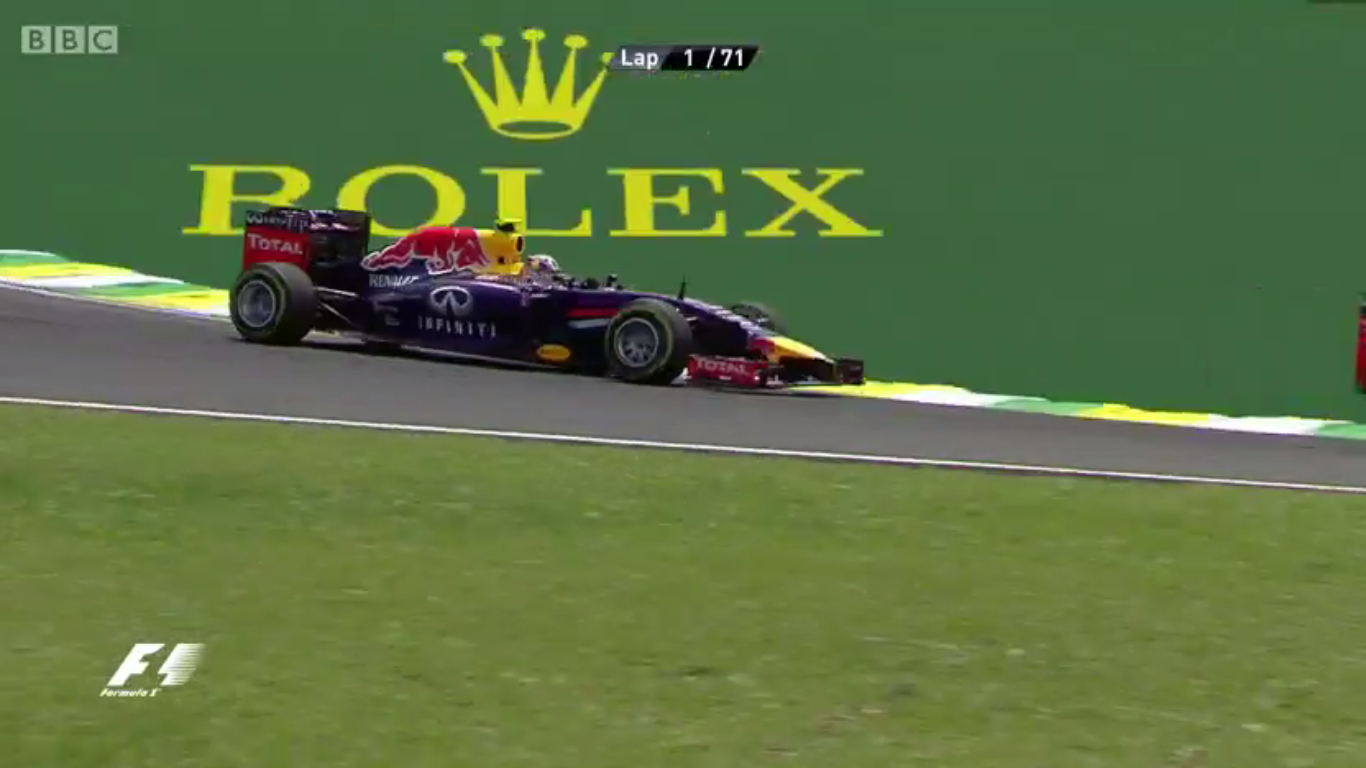
Rolex: A wonderful brand I’m sure, but what percentage of Formula 1’s audience is going to interact with the brand in the next seven days?
This brings me onto a point further down the article about Rolex and UBS, in that young kids can’t afford them. But I think the Rolex and UBS point is interesting in a different context. Are back end teams struggling to attract sponsors because Formula 1 presents itself as an elitist sport on screen? When I watch Formula 1, I don’t see worldwide sponsors that I can openly engage in, I see sponsors that only the rich and famous can engage in. Having a brand, such as McDonald’s or Nike to use two examples, alongside Rolex and UBS would look completely out of place. Does having only four or five sponsors presented on the World Feed at every race have a detrimental effect to those teams at the back of the field? Or does it not matter? I don’t know, but think it is an interesting point. Ecclestone does make the point about Formula 1 attracting an upmarket audience, which is a valid statement considering the sponsors. I’m not suggesting that Formula 1 should go towards a ‘chavvy’ audience or anything of the sort, but just that the choice of sponsors may make Formula 1 appear inaccessible, to some. Ecclestone himself in the interview with Campaign Asia says that the teams at the tale end require at least 70% to 80% of their budget to be from sponsors. If you fail to attract sponsors, you’re going to struggle.
Ecclestone says that they can’t “make Formula One more accessible to people”. I’m afraid I disagree: all races free-to-air worldwide where pay-TV growth has failed to take off, YouTube content (it doesn’t need to be World Feed, just some unique content produced by FOM) and the such like. In the UK, free-to-air television is still king. FOM are only starting to exploit social media with Twitter, but even so, you can argue that development is several years later than it really should have been. That probably does not matter that much, given that Ecclestone expresses no interest in tweeting.
“I’m not interested in tweeting, Facebook and whatever this nonsense is. I tried to find out but in any case I’m too old-fashioned. I couldn’t see any value in it. And, I don’t know what the so-called ‘young generation’; of today really wants. What is it? You ask a 15 or 16-year-old kid, ‘What do you want?’; and they don’t know. The challenge is getting the audience in the first place”, Ecclestone said in the piece. Ecclestone is probably one of the few old generation leaders who does not have Twitter. Rupert Murdoch, Vladimir Putin and Sepp Blatter all do. One reason that start-up companies are so successful in this generation is because of social media. Get a good following, with a bit of funding, and all of a sudden you can become the next big thing. There is a lot of possibilities with social media, which hopefully Formula E will be exploiting.
The two groups that Ecclestone alienated in the interview, women and young men (age 34 or under), accounted for 49 percent of the UK audience for the Russian Grand Prix according to overnight viewing figures, so half of his fan base. The main conclusion I sadly get from this piece is that Ecclestone is not interested in diversifying his audience. Ecclestone appears to be happy with what he have, but does not have the urge to change his audience, or to bring younger people into Formula 1. An ageing audience is not an attractive audience. An unattractive audience will not attract new, trendy sponsors. People associate Rolex and UBS with middle-aged businessman. The piece proves to me that Formula 1 needs new leadership. Not just Ecclestone, but the ‘yes men’ associated with Ecclestone. Someone to drive Formula 1 forward. Passion. Energy. Excitement. New media. Is Ecclestone really the person to drive Formula 1 forward, and continue to make it a global phenomenon?
In between the lull of the Brazilian and Abu Dhabi Grands Prix, there have been some interesting bits of news worth reporting in one post.
Buxton says “a very warm goodbye”
The biggest piece of news is that the Abu Dhabi weekend will be the last for Will Buxton as lead commentator of the GP2 and GP3 Series. Writing on his blog, Buxton said “My work in America has increased over the years to the point where I feel I am no longer able to divide my time effectively between three championships. By concentrating solely on Formula 1, I hope that I will be able to improve the quality of the content I bring to the burgeoning American audience, and help to grow the sport Stateside”. I’ve sampled a bit of ‘Off the Grid’ (a 30-minute show for NBC Sports) with Buxton and Jason Swales, and it is safe to say that the American audience is incredibly lucky to have two talented and dedicated people producing content for them.
I will miss hearing Will commentate on GP2. Not many people come across as passionate and articulate on the microphone, but he is always willing to give his opinion, which I think viewers appreciate. As for his replacement, Jack Nicholls and Ben Evans are surely two contenders high on the list. Nicholls is currently lead commentator on the Formula E World Feed, whilst Evans has been commentating on a lot of things for BT Sport alongside Keith Collantine. I guess we could always see someone like David Croft or Ben Edwards hoisted into the seat, but it depends whether FOM want to breed new talent or rely on a veteran figure such as those mentioned.
I’m a former MotoGP presenter
…Get Me Out of Here? Apparently so. Former MotoGP presenter for BT Sport, Melanie Sykes, is heading into the jungle. Sykes is not the only motor cycling alumni heading down under though, as Carl Fogarty is joining her on the ITV show. I didn’t mention this at the time, but Sykes did very briefly mention leaving BT’s MotoGP coverage on her Twitter feed at the end of August, albeit did not go into any further detail. Let’s see if her time in the jungle lasts longer than her time as MotoGP presenter…
MotoGP season ends with 669k
The 2014 MotoGP season ended with a combined peak audience of 669k, unofficial overnight viewing figures reveal. It was a tale of two halves however, as ITV4 figures were up compared to usual, and BT Sport ended the season on a low. The respective peaks were 518k (2.3%) for ITV4’s highlights programme and 151k (1.5%) at 13:45 for BT Sport’s live coverage from Sunday afternoon. ITV4’s highlights on Monday evening seen a boost compared to recent numbers, averaging 407k (1.8%).
No such boost for BT Sport’s coverage, which averaged 71k (0.7%) to 09:30 to 14:30. From 12:30 to 14:00, the channel averaged 110k (1.1%). Both of those numbers are poor, and I believe that is actually their lowest overnight figures for a European round of the entire season. BT’s audiences have not grown throughout the year, although they haven’t been helped by having a championship that was decided many months ago. Last year’s championship finale averaged 1.21m (11.9%) over on BBC Two. Unusually, the MotoGP finale was held on the same weekend as an F1 race, which could well have had a side-effect even though there was no direct clash.
ITV were non-committal when this blog asked about MotoGP highlights for next season. When the highlights deal was announced earlier this year, no details were released about how long the contract was for. I hope it will be multiple seasons, but we shall see. Personally, it would be a catastrophic mistake from Dorna to ignore its free to air audience. I don’t see any evidence that axing ITV4’s highlights programme would increase BT Sport’s MotoGP audience, either.
The third and final challenge in the F1 Connectivity Innovation Prize was announced by Formula One Management and Tata Communications earlier this week, and it is one which is of significant interest to this writer. FOM are, and I quote from here, “looking for suggestions to encourage F1 fans to provide audio and text commentaries of the FOM archive via the internet so that the content is indexed to allow it to be used in new and exciting ways.”
New and exciting ways. Via the internet. Terms that you do not normally hear FOM say, after all, they only made their Twitter feed engaging a little less than two months ago. In the title of this piece, I use the term ‘F1 Network’, which is deliberate. Alongside being a Formula 1 fan, I am also a fan of professional wrestling. Which brings me onto the WWE Network. The network, dubbed as ‘over the top’, is available on a multitude of devices from the traditional desktop PC, through to the iPad and onto the Xbox One. It currently runs a linear schedule, but shows are also available for fans to watch On Demand. As of writing, not everything is available on the network. In fact, WWE are barely scraping the surface as to what is currently available, however new material is being released on an ad-hoc basis. The monthly price for the network is, yep… $9.99.
The challenge description claims that FOM has around 60,000 hours of footage dating back to 1981. In that time period, up until the end of 2013, there have been 555 races. That works out at an average of 131 hours of footage per race weekend stored in FOM’s archive. That is huge. To put it another way, it would take you seven years, without stopping, to watch the entire archive. In comparison though, the WWE’s archive holds around 150,000 hours of footage, although admittedly that does contain material from a lot of defunct wrestling organisations. Around a quarter of their archive is digitalised.
Of course, it is worth noting that the WWE Network has not yet been launched in the UK, and could still launch here as a normal cable channel, like in Canada, which is basically a kick in the balls to the fans as that is just like what Sky Sports F1 is now. Sky Sports F1 is not an F1 Network. It is controlled BSkyB, who do not produce content 24/7 for the channel. An actual F1 Network, in the form of the US WWE Network, would be controlled 100 percent by FOM. Any F1 Network would need good grace from multiple providers, including Sky. FOM can not just launch an F1 Network online, the clause concerning online would have to be removed from every broadcasting contract, otherwise the network would be geo-blocked and Sky would kick up a huge fuss.
The brief says that “we need you to suggest how fans can be engaged to provide commentaries to the footage, and how these commentaries can then be converted into text form to provide a keyword index for easy searching and referencing. Once indexed, the footage archive can be used in many new and exciting ways, such as on-demand services. None of this is possible without the content being indexed in the first instance.” I would hope that any successful submission will involve some form of staggered approach. Does all of the archive need to be indexed before content can be rolled out? No. As I mentioned above, the WWE Network currently scrapes the surface and had WWE waited until all of their content was digitalised, we would be sitting here for many more years until that happens.
The quoted brief confuses me too, because it implies that the footage we hear will be fan commentary rather than the original commentary. Can I ask: who would listen to that? I’d like to hear the commentary in its original form, not dubbed commentary or anything of the like. I hope I have misread that, because fan-based commentary does not interest me in the slightest. Why can’t the original commentary be indexed? Most YouTube videos contain transcriptions, which is an automatic process with presumably little human intervention, surely something of this nature would be much more efficient than providing new commentary?
In terms of roll out, you could roll out ‘a season a year’ to the consumer with extra supplementary material surrounding that season, alongside any additional live streaming that may be considered. That might not sound like a lot for $9.99 per month, however the lifespan of the network would be increased, which is good for FOM in the long run. Release too much material at once, and you shorten the lifespan. The release of material needs to be logical for the network to be successful. Re-watching the 2011 Brazilian Grand Prix probably wouldn’t do much for me as it was recent, but watching the 1989 Italian Grand Prix on the other hand having seen the previous races that year would be fascinating.
The pessimist in me believes that we will not get a F1 Network for at least another two or three years, due to a variety of reasons that go beyond the status of current broadcasting contracts. Either way, it will be very interesting to see what the winning solution is for this challenge, and what time scales are involved.
Two comments in the past few days have raised my eye-brows and got me thinking a bit when you think about the current UK F1 television landscape in relation to the current situation we find ourselves in. The first is a comment from Ben Anderson on the AUTOSPORT website:
“It also doesn’t seem fair to try to squeeze more money out of TV companies and race promoters at a time of falling audiences and race attendance.”
The second is a comment from David Emmett, a MotoGP journalist, in a conversation I was having with him and a few others on Twitter last night:
“Not sure there’s as much room for Bernie to try to push TV revenue.”
The UK rights were negotiated in Summer 2011 as BBC renegotiated their existing deal, to bring Sky Sports into the picture to what we have now. As discussed earlier this year, the F1 rights currently are in the region of £55 million per year. Since 2011, BT Sport have entered the picture, and the cost of some rights has frankly entered the ‘silly’ territory. BT Sport paid £299 million per season to screen the Champions League from 2015-16. That’s absolute insanity. On a smaller level, MotoGP’s value multiplied several times over when it went from the BBC to BT Sport.
My point being that, with Formula 1 rights on lockdown until at least the 2019 season, FOM are losing a ton of money at the moment. If you renegotiated the rights today, or sent them to the market, in my opinion the rights value would easily head skyward of £100 million per year, probably near £200 million. And when you consider that it costs £75 million a year (based on current conversion rates) to run an F1 team, the £100 million difference between the current rights fee and what it could be in a hypothetical situation, FOM is missing out on a huge amount of money.
Of course, with any such increase, you can kiss goodbye to any terrestrial television coverage. What we have now is the best of both worlds, even if FOM are being short-changed…


 Motorsport Broadcasting