How to follow Formula 1 in 2023

After an extended winter break thanks to the men’s football FIFA World Cup, Formula 1 roars back into action this weekend with the Bahrain Grand Prix, and fans have a plethora of ways to enjoy the action.

23 races take Formula 1 from Bahrain on March 5th through to Abu Dhabi on November 26th, with twists and turns guaranteed. Familiar venues such as Suzuka, Silverstone and Spa combine with newer venues such as Las Vegas, Miami and Zandvoort, giving fans a mixture of the new world and old throughout 2023.

From a broadcasting perspective, the landscape is increasingly fierce for content creators who want to stand out from the chasing pack. There are multiple options for fans consuming the content to choose from across live and highlights, video, and audio, and online or in the traditional newspaper format.

So, what is returning, what has changed over the hibernation period, and who are new kids on the block? Motorsport Broadcasting takes an in-depth look…

Channel 4 to take F1’s in-house commentary

A new year means new graphics on the television front, with F1 promising some incremental changes for 2023.

Speaking recently to SVG Europe, F1’s director of broadcast and media Dean Locke highlighted that fans will see six to eight live helmet cameras during a race weekend, audio upgrades, “new opening titles”, as well as the potential for biometric graphics later in the season, subject to FIA approval.

The sport has revamped their UK TV base, giving broadcasters the choice of hosting their offerings from an augmented reality (AR) studio at Biggin Hill. Locke says that F1 “will host various broadcasters’ commentary here as well, potentially.”

Fans in the UK can watch every session live on Sky Sports. Sky returns as the UK’s main F1 broadcaster, the pay television outlet entering their 12th season covering the series.

Sky will remain involved for the foreseeable future after agreeing a new rights deal late last year, taking them to the end of 2029 in the UK, and to the end of 2027 in multiple other European territories.

Their roster of motor sport programming expands beyond F1, and this year the broadcaster will air Formula Two, Formula Three, IndyCar, as well as the Indy NXT series for the first time.

The latter, previously branded Indy Lights, features current W Series champion Jamie Chadwick, Chadwick making the jump stateside. However, it is unclear whether W Series, minus Chadwick, will happen in 2023 owing to financial issues.

In the off-season, Sky have tweaked their on-air roster, with both Johnny Herbert and Paul di Resta departing. The rest of the team, including the commentary pairing of David Croft and Martin Brundle, remains the same.

Expect Nico Rosberg’s presence on Sky’s coverage to increase this year, as the FIA have relaxed its COVID-19 paddock protocols for 2023. F1 banned Rosberg from the paddock last season due to his COVID vaccination status.

As announced late last year when they renewed their deal with F1, Sky viewers can access all 20 on-board cameras this season in addition to a new ‘Battle Channel‘, giving Sky Q and Sky Glass subscribers a similar level of service to that overseas fans can receive via F1 TV Pro.

All details for Sky Sports F1 unless stated.

Friday 3rd March
11:00 to 13:00 – Practice 1 (also Sky Sports Main Event)
14:45 to 16:20 – Practice 2 (also Sky Sports Main Event)
17:00 to 18:00 – The F1 Show (also Sky Sports Main Event)

Saturday 4th March
11:15 to 12:40 – Practice 3
14:10 to 16:30 – Qualifying (also Sky Sports Main Event from 15:00)
16:30 to 17:00 – Ted’s Qualifying Notebook
19:30 to 21:00 – Qualifying Highlights (Channel 4)

Sunday 5th March
13:30 to 18:30 – Race (also Sky Sports Main Event from 14:00 to 16:00)
=> 13:30 – Grand Prix Sunday
=> 14:30 – Race
=> 17:00 – Chequered Flag
=> 18:00 – Ted’s Notebook
21:00 to 23:30 – Race Highlights (Channel 4)

The full UK TV schedule for the 2023 Bahrain Grand Prix. Updated on 3rd March to reflect the shorter ‘Grand Prix Sunday’ length and longer ‘Race’ length for Sky F1.

Channel 4’s free-to-air highlights package continues this season, with highlights of every race, as well as live coverage of the Silverstone weekend, airing on their main linear outlet.

Their coverage features a change which appears minor to begin with, but is significant underneath the surface. Alex Jacques remains Channel 4’s F1 lead commentator, however Jacques is no longer part of the core Channel 4 team. Confused?

Jacques has moved back to F1’s in-house team in the off-season, and will commentate on every race for F1’s streaming service, F1 TV Pro.

Instead of producing their own bespoke commentary, Motorsport Broadcasting can confirm that Channel 4 will take F1’s in-house commentary this year, Jacques alongside a team that includes ex-IndyCar racer James Hinchcliffe, Jolyon Palmer, and Channel 4 analyst David Coulthard.

The look and feel of Channel 4’s pre- and post-race programming stays the same. For Bahrain, Steve Jones will present alongside Coulthard, Mark Webber, Alice Powell, and Ariana Bravo, while Lee McKenzie, Jamie Chadwick, Billy Monger, and Lawrence Barretto will join them throughout the year.

F1 has announced various rights extensions in the off-season overseas, including in Mexico and Belgium, where the sport will continue to air on FOX Sports Mexico and Play Sports.

Over in Asia, the sport will continue its long-standing partnership with Fuji Television in Japan, with their agreement with DAZN also continuing in the market until the end of 2025.

Fans in India will have access to live action via F1’s over-the-top service for the first time, while beIN SPORTS will cover F1 in ten territories across Asia, including Singapore, Malaysia, and Indonesia.

Elsewhere in the motor sport spectrum, 2023 sees the end of the BT Sport brand in the UK. While MotoGP remains live on BT Sport, and both World Superbikes and British Superbikes remain on Eurosport, all three will become part of the TNT Sports brand in the medium term.

TNT Sports becomes the new name for BT Sport from July, with Eurosport merging into the brand “sometime into the future” following the announcement of a joint venture between BT Group and Warner Bros. Discovery last year.

The F1 Academy series launches in April; however, details of broadcasting arrangements are unknown as of writing.

Plenty on offer in the podcasting world

The BBC remains F1’s radio rights holders in the UK, with every race airing across either BBC Radio 5 Live, BBC Radio 5 Live Sports Extra or the BBC Sport website.

Thursday 2nd March
20:00 to 21:00 – Season Preview (BBC Radio 5 Live)

Friday 3rd March
11:25 to 12:45 – Practice 1 (BBC Radio 5 Live Sports Extra)
13:30 to 14:00 – Bahrain Grand Prix Preview (BBC Radio 5 Live)
14:55 to 16:15 – Practice 2 (BBC Radio 5 Live Sports Extra)

Saturday 4th March
11:25 to 12:45 – Practice 3 (BBC Radio 5 Live Sports Extra)
14:55 to 16:15 – Qualifying (BBC Radio 5 Live Sports Extra)

Sunday 5th March
14:45 to 17:30 – Race (BBC Radio 5 Live Sports Extra)

The full UK radio schedule for the 2023 Bahrain Grand Prix.

Rosanna Tennant leads their offering for the start of 2023 season following Jennie Gow’s serious stroke at the end of December. Writing on Twitter last week, Gow said  “I’m gutted not to be well enough to return to the paddock and to bring you all the excitement.”

“My recovery is progressing well – considering eight weeks ago I wasn’t able to move fully or speak at all!” Motorsport Broadcasting wishes Gow well on her recovery.

Jack Nicholls and Harry Benjamin will share the lead commentator microphone on 5 Live, alongside a roster of talent including Formula E driver Sam Bird, Chadwick and Palmer. Supplementing the BBC’s main race offering will be their Chequered Flag podcast, presented by the 5 Live team.

Joining 5 Live in the motor sport space this year is talkSPORT, who have launched a one-hour weekly show in collaboration with Formula E.

Presented by Jon Jackson, On Track airs on talkSPORT 2 on Tuesday afternoons, focusing not only on the electric series, but also on other championships, including F1 and MotoGP.

Where original audio and podcast content is concerned, the BBC’s and talkSPORT’s offering is only the beginning in a vast landscape this season.

Sky have launched their own podcast, with new episodes premiering every Tuesday. Presented by Matt Baker, The Sky Sports F1 Podcast replaces Any Driven Monday, which will not return to Sky’s YouTube channel after a single season on air.

Say hello to the faces of the newest F1 podcast, The Fast and The Curious: Greg James, Christian Hewgill and Betty Glover (l-r).

The Race Media have refreshed their WTF1 brand in the winter break, with two of the brand’s key players, Tom Bellingham and Matt Gallagher moving to pastures new.

The two have been largely responsible for the brand’s growth over the past decade, taking the brand from start-up to major player in the motor sport landscape. Instead, the two opted to create P1 with Matt & Tommy, a brand that they have full creative control over.

Content creators Andre Harrison, Hannah Atkinson, Ciaran Oakes, and Charley Williams have joined WTF1 ahead of the new season, with Jack Nicholls’ hosting WTF1’s s flagship Internet’s Best Reactions YouTube series.

“I believe the new team we have assembled gives us the best opportunity to keep the brand relevant and cater to the next generation of Formula 1 fans,” said The Race Media founder and COO Andrew van de Burgt.

Another new addition to the podcasting world this season is The Fast and The Curious, with a few recognisable faces to a non-F1 audience. BBC Radio 1 presenter Greg James hosts the podcast alongside Betty Glover and Christian Hewgill.

The show’s creators says that the podcast is “die-hard fans as well as those who are curious to learn more about the fascinating F1 world and the characters that inhabit it,” with guests in the opening episodes including Mercedes driver George Russell and Lewis Hamilton, and new Williams rookie Logan Sergeant.

And, if that was not enough, ex-Sky F1 pundit Herbert and Monger have launched the Lift the Lid podcast, while Whisper have launched a podcast with Coulthard and Eddie Jordan.

Lift the Lid has been “brought together through a love of F1 and their joint experience of life-changing crashes,” the two “join forces to give a unique drivers-eye-view on all the hottest topics from up and down the F1 grid each week!”

The Athletic joins the F1 media pack

A big addition on the writing front for 2023 is The Athletic, who have snapped up journalists Luke Smith from Autosport and Madeline Coleman from Sports Illustrated to kick start their coverage.

Introducing their F1 offering, The Athletic’s Managing Editor for F1, Alex Davies said “Our coverage will build on The Athletic’s mission of going beyond the chyron delivering scores and stats to the bottom of your TV screen.”

“From each racetrack around the world, we’ll dive deep into the personalities, technology, strategy, business, politics, culture and miscellanea of F1,” Davies added.

“Whether you’re new to F1 or a Serious Fan, we’ll get you up to speed by telling you not just who won, but how and what it means. Not just fighting words, but the roots of the rivalries. Not just how to tune into a race, but how to watch it like a pro.”

Davies highlights Drive to Survive as a factor in The Athletic beginning its F1 coverage, which has already been recommissioned for season six covering the 2023 season.

Autosport and The Race remain on the starting grid both in the written media and podcasting world, the latter now firmly embedded into the paddock and heading into their fourth season covering the sport.

Other faces to follow across social media in 2023 include Auto Motor und Sport’s Tobi Grüner and technical expert Albert Fabrega, the two breaking stories before the UK contingent of journalists.

AMuS’s most recent exclusive concerns the future of the AlphaTauri team, with owners Red Bull considering to put the team up for sale, a suggestion later denied by the team.

If journalists or broadcasters are not your thing, there is the other option of going DTT: direct-to-team. Expect plenty of content across the ten teams’ and 20 drivers social media channels this year, bringing fans closer to the action.

While Drive to Survive and broadcasters, such as Sky, aim to give all the grid ample coverage, some teams receive the short straw last season.

A tweet posted a few weeks ago by Williams suggested that they were releasing a behind the scenes documentary series focusing on their 2022 season, however Williams have since deleted the tweet.

Whether it is Red Bull’s Behind the Charge series or McLaren’s Unboxed, there is plenty of content to engage fans throughout 2023 across the different platforms.

Are Red Bull set to dominate 2023?

Audience figures stayed stable in 2022, with F1’s commercial rights holder Liberty Media reporting a cumulative audience of 1.54 billion viewers, resulting in an average per race worldwide of 70 million viewers.

Other metrics reported by Liberty indicate that F1 remains on the rise, with strong attendances following the COVID-19 pandemic and a 23% rise in the number of social media followers.

Early signs from testing suggest that Red Bull are the outfit to beat this year, as Max Verstappen looks to clinch his third consecutive Drivers’ Championship. Nevertheless, F1 will be hoping for a closer championship battle this year to keep the audience engaged through the 23 races.

Can Red Bull remain at the front, or will Ferrari, Mercedes and even Aston Martin pose a threat this season? Will it be Verstappen celebrating at the end of 2023, or are we looking at Verstappen vs Hamilton, round 2?

In the words of Sky Sports: enjoy the ride.

If you enjoyed this article, consider contributing to the running costs of Motorsport Broadcasting by donating via PayPal. If you wish to reproduce the contents of this article in any form, please contact Motorsport Broadcasting in the first instance.

Last updated on March 3rd at 20:20 to add details about Channel 4’s on-air team, Sky’s multi-screen options, a minor tweak to Sky’s schedule and a new podcast from Whisper.

F1 and Sky extend broadcast deals across UK, Italy and Germany

Sky Sports will continue to broadcast Formula 1 across key European territories in forthcoming seasons, the two parties have today (September 30th) confirmed.

In the UK and the Republic of Ireland, Sky will air Formula 1 until the end of the 2029 season, a five-year extension to their existing deal which was set to expire at the end of 2024.

Further afield in Europe, the broadcaster has extended their rights agreements with F1 in Italy and Germany until the end of 2027. Deals in both territories were set to expire at the end of this season.

The deal includes broadcast rights to Formula Two, Formula Three and the Porsche Supercup.

Live coverage of the home race, and highlights of all other races, will remain available on a free-to-air basis. This is the same as the current UK deal, but an increased level of exclusivity for Sky in Italy and Germany, with fewer races available live on a free-to-air basis.

As part of the new agreement, F1 TV’s premium-level offering, which allowed fans access to live action, will no longer be available to fans in Germany.

F1 says that, from 2023, viewers watching via Sky will have an “improved multi-screen and second-screen option, tracking their favourite driver’s position on the circuit or selecting a driver’s on-board camera.”

The wording here indicates that UK fans will not have access to F1 TV, a source of contention for some fans in the UK. However, it is possible that the experience via Sky’s improved options will be on parity with that offered by F1 TV.

Formula 1’s president and CEO Stefano Domenicali said “We are incredibly proud of our long-term partnership with Sky, and we are delighted to announce that we will continue working together until 2029, a very important commitment from Sky.”

“Since the beginning of our relationship in 2012 we have both strived to bring the excitement, emotion, and drama of Formula 1 to our traditional fans while engaging new and more diverse audiences. Formula 1 has seen huge growth in recent years, and I can’t think of a better partner to continue to reach our fans with dedicated, expert and in-depth coverage.”

Sky not only brings fans live coverage but a range of behind-the-scenes access and content that brings F1 to life. We are hugely excited about the future of the partnership and the journey of Formula 1.”

Stephen van Rooyen, Executive Vice President & CEO, Sky UK & Europe, added “Every race. Every moment. Every twist and turn. All exclusively live on Sky for years to come!”

“Formula 1 continues to break records on Sky, with millions more watching than ever before across our markets, driven by new younger and female fans which is fantastic for the sport. More than 80 countries will continue to enjoy our world class analysis and content of one of the most exhilarating sports in the world.”

While Sky Sports will continue to broadcast F1 in the UK until 2029, it is unclear whether Channel 4 will remain involved from a free-to-air perspective following the conclusion of the 2022 season.

The broadcaster, which has aired Formula 1 on free-to-air television since 2016, issued a “no comment” statement when asked by this site whether they will continue to cover F1 next season.

Announcement in the making for some time

Motorsport Broadcasting understands that the announcement has been in the making for some time. The extension is not a surprise to this writer, who accurately predicted the timing of the announcement back in July 2021.

F1 and Sky were originally set to announce the extension on the Friday of the Italian Grand Prix weekend, however both parties agreed to delay the announcement following the death of Queen Elizabeth II the evening before.

Sky have made moves in recent months to lock in long-term deals in the UK: Scottish football (2029), England cricket (2028) and PGA Tour golf (multi-year) some of the most recent extensions, however the F1 extension is their most high profile yet.

By the end of 2029, Sky will have broadcast 18 F1 championships and close to 400 races live on their F1 channel, compared with 12 full seasons on ITV and 22 full seasons on the BBC (19 under the ‘Grand Prix’ banner and 3 from 2009 to 2011).

While Sky’s F1 viewing figures in the UK largely plateaued when coverage of half the races also aired across the BBC and later Channel 4, their viewing figures have surged in recent years.

The broadcaster was the beneficiary of a titanic championship battle between Lewis Hamilton and Max Verstappen last year, while also benefiting from Netflix’s Drive to Survive season, increasing their younger audience.

The positive trajectory has continued for Sky in the UK into 2022, with the British Grand Prix in July recording Sky’s highest ever audience for the home round.

Sky say that their audiences are skewing younger than in previous years, their offering also attracting more women to F1.

F1 audience statistics
Sky UK and Ireland

  • Average audience for 2022: 1.7 million (up 60% since 2019)
  • 4.3m new viewers to Sky Sports F1 since 2019, of which 1.7m were women
  • 4 of the top 5 most watched races ever on Sky during 2022

Sky Italia

  • Average audience for 2022: 1.5 million (up 20% since 2021)
  • Most watched Grand Prix in Italian pay-TV history was Saudi Arabia with 1.937 million viewers

Sky Deutschland

  • Average audience up 24% since 2021
  • Half of new viewers aged under 35
  • 40% of new viewers overall are women
  • Most watched Grand Prix was Saudi Arabia with 1.38 million viewers
Source: Sky

Sky will be hoping the Drive to Survive halo continues into future seasons, as their new deals with F1 come into effect.

Contribute to the running costs of Motorsport Broadcasting by donating via PayPal. If you wish to reproduce the contents of this article in any form, please contact Motorsport Broadcasting in the first instance.

F1’s UK audience figures rise in 2021, but series sees worldwide dip

Formula 1’s UK audience figures rose to their highest level in around four to five years as the titanic battle between Max Verstappen and Lewis Hamilton came to a climax, however, audience figures dipped worldwide, analysis from Motorsport Broadcasting shows.

The consolidated UK data, released by BARB, includes viewers who watched the Grand Prix within seven days of the original transmission across TV, PC, smartphone, and tablet (defined by BARB as ‘four-screen viewing data’), the body no longer splitting these out into separate components.

A small number of historical data points are missing; however, these are not statistically significant enough to impact the overall trajectory.

In addition, this analysis excludes the Russian Grand Prix, as Sky’s figures for that weekend are unavailable, but does include the shortened Belgian Grand Prix.

Sky’s figures rise to highest ever level…

On race day, Sky split their programming into three or four blocks, depending on weekend.

Their build-up normally lasts 85 minutes, with the race segment lasting 135 minutes. The ‘Chequered Flag’ programme follows the podium for 60 minutes, whilst Ted’s Notebook sometimes wraps up proceedings.

Across a mix of Sky Sports F1, Sky Sports Main Event and Sky Showcase, an average audience of 1.59 million viewers watched the 22 races live on Sky during 2021, their highest ever audience for Formula 1.

Year-on-year, Sky’s figures increased by 25.7% from 1.27 million viewers in 2020, the fourth consecutive year that Sky’s F1 audience has increased.

For the first time, over 2 million viewers watched an F1 race live via one of Sky’s television channels. The season started well in Bahrain, with an average of 1.94 million viewers watching the race, peaking above the 2 million mark.

Later in the year, 2.11 million viewers watched a dramatic Saudi Arabian Grand Prix unfold, with 2.30 million opting to stay with Sky for the season decider in Abu Dhabi. The latter figure excludes those who decided to watch Sky’s broadcast on Channel 4.

At the other end of the spectrum, the Dutch Grand Prix was Sky’s lowest rated of 2021, averaging just 1.12 million viewers.

Competition from other channels was easier than usual, with no Premier League football, however the race followed the farcical Belgian Grand Prix one week earlier, which may have invertedly caused a dip.

Sky’s wrap around programming felt the benefit of the championship battle, with their pre-race build-up increasing by 13.9% year-on-year, while their post-race analysis increased by 31.1%, both double their 2018 averages.

Unsurprisingly, both Britain and Italy saw larger post-race audiences, thanks to Hamilton and Verstappen’s on-track incidents, with 407,000 viewers sticking around for the Silverstone post-race analysis and 448,000 viewers sticking around for the Monza debrief.

The new F1 Sprint format also performed well, with an average of 739,000 viewers watching Hamilton charge through the field in Brazil, the figure including Sky’s extensive wrap-around programming.

Sky gained an extra competitive session because of the change, with the displaced Friday qualifying session performing strongly. Both the Italian and Brazilian qualifying programmes averaged 470,000 viewers, comfortably above Sky’s usual practice average.

…as Channel 4’s audience continues to drop…

While Sky benefited from the intense championship battle, Channel 4 saw no obvious benefit, outside of the Abu Dhabi decider.

Highlights of 20 races on the free-to-air broadcaster (excluding Silverstone and Abu Dhabi) averaged 1.50 million viewers, down 14.4% of the 2020 average of 1.75 million viewers.

Including Silverstone and Abu Dhabi, the 23 races on Channel 4 averaged 1.63 million viewers, down on the equivalent 2020 figure of 1.80 million viewers. An average of 3.36 million viewers watched the season decider live on Channel 4.

The return of USA and Mexico to the F1 calendar hurt Channel 4’s average, both bringing in less than a million viewers after 7 days of consolidation, in part thanks to their late night time slot on Sunday.

Channel 4’s weak average was compounded by the fact that five of the European based races (France, Styria, Belgium, Netherlands and Turkey) averaged under 1.50 million viewers compared with one race (Abu Dhabi) in 2020.

Nevertheless, there were some positive numbers in amongst the overall decline for Channel 4, with the Emilia Romagna, Hungarian and Italian rounds drawing in close to 2 million viewers for their 150-minute highlights packages.

An average of 1.97 million viewers watched as Hamilton and Verstappen collided for the second time in 2021 at Monza, a slight increase on an equally dramatic 2020 Italian Grand Prix, which brought in 1.88 million viewers.

…but the overall UK picture is positive…

Unsurprisingly, Hamilton versus Verstappen drew in the viewers in 2021.

3.22 million viewers watched across Sky Sports and Channel 4, an increase of 5.1% on 2020 average audience of 3.06 million viewers, bringing audience figures back to a level last seen in 2016 and 2017.

However, the 2021 average dropped slightly at end of season compared with the mid-season figure of 3.24 million viewers.

As referenced both the USA and Mexican rounds performed poorly on Channel 4, with Sky’s live audience failing to offset the Channel 4 drop. The lack of increase may also suggest audience fatigue crept in as the season progressed.

For example, the Qatar Grand Prix averaged 3.15 million viewers, 1,000 viewers fewer than the Emilia Romagna Grand Prix, despite the championship battle having stepped up considerably by that point.

The season finale in Abu Dhabi was the most watched race of 2021, with 5.66 million viewers watching live across Channel 4 and Sky Sports, this figure including some of the pre-race build-up and post-race wrap-around.

Overnight data showed that a peak of 7.4 million viewers watched as Verstappen overtook Hamilton to win the F1 title.

Saudi Arabia, Britain and the season opener in Bahrain also drew strong audiences. The inaugural race in Saudi averaged 3.88 million viewers, F1’s highest average at that time since the 2018 US Grand Prix.

Channel 4’s and Sky’s F1 audiences continued to converge, with a 49:51 split between the two broadcasters.

Assuming Sky’s audience figures remain strong this season, it is increasingly likely that they will become the dominant F1 broadcaster, from an audience share perspective, in the UK moving forward.

…as F1 faces a worldwide audience dip

While Formula 1’s audience increased in the UK thanks to the championship battle between Hamilton and Verstappen, worldwide the sports average audience dropped significantly.

An average of 70.3 million viewers watched each race, a decrease of 20% on 2020’s average of 87.4 million viewers, and down on the 2019 figure of 91 million viewers.

F1 says that the decrease is due to a change in broadcast rights in Germany and Brazil. For markets where broadcast rights have remained identical, audience figures increased by 13% to 60.3 million viewers, which F1 says is the best figure since 2013.

Taking the figures at face value, this implies that where broadcast rights changed hands between 2020 and 2021, F1’s average audience dropped by 24.1 million viewers, from 34 million viewers in 2020 to 9.9 million viewers in 2021.

SeasonCumulative Audience% y-o-yAverage Audience% y-o-yRaces Held
20181.76 billionn/a83.7 millionn/a21
20191.92 billion9%91.5 million9%21
20201.49 billion-23%87.4 million-5%17
20211.55 billion4%70.5 million-19%22
Source: Formula 1 press releases / Motorsport Broadcasting analysis

The drop is significant for F1, but unsurprising in some ways. F1 themselves highlighted in their 2019 data release that Brazil and Germany were two of their top markets, a statistic that will have since changed two years later.

While not impacting the whole of 2021, it is likely that the closure of Fox Sports in Asia also dented F1’s average across the season. F1 needed to find new homes in territories such as Hong Kong, Singapore and Malaysia after Fox closed its doors in early Autumn.

The fact that F1’s figures have increased for territories where the TV rights have stayed the same is good, but it fails to account for the overall worldwide drop that F1 has experienced. Like Formula 1, Formula E also used their cumulative audience data to hide a race-by-race drop.

Over on F1’s digital platforms, analysis by this site shows that the amount of people watching F1’s race highlights packages on YouTube has increased by 41% year-on-year, from an average of 5.24 million viewers in 2020 to 7.38 million viewers in 2021.

Both the cumulative TV audience and unique audience increased by 4% and 3% respectively year-on-year to 1.55 billion viewers and 445 million viewers, reflecting the longer calendar compared with 2020.

Contribute to the running costs of Motorsport Broadcasting by donating via PayPal. If you wish to reproduce the contents of this article in any form, please contact Motorsport Broadcasting in the first instance.

ITV’s F1 archive to be activated in deal with Racing Past Media

ITV’s Formula 1 archive is to be activated over the next three years following a research deal reached between the broadcaster and Racing Past Media, led by presenter Steve Rider.

The archive being explored covers live coverage of F1 races from the 1960s and 1970s, including coverage of the 1976 Japanese Grand Prix, as well as ITV’s coverage of over 50 races via the European Broadcasting Union.

RPM says that the agreement “will help organise and activate a significant volume of material held by ITV from the first 30 years of the Formula One World Championship.” The agreement does not cover ITV’s later F1 coverage from 1997 to 2008.

In their press release, RPM says that “the ambition of the project to make this exciting content available to a much wider audience.”

Although the release does not list any outlets, the deal will open the door for the ITV archive to be made available to stakeholders, such as Formula 1 themselves for usage on their over-the-top platform, or Sky Sports F1 more easily than what it currently is.

Joining Rider at RPM is Robert Foster, who spent 25 years in production, rights and archive management at the BBC before becoming vice-president at the European Broadcasting Union.

Steve Rider said “It is not just the race coverage but the documentary and feature material being unearthed that is so exciting.”

“This is the first step in a project that, along with the co-operation of other archives and rights holders, will help provide a complete and accessible archive of the formative years of the Formula One World Championship.”

Contribute to the running costs of Motorsport Broadcasting by donating via PayPal. If you wish to reproduce the contents of this article in any form, please contact Motorsport Broadcasting in the first instance.

Tracking the social media fortune of motor sports leading championships

Motor sport has successfully navigated the COVID-19 pandemic, with leading championships managing to put together championship seasons throughout turbulent times.

Off the track, each individual series has fought for the attention of viewers around the world, some more successful in others.

Across social media, the battle for followers has intensified, with real-world championships turning to eSports to try to hook the next generation of fans.

This writer has followed the battle every step of the way, and can now present a deep-dive into each series, including who is hot, and who is not…

Methodology

Since March 2017, Motorsport Broadcasting has collected and analysed metrics on 14 of the world’s leading motor sport series, dissecting their performance across the leading social media platforms.

The data gives us a greater insight on which championships are increasing their social media following the most comparatively speaking against their rivals, and which entities risk slipping out of the limelight in the years ahead.

The metrics focus on the number of followers for each series, across Facebook, Twitter, and Instagram, aggregating these totals together to form a wider view, as this is easily accessible data within the public domain.

The championships covered are:

  • British Superbikes
  • British Touring Car Championship
  • Formula E
  • Formula 1
  • Formula Two
  • IndyCar Series
  • MotoGP
  • NASCAR
  • Roborace
  • W Series*
  • World Endurance Championship
  • World Rally Championship
  • World Rallycross*
  • World Superbikes
  • World Touring Car Championship

* Added in September 2019

By analysing international and domestic series within the same time series, we can see what the natural ‘floor’ is, and whether any international championships are performing worse than anticipated against their rivals.

As thus, the surprise is not when the British Superbikes or British Touring Car Championships are at the back of the pack, but rather when someone else is.

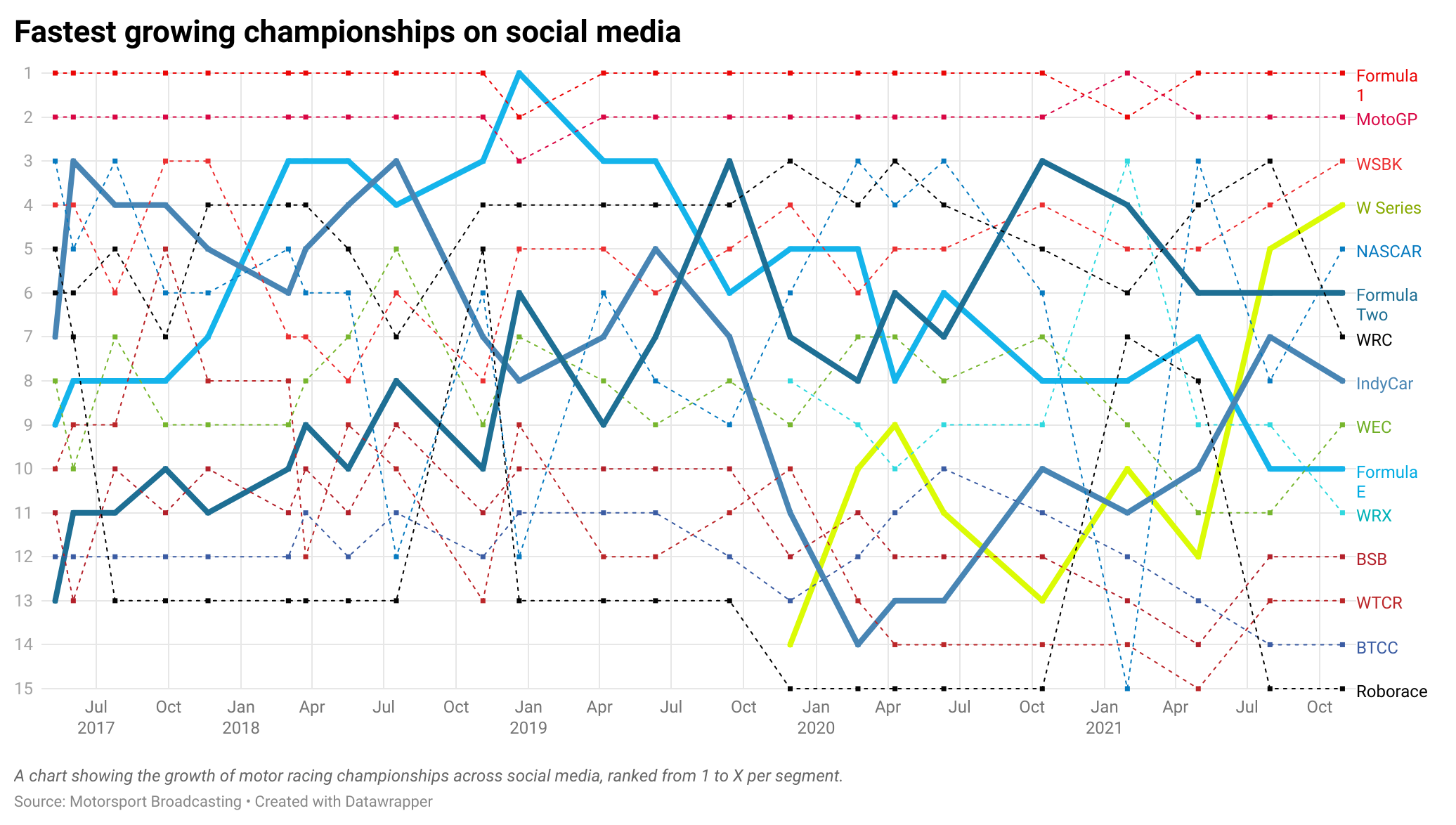
By comparing multiple data points, we can analyse how much a championship has grown over a given period, ranking this data to see which series is the best and worst performer within the data set (1st means fastest growth of the championships tracked within the period, 15th means slowest growth).

The methodology is imperfect, but helps us identify how championships are performing over a longer period against their rivals in the marketplace.

Formula Two and W Series rises show benefits of current F1 support package

The chart above shows how Formula 1, Formula Two and the W Series have performed in direct comparison to their rivals recently.

As expected, Formula 1 has led the way, only briefly dipping behind their nearest rival twice. Formula E overtook F1 in the back end of 2018, with MotoGP doing the same two years later.

More interestingly is the consistent rise of Formula Two since Liberty Media purchased F1 and their subsidiary organisations.

In early 2017, Formula Two was lacklustre in the social media space, ranking 13th (and last) in the series that Motorsport Broadcasting is tracking. To put it simply, Formula Two was growing slower in terms of raw volume than its key rivals.

Since then, Formula Two’s reach on social media has risen faster than its rivals: gradually increasing to 8th in July 2018 and 3rd in Autumn 2019 and 2020 respectively.

Formula Two’s rise has not matched the dazzling heights it saw last year (a statistic supported by Sky’s UK audience figures for the series year-on-year), however we can attribute this to the poor calendar format as opposed to any misstep on the social media front.

Social media figures have grown for the leading feeder series by 748% in the past four years: from 156,000 followers in May 2017 to 1.33 million followers at the end of October, a massive achievement.

It shows not only how well Liberty Media have treated the series across their platforms, but also how much of an afterthought Bernie Ecclestone’s F1 treated the feeder championships.

Motorsport Broadcasting has not tracked Formula Three’s figures, but expect a similar pattern to have emerged in that space.

Pleasingly, the W Series is also performing well on social media, rising at a faster rate than some of their bigger rivals this season, including F2, as the chart shows.

The championship has doubled their following in the six months to October: rising from 165,000 followers to 331,000 followers. The total volumes are still small, but there is reason to be hopeful that W Series is about to break out on social media.

An expanded calendar, to give the championship more ‘growth opportunities’ would help in that regard as we head into 2022.

Formula E and IndyCar’s stats show mixed results

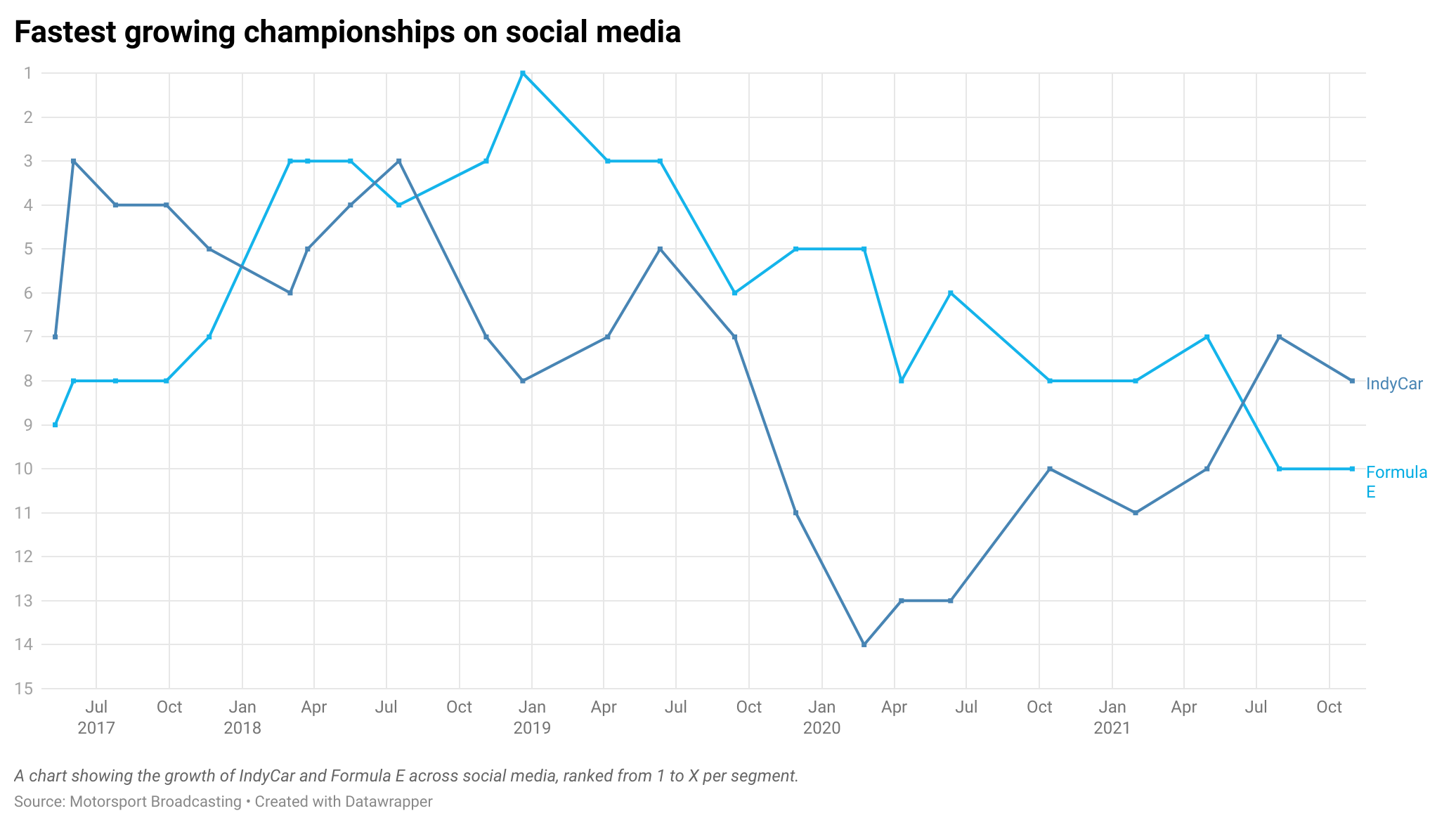
While Formula Two and W Series have generally seen a positive swing in momentum, Formula E and IndyCar have experienced turbulence in recent years.

IndyCar’s social media movement has fluctuated in recent years, with a strong 2017 and 2018 followed by a sharp slump in 2019, possibly influenced by Fernando Alonso’s first Indianapolis 500 appearance in 2017.

The series recovered throughout the pandemic, but failed to reach their earlier heights, in comparison to its rivals at least.

Whereas international championships such as MotoGP and F1 have increased their calendar length, IndyCar’s typical season lasts six months, the season beginning in March and finishing in September.

The result, from a social media perspective, has been a much sharper ‘off-season decline’ compared to their rivals, thanks to the length of their off-season. There is some evidence in the data that a long off-season hurts IndyCar to gain momentum at the start of the following season.

IndyCar’s trough came at the start of the pandemic, a surprising statistic considering how successful their eSports Series was in attracting attention, with McLaren F1 driver Lando Norris to the party. Evidently, Norris’s appearance in the video world had little impact on IndyCar overall.

Formula E’s trajectory is well supported by their decline in audience figures through the pandemic. At one point, in late 2018 at the start of the Gen2, Formula E was growing faster than most of their rivals, but has since slipped down the order. Although Formula E retains a higher reach (for now), the likes of Formula Two are currently growing at a faster rate than the electric series.

Reigning champion Antonio Felix da Costa acknowledged in an interview with The Race recently that the series has “took a few punches” recently, something that the championship needs to rectify heading into season 8.

World Superbikes performs well

The leading two-wheel championships have generally performed well in recent years. MotoGP sits behind Formula 1 as expected; however, the bigger surprise is World Superbikes.

Despite Jonathan Rea’s dominance from 2015 to 2020, the series has always been there or there abouts, consistently in the top six for social media growth since the start of 2019.

2021 has built on the strong foundations, with Rea’s time at the top of the series halted, for now at least, by Turkish rider Toprak Razgatlioglu, helping push World Superbikes into a top three spot for social media growth, only behind F1 and MotoGP.

MotoGP will be hoping that the impact of their new Amazon Prime documentary series, alongside the rest of their product offering, will help not only their social media offering, but also the broadcasters too.

“We’re not the target of these new products,” Manel Arroyo, MotoGP’s Managing Director told me earlier this year. “The purpose is to bring in a new audience of people that are normally visiting different platforms.”

“And then, they find these kind of products and documentaries, discovering us in the process. Our main target with our platforms is to create new audiences and to bring these audiences to our broadcasters, whether in Spain, Italy, Germany, UK, everywhere.”

“It’s not just about social media growth, but looking at how we deliver the growth as well to our broadcasters.”

Another consistent performer is the World Rally Championship, with the All Live platform helping. However, a poor Summer saw the series drop to 7th in the social media standings, its lowest ranking in three years.

The overall picture

What does this mean when all the data points are crunched together into one chart?

Highlighted are some of the series with the biggest fluctuations referenced in this article.

IndyCar’s standing has not necessarily declined from 2017 to 2021, but what has happened is that both it, and Formula E, have encountered competition from what an unlikely source in Formula Two.

This makes it more difficult for both IndyCar and Formula E to stand out from the crowd, with Formula Two now on the social scene. 2022 is critical for the latter, who have now fallen behind the likes of the World Endurance Championship on social media.

Overall, it shows just how important it is to have momentum on track, and how that then translates into the social media metrics.

Statistics last updated on October 31st, 2021.

Contribute to the running costs of Motorsport Broadcasting by donating via PayPal. If you wish to reproduce the contents of this article in any form, please contact Motorsport Broadcasting in the first instance.