After the Summer break, Formula 1 heads to Spa for the Belgian Grand Prix! With nine races remaining until the season finale in Abu Dhabi on December 1st, can anyone stop Lewis Hamilton from winning his sixth Drivers’ Championship?
All nine races air exclusively live on Sky Sports. Sky will be thin on the ground in Belgium, with both Anthony Davidson and Paul di Resta at Silverstone for the start of the 2019-20 World Endurance Championship season (airing live on BT Sport/ESPN). Ted Kravitz is also absent, returning to the team in Monza next time out.
Meanwhile on the Channel 4 front, Mark Webber joins Steve Jones and David Coulthard in the paddock for their highlights offering. Slightly unusual is the fact that Channel 4’s qualifying highlights air at 18:00 instead of 18:30, but this is still three hours after qualifying ends, so still within their contractual obligations.
Channel 4 F1
31/08 – 18:00 to 19:30 – Qualifying Highlights
01/09 – 19:00 to 21:00 – Race Highlights
Sky Sports F1 Sessions
30/08 – 09:45 to 11:55 – Practice 1
30/08 – 13:45 to 15:50 – Practice 2
31/08 – 10:45 to 12:30
=> 10:45 – Practice 3
=> 12:10 – Paddock Walkabout
31/08 – 13:00 to 15:35 – Qualifying
=> 13:00 – Pre-Show
=> 13:55 – Qualifying (also Sky Sports Main Event from 14:15)
01/09 – 12:30 to 17:00 – Race
=> 12:30 – Pit Lane Live
=> 13:30 – On the Grid
=> 14:05 – Race
=> 16:00 – Paddock Live
Supplementary Programming
29/08 – 14:00 to 14:30 – Drivers’ Press Conference
29/08 – 17:00 to 17:30 – Welcome to the Weekend
30/08 – 16:30 to 17:00 – The Story so Far
31/08 – 16:45 to 17:15 – The F1 Show
04/09 – 20:00 to 20:30 – F1 Midweek Debrief
BBC Radio F1 All sessions are available live on BBC’s F1 website
30/08 – 09:55 to 11:35 – Practice 1 (BBC Radio 5 Live Sports Extra)
30/08 – 13:55 to 15:35 – Practice 2 (BBC Radio 5 Live Sports Extra)
31/08 – 10:55 to 12:05 – Practice 3 (BBC Radio 5 Live Sports Extra)
31/08 – 13:55 to 15:05 – Qualifying (BBC Radio 5 Live Sports Extra)
01/09 – 14:00 to 16:00 – Race (BBC Radio 5 Live Sports Extra)
European Le Mans Series – Silverstone (BT Sport Extra 4) Also airs live on YouTube
31/08 – 14:00 to 19:15 – Race
Formula Two – Belgium (Sky Sports F1)
30/08 – 11:55 to 12:45 – Practice
30/08 – 15:50 to 16:30 – Qualifying
31/08 – 15:35 to 16:45 – Race 1 01/09 – 10:05 to 11:05 – Race 2
Formula Three – Belgium (Sky Sports F1)
30/08 – 17:00 to 17:35 – Qualifying Tape-Delay
31/08 – 09:30 to 10:20 – Race 1
01/09 – 08:40 to 09:30 10:05 to 11:05 – Race 2
IndyCar Series – Portland (Sky Sports F1)
31/08 – 23:00 to 00:30 – Qualifying (also Sky Sports Main Event)
01/09 – 20:00 to 23:00 – Race
Speedway Grand Prix – Germany (BT Sport 3)
31/08 – 17:45 to 21:15 – Races
World Endurance Championship – 4 Hours of Silverstone (BT Sport/ESPN)
01/09 – 12:00 to 16:00 – Race
As always, the schedule will be updated if plans change.
Update on September 1st at 09:05 – Due to the death of Anthoine Hubert during yesterday’s Formula Two race, the second Formula Two race of the weekend has been cancelled. The second Formula Three race moves into the slot occupied by Formula Two.
Formula 1’s television audience in the United Kingdom has dropped by between five and ten percent compared with the first half of 2018, analysis conducted by Motorsport Broadcasting suggests.
2019 heralds the start of a new era for F1 in the UK, after Sky Sports snatched exclusive rights to the championship back in 2016, in a deal that lasts until the end of 2024. The broadcaster sub-let the free-to-air element of their contract to Channel 4, in a one-year deal. The free-to-air element covers highlights of every race, as well as live coverage of the British Grand Prix.
Now in their eighth season, Sky have cemented their status in the F1 paddock as one of the sport’s main broadcasters. But how have viewing figures stacked up in the first half of 2019 compared to last year?
Overnight viewing figures
Traditionally at this point, Motorsport Broadcasting would use the UK overnight viewing figures data to generate averages across several years, using the data for comparative purposes. Unfortunately, as of April, due to circumstances beyond Motorsport Broadcasting’s control, this site no longer has access to that data.
To continue to access overnight data would cost a significant amount, and is not a viable option financially for an independent writer. Instead, we must now rely on a limited amount of consolidated audience data via the BARB website.
Overnight audience figures, known in the industry as Live + VOSDAL (live and ‘video on same day as live’), are released the day after transmission, whereas consolidated audience figures include viewers who watched via the TV set within seven days of broadcast, and exclude commercial breaks.
Therefore, the consolidated audience figures in this piece cannot be compared to overnight audience data elsewhere on this site.
The consolidated data in this piece covers the TV set only, to allow for fair and accurate comparisons with 2018. The figures exclude viewers who are watching via on-demand platforms, such as All 4, Sky Go and Now TV, which is likely to make up a larger portion of Formula 1’s audience than in previous years.
Although Motorsport Broadcasting no longer has access to overnight audience figures, I still intend to present a fair and accurate picture of Formula 1 viewing figures in the UK, as increasingly difficult as that becomes over the months ahead.
The analysis in this article covers the first eleven races of the season, meaning that the Hungarian Grand Prix is excluded.
Channel 4
In 2018, Channel 4 aired five of the first eleven rounds live, with the remaining six airing in highlights form. Now in its new contract with Sky, only one of the first eleven rounds have aired live this season, that being the British Grand Prix.
The free-to-air broadcaster splits their live race day programming into three blocks: build-up, the race itself and post-race reaction.
To present a fair comparison between live and highlights, this site uses the first two portions to generate a weighted average. For ease of analysis, we assume that Channel 4’s build-up is 40 minutes long, with 160 minutes for the race segment.
Channel 4’s programming in the first half of 2019 averaged 1.71 million viewers a decrease of 18.4 percent on the equivalent 2018 figure of 2.10 million viewers, a loss of 387,000 viewers on average.
On a like-for-like basis, Channel 4’s six highlights programmes in 2018 averaged 1.93 million viewers, compared with 1.68 million viewers for their ten highlights programmes so far in 2019, a decrease of 12.8 percent, or 247,000 viewers.
If 100 people watch Channel 4’s coverage, but only 40 people on average tune in for the wrap-around analysis (same as other sports events), the average in 2018 would be 75 compared to 68 in 2019, a decrease of 9 percent.
There are two main factors as to why Channel 4’s audience has dropped by between 10 and 20 percent, depending on the metric you use. The first is simply that a portion of Channel 4’s audience has shifted to Sky since 2018 (see below).
However, the make-up of Channel 4’s highlights has changed since 2018, due to restrictions imposed on them by Sky. A two-hour programme, with less on-track action will inevitably result in a lower average audience for the entire programme. A portion of the audience only cares about the on-track action and will skip over the chatter.
2019 started on a painful note for Channel 4, with four of the opening five races recording drops of over 30 percent. It is no coincidence that the first three races also aired live on Sky’s general entertainment channel Sky One, suggesting that Sky’s move did significant damage to Channel 4’s audience in the early phase of the season.
The scale of the year-on-year drop has diminished as the season headed towards the Summer break, but only two races have increased their audience year-on-year on Channel 4. France (up 20.2 percent) and Austria (up 3.8 percent) recorded poor numbers in 2018 due to the FIFA World Cup.
A spectacular German Grand Prix proved to be Channel 4’s highlight in the first half of 2019, averaging 2.10 million viewers, but even that was down by 16.3 percent year-on-year.
On the opposite end of the spectrum, 1.20 million viewers watched the Canadian Grand Prix in a late-night 23:00 time slot which, although it is their lowest number of the year, is a respectable figure, and down a relatively small 5.1 percent year-on-year.
Sky Sports
Ten out of the first eleven races in 2019 aired exclusively live on Sky. That, combined with a huge pre-season advertising campaign, means an increase in Sky’s audience figures is expected. But, has the pay television broadcaster clawed back the loss that Channel 4 has made, or do we end up with a net loss overall?
As highlighted above, Sky aired the first three races of 2019 on Sky One to try to attract further subscribers to Sky Sports F1. As in 2018, Sky split their programming into four blocks: Pit Lane Live, On the Grid, the race itself and Paddock Live.
Calculating a three-and-a-half-hour average, as this site has historically done, is impossible without access to detailed five-minute breakdowns. Instead, we will use the whole of On the Grid (35 minutes in length) and the race itself (around 135 minutes), using those figures to produce a weighted average per race.
Unfortunately, the data on BARB’s website for Sky’s F1 programming is incomplete, with the following data points missing:
2018
Australia – Sky Sports Main Event [On the Grid]
China – Sky Sports Main Event [On the Grid]
Monaco – Sky One [both]
Canada – Sky Sports F1 [both]
Britain – Sky One [both]
2019
Australia – Sky One [both]; Sky Sports Main Event [On the Grid]
Bahrain – Sky One [On the Grid]
China – Sky One [both]; Sky Sports Main Event [On the Grid]
Germany – Sky Sports Main Event [both]
I appreciate this is far from ideal, but it cannot be helped, without paying to access the missing data points.
You might argue that, without these data points, analysis of Sky’s data is meaningless. I would argue in response that writing an analytical article on Channel 4’s viewing figures without mentioning Sky’s own figures only paints one side of the story, and is also meaningless without accounting for the wider context.
Of course, the analysis from this point forward should be treated with a degree of caution. But I would rather write about it and let an informed debate happen, instead of choosing not to publish an article at all.
Based on the published consolidated data, a weighted average of at least 782,000 viewers have watched Sky’s F1 programming in 2019, covering both On the Grid and the race itself, an increase of 27.7 percent, or 170,000 viewers, on the 2018 figure of 612,000 viewers.
The averages above include simulcasts where BARB have reported the data, and excludes Canada, as there is no 2018 data available. Sky’s 2019 audience figures are likely to be significantly higher when accounting for the missing 2019 data.
On balance, the average audience for Sky One’s simulcasts of Australia and China, plus Sky Sports Main Event’s coverage from Germany, will have a greater impact than the two Sky One simulcasts in 2018 (when both races also aired live on Channel 4).
We know that Sky One did very well for the opening rounds (although Australia and China failed to make Sky One’s top 15 in the respective weeks), whilst Germany will add a few hundred thousand viewers on Sky Sports Main Event (for which there is no data for that week).
The Bahrain Grand Prix has been Sky’s highlight of the season so far. Airing across Sky Sports F1 and Sky One, the race itself averaged 1.41 million viewers, a figure double last year’s Sky F1-only figure of 713,000 viewers.
Close behind, a controversial Canadian Grand Prix averaged 1.38 million viewers for the race segment across Sky’s F1 channel and Sky Sports Main Event. More impressively, Sky’s Paddock Live segment for Canada averaged 370,000 viewers from 21:25 to 22:00, one of their highest ever figures for the post-race show.
What can we decipher?
Based on the data we have available publicly, Channel 4’s coverage averaged 1.71 million viewers during the first half of 2019, a decrease of 387,000 viewers year-on-year. Sky’s coverage has averaged 782,000 viewers, an increase of 170,000 viewers (ignoring Canada).
Last year, the split between Channel 4 and Sky was 77:23, compared with 69:31 this year, both in Channel 4’s favour.
Combined, an average audience of at least 2.50 million viewers have watched Formula 1 so far in 2019, compared with 2.71 million viewers in 2018, a decrease of 217,000 viewers, or 8.0 percent. The decrease year-on-year is likely to be smaller than that, given the missing data points for Sky.
If we are to assume:
Sky One’s 2019 simulcasts of Australia and China averaged 200,000 viewers each
Sky Sports Main Event’s 2019 simulcast of Germany averaged 300,000 viewers
Sky One’s 2018 simulcasts of Britain and Monaco averaged 150,000 viewers each
This would bring Sky’s average up to 837,000 viewers, an excellent increase of 201,000 viewers year-on-year. It would bring the combined average audience up to 2.55 million viewers, compared with 2.74 million viewers twelve months ago, a year-on-year decrease of 185,000 viewers, or 6.8 percent.
Whichever way you cut it, Formula 1’s viewing figures in the UK have dropped year-on-year. Whilst any drop is disappointing, the decrease is less than 10 percent, and could well be closer to 5 percent when including all the consolidated data.
Yes, the headline figures are down, but in the context of the changing television landscape and the new television deal, the figures are not actually that bad.
Formula 1 cannot be complacent though; the sport needs to work with broadcasters to try to stop the audience decline. An extension to Channel 4’s highlights package for 2020 is needed to keep the free-to-air, mass audience shop window open.
Research from UK’s telecommunications authority Ofcom, released on August 7th, showed that whilst traditional television viewing is still top dog, viewing is falling at a “slightly faster rate” than in previous years, which Ofcom attributes to “the changing habits and preferences of viewers.”
According to Ofcom, around half of UK homes now subscriber to at least one streaming service, whilst young people spend an hour a day on YouTube. With F1 now releasing highlights in a variety of formats across social media, it is inevitable that their television audience figures for non-live programming will be hit harder as a result.
What we have not mentioned at all so far in this piece is the impact that the on-track action can have on audience figures. Formula 1 has had a fantastic period on-track heading into the Summer break, with thrillers in Austria, Britain, Germany, and Hungary.
But what 2019 lacks that 2018 had is the championship battle up-front, and that could be a turn off for television viewers as the season heads into the final half, beginning with the Belgian Grand Prix in two weeks’ time.
After one of the best Formula 1 races of the modern era, the Grand Prix paddock heads to the Hungaroring for the final stop before the Summer break.
At least two on-screen talent have already started their F1 break. Germany was Ted Kravitz’s last race for Sky until Italy, meaning that neither him nor his Notebook output will be present this weekend in Hungary, or in Belgium after the break.
Over on the BBC, Jennie Gow is not with 5 Live out in Hungary, instead W Series lead commentator Claire Cottingham takes up station in pit lane.
The Budapest schedule takes up a different feel this weekend, with Formula Two and Formula Three swapping places on Saturday. The reason for this is that Formula Three qualifying takes place on Saturday morning, not Friday evening as at earlier rounds.
For UK viewers, Sky have opted to prioritise The F1 Show over the first Formula Three race, the latter airing on a short tape-delay.
Elsewhere on the scheduling front, MotoGP returns from its Summer break in the Czech Republic. But fans without BT Sport will discover that free-to-air highlights on Quest are now airing in an even later slot. The broadcaster has moved their highlights from 22:00 to 23:00, likely due to poor viewing figures.
It is a busy weekend, with the British Touring Car Championship and World Rally Championship also returning from their Summer holidays.
Channel 4 F1
03/08 – 18:30 to 20:00 – Qualifying Highlights
04/08 – 19:00 to 21:00 – Race Highlights
Sky Sports F1 Sessions
02/08 – 09:45 to 11:55 – Practice 1
02/08 – 13:45 to 15:50 – Practice 2
03/08 – 10:45 to 12:30
=> 10:45 – Practice 3
=> 12:10 – Paddock Walkabout
03/08 – 13:00 to 15:30 – Qualifying
=> 13:00 – Pre-Show
=> 13:55 – Qualifying
04/08 – 12:30 to 17:00 – Race
=> 12:30 – Pit Lane Live (also Sky Sports Main Event from 13:00)
=> 13:30 – On the Grid (also Sky Sports Main Event)
=> 14:05 – Race (also Sky Sports Main Event)
=> 16:00 – Paddock Live (also Sky Sports Main Event until 16:30)
Supplementary Programming
01/08 – 14:00 to 14:30 – Drivers’ Press Conference
01/08 – 17:00 to 17:30 – Welcome to the Weekend
02/08 – 16:30 to 17:00 – The Story so Far
03/08 – 16:30 to 17:00 – The F1 Show
07/08 – 20:30 to 21:00 – F1 Midweek Debrief
BBC Radio F1 All sessions are available live on BBC’s F1 website
01/08 – 21:30 to 22:00 – Preview (BBC Radio 5 Live)
04/08 – 14:00 to 16:00 – Race Updates (BBC Radio 5 Live)
MotoGP – Czech Republic (BT Sport 2) Also airs live on MotoGP’s Video Pass (£)
02/08 – 07:45 to 15:15 – Practice 1 and 2
03/08 – 08:00 to 15:15
=> 07:45 – Practice 3
=> 11:00 – Qualifying
04/08 – 07:30 to 15:00
=> 07:30 – Warm Ups
=> 09:15 – Moto3
=> 11:00 – Moto2
=> 12:30 – MotoGP
=> 14:00 – Chequered Flag
British Superbikes – Thruxton
03/08 – 15:30 to 18:00 – Qualifying (Eurosport 2)
04/08 – 13:00 to 18:00 – Races (Eurosport 2)
07/08 – 20:00 to 21:00 – Highlights (ITV4)
British Talent Cup – Czech Republic
03/08 – 15:15 to 16:15 – Race 1 (BT Sport 2)
04/08 – 14:15 to 15:15 – Race 2 (BT Sport 3)
British Touring Car Championship – Snetterton (ITV4)
04/08 – 10:45 to 18:30 – Races
Formula Two – Hungary (Sky Sports F1)
02/08 – 11:55 to 12:45 – Practice
02/08 – 15:50 to 16:30 – Qualifying
03/08 – 09:00 to 10:15 – Race 1
04/08 – 10:15 to 11:15 – Race 2
Formula Three – Hungary (Sky Sports F1)
03/08 – 07:55 to 08:30 – Qualifying
03/08 – 16:00 to 16:55 – Race 1 Tape-Delay
04/08 – 08:55 to 09:45 – Race 2
Speedway Grand Prix – Poland (BT Sport 3)
03/08 – 17:45 to 21:15 – Races
World Rally Championship – Finland (All Live) Also airs live on WRCPlus.com (£)
01/08 – 17:00 to 19:00 – Stage 1 (BT Sport Extra 3)
02/08 – 06:00 to 19:15 – Stages 2 to 11 (BT Sport Extra 1)
03/08 – 06:00 to 18:00 – Stages 12 to 19 (BT Sport Extra 1)
04/08 – 05:30 to 12:45 – Stages 20 to 23 (BT Sport Extra 1)
World Rally Championship – Finland
01/08 – 18:00 to 19:00 – Stage 1 (BT Sport 1)
02/08 – 01:00 to 02:00 – Day 1 Highlights (BT Sport 3)
02/08 – 18:00 to 19:00 – Stage 11 (BT Sport 1)
02/08 – 22:30 to 23:00 – Day 2 Highlights (BT Sport 1)
03/08 – 15:00 to 16:00 – Stage 18 (BT Sport 1)
03/08 – 21:15 to 21:45 – Day 3 Highlights (BT Sport 3)
04/08 – 07:30 to 08:30 – Stage 21 (BT Sport 1)
04/08 – 11:00 to 12:30 – Stage 23 [Power Stage] (BT Sport 1)
05/08 – 19:00 to 20:00 – Highlights (5Spike)
As always, the schedule will be updated if details change.
Last weekend’s German Grand Prix was an instant classic, as Max Verstappen stormed to victory in a wet-dry race at Hockenheim.
Off the circuit, the weekend marked Sky Sports’ 150th race covering Formula 1, having started back in 2012. Seven and a half years later, I look at Sky’s season so far…
Strength in numbers
Despite the ever-changing world of broadcasting, remarkably Sky’s Formula 1 line-up is still mostly intact compared with their original 2012 team.
Simon Lazenby has presented every race from track side, with David Croft in the commentary box. Martin Brundle has remained alongside both most of the time, as has Ted Kravitz.
In addition, Natalie Pinkham, Anthony Davidson, Johnny Herbert, and Damon Hill remain with Sky. Recently, Paul di Resta and Nico Rosberg have also joined the line-up. Heading into 2019 and the start of a new broadcasting deal, Motorsport Broadcasting expected change, and predicted such changes two years earlier.
The appointment of Scott Young as Sky’s new Head of Formula 1 at the end of 2017 meant that the coverage was bound to move in a different direction over time.
In the off-season, Sky added 2009 champion Jenson Button and Karun Chandhok to their roster. 2019 started on a rocky note, as a decision to drop Kravitz from Sky’s line-up was u-turned from within, the saga badly handled throughout as this site exclusively revealed at the time.
Irrespective, both Button and Chandhok have proven to be fantastic additions to Sky’s line-up during the first half of 2019, bringing a fresh perspective with them.
Chandhok brings all the expertise and knowledge with him from his three years at Channel 4, whilst Button is arguably the best new on-screen personality on the UK F1 broadcasting scene in years.
The signs of a great broadcaster were present throughout Button’s racing career during interview segments, and it is no surprise the way he has easily settled into his role with Sky, even if he is only with them for five races this year. Button’s contributions are insightful, yet down to earth, in equal measure.
Chandhok was unfairly criticised in the opening races for ‘not being Ted,’ Kravitz’s commitments cut down to 14 races this season.
Both are excellent broadcasters in their own unique way, Kravitz with his Notebook output, and Chandhok with his analytical Sky Pad segments alongside Anthony Davidson, the latter of which continues to be a highlight of Sky’s F1 coverage.
With 14 people now part of Sky’s F1 on-air team (including Rachel Brookes and Craig Slater), does the broadcaster run into the risk of having ‘too many cooks’ present? Of course, Sky uses most of the 14 in rotation, with seven to nine people present during a race weekend.
Is that too much? In my view, the amount of on-air people is fine, but the way Sky uses them can be improved.
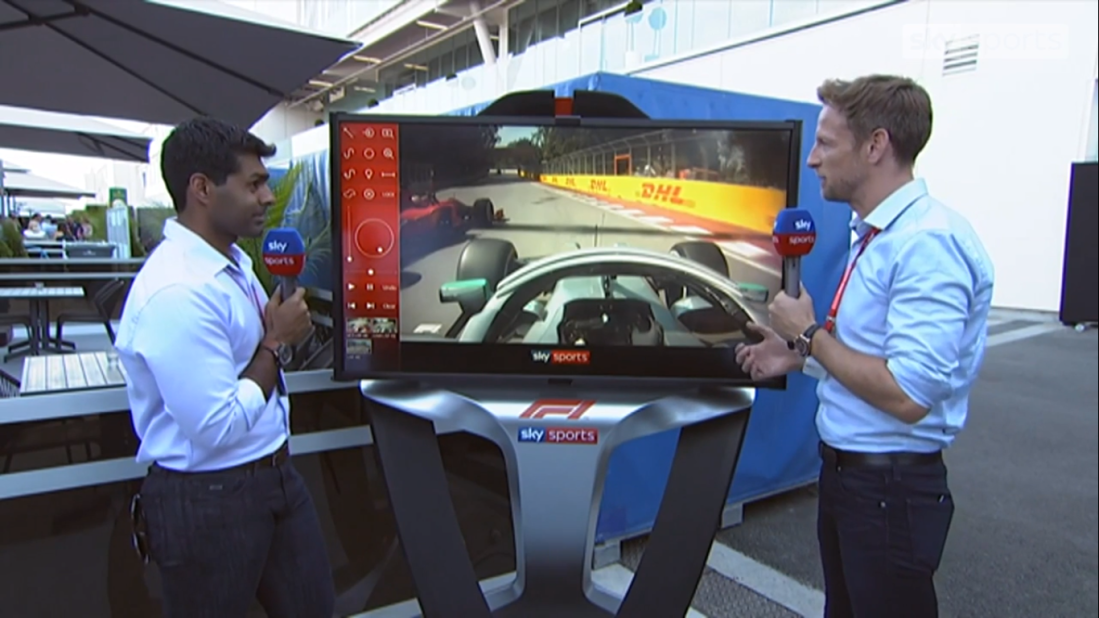
Karun Chandhok and Jenson Button analyse the incident between Sebastian Vettel and Lewis Hamilton during the 2019 Canadian Grand Prix (watch the video on Sky’s F1 website).
Feeder series stay neglected
Which brings us to the ‘feeder series problem’ that continues to be a problem for Sky.
Sky have made small, positive steps in this area recently. Most Formula Two sessions now contain a brief build-up, with Lazenby, Chandhok and Davidson engaging in brief chatter.
On occasion, we also hear a pre-recorded interview with one of the Formula Two stars, such as Jack Aitken and Nyck de Vries, helping introduce fans to the future stars. But Formula Two continues to feel like the unwanted bit on the side.
Sky’s F1 qualifying coverage should seamlessly link into the first F2 race, yet Sky have never experimented on this front, whilst each F2 race features zero analysis and wrap-up.
The social media element has suffered so far in 2019, with few tweets from the official @SkySportsF1 Twitter account for either Formula Two or Formula Three. Will Esler, who was one of Sky’s main F1 social media reporters and built up Sky’s F2 and F3 social content, left their team towards the end of 2018, resulting in a significant drop in quality.
Both feeder championships deserve promotion during Sky’s main F1 programming. Formula 1 themselves are finally realising the value of F2 and F3, promoting both championships across social media, but Sky are not following them.
Coincidentally, the lack of promotion extends to Sky’s IndyCar coverage, with Sky only sporadically referencing IndyCar during their commentary, despite Sky airing IndyCar on the F1 channel this season.
During the British Grand Prix weekend, Sky stayed on-air live during the Friday lunch break. However, apart from two live links from Lazenby, the remaining 55 minutes of the hour featured two extended pre-recorded VTs and adverts.
Sky could have spent the hour focusing on the stars of tomorrow, producing a nice bit of television for the aficionados, in a similar vein to BT’s MotoGP offering, but Sky opted not to.
To make matters worse, Sky had 13 of the 14 on-air team on hand at Silverstone, making it difficult to justify why Sky did not use the hour wisely.
If Sky want to take extra cooks to a race, fine, but Sky should use their cooks across a variety of menus (F1, F2 and F3) instead of sticking to the same recipe (F1).
Documentaries come to forefront with strong storytelling
One of the areas where Sky have improved this season is with their documentaries strand, their storytelling the strongest in a long time.
It also highlights that when Sky’s coverage is good, it can be fantastic, as the segments that aired during the British Grand Prix weekend proved.
The broadcaster aired an hour-long documentary focusing on Sir Frank Williams’ 50 years in Formula 1, an excellent piece of television, and the kind of material you would expect a dedicated F1 channel to air.
In addition, Sky aired a segment in which Ross Brawn reunited Button with his championship winning Brawn BGP001.
Unlike other car segments which Sky have aired across the years, this segment held a connection bigger than the rest, which was plainly obvious (in a positive way) in the output, the whole segment well done I felt.
Now this was special: @jensonbutton reunited with his F1 title-winning Brawn GP car around Silverstone
"There really is nothing better than this"
Watch the full Sky F1 feature with Jenson, Ross and that gorgeous BGP 001 on track: https://t.co/UlSIF2Ot5e
Sky also dealt with the tributes to Niki Lauda and Charlie Whiting appropriately in the first half of 2019, both with the right balance in my view. The Whiting tribute was lovely, yet heart wrenching at the same time, with a clearly emotional Bernie Ecclestone paying his respects.
Archive material has played its part on Sky this year. From F1’s 100th race celebrations, to reminiscing about Red Bull’s and Johnny Herbert’s first victories, it does feel like Sky are making greater use of the F1 archive than previously.
One rumour Motorsport Broadcasting heard earlier this year was that Sky were planning on packaging archive races together into smaller edits, accompanied by a voice over, so it will be interesting to see if that comes to fruition moving forward.
In an era of efficiency savings, it is difficult to see Sky repeating the success of ‘Senna Week‘ from 2014, but nevertheless I am pleased to see Sky producing excellent documentary material again.
Weekend structure not quite there
Sky’s changes were noticeable from the very first seconds of their 2019 coverage, as Outlands by Daft Punk replaced Alistair Griffin’s Just Drive, which has been front and centre of Sky’s coverage since 2012, as the opening theme.
Their weekend offering has felt more ‘all rounded’, with the addition of a practice round-up show to their Friday schedules. ‘The Story so Far’ gives viewers a digestible wrap-up of Friday’s action, allowing Sky to dissect the practice action, interviewing personalities we may not always see on screen.
If anything, The F1 Show filled this area previously, but Sky opted to move The F1 Show to Saturday’s at the start of 2018. Now in its second year on Saturday’s, I still feel that The F1 Show should revert to its Friday time slot.
It is disappointing that Sky continues to prioritise the magazine show over either Formula Two analysis, or F1 qualifying analysis, the latter a kick in the teeth considering Kravitz’s post-qualifying Notebook is no more this season.
BT Sport airs Premier League Tonight, which is a magazine show following their football coverage, tackling on and off-pitch issues that no other show in the football television landscape covers, generating conversation across social media in the process.
You would never imagine the current iteration of The F1 Show – or any show currently on Sky F1 for that matter – covering the kind of issues that PL Tonight covers.
The bugbear of Sky’s split-screen cutaways remains during their practice coverage. The odd cutaway is fine, but Sky utilises the split-screen far too often for my liking, sometimes hiding Formula 1’s own on-screen graphics.
Practice sessions can be dull, and I understand the desire to add detail, but cutting to the pit lane too much during practice risks alienating the core audience watching who just want to see cars on circuit.
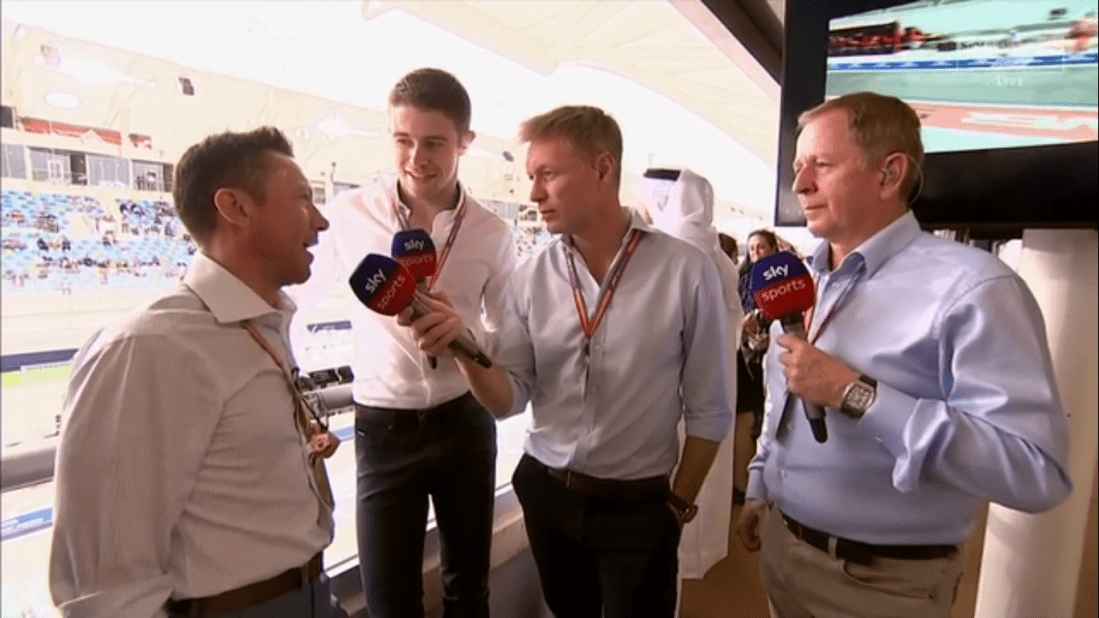
Paul di Resta, Simon Lazenby and Martin Brundle interview Frankie Dettori from the Paddock Club during Sky’s 2019 Bahrain Grand Prix build-up.
Race day content continues to improve
With Sky Pad analysis and excellent VT’s, Sky’s build-ups have had some excellent moments during 2019 so far. The variety of Sky’s line-up has helped to this effect as well.
The quality of Sky’s build-ups has fluctuated this year, from the lows in Bahrain (an excessive amount of celebrity and Paddock Club coverage), to the highs of Canada and Britain, you do sometimes wonder ‘which Sky will turn up this weekend.’
However, it does feel that the quality of coverage that Sky are putting out there has improved significantly over the past few races. It is difficult to pin point the exact moment, rather it just feels like a trend in the right direction more than anything else.
Supporting Sky’s race day broadcasts this season are the usual analytical voices on hand to offer their expert opinion, led by Brundle and Davidson, with Chandhok joining the fray this season.
Sky tried to change their post-race coverage in Australia, making use of their paddock studio base, but viewers panned the change across social media (even if this writer did enjoy the fresh style).
The change reminded me of BBC’s original F1 Forum from 2009 and had the potential to evolve into something new. The change lasted one race, with the old post-race style soon returning, although I do wish Sky tried a bit harder with implementing what they had in mind instead of giving up after Australia.
One of Sky’s initial problems for the fly-away races was the ‘hard close’ at the top of the hour, resulting in a shorter post-race than in previous years, to cater for the race repeat that followed, meaning that there were always some time constraints, despite being a dedicated channel.
Sky’s post-race is enjoyable, although you need a juicy moment in the race for the post-race content to light up, as we saw in Canada with the incident between Lewis Hamilton and Sebastian Vettel.
A post-race broadcast can only be as good as the race, a poor race lends itself to a poor post-race broadcast, and vice versa. When F1 is on top, the whole broadcast bounces up with it.
Inevitably, a calendar of 21 races means that some race weekends will not feel special, which is the risk Formula 1 as a collective take when they expand the calendar. Is it therefore unfair to blame them if one of two of their build-ups do feel ‘run of the mill?’
Sky has a vast amount of resources on offer, yet BT Sport’s MotoGP platform and WRC All Live can produce a similar level of coverage, with fewer resources.
After all the points outlined above, has Sky’s coverage evolved positively since 2012? Have your say in the comments below.
Germany plays host to the half way stage of the Formula 1 season, as the paddock heads to Hockenheim.
After live coverage at Silverstone, it is back to highlights for Channel 4 for the remainder of the season, as Billy Monger joins the team for the weekend alongside regulars Steve Jones, David Coulthard and Ben Edwards. Sky’s coverage of qualifying and the race airs across their F1 channel and Main Event.
Due to the different contractual arrangements in play between F1 and circuit organisers, Formula Two and Formula Three are again absent, leaving a lighter weekend schedule for fans attending the Grand Prix. The last time Formula Two (or GP2 as it was known then) raced at Hockenheim was back in 2016.
Elsewhere, the IndyCar Series heats up, with only four races remaining following the Mid-Ohio round. It is also a busy weekend on the endurance front, with Spa and Suzuka playing host to four- and two-wheel racing respectively.
Channel 4 F1
27/07 – 18:30 to 20:00 – Qualifying Highlights
28/07 – 19:00 to 21:00 – Race Highlights
Sky Sports F1 Sessions
26/07 – 09:45 to 11:45 – Practice 1 (also Sky Sports Main Event until 11:00)
26/07 – 13:45 to 15:45 – Practice 2
27/07 – 10:45 to 12:30
=> 10:45 – Practice 3
=> 12:10 – Paddock Walkabout
27/07 – 13:00 to 15:30 – Qualifying
=> 13:00 – Pre-Show
=> 13:55 – Qualifying (also Sky Sports Main Event from 14:00)
28/07 – 12:30 to 17:30 – Race
=> 12:30 – Pit Lane Live
=> 13:30 – On the Grid (also Sky Sports Main Event)
=> 14:05 – Race (also Sky Sports Main Event)
=> 16:00 – Paddock Live (also Sky Sports Main Event)
=> 17:00 – Notebook (also Sky Sports Main Event)
Supplementary Programming
25/07 – 14:00 to 14:30 – Drivers’ Press Conference
25/07 – 17:00 to 17:30 – Welcome to the Weekend
26/07 – 16:00 to 16:30 – The Story so Far
27/07 – 15:30 to 16:00 – The F1 Show (also Sky Sports Main Event)
30/07 – 20:30 to 21:00 – F1 Midweek Debrief
BBC Radio F1 All sessions are available live on BBC’s F1 website
25/07 – 19:30 to 20:30 – Preview (BBC Radio 5 Live)
27/07 – 14:00 to 15:05 – Qualifying (BBC Radio 5 Live)
28/07 – 14:00 to 16:00 – Race (BBC Radio 5 Live)
Blancpain GT Series Endurance Cup – 24 Hours of Spa Also airs live on YouTube
27/07 and 28/07 – Race
=> 15:15 to 17:00 (Eurosport 2)
=> 21:00 to 22:30 (Eurosport 2)
=> 09:30 [Sunday] to 10:50 (Eurosport)
=> 14:00 to 16:00 (Eurosport 2)
IndyCar Series – Mid-Ohio (Sky Sports F1)
27/07 – 19:30 to 21:30 – Qualifying
28/07 – 20:30 to 23:00 – Race
Virgin Australia Supercars – Ipswich Also airs live on SuperView (£)
27/07 – 06:45 to 08:30 – Race 1 (BT Sport 2)
28/07 – 04:45 to 06:45 – Race 2 (BT Sport 3)


 Motorsport Broadcasting