Vettel’s victory peaks with highest Bahrain number since 2015

Sebastian Vettel’s victory in the Bahrain Grand Prix peaked with nearly 4.5 million viewers, the highest peak figure for the Bahrain round of the championship in three years, overnight viewing figures show.

Race
Live coverage the weekend’s action aired across Channel 4 and Sky Sports. Channel 4’s broadcast, encompassing the build-up and the race itself from 15:00 to 18:10, averaged 2.37m (18.9%), a slight increase on last year’s figure of 2.23m (15.2%). For the purposes of the combined average below, the Channel 4 figure used will be the figure above, the same methodology as last year.

Channel 4’s average audience has changed very little over the past three years for Bahrain. Using the 15:00 to 18:30 time slot as the metric, we can see that the 210-minute slot averaged 2.30m (16.2%) in 2016, compared with 2.21m (15.0%) in 2017, and now 2.25m (16.0%) in 2018, a remarkably stable trajectory with very little to separate the three years.

Meanwhile, Sky Sports F1’s coverage from 15:00 to 18:30 averaged 524k (3.7%), a decrease on last year’s audience figure of 597k (4.1%). The average audience is Sky’s lowest for Bahrain since they started covering the sport in 2012.

The combined average audience of 2.89 million viewers is marginally up on both 2016 and 2017, by 50,000 viewers and 70,000 viewers respectively. The margins here are incredibly tight, although the gap may widen once you consider other methods of viewing, such as All 4, Sky Go and Now TV.

It is important to note that the Premier League opposition for the F1 was tougher last year (Chelsea versus Manchester United) compared with this year (Chelsea versus West Ham United), which will have affected audience figures.

An audience of 3.79m (28.2%) watched lights out at 16:15, slightly lower than 2016 and 2017, settling around the 3.9 million mark, once the Premier League game started from 16:30 onwards. As Chelsea gained the lead in the football, viewing figures jumped for the Grand Prix on both channels to a combined figure of 4.23m (28.4%) at 17:10.

The audience jump coincided with the pit lane incident involving Ferrari’s Kimi Raikkonen, which, combined with the on-track battle between Vettel and Mercedes’ Valtteri Bottas, helped figures remain above four million until the chequered flag.

A peak audience of 4.45m (27.2%) watched Sebastian Vettel win the Grand Prix at 17:40. At the time of the peak, 3.62m (22.1%) were watching Channel 4’s output, with a further 830k (5.1%) watching Sky’s coverage, a split of 81:19 in Channel 4’s favour.

Sky’s programme peaked earlier in the race at 16:25 with 884k (6.4%), this being the last five-minute segment before the second Premier League game of the day began on Sky Sports Main Event and their dedicated Premier League channel. Compared with 2017, Channel 4’s peak audience increased by 6.1 percent, whilst Sky’s peak dropped by 8.0 percent.

The combined peak audience of 4.45 million viewers is an increase of 111,000 viewers on last year’s peak figure of 4.34m (25.9%), and an increase of nearly half a million viewers on the 2016 peak of 4.01m (30.2%). However, audience figures remain a far cry from 2015 and before when F1 aired in some form on the BBC: 2015’s race peaked with 6.26m (36.3%).

Qualifying and Analysis
Live coverage of qualifying did not fare as well as the race, with viewing figures decreasing compared with 2016 and 2017. Live coverage of qualifying on Channel 4 from 15:00 to 17:45 averaged 1.08m (9.8%), down on last year’s average of 1.23m (12.7%).

Unusually, Channel 4 was third in its slot during qualifying, behind both BBC and ITV. At the same time, BBC were screening highlights of the Commonwealth Games along with Final Score, whilst ITV aired repeats of Tipping Point and The Chase.

Sky’s programming, simulcast across F1 and Mix, suffered the same fate as Channel 4, with an average of 273k (2.5%) comparing unfavourably with last year’s number of 349k (3.5%). Across the two channels, 246k (2.2%) watched via the F1 channel, and a further 27k (0.2%) watched via Mix.

The combined average of 1.36 million viewers is down 14 percent on last year’s average audience of 1.58 million viewers, the lowest average for Bahrain since 2007. The peak audience of 2.30m (18.5%) came at 17:05, a decrease of 9 percent compared with last year’s peak of 2.54m (22.6%)

Two races into the 2018 season, and overall, minus a few dips for qualifying, it is fair to say that Formula 1’s viewing figures year-on-year so far, are steady. It may be too early to state this as fact, but certainly the indications are that the Halo cockpit protection system has not had any significant bearing on the UK audience figures.

I am happy to hold my hands up and say ‘I was wrong’ where this was concerned given some of the predictions I made at the back-end of last year. Whilst the Halo is not the prettiest thing ever, I have become used to it quicker than I imagined, and it appears I am not alone in that regard.

The 2017 Bahrain Grand Prix ratings report can be found here.

overnights.tv-bannersF1

60 years of British Touring Cars: the broadcasting story

This year sees the British Touring Car Championship celebrate sixty years of high-octane, bumper to bumper racing. Currently, the championship, and its support package, enjoys up to eight hours for every race day live and free on ITV4. But, coverage in yesteryear was not quite as extensive as that…

For its first thirty years, under the banner of British Saloon Car Championship, the series had sporadic coverage on the BBC’s radio stations, but there was no formal arrangement, largely in part because deals back then were between broadcasters and circuits, making it impossible for a complete series to air on television.

The arrangement ended in 1987, allowing BBC television to cover every race in highlights form starting in 1988, with Steve Rider and Murray Walker fronting the coverage. BHP, otherwise known as Barrie Hinchcliffe Productions, were responsible for producing the BBC’s output.

Writing in his autobiography My Chequered Career, Rider goes into detail about the hurdles faced by the BHP. These include (but not limited to) funding, the placing of sponsors on the on-board camera angles, and a feature in the Sunday Times accusing the BBC of a “corrupt commissioning system.” Suffice to say that there were many different reasons why the BHP production deal may have fallen through.

Thankfully, the BHP production deal continued, and the series was a mainstay on Grandstand in the mid-1990s on BBC Two, becoming the starting point for many of today’s stars getting involved in touring cars. Television audiences increased, as did attendance figures at the circuit.

ITV pundit Paul O’Neill was one person introduced to touring cars thanks to Grandstand. “The first race I remember seeing was James Thompson winning in 1995 on Grandstand, at Thruxton in an old Cavalier,” explained O’Neil. “The thing that stuck out for me was the action that it has now, it’s part of its DNA, the other thing I remember was just how well it was broadcast especially by Steve Rider back then, but also with the music and everything they used just made it stand out massively.”

For the veteran racers that have watched the championship grow over the decades, things were slightly different back then, outside and inside the car from a broadcasting perspective. Triple BTCC champion Matt Neal fits in that category, having raced touring cars since the late 1980s. “I remember there being a VHS tape in the bottom of the foot well in the passenger seat!” recited Neal. Walker would voice over the races, which aired on a week delay in a highlights package.

“The production guys used to get the tapes, cut them all together, Murray watched it once, and voiced it in the week. Some of the mistakes off Murray were deliberate, he was a genius at commentary. It made for very exciting viewing, because they could pick and choose the action. We did have some boring races back then, but BHP were very good at finding gems over the weekend, piecing it all together for Murray to commentate on,” Neal continued.

“I used to go through the whole thing meticulously, making a shot list with brief notes on what was coming up next, then go into the sound booth and commentate on the tape pictures that were pumped into a monitor in front of me.

“I knew what was coming, of course, because I had practically learnt the vision by heart and also had my notes to remind me but, because I was making the words up as I went along instead of reading from a carefully crafted script, the effect was that the race was live and continuous rather than recorded and edited.

“It was long-winded and labour-intensive, but it worked well.” – Murray Walker, Unless I’m Very Much Mistaken (pages 174 and 175)

Rider believed the notion of delayed highlights was on “borrowed time”, and that the package produced by BHP was a “misrepresentation of the narrative and pace of the actual race,” even if it was “terrific television.”

With a Formula 1 shaped hole in the BBC’s schedules though for 1997, the corporation opted to increase their commitment to touring cars, with races airing live for the first time. Charlie Cox joined Walker in the commentary box, before Walker himself stepped aside at the end of 1997, John Watson filling the void.

Neal’s first race win in 1999 at Donington Park was one of the races that aired live, thanks to its Bank Holiday slot. It was a remarkable feat for Neal, the first win for an Independent driver in the modern era.

“Back then, you couldn’t compete on engines, tyres, and we ran with year old cars,” Neal recalled. “The first race of 1999, we ran with the same tyres as the manufactures, and won. That race was actually live! It’s one of the few times, I’ve heard the roar of the crowd from inside the car. It was surreal, almost like it wasn’t happening.”

“The next day I woke up, went into the office and my PR guy was on the phone to Australia doing interviews, and I thought ‘so what?’ It doesn’t change me as a person, so you’ve just got to roll with it, and try to do it again, which I’ve been doing ever since. It was a crazy time.”

After Formula 1 moved to ITV, BTCC was one of the remaining four-wheel motor sport left on the BBC, and stayed with the BBC until the end of 2001. Speaking to Autosport at the time, BTCC’s boss Richard West said that the BBC “admitted that certain things had not been to the benefit of the series, such as the inability to provide regular slots and, by their own admittance could not meet the exacting standards that we had put to them.” In other words, the championship could not grow further with the Beeb, partially due to no other motor racing complimenting its coverage.

Led by West, BTCC headed in a different direction, moving towards a deal with ITV and Motors TV. Briefly, a stint on the ill-fated ITV Sport Channel also ensued. Neal believes the move did damage to the health of the series. “The Head of ITV at the time wanted to move everything onto ITV Sport, and we were one of the first things to get drafted across. The viewing figures fell through the floor, people just didn’t know where to find it,” Neal said.

Following a rut on and off the circuit for touring cars domestically in the early to mid 2000s, the championship found its place on ITV, where it has remained ever since. Ben Edwards led the commentary line-up from 2002 to 2011, with Tim Harvey alongside him, before David Addison controlled the reigns from 2013 onwards. As in the BBC days, Steve Rider continues to host ITV4’s race day output.

In terms of television coverage, ITV4 has for the past decade provided extensive coverage of the championship, with a peak audience of up to half a million viewers watching each round. Although BTCC does not attract the audience it once did during the Super Touring era on the BBC, current ITV reporter Louise Goodman, who has been involved with covering the series since 2009, believes the championship is in a healthy position.

“The more exposure the championship can get the better, but it’s a very different media age to what it was like in the Super Touring era. You have to think about the amount of sports out there vying to get coverage. The level of coverage on terrestrial channels has become quite limited in many ways, so the fact that BTCC has six, seven, sometimes eight hours of free-to-air coverage on ITV4, is still a fantastic amount of exposure,” Goodman told this site.

“If we only offered half an hour of programming per weekend, the guys in the support races wouldn’t get any exposure,” Goodman added. “Those are the guys in two or three years’ time that may be racing in the BTCC, so the exposure has enabled them to make that progress through the ladder from a sponsorship and marketing perspective. I think we’re in a healthy position, it’s a proper career option for young and upcoming drivers.”

“You’ve still got the Plato’s and Neal’s of this world, we hope they’ll never go away because they’re entertaining, its great viewing and they still have what it takes behind the wheel. You need the next young talent coming through the ranks and there’s been an increase in that in recent years.”

And this weekend at Brands Hatch, the championship heads into its next sixty years hoping for more of the same action that has helped its popularity over the course of the last six decades.

Revealed: Formula 1’s gender pay gap

Six of Formula 1’s outfits based in the United Kingdom have revealed their gender pay gap publicly. In the underlying data, all bodies reveal that a significant amount of work needs to happen to bring more women into the engineering landscape.

For the first time, UK companies with more than 250 employees are reporting their pay gap to the UK government. As Ferrari, Toro Rosso, and Sauber are based outside the UK, they are exempt from this. With less than 250 employees, Haas are also exempt. The figures reveal the pay gap at Formula One Management (FOM) amongst other organisations.

F1 gender pay gap - median

This percentage gaps above show the difference between the ‘middle paid woman’ and the ‘middle paid man’.

The median gender pay gap for Formula 1’s teams is 22.9 percent, as an example if a female earned £25,000, then a male would earn £30,725. Force India’s median pay gap is least significant at 14.8 percent, with Williams at the other end of the scale at 32.9 percent.

F1 gender pay gap - mean

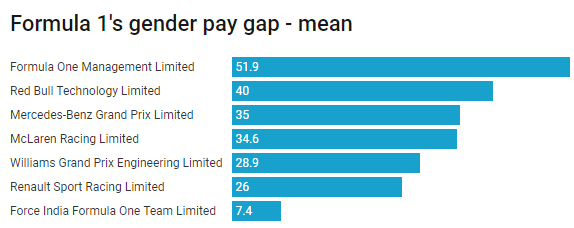
The mean gender pay gap, better known as the average pay gap, stands at 28.7 percent for Formula 1’s six teams in the UK. Red Bull has the biggest pay gap of the teams that revealed their data, with men earning on average 40 percent more than women.

The difference for Mercedes and McLaren circles around 35 percent range. There are two major outliers. Firstly, Force India is again the least significant, with an average pay gap of just 7.4 percent. Although the number of women at Force India overall is smaller in the lower quartile than other organisations, the difference between them and the other teams in this respect helps their gender pay gap overall.

Formula One Management’s mean gender pay gap stands at 51.9 percent, significantly higher than other sporting bodies such as the Football Association at 23.2 percent, and 23 percent for the Rugby Football Union. In other words, if a woman at FOM earned £20,000 across the year, a man would earn £30,380.

F1 gender pay gap - women distribution

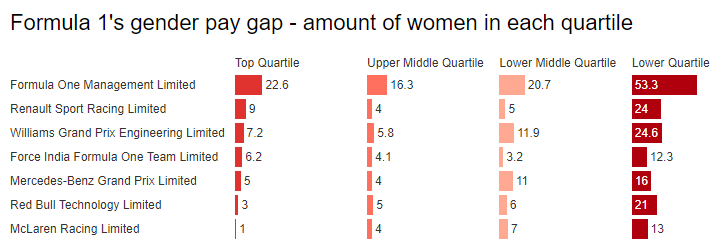
Although the proportion of women in the top quartile at FOM is higher compared with F1’s outfits, the fact that the lower quartile is filled with 53.3 percent of women means that the average is skewed in a similar manner. FOM’s average suggests that there are a small, but significant number at FOM that skews the gender pay gap overall.

The overall volumes above show that women at Formula 1 teams struggle to breakthrough to the top and middle quartile. McLaren’s figures are the most damming of the lot: only 1 percent of people at the team in the top quartile are women. Williams’ and Mercedes’ are the most balanced, but it is a very bleak picture for Formula 1.

What the data fails to reveal is whether jobs occupied by women in the lower quartile have progression paths through to the lower and upper middle quartiles. If they do, then it is possible that the percentages will move as time progresses, but it appears for every ‘lower middle quartile’ job vacancy, you may have four men and one woman vying for that role. It is also unclear if the data submitted includes contractors, as well as the two racing drivers.

Schemes such as Dare to be Different can only help, however there are still very steep barriers to overcome.

More information via The Guardian: What you need to know about gender pay gap reporting.

Scheduling: The 2018 Bahrain Grand Prix

Both Formula 1 and MotoGP remain outside of Europe, as both championships embrace round two of their respective seasons.

For MotoGP, it is a trip to South America for the Argentine round of the series, whilst Formula 1 heads to the Bahrain International Circuit. The action from Bahrain airs live across Sky Sports and Channel 4 for the third year in succession.

With Channel 4’s Lee McKenzie reducing her Formula 1 commitments further this season, her former BBC F1 colleague Tom Clarkson is super substitute, for Bahrain at least. Mark Webber and Susie Wolff join Steve Jones in Bahrain. The channel’s free-to-air race day schedule changes slightly for 2018 to cater for the F1 race starting ten minutes later than in previous years.

The Formula Two season roars into life in Bahrain, with races on Saturday and Sunday. Elsewhere, the British Superbikes returns on Easter Monday (April 2nd) at Donington Park, with action remaining live on Eurosport. Rachel Stringer joins the team as race reporter, Stringer having previously covered a variety of events for the BBC and BT Sport.

Both the domestic and world touring car series’ return as well, although the latter has a new name. The former World Touring Car Championship is back, but now known as the World Touring Car Cup as the series no longer has manufacturer participation.

Channel 4 F1
Sessions
06/04 – 11:55 to 14:10 – Practice 1
06/04 – 15:55 to 17:35 – Practice 2 (More4)
07/04 – 13:00 to 14:30 – Practice 3
07/04 – 14:55 to 17:45 – Qualifying
08/04 – 15:00 to 18:45 – Race
=> 15:00 – Build-Up
=> 15:45 – Race
=> 18:20 – Reaction

Sky Sports F1
Sessions
06/04 – 11:45 to 13:50 – Practice 1 (also Sky Sports Main Event from 12:00)
06/04 – 15:45 to 17:50 – Practice 2 (also Sky Sports Main Event)
07/04 – 12:45 to 14:15 – Practice 3
07/04 – 15:00 to 17:45 – Qualifying (also Sky Sports Mix)
=> 15:00 – Pre-Show
=> 15:55 – Qualifying
08/04 – 14:30 to 18:55 – Race
=> 14:30 – Pit Lane Live
=> 15:30 – On the Grid
=> 16:05 – Race
=> 18:30 – Paddock Live

Supplementary Programming
04/04 – 20:30 to 21:00 – The F1 Report: Preview
05/04 – 13:00 to 14:00 – Driver Press Conference
05/04 – 20:45 to 21:00 – Paddock Uncut
07/04 – 17:45 to 18:20 – The F1 Show
11/04 – 20:30 to 21:00 – The F1 Report: Review (also Sky Sports Mix)

BBC Radio F1
05/04 – 20:00 to 20:30 – Preview (BBC Radio 5 Live)
06/04 – 11:55 to 13:35 – Practice 1 (BBC Radio 5 Live Sports Extra)
07/04 – 12:55 to 14:05 – Practice 3 (BBC Radio 5 Live Sports Extra)
07/04 – 15:55 to 17:05 – Qualifying (BBC Radio 5 Live Sports Extra)
08/04 – 16:00 to 19:00 – Race (BBC Radio 5 Live Sports Extra)

MotoGP – Argentina (BT Sport 2)
06/04 – 12:45 to 20:15 – Practice 1 and 2
07/04 – 12:45 to 20:15
=> 12:45 – Practice 3
=> 16:00 – Qualifying
08/04 – 13:30 to 21:00
=> 13:30 – Warm Ups
=> 15:15 – Moto3
=> 17:00 – Moto2
=> 18:30 – MotoGP
=> 20:00 – Chequered Flag

MotoGP – Argentina (Channel 5)
10/04 – 19:00 to 20:00 – Highlights

British Superbikes – Donington Park
01/04 – 15:30 to 18:00 – Race 1 (Eurosport 2)
02/04 – 13:00 to 18:00 – Race 2 (Eurosport 2)
04/04 – 20:00 to 21:00 – Highlights (ITV4)

British Touring Car Championship – Brands Hatch (ITV4)
08/04 – 10:15 to 18:20 – Races

Formula Two – Bahrain (Sky Sports F1)
06/04 – 09:30 to 10:20 – Practice
06/04 – 17:55 to 18:35 – Qualifying
07/04 – 11:05 to 12:15 – Race 1
08/04 – 12:10 to 13:10 – Race 2

IndyCar Series – Phoenix (BT Sport 3)
07/04 – 02:00 to 05:00 (Saturday night) – Race

World Rally Championship – France
Every stage live via WRCPlus.com
06/04 – Day 1 Highlights
=> 22:15 to 22:45 (BT Sport 1)
=> 22:30 to 23:00 (Motorsport.tv)
07/04 – 10:00 to 11:00 – Live: Stage 7 (BT Sport 1)
07/04 – Day 2 Highlights
=> 21:45 to 22:15 (BT Sport 1)
=> 22:30 to 23:00 (Motorsport.tv)
08/04 – 11:00 to 12:30 – Live: Stage 12 [Power Stage] (BT Sport 2)
08/04 – Day 3 Highlights
=> 21:00 to 21:30 (BT Sport 2)
=> 22:30 to 23:00 (Motorsport.tv)
11/04 – 19:00 to 20:00 – Highlights (Channel 5)

World Touring Car Cup – Marrakech
08/04 – 10:30 to 11:50 – Qualifying (Eurosport)
08/04 – 16:30 to 18:55 – Race (Eurosport 2)

As always, if the schedules change, I will update the above times.

Update on April 3rd – I would not normally update schedules retrospectively, but it is important to note that British Superbike’s first race of the weekend from Donington Park was moved from Monday to Sunday, avoiding the torrential weather that hit the circuit yesterday morning. I have updated the above for future reference to show what actually happened.

In other news, Ted Kravitz (and his Notebook!) is not part of Sky Sports F1’s Bahrain Grand Prix team this weekend as his wife has given birth to a baby girl!

Update on April 4th – As a result of Ted’s absense, Paddock Live following the race on Sunday has been cut to 25 minutes from its normal 40 minute length.

News round-up: F1 series coming to Netflix; IndyCar domestic rights changing

In addition to all the discussion around Formula 1’s new graphics suite, the past week saw a variety of broadcasting related announcements, covering both F1 and the IndyCar Series.

F1 documentary series to air on Netflix
Netflix are to air a ten-part documentary series in 2019 focusing on the inner surroundings of Formula 1. The deal between the two parties has been mooted for several months, with an official announcement coming on the Saturday of the Australian Grand Prix weekend.

Filming has already started, and will continue throughout the 2018 season, with the production team revealing “the intense fight for the heart, soul, and direction for the future of this multibillion-dollar business.” James Gay Rees, who was previously part of the making of Senna, and Paul Martin for Box to Box Films, are the executive producers.

The Netflix series builds on the foundations laid by Amazon’s Grand Prix Driver. The four-part Amazon series focused on McLaren’s pre-season exploits prior to Australia 2017, whereas the Netflix programming has a wider remit across the whole year. I enjoyed Amazon’s documentary, and if this is half as good as that, Formula 1 fans will be in for a treat.

Sean Bratches, F1’s Managing Director of Commercial Operations, said “Formula 1 is a global sport that we are actively repositioning from a motorsport company to a media and entertainment brand. This series will unleash a compelling vantage point to the sport that will delight fans and serve as a catalyst to entice new fans.”

Bela Bajaria, Vice President of Content for Netflix, said “This partnership with Formula 1 furthers our mission of working with world-class brands and production partners to produce best-in-class unscripted series. We can’t wait for this weekend’s Australian Grand Prix and to embark on an incredible season across the world.”

In a second announcement from Formula 1 last week, the organisation confirmed that coverage was returning to free-to-air broadcaster CCTV in China, with all qualifying and race sessions airing live on the network throughout 2018.

ESPN’s US coverage receives complaints
Bratches’ former home ESPN was subject to numerous complaints over the Australian Grand Prix weekend. The US broadcaster, which took over from NBC as rights holder for Formula 1, was expected to take Sky UK’s pre-race build-up show ‘On the Grid’. However, the show failed to make the air at the expected time, with a variety of technical issues.

ESPN released a press statement late on Sunday evening apologising for the difficulties. “We deeply apologise to Formula 1 fans for the technical issues that caused them to miss the first 20 minutes of the pre-race show for the Australian Grand Prix. We are sorry that our first F1 telecast did not go as smoothly as we would have liked but we are taking steps to prevent those same issues from occurring in the future.”

The secondary problem is commercial breaks. Formula 1 commentary in the UK is free-flowing, as Sky Sports air F1 uninterrupted, whereas ESPN in the US take commercials. This is a major issue if something happens whilst ESPN is on a commercial break.

Historically, US viewers had a dedicated commentary team for their audience meaning that the lead commentator could re-cap the action on return. Forcing Sky’s UK commentary team to do the same thing would disturb the flow for anyone taking the UK coverage uninterrupted and would provoke a backlash from UK viewers.

One approach would be to have Sky’s F1 presentation team (i.e. Simon Lazenby) do a voice over for US viewers leading back into the UK commentary at a given point, that way the commentary flow is untouched.

In further news, ESPN’s coverage of the Grand Prix rated lower than NBC’s coverage in recent years. According to Showbuzz Daily, ESPN2’s show failed to make the top 150 for original programmes on Saturday, recording under a 0.05 share in the adults 18 to 49 metric. Last year’s NBC coverage averaged 238,000 viewers, whereas 2016’s show averaged 222,000 viewers.

International television rights for IndyCar up for grabs
The IndyCar Series is heading to NBC from 2019, with their existing US agreement with ESPN and ABC Network coming to an end after this season, the two sides confirmed last week.

The three-year deal will see eight races, including the Indianapolis 500, broadcast on NBC’s main channel with the remaining races airing on NBC Sports Network.

In addition, NBC’s over-the-top platform, dubbed NBC Sports Gold, will offer an IndyCar package consisting of every race from the feeder series Indy Lights, plus all practice and qualifying sessions from the main series not broadcast on one of NBC’s linear television channels.

As part of the press release, NBC touted the fact that IndyCar’s viewing figures have grown in recent years with the broadcaster as part of the shared contract with ESPN/ABC. “We’re honoured to bring the Indianapolis 500, one of the most prestigious events in all of sports, to NBC, further enhancing NBC Sports’ Championship Season,” said Jon Miller, NBC’s President of Programming.

“We’ve seen consistent growth for INDYCAR on NBCSN in the past decade, and we hope to continue that growth throughout the series by leveraging the television, digital, production and marketing assets that make NBC Sports a powerful media partner.”

IndyCar officials have also confirmed that the international broadcasting rights for the series are up for grabs at the end of 2018. For UK fans, it helps clear up a few things. BT Sport have a deal to with ESPN’s international arm to air a range of content up to and including the end of 2022. Separately, IndyCar’s non-domestic rights sit with ESPN’s international arm.

ESPN International are the ‘middle man’ here, if that man changes then BT Sport will need to negotiate with the new ‘middle man’ if they want to continue to air IndyCar, unless IndyCar go direct to a broadcaster, for example Eurosport (see below).

Mark Miles, the CEO of IndyCar’s parent company Hulman and Company, said “We will now move to working on the international rights licensing right away. We’ve had a lot of those very early conversations to understand both from an agency perspective and individual broadcaster perspective who wants to talk to us.”

“[The NBC deal] does not preclude an ongoing involvement by ESPN International. Although with any result, I think it will change. There may be countries where we go direct to broadcasters in any major country with IndyCar interests. I see us being at the table, even if we go with a distributor or packager like ESPN International.”

“There are a number of agencies that would love to compete with ESPN International for whatever we’re willing to license as part of a package, and there are a number of countries where we’re already having direct conversations with broadcasters. It will be some kind of a mixed approach undoubtedly.”