Strong social media growth for Formula E as Hamilton continues F1 onslaught

Motorsport Broadcasting has tracked the social media figures for a range of stakeholders over the past five years.

In the latest analytical piece, we look at Formula E’s growth across social media, Lewis Hamilton’s gargantuan reach, and how Twitter is fast becoming an archaic platform.

As always, this site uses publicly available data to piece the jigsaw together, such as the number of followers.

Whilst the figures presented do not give a reliable indicator as to the engagement per series, the figures do give an idea as to whether a championship or team is attracting a new audience, which is critical for the growth of the sport moving forward.

Championships
This site tracks the social media fortunes of thirteen different championships at a variety of levels. The list ranges from the likes of Formula 1 and MotoGP on a global level, down to the domestic championships, such as the British Superbikes series and the British Touring Car Championship.

As each entity operates at a different level, expecting the same amount of growth from all of them is unrealistic.

The series on the move from a percentage perspective is Formula E, having grown its social media following by 160 percent since the middle of 2018. From 893,000 followers last Summer, the championship now has 2.33 million followers, a staggering growth for the electric series.

However, analysis of the underlying figures raises some suspicions as to whether Formula E’s growth is all natural. Whilst their Twitter reach has stalled, their Facebook following has jumped significantly from 497,000 likes last Summer to 1.60 million likes currently, an unusual rise considering that growth was slow for the first half of 2018.

In comparison, Formula E’s Instagram growth is more natural: 217,000 likes in May 2018 to 361,000 likes in December 2018, and now 544,000 likes, with the percentage increases modest along the way.
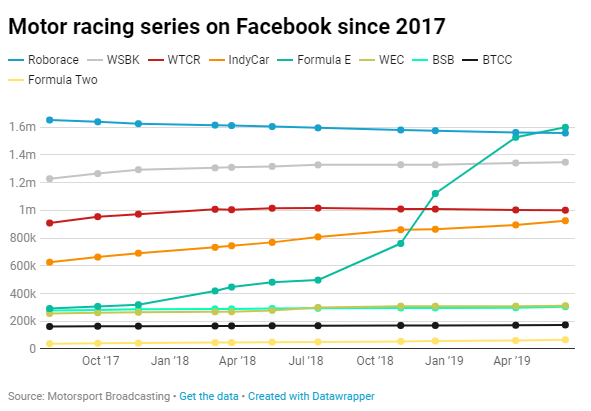
The other big mover is Formula Two, whose social media following has increased by 65 percent in the past year. However, the raw volumes are low, as Formula Two’s portfolio of channels increased from 215,000 followers to 355,000 followers in the past year, Instagram contributing most to the gain.

MotoGP and Formula 1 continue to lead the way. Between December 2018 and now, MotoGP’s portfolio has increased by 1.12 million fans, with F1 jumping by 2.36 million fans. F1’s growth has actually slowed compared to last year, a legacy of how F1 playing catch-up on social media after years of neglect from Formula 1’s owners.

Formula 1’s presence on Netflix, with Drive to Survive, should help the figures grow, but to what effect is difficult to say. Although the Netflix documentary launched to a huge buzz within F1 circles during March, the impact it has may serve as an undercurrent to these statistics throughout the remainder of 2019 as non-F1 fans find the series, rather than present a ‘big bang’ effect immediately.

In addition to Netflix, F1 has made significant movements on the social media front in recent years, so any movement will be down to a multitude of reasons for them. The series has experienced a good first half of 2019 on Instagram, with F1’s number of followers increasing by 24.6 percent, from 5.60 million fans to 6.97 million fans.

An extra emphasis on Instagram helped the World Rally Championship in the first half of 2019. Their following on the platform increased from 734,000 fans to 996,000 fans, representing a larger than usual jump at 35.7 percent, and helping the series to a 9.8 percent increase overall across the main social media platforms.

F1’s teams
The same core principles apply when analysing Formula 1’s ten teams: Instagram growing, Twitter slowing and Facebook holding the core of the audience. However, Instagram is making serious inroads on Facebook on this front, and again is the place for stakeholders to direct their resources.

F1 and F1.5 gap is prevalent across social media, although McLaren joins the top three teams, with the remaining six teams forming F1.5. The story remains the same as before, as Red Bull continues to close the gap on Mercedes.

Between July 2018 and now, Red Bull’s following increased by 1.99 million fans, with Mercedes’ increasing by 1.50 million followers. Mercedes’ following continues to reach the edge, with McLaren recording a larger gain.

Red Bull continues to seize the initiative on Facebook. The Milton Keynes based team increased their following by 835,000 likes in the past year, compared with an average increase across the grid of just 135,000 likes. Mercedes have failed to improve their Facebook reach in nearly three years (stagnating at around 11 million followers), with Racing Point further down the grid also struggling.

Mercedes, Red Bull and Ferrari remain in close formation on Twitter with Ferrari having the edge, but Instagram is where all teams have seen their reach increase significantly. Since July 2018, McLaren’s audience on the image sharing platform has increased by over one million fans, with the other three big teams following behind.

The Netflix effect appears to have had, at headline level, a positive impact for Renault and Haas. Helped by the arrival of Daniel Ricciardo, Renault’s following has increased from 3.66 million followers last Summer to 4.27 million followers currently, a strong increase considering their growth figures had slowed somewhat up until that point.

Being a newer team means that the full impact of Haas’ increase is not apparent in raw volume, but a percentage jump of 39 percent cannot be overlooked. The increase helped them claw over the one million figure as well, just ahead of the now defunct Manor outfit at the time of their administration.

Outside of Haas and Renault, there are no other unusual increases. There may have been minor bumps due to Netflix, but nothing significant in the grand scheme of things.

F1’s drivers
Standing far above everyone is Lewis Hamilton, with 21.20 million followers across Facebook, Twitter, and Instagram, a gulf that increases by the day.

The combined following of the next nine drivers, from Ricciardo on 4.83 million followers down to Carlos Sainz on 1.33 million followers, is 21.48 million. In other words, nine smaller F1 drivers equals one Lewis Hamilton from a social media perspective!

Hamilton’s following on Facebook and Twitter have stalled, however his reach on Instagram has almost doubled since last Summer, moving from 6.89 million followers to 11.50 million followers, cementing his place at the top of the Grand Prix tree.
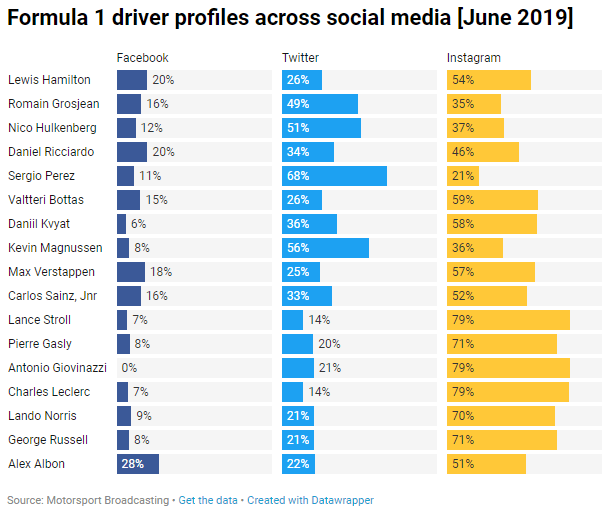
Behind Hamilton, Verstappen and Ricciardo made respectable increases, but further down the pecking order there are three success stories.

Despite being in only his second season, Charles Leclerc is already the sixth popular F1 driver on social media, and rising, with an increase of over a million followers in the past year, helped by his move to Ferrari and an ever-increasing Instagram presence.

The aura around Kimi Raikkonen has resulted in him becoming the fourth most popular driver on Instagram, despite having zero presence elsewhere on social media. Elsewhere, Lando Norris’ following is increasing rapidly across all social media platforms, as Norris’ following cross cuts both F1 and eSports.

As new drivers enter the sport, it is interesting to note how the skew for each driver moves increasingly towards Instagram and away from Facebook and Twitter. For example, 50.8 percent of Nico Hulkenberg’s following comes from Twitter, compared with 13.8 percent for Charles Leclerc. In contrast, 37.0 percent for Hulkenberg is Instagram related, versus 78.9 percent for Leclerc.

The younger drivers are far more likely to build a platform on Instagram in 2019, whereas the 2009 to 2014 generation of drivers focused far more on Twitter at that time, hence the wildly different skews.

If you manage any championship on social media, Instagram is the place to divert your resources. Facebook is still growing from a motor sport perspective, and remains by far the biggest social media platform, but has now fallen Instagram in terms of growth.

Facebook is better for long form content with Instagram primarily intended for short-form videos. Twitter is great for your existing audience, but not great if you want to hook new fans in, as the figures throughout this article demonstrate.

What content across social media has made your eye-brows raise recently? Have your say in the comments below.
News round-up: F1’s US audience figures increase; Formula E hits the big screen

In the latest Motorsport Broadcasting round-up, it is good news for Formula 1 in the US, whilst Formula E hits the big screen at the Cannes Film Festival.

ICYMI: Round-Up #1 (May 13th): Turner returns to F1 fold; F1 adjusts OTT pricing; Barrat joins Formula E’s TV team

Formula 1

  • Good news for F1 on the US audience front, with ESPN reporting double-digit growth year-on-year. The first five races (excluding Monaco) have averaged 564,000 viewers on ESPN compared with 442,000 viewers last year. ESPN also tout the strong growth in the coveted Adult 18-34 demographic, increasing 107 percent year-on-year.

Formula E

  • A new feature-length documentary covering the 2017-18 season premiered at Cannes Film Festival last week. Fisher Stevens, Malcolm Venville and Leonardo di Caprio produced ‘And We Go Green‘, which goes behind the scenes during Jean-Eric Vergne’s championship winning season. LBI Entertainment are handing distribution rights for the documentary.
  • With Dario Franchitti over at Indianapolis, Tom Blomqvist and Nick Heidfeld joined Jack Nicholls and Bob Varsha on commentary duty during the Berlin E-Prix weekend. Blomqvist was alongside Nicholls for practice and qualifying, with Heidfeld joining Nicholls for the race.

MotoGP

  • Quest have changed the time slot of their MotoGP highlights programming. The first three races aired in an 18:00 and 23:00 time slot on Monday evenings, effectively splitting the audience.
    • Viewing figures have not been good. Their 18:00 showing for Austin made BARB’s consolidated top 15 with 196,000 viewers, all other airings have failed to make Quest’s top 15, averaging around 150,000 viewers or below.
    • From Jerez onwards, Quest reduced the two airings to one, airing at 22:00 only on Monday evenings. Current schedules for Mugello suggest that the one airing strategy will continue moving forward.
  • Suzi Perry is back in the BT Sport hotseat for Mugello, after a recent bout of illness.

W Series

  • Speaking to this site following Zolder, Whisper Films stated that their production team during the Hockenheim and Zolder weekends consisted of 34 people. The split was exactly 50/50, with 17 women and 17 men. The production house says that this covers both permanent staff and freelancers.
    • The figures cover the live World Feed production, as well as highlights
    • The figures also include those working on a documentary that Whisper are producing covering W Series’ inaugural season
  • Speaking to RaceFans, series organisers noted that over 400,000 viewers watched the first race in the UK on Channel 4 from Hockenheim. CEO Catherine Bond-Muir told the site “Even [on] Channel 4 we absolutely knocked out of the park the internal audience estimates.”
  • NBC in America has picked up highlights of the series. The broadcaster will air a one-hour highlights show of each race on their NBCSN channel (including commercials).

IndyCar Series

  • The first Indianapolis 500 to air on NBC drew the 500’s highest audience since 2016. According to Adam Stern of the Sports Business Journal, the race drew 5.4 million viewers across TV and digital. The race recorded a 86 overnight rating (excluding digital), also the highest since 2016.
  • Ahead of his Indianapolis 500 commentary debut, NBC lead commentator Leigh Diffey spoke to Phillip Bupp at Awful Announcing about his journey to date (link).

Elsewhere…

  • Eurosport have picked up the rights to MotoAmerica highlights in the UK. The one-hour highlights programme began airing last Saturday.
  • Motorsport Network have announced that their new feature length film Heroes will premiere in the run-up to the British Grand Prix. The trailer, which features swathes of archive F1 footage, was unveiled last week. Manish Pandey, one of the men behind the Senna movie, is director and writer for Heroes.
  • It is worth mentioning changes within the Sky Sports hierarchy in the UK. Sky have promoted Barney Francis into the role of Chief Executive of Future Sport, with Rob Webster succeeding Francis as Managing Director of Sky Sports UK.
  • Down under in Australia, the Sydney Morning Herald report that Foxtel, which is owned by News Corporation and Telstra, is struggling against the rise of streaming platforms. The paper reports that “non marquee” sport, including motor racing, are under threat.
  • ESPN in the US featured Billy Monger’s remarkable story in their weekly E:60 magazine programme. The show featured his story last Sunday (ESPN’s Vimeo account have uploaded a preview clip).
  • The BBC have written a fantastic piece looking at Katherine Legge’s battles in motor sport, which is worth a read.

Spot any stories making the rounds worth mentioning? Drop a line in the comments section.

News round-up: Turner returns to F1 fold; F1 adjusts OTT pricing; Barrat joins Formula E’s TV team

As part of a new strand on Motorsport Broadcasting, we will begin to round-up the stories behind the camera that may not have featured in one of the main articles on this site.

The regular round-up will include snippets from across the landscape, every two to four weeks. In the first round-up, a familiar name returns to the F1 fold, plus a whole lot more…

Formula 1

  • After leaving his role as Sky’s Head of Formula 1 in 2017, Martin Turner is back in the F1 fold. Turner is supporting F1 with their new digital programming, including the Weekend Debrief, which Ted Kravitz presents. Both Turner and Sky’s current Head of F1 Scott Young are involved in the production of the show, in a collaboration between F1 and Sky.
  • Formula 1 continues to tweak the format of the post-session ‘interview pen’ for broadcasters. During the Spanish Grand Prix weekend, each ‘group’ could ask each driver one question post-qualifying, with up to three minutes allocated post-race, although I understand that the situation is fluid depending on the race in question.
  • Alex Jacques and Davide Valsecchi’s voices will be on show in the upcoming F1 2019 video game. As in real life, the two lend their dulcet tones to the Formula Two action, which makes its debut in the gaming series.
  • The Azerbaijan Grand Prix saw Max Chilton partner Jolyon Palmer in the BBC 5 Live booth for practice and qualifying. Two weeks later for Barcelona, Tom Gaymor was alongside Palmer on Friday, with Marc Priestley joining him on Saturday.
    • An unusual set of teams, 5 Live’s coverage for both races was based back in the UK, with only Jennie Gow on site. With Jack Nicholls on Formula E duty, 5 Live’s commentary often this year is coming off-tube from the UK.
  • Formula 1 has adjusted the pricing for their over-the-top platform. The premium tier, F1 TV Pro, has had its price reduced from $99.99 to $79.99, or roughly equivalent depending on territory. Formula 1 has yet to give an official reason as to why, although the service experienced problems during the Azerbaijan Grand Prix weekend. Speaking to journalists in Spain, Chase Carey said that it may take ‘another year’ to iron the bugs out of F1 TV.
  • In a change for 2019, selected journalists and outlets can now film content from inside the F1 paddock. The likes of Motorsport Network and Peter Windsor are already taking advantage of the change. However, there are restrictions in place, so that journalists are not treading on the toes of television broadcasters.
  • Sky Sports have launched a YouTube channel for their Formula 1 coverage. As a general rule, anything filmed outside of the race track has unrestricted worldwide access, such as this piece with Sebastian Vettel and Martin Brundle (currently at 97,000 views), however anything filmed inside the circuit, such as this Behind the Scenes feature with McLaren (currently at 10,000 views) is geo-blocked to UK only.
  • Both Porsche Supercup and Formula Three launched their 2019 campaigns in Barcelona, with updated graphics sets. With large fields, the graphics did not offer as much capability as the Formula 1 and Two sets. Nevertheless, Formula Three’s coverage saw the addition of team radio for the first time at that level.

Formula E

  • The Gadget Show’s Georgie Barrat will be part of Formula E’s television team for the remainder of the season, substituting for Nicki Shields who is on maternity. Barrat made her debut with the team in Monaco, although she has been inside the Formula E paddock before, filming a special edition of The Gadget Show during the 2017 Hong Kong E-Prix.
  • As with Formula 1, TMC directed the Monaco E-Prix last weekend, with Aurora Media Worldwide having a smaller on-site presence than usual.
  • Fans of Formula E can now race against their favourite drivers in real-time, as Virtually Live Ghost Racing is now available to download for free on iOS and Android.
    • The game re-creates every Formula E circuit, also doubling up as a second-screen experience, allowing fans to also ride on-board with their favourite drivers. Ben Constanduros and Chris McCarthy share the commentary duties throughout the season.

W Series

  • The news that W Series may become part of the F1 support bill next year in some capacity raises the question of which UK broadcaster would air the series if that scenario came to fruition.
    • Sky airs F1 exclusively live (for every race bar Britain), and may have some say as to whether Channel 4 can show W Series live, if it is part of the F1 under-card.
    • Porsche Supercup’s contract with Formula 1 expires at the end of 2019, which may open an opportunity for W Series.
  • Whisper Films, who produces the World Feed, noted in the run-up to the first round in Hockenheim that half of their “production crew for the 4 May will be female.”
    • Insiders pointed out to this site that many people working on the production were freelance and male, and are unlikely included in Whisper’s headcount.
    • picture of the on-site Channel 4 crew from F1’s Australian Grand Prix (also a Whisper production) highlights the gender imbalance. This is an industry problem as opposed to a Whisper-only problem, but writing statistics that are factually inaccurate will not make the problem disappear.
  • UK viewers will have access to live coverage of qualifying from Zolder onwards. Coverage from Hockenheim was geo-blocked for UK fans, but series organisers have confirmed that fans will be able to watch qualifying across Facebook and Twitter moving forward.
  • More than a week after the first event has concluded, and W Series have yet to upload highlights of the race to YouTube.
  • Prior to the inaugural race, organisers announced that Pitch International will “sell rights to broadcast W Series around the world” outside of the UK. As of writing, series organisers have yet to announce further rights details post-Hockenheim.

Elsewhere

  • Motorsport Network’s over-the-top platform has grabbed live coverage of the Japanese Super GT series. The championship, which features the likes of Jenson Button, initially opted not to pursue an English language live stream for 2019. Super GT in recent years has gained a cult following through NISMO TV’s YouTube stream, a deal which ended following the 2018 season. Instead, the series will air worldwide on Motorsport Network’s portfolio of outlets.
  • A bout of prolonged sickness has left BT Sport’s MotoGP presenter Suzi Perry on the side-lines in recent races. The existing BT team have helped cover the gap, whilst three-time British Superbike champion Niall Mackenzie joined the crew last time out.
  • The UK arm of the TCR Series will not air live in 2019. Instead, highlights of the series will air across the Fast Zone programme on Sky Sports, as well as Motorsport.tv, Front Runner and YouTube.

Spotted anything worth reporting? Drop a line in the comments section below.

Casting an eye over F1’s podcasting exploits

Podcasting is increasingly playing a major role in the broadcasting landscape, as fans look to listen to their favourite stars on the go, whether it is on the tube, on the train, or out on the run. Last year, Formula 1 got in on the act with their own podcast.

Daniel Finley (@DF190587), a regular Motorsport Broadcasting reader, sent in his thoughts on the podcast so far…

At the end of June 2018, a teaser trailer for an upcoming podcast appeared across Formula 1’s social media platforms. The trailer promised to give you insights into what the drivers, team bosses and other stars get up to ‘Beyond the Grid’. The trailer included snippets from interviews with Lewis Hamilton and Gerhard Berger.

A few days later, Formula 1 published the first episode, as presenter Tom Clarkson interviewed Hamilton in a 54-minute piece. The tagline “F1 has given me a life – but it’s also broken me” was centre of attention.

This week saw the publication of episode 38 (an interview with James Allison), and with the first anniversary fast approaching, now feels like a good time to provide a review.

A different medium, the same rewards
Podcasting in general is a very popular media outlet. Just last week at the Digital Content NewFronts conference, it was revealed that the New York Times podcast ‘The Daily’ reaches two million listeners per day, an astonishing statistic. Public data on the number of subscriptions and listeners is difficult to come by.

The top ten sports podcasts in the UK on iTunes contains mainly football based podcasts. At the time of writing ‘Beyond the Grid‘ was ranked the 11th most popular show in the sports category which does suggest that it is doing well, with an average rating of 4.9 out of 5.

Interestingly, Beyond the Grid is not the highest ranked F1 podcast currently: that honour goes to Whisper Films for Channel 4’s F1 podcast ‘On the Marbles‘, which is currently 9th in the charts after just four episodes.

There are of course other long-running F1 podcasts available. BBC Radio 5 Live have published a podcast, ‘Chequered Flag Formula 1‘, for over a decade. Their offering includes a preview and review of a race weekend, which is useful if I have not been able to follow full weekend, but for me of limited benefit most of the time.

The 5 Live team does offer some special episodes but these are sporadic. Recent special episodes have included a debate on the newly created W Series, and a discussion with Bernie Ecclestone.

Of the 37 Beyond the Grid episodes so far, nine have featured current F1 drivers, with five featuring current team bosses. The rest feature past F1 drivers, old team bosses and other F1 celebrities, including a particularly special episode with a certain legendary commentator.

In true podcasting form, episodes are available free of charge through popular podcast applications. There are, of course, some adverts often at the beginning, middle and end of the episode that Clarkson reads out featuring sponsors Bose. While they may break up the flow of the podcast it is a small price to pay for a free product (and there is always the fast forward button).

Each episode last around an hour, giving enough time to chat to the guest in detail. Clarkson conducts each interview in a professional but relaxed manner, and is well prepared for each guest. It is clear that he knows each guest well, often referring to the first time he met the guest, helping to build-up rapport between Clarkson and the listener.

The highlights so far
I have thoroughly enjoyed every episode to date, they are informative and provide some great anecdotes that are not often heard. Some highlights for me include:

  • Episode 7 with Christian Horner included a guest appearance from Geri, Horner’s wife, and was recorded the day after Daniel Riccardo’s announcement that he would be moving to Renault.
  • Episode 20 with Claire Williams provided a fantastic insight into her early years around F1, getting to know the drivers as they stayed at the family home, as well as her current role in F1.
  • Episode 22 with Emerson Fittipaldi was an emotional listen, as Fittipaldi described his time with Ayrton Senna.
  • Episode 23 with Rob Smedley, in particular when he was discussing the 2008 title loss.
  • Episodes 27 and 28 were special episodes with Ross Brawn and Sabine Kehm respectively, to celebrate the 50th birthday of Michael Schumacher. Both episodes provided great stories from their times with Michael.

My absolute favourite to date is episode 34 with the legendary Murray Walker, to celebrate the 1,000th F1 race. If you are only going to listen to one episode then this is the one. His knowledge and passion for F1 remains, and the final two minutes of the podcast are enough to make the hairs on your neck stand up.

In my opinion the podcast is a very welcome addition to the overall broadcasting offering by Formula 1, under Liberty Media. I would certainly have no hesitation of recommending the podcast to new and long-time followers of F1.

I look (and listen) on with interest to see how the podcast will develop. Clearly there are several current drivers and team bosses who have not been interviewed yet, which are obvious future candidates for Clarkson to chat to.

I personally would love to see the podcast extended to include some people who are not normally heard/seen from F1. Perhaps a pit lane mechanic, a member of the hospitality side within a F1 team, or who knows maybe even an interview with Chase Carey.

In the meantime, go ahead and give the podcast a listen.

Fancy contributing to Motorsport Broadcasting? Head over here for further details…

Flashback: 2009 Australian Grand Prix

After twelve years of F1 on commercial television in the United Kingdom, Formula 1 returned to the BBC ten years ago this weekend, with live coverage of the 2009 Australian Grand Prix.

To celebrate the anniversary, Motorsport Broadcasting looks back at their race day offering from the opening race. The BBC’s offering was over a year in the making, with ITV pulling out of the sport in March 2008.

Every session live, multiple video streams, a new presentation team led by Jake Humphrey, 2009 marked the start of a new era of Formula 1 broadcasting in the UK.

ITV’s coverage ended on a high note the previous year, with Lewis Hamilton winning his first ever championship in dramatic fashion. Now, it was time for BBC to stamp their authority on the sport that they arguably neglected thirteen years earlier.

  • Date: Sunday 29th March 2009
  • Channel: BBC One / BBC Red Button
  • Time: 06:00 to 09:00 / 09:00 to 10:00
  • Presenter: Jake Humphrey
  • Reporter: Lee McKenzie
  • Reporter: Ted Kravitz
  • Commentator: Jonathan Legard
  • Commentator: Martin Brundle
  • Analyst: David Coulthard
  • Analyst: Eddie Jordan

Only Ted Kravitz and Martin Brundle made the jump from ITV to the BBC in the off-season.

The BBC’s in-house commentator Jonathan Legard, who previously was the voice of F1 for Radio 5 Live, joined Brundle in the box, whilst Lee McKenzie joined Kravitz as the BBC’s roving reporter.

In addition, the BBC’s radio offering, with David Croft, Anthony Davidson and Holly Samos leading the coverage took on added impetus, as the BBC not only covered practice in audio form, but now visually via the Red Button.

> BBC archive blog: F1 editor, the best job in the world (Mark Wilkin, Editor – Friday 06/03/09)

Formula 1’s return to the corporation was supported by a significant cross-platform campaign spanning digital, radio and television, bringing the sport into the digital age. Their pre-season trailer, filmed in South Africa, depicted a car chase between a yellow car and black car, which ended with a familiar bass riff. Welcome back, ‘The Chain’…

Pre-Race
But before The Chain, there is the small matter of ‘The Scream of Science’, an 80 second promo intended to get the heart racing. Voiced by Louis Mellis, it is one of the best trailers for Formula 1 full-stop, and one that fans watch ten years later, which is a sign of just how good it is.

The BBC’s actual title sequence, produced by Liquid TV, was fully computer generated (CGI), ending with various racing cars converging into one, with The Chain in full voice in the background.

“A brand-new season, and a new channel,” were the words that greeted viewers, as Humphrey walked down the Albert Park pit lane. The BBC ditched ITV’s ‘blazer style’, which had greeted their coverage for the past three years in favour of a more casual style.

As a collective, the BBC’s coverage focused heavily on the Brawn story. The team, led by Ross Brawn, rising from the ashes of Honda in spectacular style. The story went beyond Formula 1, and into sporting history. Think Leicester City style for readers unfamiliar with the Brawn story.

Interspersed with the Brawn angle were video edits shining the light on the remainder of the 2009 field, with Legard providing voiceover. Kravitz provided his own voiceover for the qualifying report.

The main feature in the build-up focused on the bushfires that hit Australia in the weeks before the Grand Prix, as a film crew travelled with Red Bull driver Mark Webber through the aftermath to meet some of the victims, a stark reminder of the contrast beween F1 and some of the outside world.

2009 Australian GP - BBC pre-show
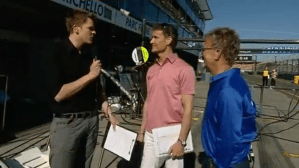
The BBC’s presentation team of Jake Humphrey, David Coulthard and Eddie Jordan in pit lane before the race.

As the discussion becomes more fluid in the half hour before lights out, it is clear Humphrey has done a huge amount of research, coming across to the viewer as knowledgeable, yet down to earth, for what is his first Grand Prix presenting. At this stage, the show and discussion feel raw, with all three new to their paddock roles.

Pleasingly, the build-up strikes a balance on Formula 1’s technical aspects (diffusers, otherwise known as ‘confusers’ in Jordan’s dictionary), explaining them without alienating the casual viewer, whilst giving an introduction on key motor sport terminology through a ‘Behind the Formula’ segment narrated by Brundle.

The CGI which featured in the opening title sequence is a running theme through the BBC’s 2009 output, with CGI fly-overs of the Melbourne circuit leading into the calendar graphic, as well as being utilised during the track guide with Brundle and Coulthard. The track guide is informative, both using their previous Melbourne experience to their advantage, aiding the broadcast.

Attention turns back to the British drivers, with Brawn sponsor and Virgin owner Richard Branson joining in on proceedings, as we approach lights out, and Brundle’s first BBC grid walk!

A media scrum of sizeable proportions greets Brundle on the grid, the media trying to grab both Jenson Button and Rubens Barrichello, but Brundle manages to navigate through the scrums. The highlight is Brundle’s front wing analysis, suggesting that the wings would be more aesthetically pleasing with “brown paper bags over them.”

Brundle – Jenson, can you do this?
Button – Yes.
Brundle – How?
Button – By crossing the line first at the end of the race.

After the grid walk, Coulthard and Jordan wrap up the pre-show discussion, outlining what activities take place between now and lights out. Ferrari’s Chris Dyer adds additional insight on Brawn with Kravitz, giving suggestions as to why Brawn are out in front.

And then, for the first time since the 1996 Japanese Grand Prix, is a F1 race airing live and uninterrupted for UK fans!

Race
For Brundle, 2009 was his thirteenth season in the F1 commentary box. For Legard, it was his first F1 television commentary, although at that stage he was a veteran in his own right, if not in that given context.

One of the new regulations for 2009 was that F1 teams had to declare the weight of their car following qualifying, the information sensibly used by Formula One Management (FOM) in their graphics set. However, there were no graphics related to tyres, even if they played a pivotal part in the race as various drivers hit the ‘cliff’ and slumped down the pecking order.

What a difference a year makes. Lewis Hamilton dominated this event last year, now he needs a set of binoculars to see the lights go out. – BBC co-commentator Martin Brundle commenting on Hamilton’s trajectory.

Brawn’s fortunes off the line are mixed, with Barrichello tumbling down the order, causing mayhem at turn one. Legard’s commentary at the start is far too fast (almost as if he was commentating on radio…), but he soon settles down into a rhythm.

Brundle’s expertise is invaluable from the get-go, making sense of Ferrari’s early progress, due to their soft tyres combined with the Kinetic Energy Recovery System (KERS), as well as fantastic analysis of the turn one crash.

The KERS device has a significant impact on the race as a whole, not only for Ferrari, but also Hamilton yet, speedometer aside, does not play a part in F1’s graphics set. Unlike in more recent years, when you can see the rear wing opening for the Drag Reduction System (DRS), there is no obvious way the viewer can see when a driver is using KERS to overtake.

With high-definition not yet a thing for Formula 1, the graphics set (on the BBC feed at least) remains within the 4:3 ‘safe zone’, with timing information sporadically scrolling across the bottom of the screen, although this is far too infrequent for my liking.

Despite the inferior graphics, Legard utilises the timing screens on offer to him fantastically to spot when cars are hitting the cliff and informing the viewer, although there was a feeling of repetitiveness as the race unfolded. At one stage, BMW’s Robert Kubica was six seconds off the pace due to tyre degradation before his pit stop resulting in significant field spread.

Nakajima helped close the field back up by crashing his Williams, the BBC using the Safety Car opportunity to promote their post-race forum show, no Twitter back then and instead an e-mail address!

2009 Australian GP - Hamilton and speedometer.png
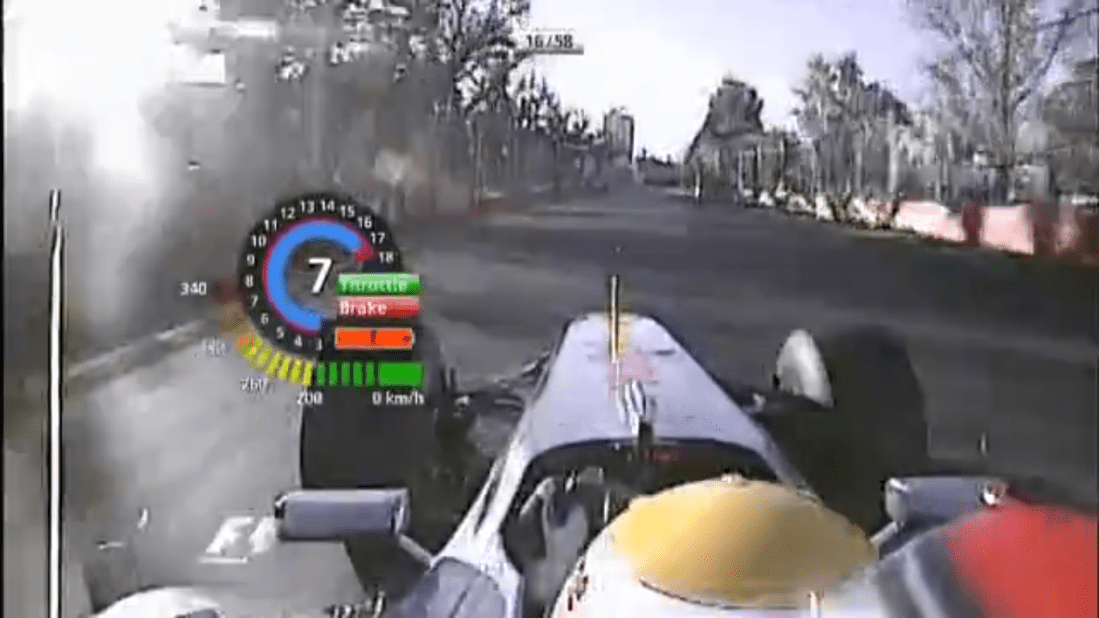
On-board with McLaren’s Lewis Hamilton during the 2009 Australian Grand Prix. Featured on FOM’s graphic is the speed, rev counter, throttle and brake usage, and amount of KERS battery left.

The camera angles were noticeably higher at some corners here than what we have currently, FOM under Liberty Media’s ownership reverting to some of the old F1 Digital angles to capture the speed, which was not as noticeable during 2009. Saying that, I did enjoy seeing a camera angle panning down between turns five and six, showing the speed following the fast right turn.

Following Nakajima’s crash and into the latter stage, the race is all about “who is going to hit the cliff first” where the tyres are concerned. One thing that occurred to me as the race progressed was that I was complaning about the direction less, primarily because there were fewer graphics that alerted viewers of emerging battles. In other words, if the commentary team did not alert viewers that driver X was closing on Y, the fans watching at home would be totally oblivious.

The cliff eventually does hit, with Nico Rosberg and Sebastian Vettel suffering the most: Rosberg’s Williams being overtaken by multiple drivers, whilst Vettel’s race ended in a ‘clumsy’ collision with BMW’s Robert Kubica. The drama, which is explained well in commentary, promotes Barrichello to second, and gifting Brawn GP a one-two finish on their debut!

Post-Race
Prior to the podium celebrations on the cool down lap, there is some good discussion between Legard and Brundle talking about Brawn’s winter, and why Brawn were right to pick Barrichello over Bruno Senna, who media expected to take the second Brawn seat.

20 minutes from chequered flag to off-air was just about enough for the BBC to squeeze in the podium, top three press conference, as well as interviews with Hamilton and Nick Fry.

The whole of the post-race segment on BBC One had a feel-good factor to it with the underdog effect playing its part, in what was a fantastic news story for the whole of Formula 1.

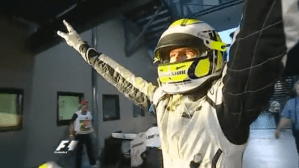
2009 Australian GP - Button
Winner.

Of course, it was not just 20 minutes, because following the BBC One transmission, for the first time ever was an additional 60-minutes of analysis and chatter via the BBC’s interactive Red Button service.

The team decamped to the Force India area within the Melbourne paddock, with Humphrey, Coulthard and Jordan accompanied by single camera set-up for most of the broadcast.

An additional four Brawn interviews followed during the F1 Forum, with both drivers in the interview ‘pen’, Branson, and Button’s engineer Andrew Shovlin during the forum. One may argue that this is over-the-top, but the size of the story arguably justifies this.

A secondary factor is that, back in 2009, there was no concept of the interview ‘pen’ beyond the top three, meaning that it was anywhere goes in the paddock. On one hand, that is to the detriment of the broadcast meaning that we do not get to hear all the stories, but meant that we heard a variety of different voices from on and off the track as the show progressed.

During the broadcast, Kravitz interviewed team bosses Martin Whitmarsh (McLaren) and Mario Theissen (BMW), with Vijay Mallya (Force India) joining the presentation team live, all three teams discussed in detail, which may not have been possible in the ITV days with limited air-time.

> BBC archive blog: Reflecting on a memorable Melbourne weekend (Jake Humphrey – 30/03/09)
> BBC archive blog: The morning after the morning before (Roger Mosey, Head of BBC Sport – 30/03/09)

More importantly, the conversation flowed from one subject to another, instead of the BBC treating them as standalone entitles: Whitmarsh’s interview touched on Ferrari and Brawn, whilst Mallya’s interview focused on Force India’s late development due to the timing of their engine agreement, and how McLaren in turn helped seal the deal in that respect.

All of this helped the programme, which aired without significant constraints or the worry of any upcoming commercials, a breakthrough for Formula 1 broadcasting in the UK.

The three analysts referred to their own experience at various points, Coulthard leading Brundle into a conversation about Brawn’s car design, relying on Brundle’s experience from working with Brawn in sports cars.

The crew dissected the race ending incident between Vettel and Kubica, Coulthard “very disappointed” with both, whilst Brundle brought up Vettel’s past in this area, having smashed into Webber in Japan 2007. The debate led to the first of many friendly disagreements between Jordan and Coulthard, the two disagreeing on whether Vettel should have apologised to close friend and BMW boss Theissen (which the BBC’s cameras captured in the paddock).

In addition to the World Feed analysis, having access to additional race feeds meant that the BBC could play these into the Red Button broadcast, such as analysis from Hamilton’s own on-board.

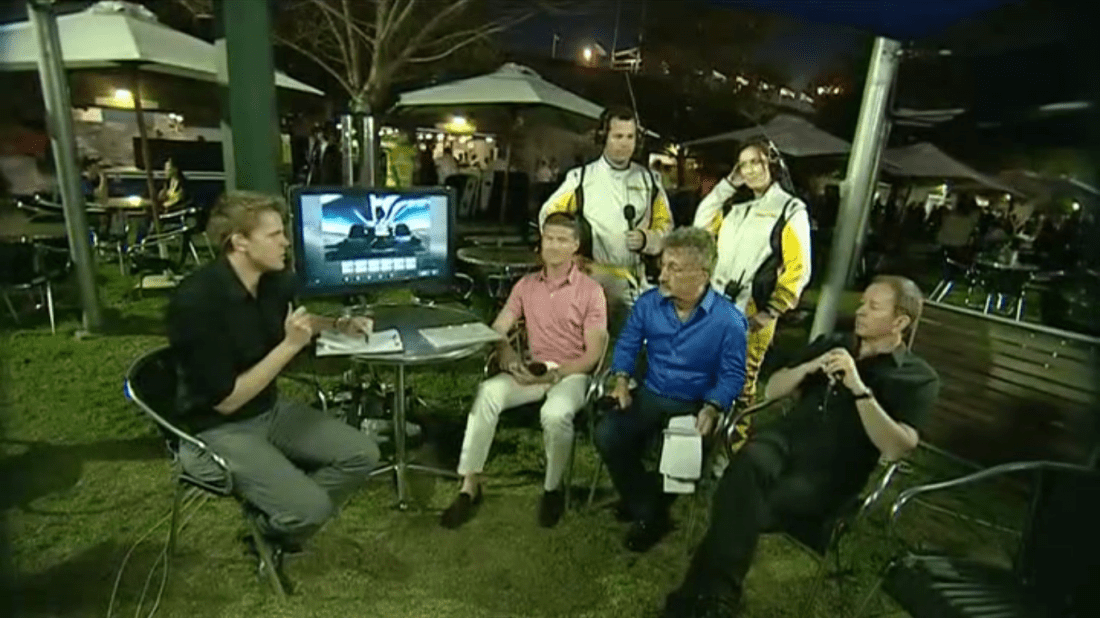
The first BBC F1 forum at the 2009 Australian Grand Prix. Jake Humphrey (l), Ted Kravitz and Lee McKenzie (top r), David Coulthard, Eddie Jordan and Martin Brundle (bottom r).

In later years, the forum went on for as long as deemed necessary, but to start with, the programme ran to time. Only one e-mail managed its way into the broadcast, but irrespective, the question generated an open-end discussion, paving the way for what was to come in future.

Kravitz and McKenzie joined Humphrey, Coulthard, Jordan and Brundle in the temporary Force India set-up, to reflect on their first weekend in Melbourne.

Times Like These by Foo Fighters played out the BBC’s first Formula 1 television broadcast in nearly thirteen years, a marathon four-hour broadcast across two outlets.

Overnight viewing figures quickly justified their expansive coverage: a staggering peak audience of nearly seven million viewers watched the race, with many millions more reached across digital and radio.

For Brawn, for Button, for Barrichello, and for the Beeb, Melbourne 2009 really was a fairy tale.