F1 moves along on new media, but more work is needed

Five months ago, Formula One Management (FOM) launched official F1 accounts on both YouTube and Instagram. It was a long time in the making, and both were much needed in order to drive younger fans towards the sport, letting them engage with the content produced. How successful has it been so far?

Whilst Formula 1 has a lot of problems on and off the circuit at the moment, social media is one area where the team are starting to get things right. Their Instagram feed launched on March 14th and has since amassed 254,000 followers, which is very impressive in the time period. The majority of Formula 1’s images on Instagram get in the region of 14,000 likes, which helps boost their profile further on the image sharing website. Instagram is owned by Facebook, so some of the traffic could be coming from there. However, Formula 1 does not have an official profile on Facebook, meaning that they are missing out on a whole new audience potentially. For example, MotoGP has 752,000 subscribers on YouTube, but 8.9 million likes on Facebook. When analysing Formula 1 teams and drivers, Facebook has a bigger reach than Twitter and Instagram thanks to Facebook’s significantly bigger user base. The good news for FOM is that their own social media numbers should increase exponentially through the year as more people become aware of the content.

The thing that does surprise me is the lack of integration on the official F1 website with Twitter, Facebook and YouTube. A typical article does not have options to share the content on social media websites. Compare that to the Sky Sports or BBC websites where there are various ways to share the content. If anything, FOM should be proactive towards social media services, and treat it as two-way traffic. A user posts a link to Facebook which can then drive other users towards the website, at the moment, FOM are missing out on that aspect.

In comparison to the above numbers, Formula 1’s YouTube channel has 67,000 subscribers. It is significantly lower than Instagram. I attribute that to the instant aspect of Instagram versus YouTube. With Instagram, liking pictures is instant, you are unlikely to ‘like’ a picture that is six months old. But on YouTube, you are just as likely to watch a video that was posted six months ago compared to one that was posted yesterday. Examining what videos are popular on Formula 1’s channel makes for interesting reading:

Most watched videos on Formula 1’s official YouTube channel
1. 224,000 – F1’s Greatest Lap? Ayrton Senna at Donington 1993 (uploaded 3 months ago)
2. 145,000 – Your Favourite Monaco Grand Prix – 1992 Senna v Mansell (uploaded 2 months ago)
3. 110,000 – Raikkonen Wins At Suzuka From 17th On The Grid | Japanese Grand Prix 2005 (uploaded 3 months ago)
4. 106,000 – Your Favourite Chinese Grand Prix – 2006 Schumacher’s Last Win (uploaded 3 months ago)
5. 95,000 – Michael Schumacher Weathers Stormy Sepang | 2001 Malaysian Grand Prix (uploaded 4 months ago)

It shouldn’t be a surprise to anyone that the most-watched videos on their YouTube channel contains archive video as the main draw. Sky’s viewing figures may not show that, but casual fans are clearly interested in archive footage of a bite-sized nature. The amount of archive content has increased on their YouTube channel recently, but they are not uploading much content outside of that during race weekends, with other footage instead being kept solely on the official website. On the whole area of video though, Formula One Management need to be keeping an eye on World Wrestling Entertainment’s (WWE) recent figures for their over-the-top Network.

After a slow start last year, WWE’s new model is proving more popular, and profitable, than their old pay-per-view model for their monthly extravaganzas. With over 1.2 million subscribers for the WWE Network, other companies need to be looking to see if that model is worth investing in. And that includes FOM, as I’ve spoken about before. Wall Street certainly liked WWE’s news. Unfortunately FOM tend to be behind the bend rather than ahead of the bend. One day I hope it does happen. But their journey is only just beginning, whereas WWE began their Network journey years ago.

Personalities fill FOM’s Facebook void
As mentioned above, FOM (or Formula One Digital Media – whichever you prefer) do not currently have any presence on Facebook. The exact reason for the lack of a Facebook page is unclear, although Marissa Pace did state in interviews late last year that the plan was to launch YouTube first, then Facebook later. Whilst it is great that FOM have a strategy, it could be argued that Facebook can be exploited a lot more than YouTube, so should have been targeted first.

On Facebook, Mercedes have a combined audience of 12.26 million accounts, with a reach of around 10 million accounts. Compare that to Twitter. Mercedes there have a combined audience of 4.37 million accounts, reaching around 3 million accounts (the reach is lower than the combined audience as one account can follow many pages). Overall, Facebook from a Formula 1 fan perspective is nearly twice as popular as Twitter. Facebook is worth ten times more than Twitter, which for FOM means that they are losing a huge cut of a potential audience.
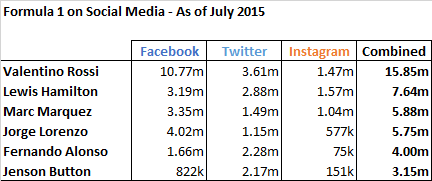
How Formula 1's and MotoGP's stars compare on social media, as of July 2015.
How Formula 1’s and MotoGP’s stars compare on social media, as of July 2015.

Trying to analyse social media demographics is incredibly difficult, but the consensus tends to be that Facebook has a broader reach, Instagram a younger reach, with Twitter potentially more dedicated in what accounts may tweet about. Looking at Formula 1 on Facebook, as alluded to above, the official Mercedes AMG Petronas account has a huge 10 million likes. It is not quite the biggest motor sport page on Facebook: Valentino Rossi has 10.77 million likes. Obviously, 10 million is a relatively small number when you compare it to football clubs, for example, Chelsea FC have 44 million likes, but it isn’t a number that should be underestimated. When including Twitter and Instagram, almost two-thirds of Mercedes followers come from Facebook. Lewis Hamilton is twice as popular as Fernando Alonso on Facebook – with 3.2 million likes compared with 1.7 million likes for the Spaniard.

Hamilton is by far Formula 1’s most popular driver across Facebook, Twitter and Instagram, which is partly why Mercedes’ combined audience is so much higher across these outlets. As good as Hamilton’s numbers are, it shouldn’t be too surprising that Rossi dwarfs Hamilton’s figures, although Hamilton’s combined audience across the three main social media platforms is higher than Marc Marquez and Jorge Lorenzo. Marquez and Lorenzo though have a bigger reach than the remainder of the Formula 1 field. It doesn’t help that two of Formula 1’s biggest stars have no social media presence. Okay, I can understand why Sebastian Vettel and Kimi Raikkonen stay off social media, but you can also understand why Bernie Ecclestone makes comments like he does surrounding Hamilton and his marketability.
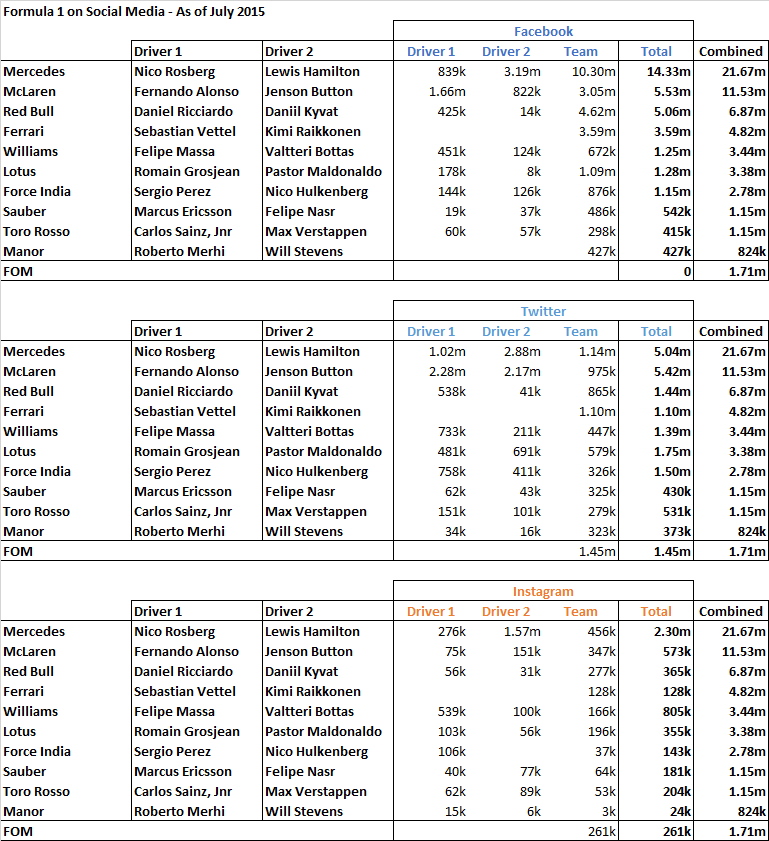
The Formula 1 social media statistics, as of July 2015.

Ferrari has the highest skew towards Facebook, with 75 percent of their combined followers originating from there. In comparison, only 36 percent of Toro Rosso’s fans come from Facebook, although that number could drastically change if Max Verstappen and Carlos Sainz continue to make an impression in the latter half of 2015. Of course, FOM have zero percent. It’s difficult to say exactly how many likes they would have on Facebook, but you have to be looking at nearly ten million likes, if not higher. The raw numbers in the two figures above really show much much you need a presence on Facebook, as I outlined earlier in this piece. Force India and Lotus have the biggest relative impact on Twitter, the latter shouldn’t be too surprising when you consider the content that they upload to the site in order to be distinctive. Only 23 percent of Mercedes’ following originates from Twitter, but this is down to the huge Facebook number rather than a low Twitter base.

Formula 1 teams, drivers and media are only just beginning to exploit Instagram, and that is clear in the figures. Only Mercedes break the one million mark. Hamilton and Felipe Massa are the only two drivers to really grab hold of the image sharing site. Fernando Alonso and Jenson Button, who are big on Facebook and Twitter, currently have a very small presence (follower wise) on Instagram.

I think Formula 1 needs to exploit Facebook much more than what it currently is. That will only happen when FOM lead the way by joining the website and share content. I wonder if they are looking to be a part of Facebook’s video monetisation scheme? A lot of work has happened in the past half a year, and it will be interesting to track the numbers further as Formula 1 continues to exploit the various platforms.
Archive Grand Prix footage released on AP’s YouTube channel

The Associated Press, in conjunction with the British Movietone, have released over a million minutes of historical archive footage on to two new YouTube channels.

Unsurprisingly, both channels contain masses of Grand Prix footage dating back to before the war. The majority of the footage covers the period before 1982 – i.e. pre Formula One Management – however there is still some archive material that is clearly from FOM’s archive (but also AP’s, evidently) on the channel:

Unfortunately, given what has unfolded in the past week, the first page of results when searching for ‘Grand Prix‘ on AP’s YouTube channel are a few safety related videos, although this video in the aftermath of the 1994 San Marino Grand Prix is one that I have not seen before. It shows Max Mosley addressing the media on the Wednesday following the events of that weekend:

More recently, we have the outcome of the McLaren 2007 spying case, with Norbert Haug, Ron Dennis and Pedro de la Rosa trying to escape the court room:

I don’t know how many motor racing videos have been uploaded to the AP’s and Movietone’s YouTube channel, but there will almost certainly be some hidden gems in the collection that has been uploaded.

News round-up: Jacques begins feeder series commentary; NBC F1 ratings rise

In the third and final catch-up, news on the identity of the GP2 Series lead commentator and a look at NBC’s continuing Formula 1 ratings rise.

Jacques becomes new GP2 and GP3 commentator
The news towards the end of 2013 that Will Buxton would no longer be lead commentator for the GP2 and GP3 Series caught many by surprise, with Buxton choosing to prioritise his duties with NBC Sports over commentating on the feeder series’ for Formula One Management (FOM). There were not many stand-out candidates for Buxton’s replacement, I noted last November that the replacement depended upon whether FOM wanted to “breed new talent or rely on a veteran figure”. In the end, the corporation went for the former approach.

Alex Jacques was officially announced as lead feeder series commentator for GP2 and GP3 on Thursday 16th April, prior to the Bahrain Grand Prix weekend. You probably are, like I was at the time, wondering who Jacques is. And, to a degree, I am still wondering who Jacques is. Google brings back very little about his past commentating exploits, whilst Jacques has no profile on social media. The nearest information we have about Jacques is that he may have done BBC local radio commentary covering football in the past few years, but apart from that, there is nothing concrete in the public domain.

The reaction on social media has been positive towards Jacques. From the action that I’ve watched, Jacques does sound a bit stilted from time to time, but on the other hand I haven’t heard any howlers from him, yet. What is apparent though is that Jacques is trying to be the first Alex Jacques and not the second Will Buxton. That’s more than good, there is nothing worse than trying to act and be like another commentator or presenter and fail at the first hurdle, so it is good to see Jacques bringing his own style to proceedings.

Sticking with GP2 and GP3, the graphics set for the feeder series’ have stayed the same, unlike its bigger brother, which means that they have been using the same graphics set for a decade now. There have been a few tweaks, such as the timing bar at the bottom of the screen, which has been present in the F1 coverage since at least 2008. Behind the scenes, it was confirmed earlier this month that Tata Communications would be supplying the live broadcast signal for GP2, GP3 and the Porsche Supercup via fibre optic and satellite. James Allen said that the move “is clearly a trial run for both F1 Management and Tata with a view to one day transmitting F1 Grands Prix this way.”

NBC’s F1 ratings continue to rise
In an ongoing story, Formula 1’s television ratings in the United States are continuing their upward curve with coverage on NBC Sports. Following a brilliant number for Malaysia in late March, the Bahrain Grand Prix benefited hugely from a mid morning start time in the US. An average audience of 630k watched Lewis Hamilton win, making it the most watched race ever for NBC Sports Network, and the most watched non-domestic F1 race on cable in eight years.

As I’ve said before, it is unbelievable that the numbers are increasing further in the States when you consider that figures have largely stagnated and even dropped worldwide. The unfortunate thing for Formula 1 is that it is coming from such a low base, meaning that there is still a ton of work to do to get viewing figures over a million, if possible, for mid morning races such as Bahrain.

How WEC can grow, if it wants to
With two rounds of the 2015 World Endurance Championship completed, the series has been receiving more plaudits, comparisons are again being made between it and Formula 1. As Edd Straw said in an editorial on the AUTOSPORT website (£) a few weeks ago, pundits should not use the series as a battering ram to attack Formula 1 with given that the two are distinctly different.

WEC races are typically six or 24 hours long, whereas a Formula 1 race lasts just under two hours, meaning the latter is much more likely to attract a bigger audience. Also, Formula 1 has the luxury of free-to-air output on BBC and Sky. The endurance series however is on Motors TV with a much lower reach than the remainder of the Sports portfolio, including Sky Sports and BT Sport. The Silverstone round peaked with 24k according to unofficial overnight viewing figures.

The buzz at the moment for WEC is just within the motor sport circles, at the hardcore level. How can that be changed to bring in a casual audience, whilst not alienating the hardcore audience, if possible? I think it is important to point out that, in the mid to late 2000’s, the last few hours of the 24 Hours of Le Mans were screened live on ITV4, which should happen again. Why the series also doesn’t have a highlights package either is confusing to me. Both of these are easy method of increasing audiences, demand and reach. Yes, it is great to stream live online and the like, but you need to have a good reach on traditional platforms as well, which WEC does not have.

It could be argued that it would be difficult to package together a six hour race, plus practice and qualifying into a 45 or 90 minute highlights programme (excluding commercials) without completely losing the flow and story of the race, but that doesn’t mean that it shouldn’t be attempted. Elsewhere, in a big story from a broadcasting perspective, all TV cameras will be active for the entire 24 Hours of Le Mans, according to Graham Goodwin, the editor of DailySportsCar.com. In previous years, the majority of TV cameras were switched off overnight, with a limited number of cameras running alongside CCTV cameras to pick up any incidents. A lot of action was missed as a result, with incidents and crashes occurring off camera, but it looks like that won’t be the case for this year’s race.

News round-up: Sky explore YouTube; online battle for readership continues

In the second round-up catching up on the stories of the past month, this blog looks at the ongoing battle for readers across various websites and the advances over on YouTube.

Sky explore YouTube, but did anyone notice?
Sky Sports conducted an interesting experiment with the Friday 24th April episode of The F1 Show. Under the #AskCrofty banner, the episode was streamed live on YouTube. I believe this was the first time that Sky have ever streamed F1 content on the video sharing website, traditionally it had only been available to pay-TV subscribers via the usual ways. Personally, I think that such an occasion would have been good to ‘big up’ with some extra advertising or hype via social media, maybe try and reach out to a few new subscribers. For whatever reason, that didn’t happen.

The episode was streamed live on YouTube to around a few hundred people, a number which can only be described as shockingly low. Yes, it is only an F1 talk show on a Friday night, but you can’t defend numbers as low as that. I’d have expected at least a few thousand people to watch it live via YouTube, given the amount of people that the Sky Sports brand reaches on Facebook, Twitter and their own website on a daily basis. This experiment failed before it even started, to be honest. The low number also in its own way confirms the low TV viewing figures that The F1 Show receives, never hitting 100k and very rarely hitting 50k.

Sticking with YouTube, and the news that the official F1 channel appears to be forming some sort of partnership with NBC. Eagle eyed viewers will have noticed that the F1 website tends to take NBC’s interviews conducted from the broadcast pen, as of course Formula One Management (FOM) own all the content that is filmed inside a race track. That relationship appears to be evolving, with NBC features possibly appearing on F1’s YouTube channel, according to NBC’s pit lane reporter Will Buxton who commented on it during a recent AMA on reddit. Obviously such a development, should it come to fruition, is positive news as it means more people will be able to experience the content that NBC’s F1 team produce.

F1 2016 schedule and the implications
The provisional 2016 Formula One schedule presents some interesting decisions for both BBC and Sky should the schedule not change. The good news is that the season would start after the conclusion of the Six Nations and after the Boat Race. The Australian Grand Prix, scheduled currently for April 3rd, would not clash with any of the big standalone events. The Chinese Grand Prix would be held on the same weekend as the Grand National, but not a direct clash. It is the Bahrain Grand Prix that would suffer, clashing with the London Marathon and the FA Cup semi finals, but on the other hand it could provide BBC with a bumper Sunday if they showed the Grand Prix live after the marathon.

However, with both the football European Championship and the Olympic Games taking place next year, it means a congested Summer of sport. Provisionally, the Canadian, Austrian and British rounds of the championship will take place during Euro 2016, whilst the Hungarian Grand Prix clashes with the opening weekend of the Olympic Games. And that hasn’t even taken into account Wimbledon…. of course, it is impossible to avoid everything. But, the promoters and governing body of the sport must ensure that F1 is given the best scheduling opportunities where possible, minimising the chance of direct clashes.

AUTOSPORT widen their horizons
The online battle for readers has increased over the past year, with multiple talent changes across AUTOSPORT and Motorsport.com. The talent changes are now in place, which should result in stronger competition across the board, as Motorsport.com tries to take a slice of the action from AUTOSPORT and other related websites. In theory, the changes can only mean good things for the consumer. The quality should increase as both sites strive to make their portfolio of content as strong as possible, irrespective of whether it is two wheels, four wheels, tarmac or gravel.

AUTOSPORT are further bolstering their line-up with a new website currently in beta, so that will only help things for them in the online department. Their commitment to all things two and four wheels was demonstrated a few weeks ago, with Kris Meeke’s victory at the Rally Argentina their lead story on the cover of AUTOSPORT Magazine, despite rallying traditionally not a strong selling point in comparison to Formula 1. Edd Straw, AUTOSPORT’s editor, justified the decision noting that he hoped that AUTOSPORT’s readership would respond to a different cover “better than expected”, whilst it was simply “the right thing to do” due to the story behind Meeke’s victory. It should be noted that some mainstream media covered Meeke’s victory, both the BBC and Sky covered the victory on their respective websites.

Elsewhere, the recent general election alongside Floyd Mayweather’s victory against Manny Pacquiao in the boxing meant that the BBC smashed their own online records, with 12.3 million browsers accessing the BBC Sport website in total on Sunday 3rd May. 8.7 million browsers were from within then UK, with the remaining 3.6 million browsers from outside the UK. In comparison, as the aftermath of the general election was felt, a whopping 28.3 million browsers accessed the BBC News website, of which 20.6 million were from within the UK. The numbers are simply staggering.

News round-up: Formula E exposes good and bad of social media; BT reduce Indy 500 output

In the first of three round-up posts catching up on the stories of the past month, this blog looks at Formula E amongst other topics that have caught the spotlight.

Formula E – the good, bad and dodgy
The inaugural season of the Formula E series is coming to a conclusion, with four races remaining. In the past month alone, there has been evidence of the good, bad and perhaps dodgy things that have been occurring across its output.

The announcement that the 2016 Formula One season is provisionally set to start in April should be seen as good news within Formula E circles. Assuming that the second season it scheduled well, and initial indications suggests that will be the case, then Formula E should be able to gain momentum through January, February and March 2016 before the Formula One season begins and inevitably takes away a portion of its reach. Starting off with the good news, and that is that Formula E is using new technologies effectively and to their advantage, for example live video streaming app Periscope. Using Periscope allows fans to get closer to the action, giving them a virtual behind the scenes pass, meaning that they can interact with teams’ and drivers’ instantly.

Another app that the electric racing series has been using is Grabyo, which allows rights holders such as Formula E to post short video snippets straight to Twitter instantly, which is exactly what they did with the turn two crash at the Monaco ePrix. The key word with both Periscope and Grabyo is ‘instant’. Because instant communication is what social media thrives on, and it is fantastic to see Formula E exploiting these new apps to their advantage. Planned or not, it always helps when someone with nearly eight million Twitter followers shares one of these clips, as footballer Cesc Fàbregas did a few hours after last Saturday’s race. I’d be fascinated to see just how many people Formula E managed to reach with the Grabyo clips, and how many people then went and watched a few more of their clips.

There were a few negatives coming out of the Monaco ePrix weekend. The first surrounded the direction, which, as expected for Monaco was controlled by the local host. The camera angles that viewers saw were typical of Monaco, they were the same as the angles used during the F1, and given Formula E’s lack of speed, it didn’t paint the series in the best of ways. However, it did make me appreciate the fantastic work that Westbury Gillett and team have done so far this season in bringing out the best of Formula E with brilliant direction that gets the cameras as close to the cars as humanely possible.

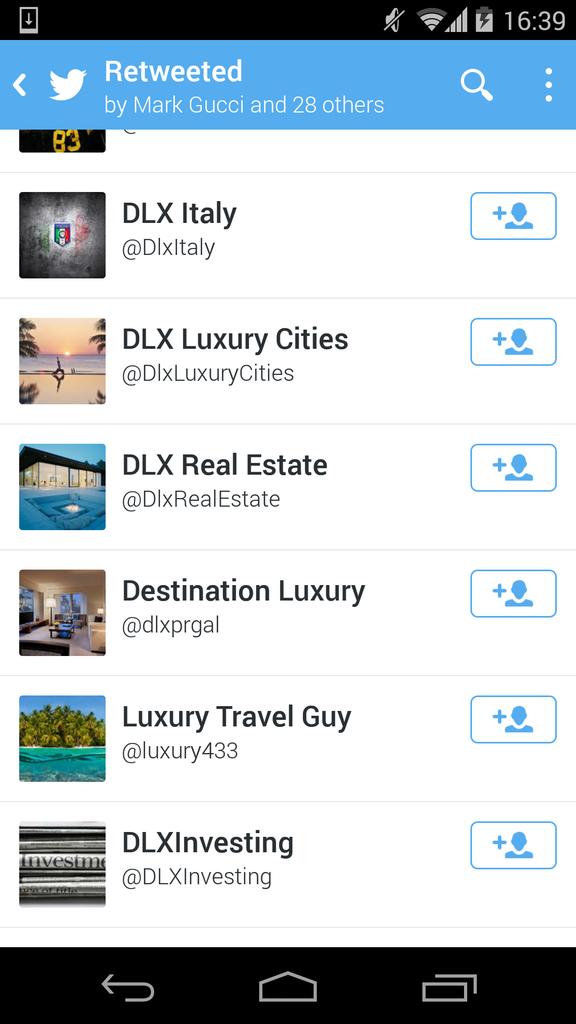
Accounts related to Destination Luxury 'mass retweeting' content related to Formula E.
Accounts related to Destination Luxury ‘mass retweeting’ content related to Formula E.

There are two personnel changes to keep an eye on next Saturday. Mike Conway replaced Dario Franchitti as colour commentator for Monaco due to Franchitti’s Indianapolis 500 commitments, which presumably means that Franchitti will not be commentating on next Saturday’s Berlin ePrix either. Elsewhere, Andy Jaye is replacing Jennie Gow as ITV presenter for Berlin and the Moscow ePrix in early June, as Gow is covering the Monaco and Canadian Formula 1 events for BBC Radio 5 Live. Jaye covers speedway for British Eurosport, so is a good choice to replace Gow. As of writing, ITV have not confirmed coverage plans for the London ePrix on June 27th and 28th, however, the Sunday action clashes with British Touring Car Championship, so one of them will need to be moved to ITV.com, or hopefully moved to ITV’s main channel.

The last Formula E note is frankly bizarre. I tweeted about Formula E at the end of April and was slightly surprised to see that 108 ‘people’ had retweeted the tweet. After closer investigation, including looking at some of the other Formula E tweets, it was clear that it wasn’t actually 108 unique people. At least 50 of those accounts originate from a group called Destination Luxury (DLX). I’m not sure whether this falls under the category of Formula E buying Twitter followers in order to boost the retweet numbers, but it looks a bit strange to me in any case.

Two steps forward, three steps back?
2015 started off brilliantly for Formula One Management (FOM). A slick-looking graphics set. A new-look website. Advances in the social media department. Unfortunately, the appalling direction is a continuing frustration with the bi-weekly Formula 1 product. The direction came to the forefront of this blog’s attention during last year’s Canadian Grand Prix, where it has remained ever since.

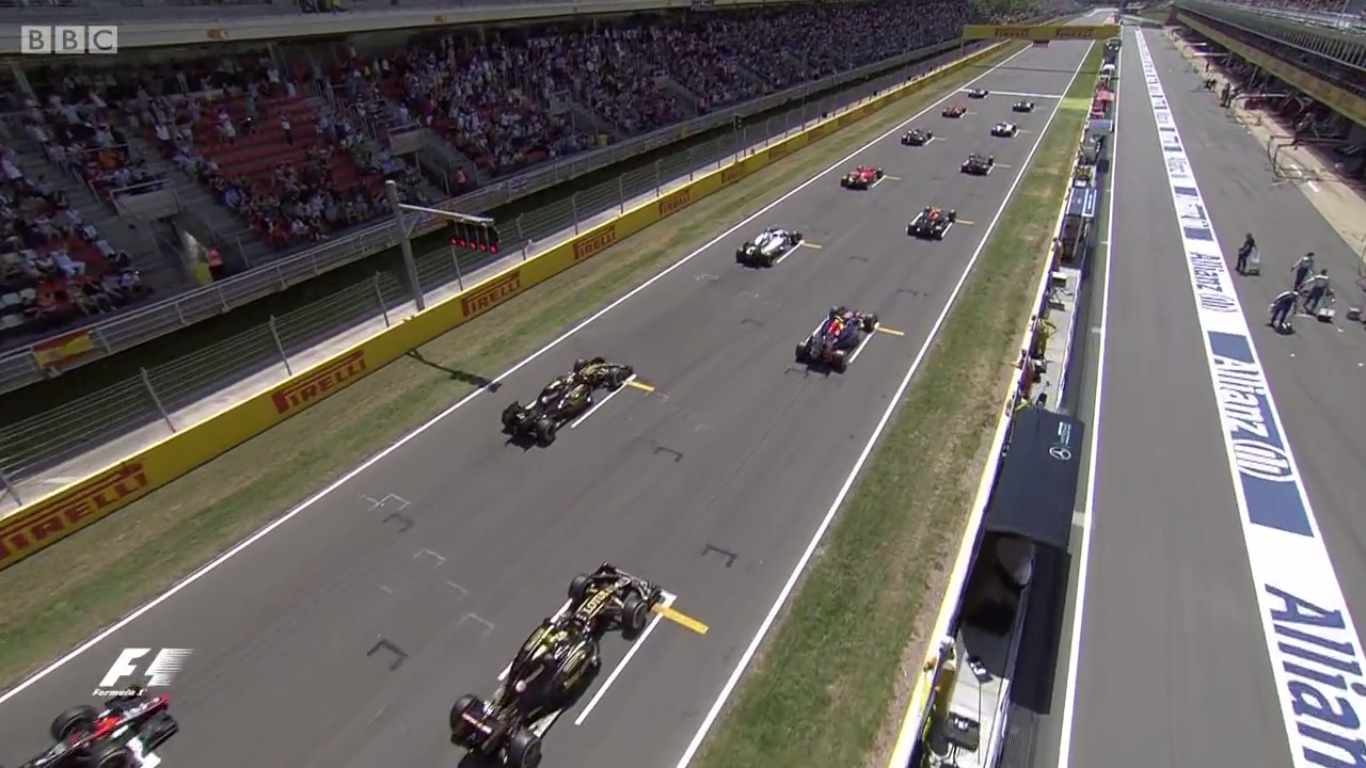
Is this an appropriate shot for the start sequence?

Decisions made by the directors (or whoever controls the pictures that viewers worldwide see) are left to be desired. For me, there are two major issues at the moment. The first surrounds the start sequence. Recently, FOM have been experimenting with shots such as the above for the race start. The problem that I have is that the shot is inappropriate for the race start, irrespective of how many seconds the shot remains on the World Feed for after the green light. By all means use it half way through when there is not as much action, but don’t use it at the start. The direction was further exasperated in Spain when FOM went to a helicopter shots during the first lap. On lap 1, I want to identify cars as easily as possible, and track the running order. In essence, the shots need to be stable for this to happen. I don’t like FOM’s direction as of late, and unfortunately it is part of a downward trend that has been taking place for many years now.

Now that we’re five races in, I maintain the view that FOM’s 2015 graphics are better than their predecessors. However, are they at the standard of Dorna’s MotoGP graphics? No. Dorna themselves have taken the MotoGP graphics forward another set this year. Innovative, awesome and creative are three words that I’ve used on Twitter to describe Dorna’s graphics set in the last month alone. The problem FOM now have is that they need to exploit the current graphics set to their best potential, which is what Dorna are doing. The latest move from Dorna is movable graphics, which have been used in NASCAR for a while. But over in Europe at least, the move is a new step. FOM’s production and direction side seems reluctant to positive change that will benefit the product that the viewer at home sees. Instead, they seem to be moving the product to suit other agendas. Mind you, I suspect the direction is the least of F1’s worries right now…

BT reign in IndyCar coverage
With BT Sport focussing all of its efforts on MotoGP, it appears next weekend’s coverage of the Indianapolis 500 on ESPN will be a copy of the US feed rather than BT adding any of their own colour to it like last year. Coverage starts at 16:00 next week, with no Motorsport Tonight segment like last year in the schedules. Last year, BT Sport 2 went on air at 15:30, with an hour of studio talk before handing over to their American colleagues. It shouldn’t be too much surprise if BT have decided to just take the American feed, because the approach they took last year was derided a fair amount on social media, with the negative comments outweighing the positive comments. In fact, it looks like both Motorsport Tonight and its MotoGP Tonight counterpart have been permanently axed from BT’s schedules in exchange for The Chequered Flag and BT presenting every MotoGP race on site.

This week has been a reminder that series such as IndyCar only get coverage in the UK whenever a bad crash happens. Multiple media outlets covered the heavy crashes of Helio Castroneves and Josef Newgarden during practice for the Indianapolis 500 including the BBC and The Times. Let’s hope that the next eight days pass without any other major crashes occurring during the build-up to the Indianapolis 500.