Over 2 million viewers watch F1’s first Sprint in UK

F1’s new look format, trialled over the British Grand Prix weekend, helped audience figures improve in the UK, consolidated data released by BARB suggests.

The Silverstone weekend was Channel 4’s only live action of the season, the broadcaster sharing live coverage with Sky Sports.

The consolidated data accounts for viewers who watched within seven days of the original transmission.

New format draws the viewers…

Usually, Friday plays host to two practice sessions.

However, only one practice session took place on Friday at Silverstone, with the traditional three-part qualifying session moving to Friday evening.

According to industry website Thinkbox, which publishes BARB consolidated data, 1.08 million viewers watched the qualifying session on Channel 4 from 17:00 to 19:30.

An additional 530,000 viewers watched on Sky Sports F1, across a shorter time slot from 17:25 to 19:30. A caveat here that Sky’s figure includes those that watched on devices, whereas Channel 4’s figure is for the TV set only.

Nevertheless, with a combined audience of 1.6 million viewers, the British Grand Prix marked F1’s highest UK audience on a Friday since at least 2003, if not earlier. Back then, ITV aired highlights of Friday qualifying in a late-night slot.

On Saturday, a combined audience of just over 2 million viewers watched Channel 4’s and Sky’s Sprint programming, including build-up and post-session analysis.

1.40 million watched the Sprint across all devices on Channel 4 from 15:45 to 17:40, with a further 610,000 viewers opting for Sky’s programming across a slightly longer time slot.

The figures are higher than what a normal three-part qualifying session would have achieved in its usual Saturday slot.

Initial analysis from Motorsport Broadcasting suggests that F1 may have recorded its highest Saturday audience for the British Grand Prix since 2013.

Race day saw an audience of around 3.6 million viewers watch Channel 4’s and Sky’s main programming, an average that includes the extended red flag period, but excludes the extended wraparound offering.

2.34 million viewers watched on Channel 4 from 14:26 to 17:07, with 1.21 million viewers watching on Sky Sports F1 from 14:53 to 17:35.

Year-on-year, Sky’s race audience increased by 15%, with Channel 4’s decreasing by around 8.5%, reflecting the positive trajectory Sky’s F1 audience figures continue to take.

Both broadcasters benefited from the Lewis Hamilton and Max Verstappen collision, with 2 million viewers sticking around for the post-race programming until 18:30.

…what this means…

Although peak audiences are unavailable, we can use the average audience figures already in the public domain, along with programme lengths, to draw some conclusions.

Using the available data, it is likely that Friday’s qualifying session peaked with 2 million viewers, Saturday’s Sprint session with 3 million viewers, and Sunday’s race with 4.5 million viewers.

Having the weekend live on free-to-air television undoubtedly helps the audience figures, but even for Sky, the British qualifying session was their highest ever F1 audience for a Friday – including the plethora of evening practice sessions where they were the exclusive broadcaster.

In some ways, that is unsurprising, but it shows that fans tuned into the idea of having a meaningful session take place on a Friday evening.

Fans did not dismiss Friday qualifying, and instead felt that it was important part of the F1 weekend, and important enough to tune in to.

Whether the Sprint figures were higher than a typical Saturday because of the novelty of it remains unknown, and only something we will know when audience data for the Italian Grand Prix comes in next month.

But, arguably, the events of the Sprint contributed to what followed on Sunday from a sporting perspective.

Speaking to selected media, including The Race, on a conference call, F1’s CEO Stefano Domenicali described the response to the Sprint as “really positive”.

“After the first sprint event at Silverstone, the response that we have from the drivers, from the teams, the media, has been really positive, and also for the promoter,” said Domenicali, as quoted by The Race.

“The outcome of the first event has been dramatically positive. It’s great because that brought attention, interest on TV, and also partners. We have already seen the financial interest be positive.”

The audience data for the weekend, which F1 is no doubt digesting, backs up Domenicali’s statement.

…as W Series beats Formula E

But, Formula 1 was not the only beneficiary of the revised schedule.

The W Series race normally takes place after F1’s qualifying session. For Britain, the race remained on the Saturday, but aired in between F1’s single practice session, and before the Sprint.

An impressive average of 533,000 viewers watched on Channel 4 from 13:05 to 14:17, a figure which excludes those who watched on other devices.

Now in its second season, the all-female championship, retained around 66% of the F1 practice audience. The F1 session, which began at 12:00 UK time, averaged around 800,000 viewers across Channel 4 and Sky.

A week after the Grand Prix, Formula E’s London outing aired live on Channel 4 across the weekend of July 24th and 25th with a double header event.

The electric series reached a high of 382,000 viewers from 13:51 to 15:12 for its second race of the weekend, again excluding the ‘other device’ watchers.

The audience figures demonstrate how W Series benefited from being on the same card as Formula 1, whereas Formula E’s events are largely standalone with no wrap-around support.

W Series also benefited from added exposure through Channel 4’s live F1 coverage, the only weekend of the year that the free-to-air broadcaster covers F1 live.

Moving forward, W Series will not have the luxury of an F1 lead-in on the same channel.

In addition, Formula E faced the opening weekend of the Olympics across the BBC, which took attention away from the E-Prix. In that context, the Formula E figure is good given the lack of support the series has received from free-to-air stations in recent years.

Most importantly, The Race notes that Formula E “surpassed the expectations of the C4 management team,” which bodes well for a future rights deal between the two parties.

Motorsport Broadcasting will publish a full analytical piece looking at the UK F1 audience picture at the half way stage of the 2021 season shortly.

Contribute to the running costs of Motorsport Broadcasting by donating via PayPal. If you wish to reproduce the contents of this article in any form, please contact Motorsport Broadcasting in the first instance.
5 key stories from the 2021 British Grand Prix weekend

The key talking point after last weekend’s British Grand Prix was, of course, that incident between Lewis Hamilton and Max Verstappen which has generated column inches across the board.

On the broadcasting side, it was a newsworthy weekend, for multiple reasons.

Alongside the previously announced offline HDR test, there were other things that caught the eye over the Silverstone weekend. Here are just a few…

New format, new graphics…

A new experiment for Formula 1 brought with it new graphics for the Sprint session.

The changes were visible to fans immediately after the F1 opening titles, with the usual fly-over coming in the form of enhanced augmented reality graphics.

The pre-race graphics detailed the same information as usual, such as the track layout and starting grid, but in a different format to the Grand Prix graphics.

In my view, the changes helped to differentiate the Sprint to the main event on Sunday.

I know sometimes F1, and other forms of motor sport, sometimes have a habit of implementing ‘change for changes’ sake, but I thought that this was a cool change.

As a wrestling fan, it reminded me of WWE’s broadcasts, the wrestling juggernaut having used augmented reality to their advantage throughout the pandemic with no fans in attendance.

The graphics which followed during the race had mixed execution, however.

A graphic depicting the live speed of McLaren’s Daniel Ricciardo at The Loop and Aintree fell into this category.

If this was a top speed graphic, it might make sense, displaying the live speed at one of the slowest parts of the circuit added little to the broadcast.

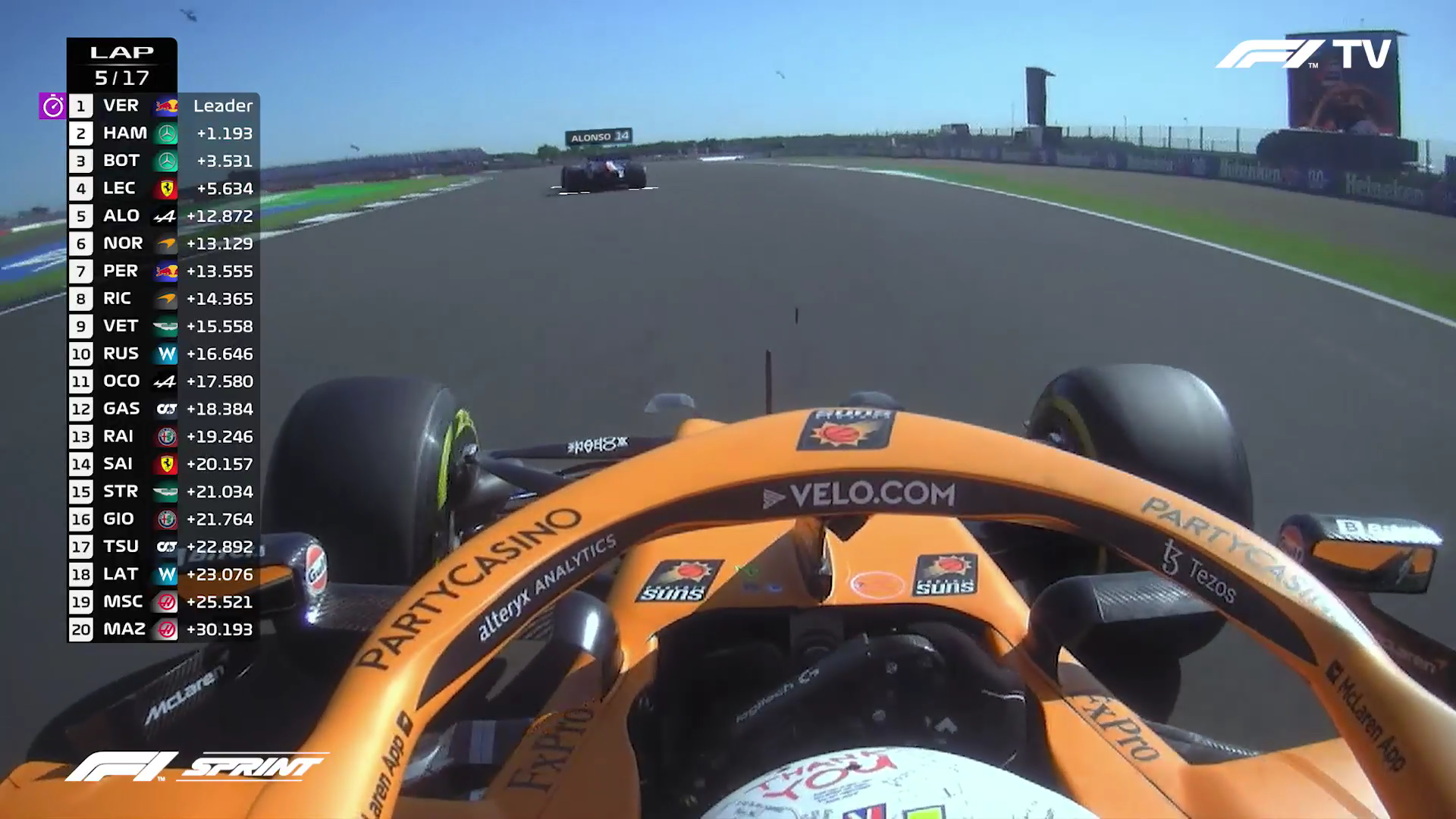
In contrast, F1 used augmented reality to highlight Alpine’s Fernando Alonso when riding on-board with McLaren driver Lando Norris, a graphic which worked well.

McLaren’s Lando Norris chases down Alpine’s Fernando Alonso in F1’s new Sprint experiment.

Others suggested that the Alonso graphic resembled a video game, but that for me is not a valid criticism.

Not every livery stands out as easily as a McLaren (orange) or Ferrari (red), especially when viewing from behind.

If F1’s implementation helps new viewers engage in our sport, then this is a change for the better.

Besides F1 are not the first (see: MotoGP, NASCAR, amongst others), and certainly not the last, to implement a graphic of the nature. 

…as audiences in the Netherlands remain strong

In the Netherlands, ratings bureau SKO reported that Friday’s evening qualifying session averaged 552,000 viewers (15.5% audience share) on Ziggo Sport.

The figure in-line with Saturday’s afternoon qualifying session from Austria, which brought 585,000 viewers (31.7% audience share).

The higher share for Austria is reflective of the fact that the Silverstone qualifying session aired in an evening time slot, so whilst more viewers could have watched Friday qualifying in the Netherlands, they opted not to.

Saturday’s Sprint averaged 717,000 viewers (28.9% audience share), a significant volume increase on Austria qualifying, with a slight share drop.

The race on Sunday, from the start of the red flag period, averaged 1.31 million viewers across Ziggo Sport and Ziggo Sport Select, equating to a 62.9% audience share.

In the US, 529,000 viewers watched the new Sprint format on ESPN, while the race averaged an excellent 1.03 million viewers, continuing F1’s positive trajectory in the States.

The picture was less positive in Spain, where the Sprint generated no additional interest.

According to Formula TV, 114,000 viewers (1.3% audience share) watched the Sprint programme on DAZN, compared with the 116,000 viewers who watched the Austria qualifying session.

Sustainability on the agenda…

Wherever you looked across the F1 weekend, sustainability was one of the main topics featured across F1’s UK broadcasts.

Sky’s #GoZero campaign was in the spotlight during the coverage, with all their presentation team using green ‘Sky Zero’ microphone coverings and recycled clothing.

The broadcaster hopes to become net zero carbon by 2030, and is working in collaboration with F1 to help bring down carbon emissions across the sport. F1 themselves announced that the Silverstone weekend was their first ever Carbon Neutral broadcast.

Writing on Sky’s F1 website, senior producer Jamie Coley explained how he plays his part in Sky’s Sustainability Content Group.

“The group brings producers and journalists together from across Sky Sports to find ways of achieving tangible results and awareness around the environmental problems our world faces through our sports coverage,” he says.

“Over the last year, this group has achieved some significant milestones, including making all our host broadcast sports productions albert certified sustainable productions, and joining the UNFCCC’s Sport for Climate Action Framework.”

“It has also led to Sky Sports marking a ‘Summer of Sustainability’ at some of the biggest events on the sporting calendar this week, including the British Grand Prix.”

“As a producer for Sky Sports F1, my part in this is helping to tell the great stories of how Sky and F1 are going green.”

“The best person to showcase the great work F1 has done and continues to do to improve its environmental impact, which for a petrol sport is no way easy feat, is Nico Rosberg who I filmed a special feature with that airs during this weekend’s coverage at Silverstone.”

Over on Channel 4, a feature involving Aston Martin’s Sebastian Vettel aired. Vettel, along with Lee McKenzie, visited a local school to help engage children on how to live sustainability in the future.

…as Channel 4 teams up with Hollywood stars

Channel 4 splashed out on their live offering from Silverstone, with Hollywood stars Tom Cruise and Ryan Reynolds featuring through their broadcasts.

Reynolds introduced viewers back to Channel 4’s programming throughout the weekend through short VTs.

Meanwhile, Cruise featured in the broadcaster’s excellent opener to their race day coverage alongside Steve Jones, David Coulthard and Mark Webber.

In the build-up to the Grand Prix, the BBC’s Top Gear team were also in action, preparing for the next series, which will air in the Autumn.

The feature sees Sebastian Vettel, Antonio Giovinazzi and Lando Norris taking on Paddy McGuiness, Freddie Flintoff, and Chris Harris in a head-to-head challenge.

Elsewhere, a week of contract signings

Outside of the F1 world, it has been a big week for a few rights holders.

Stateside, the IndyCar Series and NBC have extended their partnership in a multi-year agreement. Normally, a rights renewal is not surprising news, however in this instance it is, as earlier suggestions linked IndyCar to CBS.

NBC’s main station will air 13 races next season, with the remaining races airing on USA Network and NBC’s over-the-top platform Peacock.

No races will air on NBC Sports Network after this season, following NBC’s decision to close the channel at the end of 2021.

In the UK, BT Sport will remain home to the World Rally Championship until the end of 2024, after the two parties agreed a new three-year deal.

On the personnel front, Will Buxton has joined Motorsport Network’s portfolio of talent, the network has this week confirmed.

While Buxton will continue his F1 commitments, his YouTube show (This Week with Will), will move across exclusively to Motorsport.tv’s over-the-top platform on a free-to-view basis.

Contribute to the running costs of Motorsport Broadcasting by donating via PayPal. If you wish to reproduce the contents of this article in any form, please contact Motorsport Broadcasting in the first instance.

MotoGP performs solidly as live action returns to free-to-air TV

MotoGP’s first live race on free-to-air television in the UK in over seven years saw viewing figures increase, in-depth analysis by Motorsport Broadcasting shows.

Muddying the picture however is the fact that highlights of the race slumped because of the live coverage.

Consolidated data via BARB, which accounts for viewers who watched within seven days of the original transmission, allows us to draw some conclusions.

Live action performs well across BT Sport and ITV4

Since 2014, BT Sport have aired MotoGP exclusively live, with audiences regularly hovering between 150,000 and 250,000 viewers.

Pleasingly for the pay-TV broadcaster, who will continue to cover MotoGP until at least 2024, figures for their live French Grand Prix programming on Sunday 16th May were in-line with expectations.

An average audience of 176,000 viewers watched Moto3, Moto2 and MotoGP on BT Sport 2 from 09:30 to 14:08, as weather conditions changed throughout the day in France.

Two weeks earlier in Jerez, an average of 174,000 viewers watched BT’s programming across the same time slot.

In other words, BT was unimpacted by the choice on offer for the French round, showing how highly fans regard BT’s coverage.

ITV4’s free-to-air coverage, which took MotoGP’s World Feed commentary for the duration, averaged 213,000 viewers from 09:45 to 14:15, a solid number from a standing start.

An average audience of 389,000 viewers watched the live action from Le Mans, across all three classes, an increase of 124% on the BT-only figure from Jerez.

When focussing only on the MotoGP class, an average of 238,000 viewers watched the race via BT Sport, compared with 236,000 viewers for Jerez.

ITV4’s figure for the MotoGP segment (from 12:35 to 14:15) is unknown, however we can draw some conclusions from publicly available data.

Motorsport Magazine reports that a one-minute overnight peak of 425,900 viewers watched the Le Mans race on ITV4, and live sport does not add additional viewers on within the seven-day consolidation window.

Thus, it is fair to conclude that ITV4’s coverage peaked with around 430,000 viewers, averaging around 300,000 viewers for the MotoGP segment itself, including pre-race build-up and immediate post-race analysis.

Motorsport Broadcasting’s analysis suggests that an average audience of 538,000 viewers watched the MotoGP race, an increase of 128% on the BT-only figure from Jerez.

But highlights slump shows that live viewers were not returning fans

While the surge in MotoGP’s live audience is excellent, and shows why MotoGP needs the live free-to-air presence, ITV4’s highlights audience slumped the day after the race.

According to industry website Thinkbox, which publishes BARB data on a rolling week-by-week basis, highlights of the Le Mans round on ITV4 averaged 91,000 viewers, the 40th most watched show on ITV4 that week.

In comparison, highlights from Jerez a fortnight earlier averaged 296,000 viewers, and was the 6th most watched show on ITV4.

Looking at the MotoGP segment in isolation, the audience figures in totality suggest that an average of around 628,000 viewers watched the MotoGP action for Le Mans, with between 550,000 viewers and 600,000 viewers doing the same for Jerez.

So, whilst the change between Jerez and Le Mans did result in more viewers watching MotoGP live, these viewers were not new (in most cases).

Instead, all that happened was that around 70% of ITV4’s regular highlights audience jumped ship to the ITV4 live show on Sunday.

How many viewers were new, or returning, is difficult to quantify, but Motorsport Broadcasting’s analysis suggests that this figure is below 100,000 viewers, which makes the figures in totality look less spectacular than first suggested.

The headline here is that more people watched MotoGP live, with MotoGP recording its highest live average since 2013, thanks to its free-to-air presence, but that these viewers were not ‘new’ in the wider context.

The deal to air two races live across ITV’s network was broken first on Motorsport Broadcasting, with other news outlets following suite. However, an official press release was only issued by MotoGP’s commercial rights holder Dorna two days before the race.

If Le Mans was going to break through and capture more viewers, organisers needed to announce the deal far earlier rather than it coming across as an eleventh-hour deal. The timing very much felt like all parties were testing the waters to see what the reaction would be.

If fans knew before the season that ITV4 were airing races live, it may have given some an extra incentive to keep in touch with the highlights package throughout the season rather than jumping in cold.

An unscientific poll over on this site’s Twitter page suggests that BT’s audience may see a small bump over the months ahead thanks to Le Mans airing live on free-to-air television.

MotoGP has another bite of the free-to-air cherry in August, as Silverstone airs live on ITV’s main channel, and thus has a much bigger chance at attracting a wider audience who would never normally watch the championship.

Contribute to the running costs of Motorsport Broadcasting by donating via PayPal. If you wish to reproduce the contents of this article in any form, please contact Motorsport Broadcasting in the first instance.

Is Formula 1 really ‘taking off’ in the US? What the data says…

It is a perennial question that comes around every so often in Formula 1 circles, both within the paddock and within the fanbase.

‘When will F1 finally break America?’ F1 has tried multiple times in the past to cut through to the wider American population, but with limited success.

Now, the question is changing. ‘Is F1 finally breaking America?’ With TV audiences on the slide, the job for F1 is increasingly difficult, but we look at how well F1 is succeeding…

A history lesson…

Over the past 30 years, multiple different venues in America have hosted F1 races, whilst many cities, such as New Jersey, have tried, and failed, to enter the arena.

After stints in Las Vegas, Phoenix, Watkins Glen, amongst others, Formula 1 returned to America in 2000 at the Indianapolis Motor Speedway.

F1’s stint at Indy lasted eight years, the circuit playing host to the infamous race in 2005 which saw only 6 cars start, a race which arguably led to F1’s Indy spell ending.

Austin has hosted the US Grand Prix since 2012, minus 2020 due to the pandemic, and next year sees the arrival of Miami to the Grand Prix calendar.

Despite F1’s flirtation with the US, only three drivers have competed in F1 since 1990 with limited success: Michael Andretti in 1993, Scott Speed in 2006 and 2007, and Alex Rossi in 2015. And, well, the less said about the attempted US F1 team, the better…

On the broadcasting front, the championship has moved around different broadcasters in recent years, moving from Speed to NBC, and now ESPN.

Will Buxton, Leigh Diffey, Steve Matchett and David Hobbs led the broadcasting team on NBC, but the move from NBC to ESPN for 2018 saw the line-up disbanded, ESPN instead opting to simulcast Sky’s UK coverage.

Although fans reacted negatively to the removal of the NBC line-up, the move to ESPN did lead to two benefits, but not without their hurdles.

Fans in the US were able to access F1’s over-the-top service from launch whilst ESPN, from race two onwards, aired commercial free coverage of F1. The commercial free move came only after the network faced a barrage of criticism following the opening round in Australia.

Around the same period at the start of 2017, US media giant Liberty Media acquired the sport from Bernie Ecclestone and private equity fund CVC.

Under Liberty, F1 has made tremendous strides on social media to reach new audiences, including commissioning Netflix to produce a documentary series. Entitled Drive to Survive, the series has been a hit with fans.

Drive to Survive’s popularity has led to some claiming that F1 is reaching new audiences in the US. But, is this really the case, and does the publicly available data back up the claim?

…what the data shows…

Motorsport Broadcasting has analysed four years’ worth of television audience data, available publicly via Showbuzz Daily to get an idea of the year-to-year trends.

The industry website publishes audience data for key sporting events each weekend, both total people and those aged within the 18 to 49 demographic, pertinent given F1’s desire to attract younger audiences.

Total audience

In 2017, the last year of F1’s contract with NBC, four races aired on NBC’s main broadcast outlet, with the other races airing on NBC Sports Network (NBCSN) or NBC’s business news channel CNBC.

An average of 645,000 viewers watched 16 of the 20 races in 2017. The figure is slightly lower than suggested, as it excludes Australia, China, Malaysia, and Japan, which aired in the early hours for US fans.

In addition, the average drops further when removing the four races that aired on NBC. Excluding those four races drags the figure down to 483,000 viewers, giving us a better baseline to work with.

Three of the four races that aired on NBC in 2017 averaged over 1 million viewers, hence the discrepancy between the two averages. The four NBC races did little to boost F1’s regular NBCSN and CNBC programming over the course of the 2017 season.

The averages include NBC’s wrap-around content, consisting of around 30 minutes of build-up and some post-race reaction, as well as commercial breaks during the races.

Fast forward to 2020, and none of the 17 races aired on broadcast television in the US, owing to the pandemic affected schedule. Instead, every race aired live via ESPN or ESPN2.

An average of 603,000 viewers watched the 2020 action, this figure for the race segment only, from F1’s 5-minute introduction through to the initial post-race analysis.

Viewing figures for the 30-minute segment immediately before the race are unavailable, but including that segment is likely to push the average closer to 550,000 viewers, which is still an increase on the NBCSN/CNBC only figure from 2017.

F1’s growth in the States pre-dates 2017, starting as early as 2013, as reported by Motorsport Broadcasting at the time. Early data from 2021 suggests that the upward trajectory is likely to continue.

ESPN says that an average of 906,000 viewers watched the Emilia Romagna Grand Prix, the 6th largest cable audience on record and the biggest F1 audience since the 2019 Canadian Grand Prix, which aired on broadcast network ABC.

18 to 49 audience

From a demographic stand-point, an average of 196,000 viewers aged between 18 and 49 watched each F1 race in 2017, but this figure drops to 142,000 viewers when removing the four races that aired on NBC.

In 2020, an average of 218,000 viewers watched the action, this metric likely dropping to around 190,000 viewers when accounting for 30-minutes of build-up to bring it equal with NBC’s 2017 offering.

Since 2017, F1 has attracted a younger audience in the US. Around 30% of F1’s audience in 2017 were within the coveted 18 to 49 demographic. The skew has since increased over time to around 36%, although analysis shows that the 2020 skew was slightly lower than 2019.

Nevertheless, 2021 has started brightly in this area: 46% of the Emilia Romagna audience were aged between 18 and 49, equating to 416,000 viewers, a massive number for the sport in the US.

From a wider motor racing perspective, NASCAR remains comfortably on top of both F1 and IndyCar, but F1 skews considerably younger than both commodities, making it a more attractive proposition to advertisers.

During the same weekend as Emilia Romagna, a NASCAR race averaged 3.31 million viewers on Fox, but only 650,000 of those were within the crucial 18 to 49 demo, a skew of just 20%.

In contrast, IndyCar brought in 6,000 more viewers than F1, but 159,000 fewer viewers in the 18 to 49 demographic.

…still small pickings in the grand scheme of things

In the wider context, an average audience of just under 1 million viewers for F1 in a country with over 320 million people feels like very slim pickings.

However, Formula 1 is fighting an uphill battle in the US from the outset, with unfriendly time slots throughout the season, especially compared to IndyCar and NASCAR.

Most races start at 06:00 PST / 09:00 ET, meaning that F1 is relying on fans either watching live during their breakfast or catch-up later to engage fully in the sport.

The alternative for F1 would be to move European races to later in the afternoon, and ensure that the likes of Australia, Japan and China start early in the morning.

Both moves would likely result in higher audiences in the Americas and Europe, but lower audiences in Asia and Oceania, making it impossible for F1 to please everyone in this scenario.

In addition, television audiences in America are rapidly declining, and F1’s increases (slim or otherwise) on the traditional platforms should be considered even better in that context.

While TV audiences initially rose as COVID hit in March 2020, figures soon went back into reverse and, as Hollywood Reporter put it, the gains “couldn’t reverse larger, systemic declines on ad-supported networks.”

For F1, and many other sports, traditional TV is only part of the picture, with fans able to easily access F1’s over-the-top platform and watch the live action, cutting the cord.

Or, alternatively, fans can watch bite sized highlights on F1’s YouTube channel, something that has only been available during the past few years.

Only F1 knows the true scale of how many fans in America are accessing this content, as F1 does not release these figures publicly.

But, given that F1 has seen slight increases via the traditional, yet declining, linear platforms, it therefore is an accurate statement to say that F1’s popularity in the US has increased, and more so with younger audiences.

With two more series of Drive to Survive on the horizon in the pipeline1, and a new race in Miami, things will only improve further for F1 stateside, as F1 begins to take off in the US.

Can F1 break through the glass ceiling and cut into the mainstream conversation in America? Only time will tell…

Contribute to the running costs of Motorsport Broadcasting by donating via PayPal. If you wish to reproduce the contents of this article in any form, please contact Motorsport Broadcasting in the first instance.

1. See Episode 29 of the Australian Grand Prix podcast ‘In the Fast Lane‘, featuring Drive to Survive’s executive producer James Gay-Rees.

Sky’s UK F1 audience jumps to record high as 2021 begins

Sky’s Formula 1 figures in the UK soared to a record high to begin the 2021 season, overnight audience data from the Bahrain Grand Prix weekend shows.

F1 reaches highest ever pay-TV audience in the UK…

Live coverage of the race itself, which aired across Sky Sports F1 and Sky Sports Main Event, averaged 1.98 million viewers from lights out to chequered flag, according to a press release issued by Sky.

The race peaked with an excellent 2.23 million viewers as Lewis Hamilton and Max Verstappen battled it out at the head of the field, the first time that Sky’s coverage of Formula 1 has peaked with over 2 million viewers, making it F1’s highest ever pay-TV audience in the UK.

Sky says that their audience for Bahrain jumped year-on-year by 42%, whilst the season opener increased by 31% on last year’s opener in Austria, a remarkable rise considering how strong 2020 was for Sky F1.

Their live programming comfortably beat Channel 4’s highlights programme on Sunday evening. The Whisper produced show peaked with 1.8 million viewers, meaning that a combined peak audience of over 4 million viewers watched F1 in the UK last Sunday.

For Sky, these are superb viewing figures, and a long time in the making, their F1 programming finally breaking the elusive ‘2 million barrier’ that Motorsport Broadcasting has referenced for years.

However, whilst we should recognise Sky’s strong audiences, we must also remember the bigger picture, in that F1’s audience figures in the UK are down on a decade ago, when the sport aired live on free-to-air television.

Although there was no domestic football action on Sunday, the Grand Prix still faced tough competition.

Sky’s live F1 programme faced live coverage from both England cricket (also on Sky) and England football (airing live on ITV). Later, Channel 4’s package faced competition from BBC One’s smash hit Line of Duty.

The audience figures exclude those viewers who watched on platforms such as Now, Sky Go and All 4, as well as those who listened to the BBC’s radio coverage of the Grand Prix.

Qualifying on Saturday saw similar record highs, with an average of 1.14 million viewers watching the 60-minute session on Sky, peaking with 1.34 million viewers.

In addition, Motorsport Broadcasting understands that all three Formula 2 races last weekend peaked with over 250,000 viewers – a fantastic set of figures for a series that struggled to hit 50,000 viewers on the same channel a few years ago.

…and in the Netherlands, but Germany feels the pay-TV crunch

Viewing figures also rose in the Netherlands, hitting record highs thanks to Verstappen’s challenge at the front, according to ratings agency SKO.

An average of 2.51 million viewers (54.3% audience share) watched the race on Ziggo Sport and Ziggo Sport Select from 16:55 to 18:40 local time.

The race peaked with a massive 3.08 million viewers. At its peak, 18% of the Netherlands population were watching the Grand Prix, an extraordinary number for the sport.

If the Hamilton and Verstappen battle turns into a championship contest, F1 has a year of strong audience figures ahead of them in both the UK and Netherlands.

Unusually, more people watched the Grand Prix in the Netherlands than in Germany on Sunday, as the sport moved to pay-TV in Germany and away from free-to-air television.

An audience of 1.12 million viewers (5.8% audience share) watched via Sky Sport F1 according to DWDL.de, an increase for Sky year-on-year, but a sharp drop of almost 75% on what F1 achieved last year in Germany, when it regularly achieved between 4 and 5 million viewers across RTL and Sky.

The difference between the UK and Germany is that, when F1 began to move to pay-TV in the UK in 2012, it happened gradually over time, giving the audience time to adapt and follow the sport, whereas German audiences have had a ‘big bang’ approach imposed.

Whilst F1’s audiences in the UK have unquestionably dropped, the drop over the past decade has been between 30% and 40%. Some of that is natural turnover, some of it is fans migrating to other platforms to view the sport which makes it difficult to quantify what the ‘true’ fall is.

But, at no time did F1 see a 75% slump in the UK, which makes Germany’s viewing figures far more concerning. Sadly though, this was also wholly predictable given the deal F1 agreed with Sky in Germany.

As if to show F1 what it was missing, Germany’s football World Cup qualifier on RTL (the station that aired F1 last year) peaked with nearly 7 million viewers.

The championship moves to Italy next for the second round of the season in Imola, which takes place on Sunday 18th April.

Contribute to the running costs of Motorsport Broadcasting by donating via PayPal. If you wish to reproduce the contents of this article in any form, please contact Motorsport Broadcasting in the first instance.