
As the 2017 Formula One season starts to take shape with the sport’s stakeholders thrashing out the technical regulations, on the broadcasting side movement continues to be made in both Formula 1 and beyond.
Changes are coming…
There will be two significant changes in 2017 for viewers watching Formula 1. For the first time ever, Formula 1 will be broadcast in 4k resolution (Ultra HD) from 2017. The news was announced at the time of Sky’s new rights deal back in March. It is not the first time a motor sport event has been broadcast in 4k: BT Sport aired the British MotoGP last season in ultra HD. The 2017 announcement with relation to Formula 1 has not yet been mentioned via any of Formula One Management’s (FOM) outlets, namely their website or social media channels.
Despite this, as the Sky press release mentioned every race will air live in 4K next year. It will be interesting to see how much demand there is for 4K content. FOM’s current circuit cameras are configured for 4K, meaning that there will be only World Feed. In comparison, BT Sport usually have two commentary teams for the events they air in ultra HD, the British MotoGP was one example of this last year.
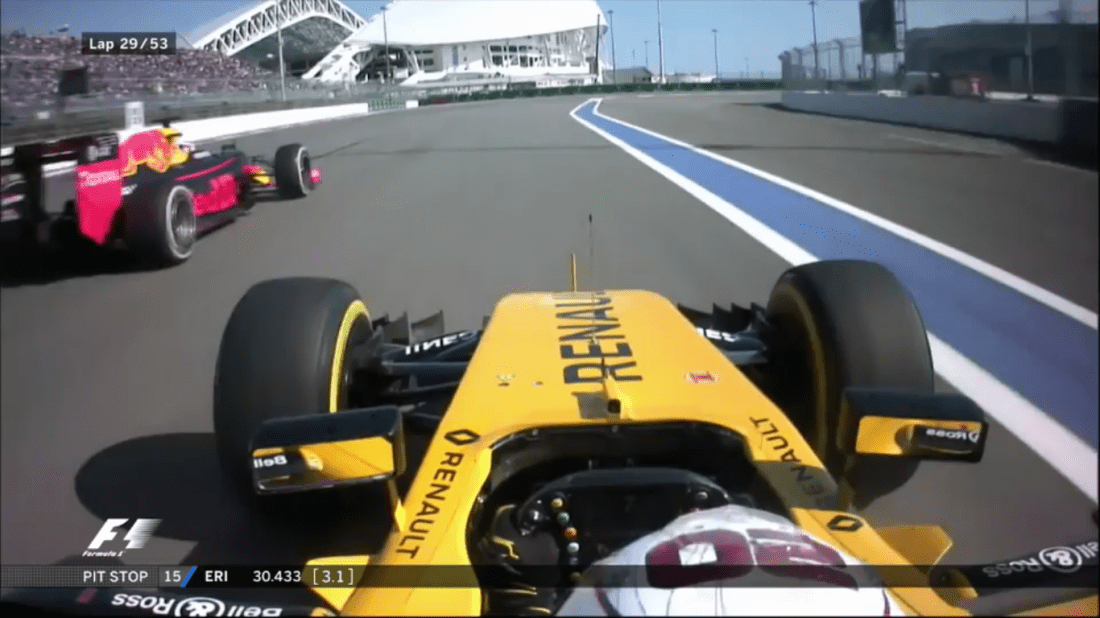
The second major change that will be noticed worldwide is the change to the T-camera. Probably the most well-known and used on-board camera, the introduction of a cockpit protection system (Halo, Aeroscreen or something else) means that the perspective this camera gives will be radically different. Unfortunately, we did not see any on-board cameras from Daniel Ricciardo’s car during his Aeroscreen demonstration during practice one at the Russian Grand Prix, but I’m hopeful we will see on-board shots in forthcoming races.
An Aeroscreen like solution does provide opportunities to bring in new camera angles. The most logical one is a camera looking back towards the driver, which should be closer than ever before. If you wanted to be clever, you could have a camera embedded within the Aeroscreen that rotates around the top rim. I’m sure there’s many more, but if Aeroscreen was made mandatory, there certainly are a lot of ways that FOM could try to use the system to get closer to the driver in the future.
…say hello to drones and virtual reality…
Before the 2017 season gets underway though, there is at least one new innovation we will see in Formula 1 this year. According to Joe Saward, the Italian Grand Prix will play host to drones, with the hope that it will “create better coverage”. I’m intrigued to see how this goes, although there are some very obvious safety aspects to take into account, as Saward himself mentions in the link above.
Elsewhere, 360 degree videos and virtual reality is the thing doing the rounds at the moment, in both Formula 1 and Formula E. 360 degree videos are not new though, and in fact have been around for several years, dating back to at least 2012. Nevertheless, Formula E has managed to get the jump on Formula 1 by offering 360 degree highlights of races from a selection of on-board camera angles. To my knowledge, we have not yet had 360 degree videos during an F1 race weekend, the closest we have come so far is this video from Sky’s virtual reality studio that was released in March.
Alongside Formula E’s 360-degree movement is the announcement that was made in March that the series has teamed up with Virtually Live, with the intention to broadcast races live in virtual reality in the near future. Virtually Live’s CEO Tom Impallomeni said: “Formula E aims to represent a vision for the future of the motor industry, serving as a framework for R&D around the electric vehicle, while Virtually Live is building a revolutionary, immersive virtual reality technology allowing everyone to experience the magic of live sports and events from anywhere in the world.”
…FOM and Dorna roll out new graphics
There have been some subtle graphical changes rolled out this season so far from FOM. Ignoring the elimination qualifying ‘countdown’ graphic that we will hopefully never see again, the main changes are around pit stops and tyre choices. The pit stop graphic is the most effective change, with added detail compared with 2015. There is more emphasis on tyre choices, which are embedded within the pit stop strip, as well as the stint length that the tyre lasted.

The tyre graphics as a whole have been tweaked out of necessity for the new tyre rules for the 2016 Formula One season. With three tyre compounds available, it means six possible options are available (new and used). FOM use a filled-in tyre to show that it is a new tyre at the start of the stint. An unfilled tyre, like the graphic above shows, means that some laps had already been completed on that tyre before the current stint started – in the case above with Hamilton, this would have been during qualifying.
I understand why FOM may have wanted to add the new and used aspect to the graphics, but, is the graphic useful if it has to be explained to casual viewers at every race? I’m not so certain. After a few laps a tyre is no longer new. This feels like over complexity to a degree. I like the graphic, I just wonder whether it was necessary though in the first place.
ESPN have taken a page out of FOM’s book with their new IndyCar graphics for the 2016 season. The graphics, only available to domestic viewers when ESPN are covering the action live, can be seen here. The graphic set uses a similar layout to historical IndyCar graphics but with a modern, flat look, bearing similarities to the graphics Formula 1 introduced at the beginning of 2015.

 Motorsport Broadcasting