RTL will cease broadcasting Formula 1 live at the end of the season, the German broadcaster has announced.
The broadcaster first showed live races between 1984 and 1988 and has done so continuously from 1991. In 2017 it renewed its deal with F1 to continue broadcasting until 2020.
Financial reasons lie behind the decision. In a statement, RTL’s Head of Sport, Manfred Loppe, announced on Sunday “When you have competitors in the game who are prepared to offer double as much as you can then you are forced into a position of having to withdraw.”
Loppe stressed that RTL “still obviously wants to try in the future to present attractive sporting events to our viewers. But it is clear that economic limits will play a role, as well as the changing competitive environment.”
“We have broadcast Formula 1 for over three decades with great love and passion, as well as with a plucky readiness for innovation and investment,” Loppe continued. “RTL will forever be associated with the most widely viewed, most emotional, unforgotten moments in the top motor racing series.”
In Germany viewers have had two choices for watching F1: either to pay a subscription to watch uninterrupted coverage on Sky or to watch free-to-air coverage on RTL with advert breaks.
Figures from Motorsport.com show that a peak of 5.26 million viewers tuned into RTL’s coverage of the Italian Grand Prix last year (a market share of 32.3%), whilst a further 450,000 viewers watched on Sky (2.8%). Over the course of the whole of last season RTL was able to secure average viewing figures of just over 4 million viewers.
The managing director of RTL, Jörg Graf, added “Competition for TV rights has changed and the market has in part overheated. As such it has extended beyond our ambitious, but at the same time economically justifiable, limits.”
In January 2020 the company announced it was expanding its football coverage by signing an agreement with UEFA to broadcast the Europa League and the newly created UEFA Europa Conference League from 2021.
Graf confirms that this is where focus for the broadcaster will now lie. “We will now with our power, passion and joy concentrate on football as our number one sport,” he said.
It remains unclear whether Germans will have access to free-to-air coverage going into the 2021 season or whether F1 will consider a model like the UK currently has, with all races airing live on pay TV, and the home race live on a free-to-air channel.
As Motorsport Broadcasting speculated in March, following an interview with RTL’s anchor Florian König, it remained unclear, especially in the current climate, whether RTL would extend its deal.
Today’s decision therefore does not come as a total surprise and is indicative of the changing F1 broadcasting landscape. König, long-standing pit-lane reporter Kai Ebel and the lead commentator Heiko Wasser have yet to react to the news as they now enter their final season of broadcasting live races for the Cologne company.
Ausstieg nach drei Jahrzehnten! Am Ende der @f1-Saison fahren wir in die Box und stellen den Motor ab. Eine einzigartige Ära im Free-TV geht dann zu Ende. Ab 2021 liegt unser Fokus ganz auf dem Fußball mit @DFB_Team und @EuropaLeague. https://t.co/0nWtJ4uJDl
Analysis – RTL’s decision gives us an insight into the road ahead
Any broadcaster opting not to renew a contract after 30 years is always a big story, and RTL’s decision to not renew their F1 contract falls into that category.
It is, however, not a major surprise.
Interest in Formula 1 in Germany has gradually declined since Michael Schumacher’s heyday in the mid-2000s, although viewing figures remained strong during Sebastian Vettel’s four championship victories.
Now, with Vettel heading out of Ferrari at the end of 2020, there is a distinct possibility that there will be no German drivers on the F1 grid in 2021.
Combine this with the ongoing COVID-19 pandemic presents the perfect storm. RTL, like all free-to-air broadcasters worldwide, will be looking to save money as advertising revenues slump.
The situation is like the one UK broadcaster ITV found themselves in back in 2008. ITV needed to save money following the worldwide financial crisis at that time, and prioritised football over F1, executing a get out clause in the latter’s contract.
RTL’s contract to broadcast F1 is expiring anyway at the end of this year, but the overall business direction from both is identical.
The COVID-19 pandemic means that, in my view, we are likely to see more pay TV deals moving forward. The motor sport industry right now needs money pumping into it, more than ever before, and the crisis has exasperated problems the industry had prior to the pandemic.
Free-to-air and five million viewers will only get you so far. Ask MotoGP for another UK equivalent.
In 2013, the series was struggling with Moto2 and Moto3. Faced with a choice, they brought pay TV broadcaster BT Sport into the fold, who outbid the BBC significantly in acquiring the UK television rights.
MotoGP went with BT Sport. Yes, the fans at the time may not have liked the decision (including me), but that move ensured many Moto2 and Moto3 teams could continue racing to ensure the wider eco system did not collapse.
The optics may not be as severe here, but fans should be prepared for a further move away from free-to-air, not towards as motor sport fights against COVID-19.
There is not one specific reason RTL has opted not to extend its F1 deal. But one thing is for sure: 2020 will mark the end of an era for F1 broadcasting in Germany.
Reporting by Edmund Wareham; analysis by David Nelson.
In a guest article for Motorsport Broadcasting, Edmund Wareham reports in from overseas again, giving insight on a recent podcast featuring RTL’s F1 reporter Kai Ebel. For those that missed Edmund’s first piece on RTL’s Florian König, head over here…
There are few F1 pitlane reporters who have rap songs written about them. But in 2010 the German rapper Eko Fresh produced Kai Ebel Style, in honour of the German TV legend that is Kai Ebel, renowned for his striking fashion sense and his exuberant interviewing style.
Following on from their interview with König, the German podcast Starting Grid caught up with Ebel, who would have been reporting on his 28th F1 season this year but instead is biding his time at home.
“I should have been coming back from Vietnam at this point, but instead I’ve just come in from my garden.” In the wide-ranging interview with Kevin Scheuren, Ebel discusses his long career in the pitlane, how he reacts to criticism and how he makes no apology for regarding F1 as entertainment.
Ebel’s entry into F1
As with König, Ebel studied sport’s journalism at the German Sport University in Cologne and in 1988 was able to secure a four-week internship at RTL during UEFA Euro 1988 which West Germany hosted.
In 1992 RTL lost coverage of the Bundesliga football rights and Ebel considered whether it was better to leave what he feared at the time could be a “sinking ship”, however their decision to ask him to join the channel’s F1 coverage swayed him otherwise.
Ebel admits that he was not a fan before (he uses the same phrase as König: “I didn’t have petrol in my blood”) and as with his on-screen colleague saw this as an advantage. “You don’t see the bigger picture as a fan. I could learn from a distance and then gradually get closer,” Ebel told the podcast.
When Ebel first joined RTL, he believes F1 teams underappreciated the value of the press and media. The media conducted post-race interviews in a mixed zone (like football), where broadcasters and journalists vied to get a word with a driver. Together with a group of other broadcasters, Ebel was a driving force behind the introduction of the more professionalised media pen.
1994
He also had the idea of introducing live interviews during the race from the pitlane, arguing that it could break the monotony of more boring races. RTL first introduced this at a weekend which still leaves a mark on Ebel. Over the course of his long career, Ebel has been present at some of the most important junctures of F1’s history, and none more so than Imola 1994.
Ebel recalls interviewing a “super worried” Ayrton Senna on Saturday, after Rubens Barrichello’s crash on Friday and Roland Ratzenberger’s fatal accident on Saturday.
On the Sunday, broadcasting live, “I just simply tried to function.” He tried to do as many interviews as possible. In his final task of the day, he had to appear on RTL’s evening news bulletin, and after the broadcast it sunk in what had happened. “I broke down and just cried. I was unbelievably battered,” Ebel said.
Over the course of 1994, as Schumacher chalked up victory after victory, viewing figures continued to rise, culminating in the “thriller” that was Adelaide 1994. Ebel believes over the course of the season Schumacher was a better driver than Damon Hill, but that he “committed a foul” to win the title that year.
Whilst Ebel remains good friends with Heinz-Harald Frentzen, his relationship with Schumacher was more functionable, calling it “respectful and reliable.” Ebel admired above all Schumacher’s hard work.
He recalls the 2000 Japanese Grand Prix, when Schumacher wrapped up his first title for Ferrari, and the newly crowned champion coming to the interview with a Bacardi and Coke. Wondering why Schumacher had yet to finish his drink, he explained “I have to go to my debrief.”
Dealing with criticism
Under YouTube videos featuring Ebel you will read a comment saying “Kai Ebel, you can’t be more stupid” with the reply underneath “there’s no one better.” Ebel is in many respects a polarising figure and openly admits that he is not your usual pit lane reporter. Over the course of his career he has faced a lot of criticism for the questions he asks and his unique style.
Boxing is Ebel’s favourite sport and he draws on the sport to explain how “factual criticism above the belt is absolutely OK but anything below, that’s not on.” But he accepts he has made mistakes.
In 1997 in Jerez, for example, he recognises in retrospect that he treated Schumacher too lightly after he had tried to ram Villeneuve off the track. Over time and with more experience he has learned to see criticism at more of a distance.
Despite opinions that he is not serious enough, Ebel makes no apologies for the fact that he regards F1 as a show. He remembers Bernie Ecclestone approaching him at the Nürburgring asking him to conduct podium interviews for the first time and demanding “entertainment. I do not want boring questions.”
Ebel loves meeting the celebrities who come to the grid, whether securing an exclusive interview with Usain Bolt thanks to a tip off from the head of Puma or boldly walking up to Al Pacino deep in conversation with Bernie.
Fashion and music
Ebel has also come under the spotlight for his fashion choices. Clothes have always been important to him so it was not his choice to have to wear race overalls in the pitlane following Jos Verstappen’s fire in Hockenheim 1994.
“I was just interviewing Mika Häkkinen and in the middle of the interview his eyes just dilate in this horrified way and he walks away,” Ebel recalls. “You think: the question can’t have been that bad! What was up? Behind me Jos Verstappen’s Benetton had just burst into flames.”
The gallery on Ebel’s website gives just a small insight into some of the very colourful shirts, shoes and ties that Ebel has worn over the years. Eddie Jordan pales into insignificance.
Music has been another important part of Ebel’s life and another way in which his profile has been beyond the pitlane. In 2004, Ebel made a guest appearance in the music video of the song Runaway by the band Groove Coverage. Four years later he made his debut as a singer, releasing Sie schrei’n Ebel, a song which originated as a bit of fun but which his bosses wanted to promote.
Whilst his musical career never had the same longevity as his time in the pitlane, the sense of fun which Ebel brings to his role is palpable. Whatever one’s views, there is no denying that he brings colour, energy, and humour to a sport which from the outside could be seen as sanitised.
Behind that is his dedication to the job and desire to convey some of the excitement of the F1 paddock back home to viewers. He has been at the forefront of a pivotal period in the sport’s history. “I find the whole job a privilege,” he says.
Fancy contributing to Motorsport Broadcasting? Head over here for further details…
Over the past 50 years, many voices have graced the small screen to broadcast Formula 1 to the masses in a wide range of territories: from the UK to the US, from free-to-air to pay TV and beyond.
But how many would make Motorsport Broadcasting’s on-air team, and why? To answer that question is incredibly difficult, when trying to account for the different eras, the different broadcasters, the age of the talent in question, and so on.
The fan that ITV was trying to attract in the late 1990s may be different to the fan Sky is currently trying to attract to their offering.
As part of the selection process, I am assuming that age is not a factor, that time has no bounds, alive or deceased.
The cast assembled in my opinion brings together the best of the BBC, Channel 4, ITV and Sky Sports into a super team, with a few surprises thrown in for good measure. Think of it as my version of the Avengers, for use of a better term!
Of course, this is all judgemental (I admit to being openly biased for the next 2,000 words) and that there is no right or wrong answer to this question. The line-up comprises of:
2 x presenters
3 x analysts
2 x pit lane reporters
2 x technical reporters
2 x commentators
So, who is in, and who is out? Revealed, Motorsport Broadcasting’s dream F1 presentation team…
Presenters
Every good on-air presentation team needs a presenter to fit the bill. For me, watching Formula 1, there are two presenters that brought warmth with them whenever presenting the sport.
First up, the BBC’s Formula 1 presenter from 2009 to 2012, Jake Humphrey. Humphrey worked his way through the BBC ranks, from children’s television into BBC Sport, and eventually onto BBC F1 for the start of F1’s return to the Beeb in 2009.
Humphrey’s style was a departure from his predecessors Jim Rosenthal and Steve Rider on ITV. Both Rosenthal and Rider are excellent, top-tier presenters, but Humphrey brought with him an additional element. During that period, it felt like Humphrey was one of us: a fan who happened to be living the dream as F1 presenter.
In my view, Humphrey helped bring us closer to the sport that we love, thanks to his presenting style, bouncing off his co-presenters where necessary.
Alongside Humphrey anchoring the show is Georgie Ainslee (nee. Thompson). Ainslee has been round the motoring circles for years, having been part of Sky’s A1 Grand Prix coverage in the mid-2000s.
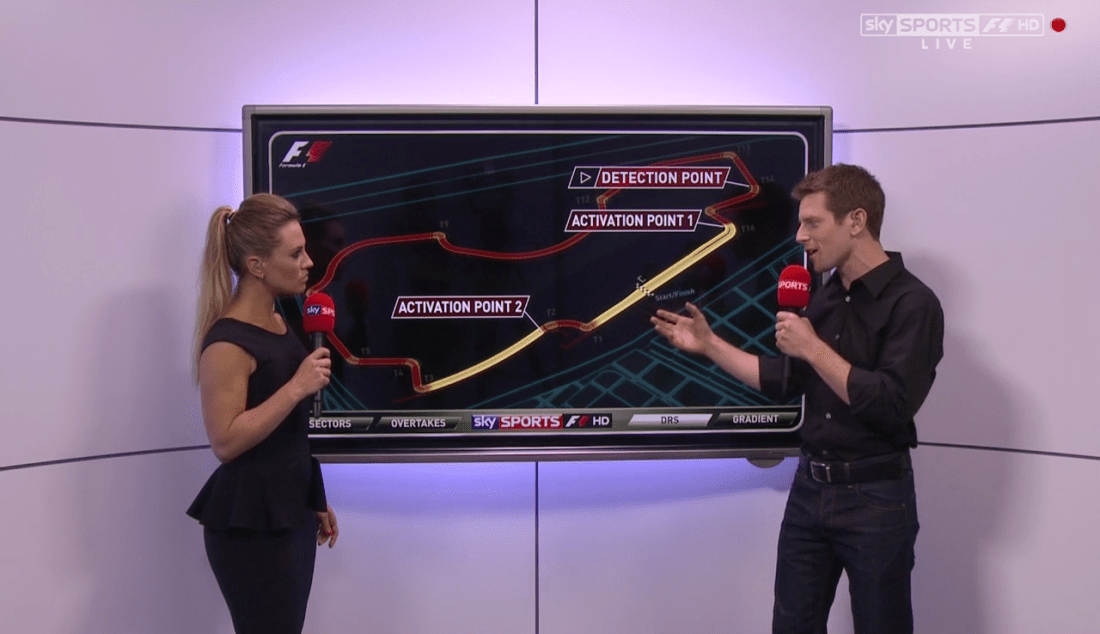
Georgie Thompson and Anthony Davidson analyse the action on the Sky Pad, during Sky’s inaugural race weekend in 2012.
Ainslee was part of Sky’s F1 coverage in 2012, presenting elements of their programming including The F1 Show, but quietly left prior to the 2013 season, with reports at the time suggesting that she wanted a bigger role within the team.
One presenter anchoring the entire weekend is too much, so having two presenters in equal capacity feels the best way to handle the situation.
Back in 2012, I really enjoyed Ainslee’s Sky Pad contributions with Anthony Davidson, and it is unfortunate that she left in the manner that she did, considering she was one of the better parts of Sky’s offering in their inaugural season.
Analysts
This is where the choices get tough, given that there is a plethora of personalities to choose from spanning across the BBC, Sky, Channel 4, and ITV. Narrowing the choices down to three or four stars, past and present, is an extremely difficult challenge. But hey, we did say that this is a dream team.
All three of my choices are natural broadcasters, and all three were part of Sky’s Formula 1 line-up last season. We start with Martin Brundle, 2020 marking his 24th season on the microphone in the commentary box.
Brundle could double up as a third co-commentator, although this piece for brevity keeps Brundle primarily in an analytical role. Alongside Brundle are Sky colleagues Anthony Davidson and Jenson Button, both of whom have shown why they are worthy of being in a dream team in recent years.
Davidson’s broadcasting life started in 2008 alongside David Croft in the BBC Radio 5 Live commentary box, moving over to Sky for the start of their coverage in 2012.
Button joined Sky for five races last year. The thing that lets Sky down is that both Davidson and Button appear on-screen too infrequently across the season, but that is a wider issue surrounding the number of races as opposed to a Sky-specific problem.
On the Sky Pad, Davidson is a wizard, whilst Button has the same characteristics as Humphrey from a broadcasting perspective: a warm style, and a down to earth personality.
If you are looking for entertaining features, maybe this is not the trio for you, it really depends what you are after from a programming perspective.
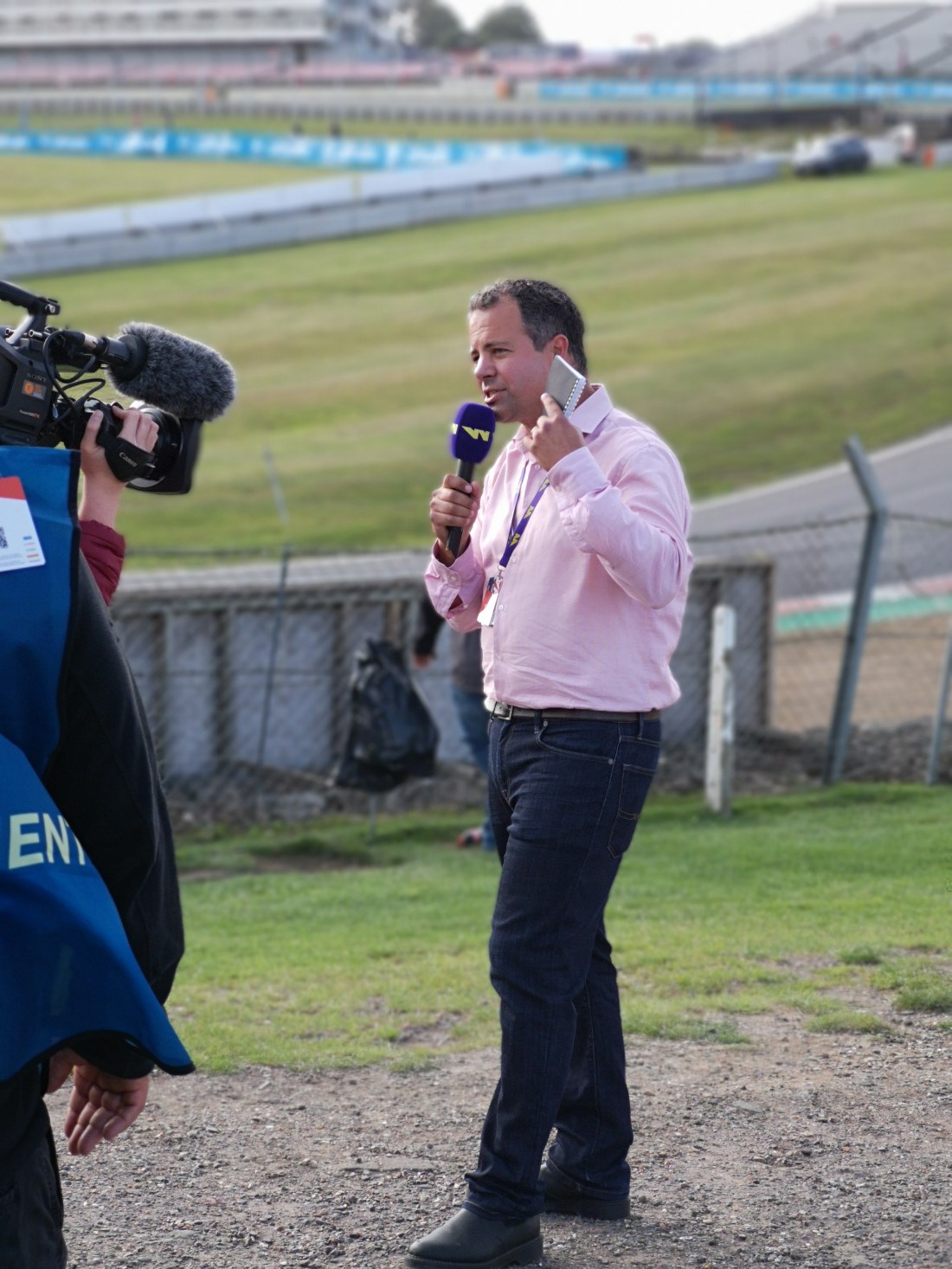
Ted Kravitz dissects the W Series action during his Notebook segment.
For me, I want analysts who live and breathe F1, who know it like the back of their hand, and can articulate their knowledge back to the viewer at home in a digestible manner. Brundle, Button and Davidson tick those boxes for me.
Missing out by small margins are Mark Webber, Karun Chandhok and Allan McNish. On a different year in history, the choice may be different.
Also, it is worth bearing in mind that I am looking at this from a UK broadcasting perspective, so opinions may vary depending on where you are based.
Pitlane
Roving the pit lane are two faces, one of whom has never appeared in an official F1 capacity for a UK broadcaster, either through choice or because they overlooked him at every opportunity.
Enter Will Buxton. Currently Formula 1’s digital presenter, Buxton first made a name on the F1 broadcasting scene as GP2 and GP3 lead commentator. More recently, fans stateside heard Buxton’s voice during both Speed’s and NBC’s coverage of the sport from 2010 to 2017.
Despite being around the sport for nearly twenty years, Buxton has never worked in an F1 capacity for Sky, Channel 4, the BBC or ITV at their respective times. UK’s loss was America’s gain over the past decade.
During NBC’s coverage, Buxton and producer Jason Swales hosted several behind the scenes documentaries on the sport, including the ‘Road to…’ series, which was well received by fans.
Joining Buxton is Channel 4’s Lee McKenzie, who has been part of the UK’s free-to-air F1 output since 2009, grilling the drivers on a variety of topics.
Outside of the small screen, both McKenzie and Buxton are brilliant journalists in their own right, both with a unique ability to get the best out of their interviewee on any given occasion: whether in a pre-race vignette, or during the post-race media pen interviews.
You might think two reporters in pit lane and beyond is excessive. But remember, F1 consists of ten teams, 20 drivers, and hundreds of people that help bring the show to life. It is Buxton and McKenzie that get beneath the skin of the sport, helping to tell the stories that may otherwise go unnoticed.
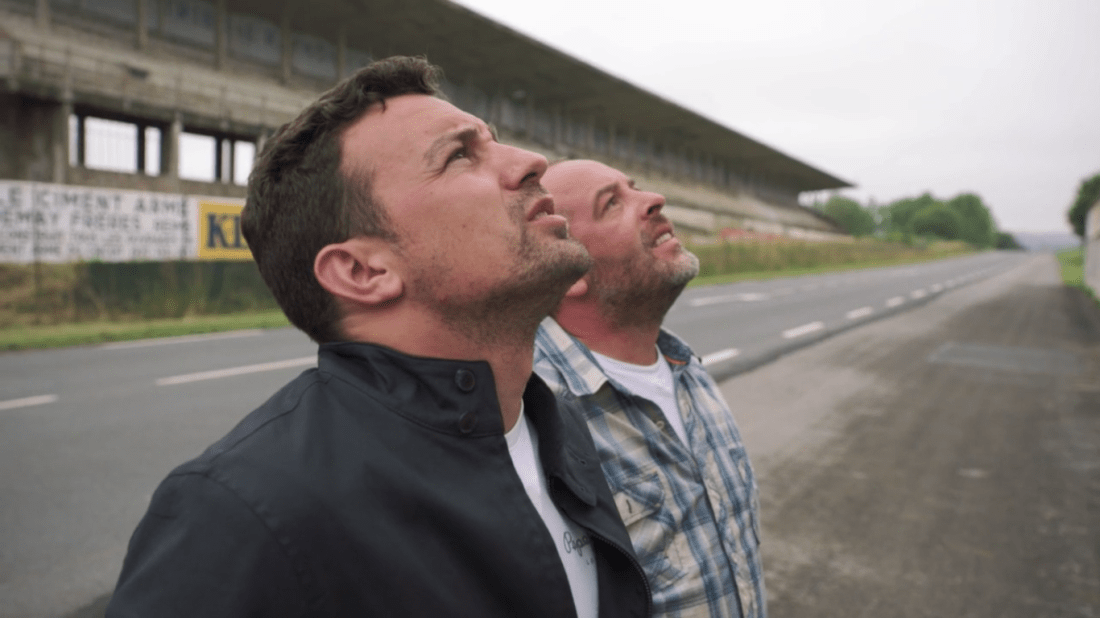
Will Buxton and Jason Swales at Reims for the Road to Mercedes documentary.
Technical
On the technical side, Ted Kravitz leads the output, having been part of the broadcasting scene since the 1990s. Kravitz moved to ITV’s F1 on-air team in a full-time capacity following Murray Walker’s retirement, staying in that role until 2008.
Kravitz moved with F1 to the BBC in 2009, and then again to Sky in 2012, where he has remained ever since, narrowly avoiding the chop from their team prior to the 2019 season. Well-liked by fans, Kravitz’s Notebook has been a fixture of Sky’s F1 coverage since its inception, along with the Development Corner segment.
What Kravitz has never had though, is a good wing man in the technical space, someone to bounce off from time to time. And that is where the second technical expert comes in the form of Craig Scarborough.
With the resources that he has, Scarborough does a great job dissecting the technical innovations across social media, sometimes with Peter Windsor in toe. Both were dropped by Motorsport Network in the latter half of 2018 as part of their cost-cutting exercise at the time.
I suspect no UK broadcaster has ever picked Scarborough up because he has never worked with in an F1 team as technical expert, unlike the likes of Gary Anderson, who was part of the BBC’s F1 offering in 2013 and 2014 before they dropped him.
Nevertheless, if you want an all rounded team that covers both the human element and technical element in equal detail, then you need two technical experts, and Kravitz and Scarborough are the two for me.
Commentators
The beauty of having a broadcasting dream team is that there is no right, or wrong, answer. I started watching Formula 1 in 1999, so caught the later years of Murray Walker‘s commentary.
I met Walker twice: once at a book signing back in 2002, and more recently at Channel 4’s Formula 1 launch in 2016. And, thanks to the internet, many classic races feature his commentary.
“And it’s Go! Go! Go!”
“Three point three six seconds! Damon Hill wins the Japanese Grand Prix!”
“And he exits the final corner for the fifty-third and last time, to win the 2000 Japanese Grand Prix, and the World Championship, for the third time!”
Commentary lines such as these will live on in Formula 1’s history. And it is for that reason that Murray, and his Murray-isms, feature in my dream team. Yes, Walker made mistakes.
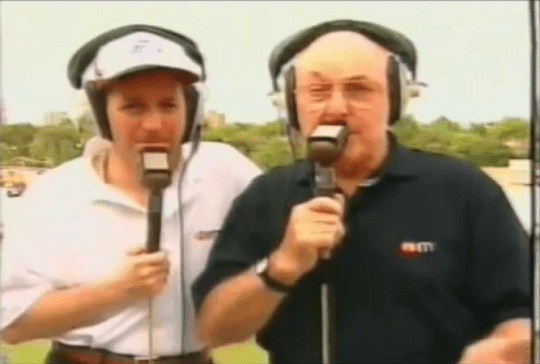
Martin Brundle and Murray Walker on the balcony during ITV’s coverage of the 1997 Australian Grand Prix qualifying session.
But, if I had a choice between a commentator that could make paint dry sound exciting, with a few mistakes here and there, or someone who struggled to capture the excitement that F1 brings, it is the former all day long.
To put it simply, Walker’s voice is infectious, and we are lucky that he stayed in the commentary box for as long as he did. Walker will always be F1 to me, and for a whole generation of fans in their late 20s and onwards.
On the other side, one of Walker’s colleagues left this arena far earlier than they should have. James Hunt passed away at the age of 45 in 1993, days after commentating on the Canadian Grand Prix. Had Hunt opted to retire at the same age as Walker, Hunt would still be commentating on F1 today at the age of 72.
I was too young to watch Hunt’s commentary live – I had not even turned one when Hunt passed away. But what I do know is that Hunt in the commentary box was passionate about the racing that was unfolding in front of him, telling it how it was.
It is a testament to the relationship between Hunt and Walker that the pairing lasted 13 years, from 1979 until Hunt’s untimely death.
In a parallel universe, Hunt would have been commentating alongside Walker for many years to come, but alas, it was not too be. In a dream broadcasting line-up, both Hunt and Brundle would be part of that team (clearly, I am bending the rules in the name of fun).
If time had no bounds, this is Motorsport Broadcasting’s dream F1 presentation team:
Presenter: Georgie Ainslee
Presenter: Jake Humphrey
Commentator: James Hunt
Commentator: Murray Walker
Analyst: Anthony Davidson
Analyst: Jenson Button
Analyst: Martin Brundle
Pitlane: Lee McKenzie
Pitlane: Will Buxton
Technical: Craig Scarborough
Technical: Ted Kravitz
Like with any team, whether the eleven would blend together on-screen is a different question, in the same way that two world class drivers in the best team may go pear shaped.
You want a line-up that is flexible. You do not want a commentator that just commentates, or a technical expert that cannot interview drivers. In the scenario above, Walker would still interview drivers, and Brundle could still commentate, for sake of argument.
Notable by their omission are David Coulthard and Eddie Jordan, amongst other high calibre candidates, which shows how difficult it is to select a dream team cutting across different eras. Had I been focusing on current generation only, then Coulthard and Jordan may well have made the cut.
To bring gravitas to the production is Channel 4’s F1 producer Whisper, but with backing from Sky Sports. Sky bring with them the Sky Pad, the paddock stage set up, as well as the extensive air-time, whilst Whisper bring with them some excellent VTs and a graphics package that is second to none. The best of both worlds, in my view.
And that is my dream Formula 1 broadcasting line-up. What is yours? Have your say and debate the question in the comments below.
Fancy contributing to Motorsport Broadcasting? Head over here for further details…
In a guest article for Motorsport Broadcasting, Edmund Wareham reports in from overseas, giving the low-down on a recent insightful podcast featuring RTL’s F1 presenter Florian König, as well as his own thoughts on RTL’s F1 offering in Germany…
One of the few benefits of the current crisis is that those who would normally be crisscrossing the world with the F1 circus now have the time on their hands to discuss their experience in the paddock. The good folk of Starting Grid, a German F1 podcast, were recently able to sit down with Florian König, the moderator of RTL’s F1 coverage, and chat for almost two hours about his time behind the microphone.
Starting Grid is a podcast on the meinsportpodcast.de platform, moderated by Kevin Scheuren and Ole Waschkau, in partnership with Christian Nimmervoll, chief editor of Motorsport-Total.com and Formel1.de. I can highly recommend the podcast for anyone who speaks German (and even those who are learning!), not least for the in-depth way in which they tackle topics.
British viewers may well be familiar with RTL’s F1 coverage through Kai Ebel, the channel’s pit lane reporter and interviewer, who has conducted podium interviews and whose sartorial choices rival that of Eddie Jordan. Florian König is presumably less well known in the UK but vital for what he describes as the “well-oiled machine” that is RTL’s coverage.
I thought it would be interesting for readers of this site to pull out some key headlines from König’s interview and consider the F1 broadcasting perspective from the German point of view. I watch F1 in the UK (Channel 4 at home or Sky in the pub) but always watched RTL’s coverage when I lived in Germany for a couple of years and when I still visit the country.
König’s Relationship with Lauda
König began his broadcasting career for Süddeutscher Rundfunk, a radio and television station based in Stuttgart, reporting on the Bundesliga, the Barcelona Olympics and the 1993 World Athletics Championships. In 1994, König moved to RTL, becoming the moderator of their F1 coverage two years later, during the rise of one Michael Schumacher.
Speaking on the Starting Grid podcast König admits that, despite watching the odd race before, he was never an F1 fan, much preferring to watch football, but argues that this distance gave him a certain advantage in his role as presenter.
“It wasn’t just F1 fans, insiders and specialists who sat in front of their screen to watch RTL,” he says. “The sport before Schumacher wasn’t a mass phenomenon in Germany, so it wasn’t actually all that bad to have someone with a significant role who could give the viewing public a voice, to ask questions which people at home might also ask.”
Triple F1 champion Niki Lauda joined König on-screen from 1996 until 2017 and some of the most interesting parts of the interview concern König’s relationship with the Austrian. Lauda’s forthright opinions and extensive contacts across the whole paddock made for excellent viewing.
Their partnership was not without its challenges, from Lauda running away to catch a flight before a RTL broadcast ended, to a controversial moment in May 2010 at the Monaco Grand Prix.
Lauda called Robert Kubica a “polack” (an ethnic slur for Polish people) live on-air and maintained that the term was not derogatory in Austria. König challenged him directly in the broadcast and hurriedly had to cut to a feature with Ebel. At the behest of RTL, Lauda later apologised to Kubica.
Controversy notwithstanding, there was an obvious chemistry and understanding between the two. König says that it was “an absolute gift” to work with him.
“He was so clear. He always said what he thought. Of course, on the next day he always thought something different and would then say so,” König retells. When König asked Lauda how they imagined things would work between them, Lauda put it simply: “You ask the questions, I’ll answer them.”
In 2017, to the shock of König who had no inkling of what was to come, Lauda announced live on air that he would no longer be part of RTL’s coverage. “That was first a surprise, secondly live, thirdly emotional. That was really intense. That was very Niki,” he says.
Schumi TV?
Around the turn of the millennium, an average of ten million viewers per race were watching RTL’s coverage, thanks to the raised profile of the sport in Germany through Schumacher’s domination. Fans dubbed RTL ‘Schumi-TV’ in this era, something König openly and honestly admits would be different today.
“In retrospect, if I may say so, we concentrated insanely on Schumacher,” König tells the podcast. “We were intoxicated by his success and the very high viewing figures so that we didn’t question our approach. We would do it a bit differently today.”
König is critical of the way RTL presented Schumacher’s championship rivals on-screen, especially Damon Hill.
“We didn’t report enough on the other drivers and we weren’t fair about his competitors. Naturally Damon was the antagonist, the baddie. That was the narrative of the time, we reported in a very black and white way. That is how it was then and the state of things.”
But at the same time, he argues that RTL’s coverage was driven to a large extent by what people wanted to see, noting how RTL treated Schumacher’s other championship rival Mika Häkkinen much more favourably, in part because of his exposure on German TV in adverts for companies such as Mercedes-Benz.
The changing relationship between drivers and broadcasters
Pictures on König’s personal website show him first broadcasting from the paddock in jacket and tie but now, as seems de rigueur with sports’ presenters, it is the open neck shirt look. Fashion trends aside, over the course of 25 years covering the sport, König is in an excellent position to see how it has developed from a broadcasting point of view.
When König first started with the channel, only a handful of races aired live on location, with all other programmes filmed in the studio in Cologne, before switching in the early 2000s to circuit-based presentation.
Nowadays, production, editing, and sound mixing all happen back in Cologne, meaning the size of the team having to be on site at races has become markedly reduced from the sixty or so people who used to travel.
König’s first task for RTL in the F1 arena was to produce a feature on Heinz-Harald Frentzen at the 1995 French Grand Prix. In the podcast, König recalls spending the whole day pacing the Magny-Cours paddock hoping to catch a word with the Sauber driver, at time when there were not even dedicated press schedules.
In the intervening years relationships between teams and broadcasters have become far more professionalised. Whilst this obviously makes planning things easier, he does feel that the human element has become lost, such as joining other German journalists in drinking schnapps and singing songs with Norbert Haug after a race.
As with many broadcasters one of the aspects he most enjoys is forty minutes before lights-out and the unscripted pre-race grid walk. “It’s a challenge, but it’s what makes the programme so fun,” he says. While there are several German speakers in the paddock (Verstappen, for example, conducts interviews in German), there is the further demand placed on broadcasters of having to ask many of their questions in English.
The Future of F1 in Germany – and a future for RTL?
F1 in Germany faces its challenges and, with the retirement of Nico Hülkenberg last year, Sebastian Vettel remains the only German driver on the grid. The 2020 season also sees no race in Germany. But König says that viewing figures remain healthy with around four million viewers tuning in, especially with the much greater choice that is now available to viewers, which just was not the case when he first started out covering the sport.
In Germany viewers have two choices: either to pay a subscription to watch uninterrupted coverage on Sky or to watch free-to-air coverage on RTL with advert breaks. Figures from Motorsport.com show that a peak of 5.26 million viewers tuned into RTL’s coverage of Monza last year (a market share of 32.3%), whilst a further 450,000 viewers watched on Sky (2.8%).
The adverts breaks and constant competition plugs are obviously frustrating and remind this writer of the ITV days, but the figures demonstrate, especially when seen in comparison to the UK, that watching the event live has an obvious pull.
F1’s current deal with RTL was signed at the end of 2017 and runs until 2020. On F1’s future with RTL from 2021 König won’t be drawn and only says that “RTL would like to keep F1.” It will be interesting to see how the disruption of this season affects the negotiation of rights going into 2021 and whether König will be on Germany’s F1 screens in the future.
König, a self-styled “great friend of this sport” has done much over the last twenty-five years to promote F1 in Germany in his professional, down-to-earth, and articulate manner. As we await with uncertainty whether we will see any F1 this season, it is good to have these sorts of high-quality podcasts with their interesting insights available so that, in the words of the podcast Starting Grid’s slogan, we can “Keep Racing!”
Thank you to them above all for putting together such a wide-ranging and insightful interview.
Fancy contributing to Motorsport Broadcasting? Head over here for further details…
The coronavirus pandemic is disrupting motor sport in a way we have never seen before, impacting everyone involved in sport.
Collectively, the entire industry stands to lose a significant sum of money, and what the future holds is unclear. The longer this goes on, the worse the financial situation becomes, notwithstanding the fact that a global recession is likely because of the pandemic.
Who are the key players, and what are their role in the overarching ecosystem that is motor sport? Being a broadcasting site, naturally the focus is on broadcasting, although there is heavy linkage between broadcasting and the wider motor sport economy.
Speaking at the Black Book Motorsport Forum last September, Sky’s Head of Formula 1 Scott Young spoke about the delicacies of the ecosystem in a conversation around over-the-top broadcasting and pay television.
“Our investment is significant as one of the one of the investments that underpins F1, as all our rights do in every sport,” explained Young.
“I think that’s one of the differences between an OTT platform right now and major sporting broadcasters, like Sky and Eurosport, that actually invest a large amount of money that goes into those sports of which they need to help fund the teams to compete.”
“There’s an ecosystem in there that is quite delicate, and if you unravel it too quickly it can have some lasting effects,” he said.
Young quite clearly encapsulates the key themes of the ecosystem: the broadcasters, the rights holder, and the teams. If the system changes too quickly, the consequences could be catastrophic.
Coronavirus creates a gap in the chamber. The flow of money into the sport stops, meaning that money cannot flow back out the other end easily.
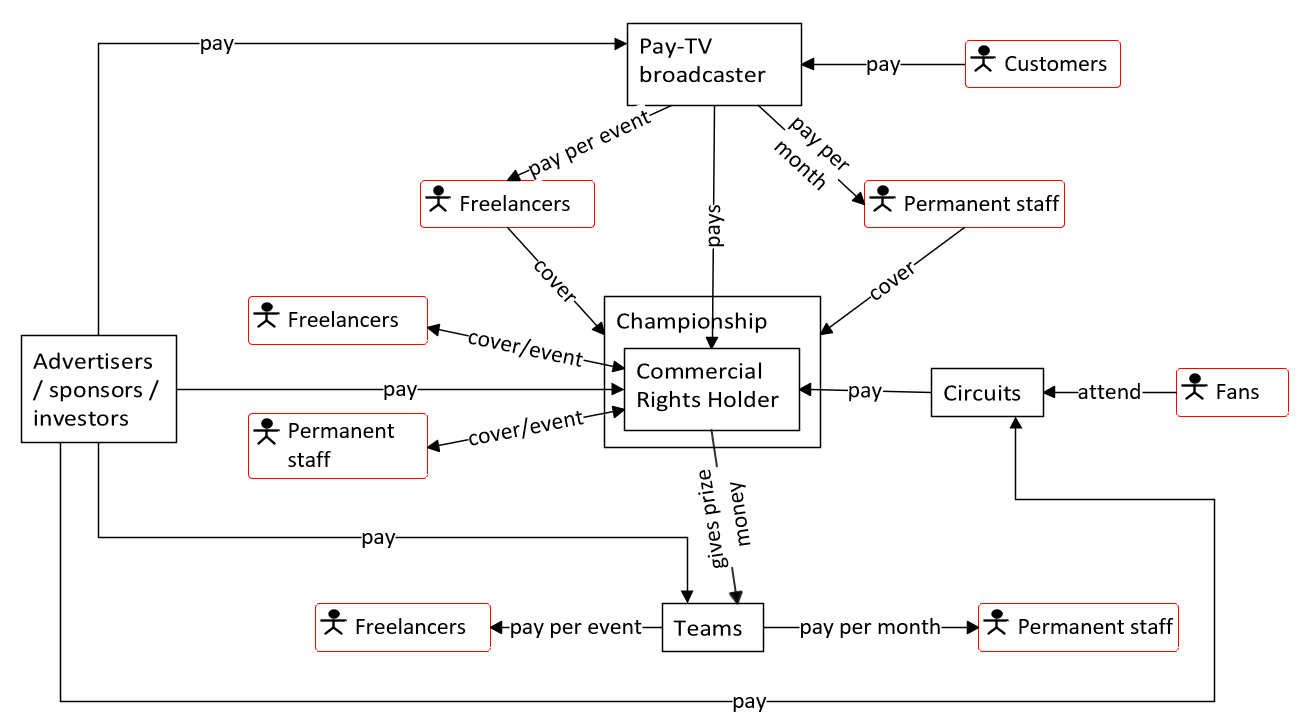
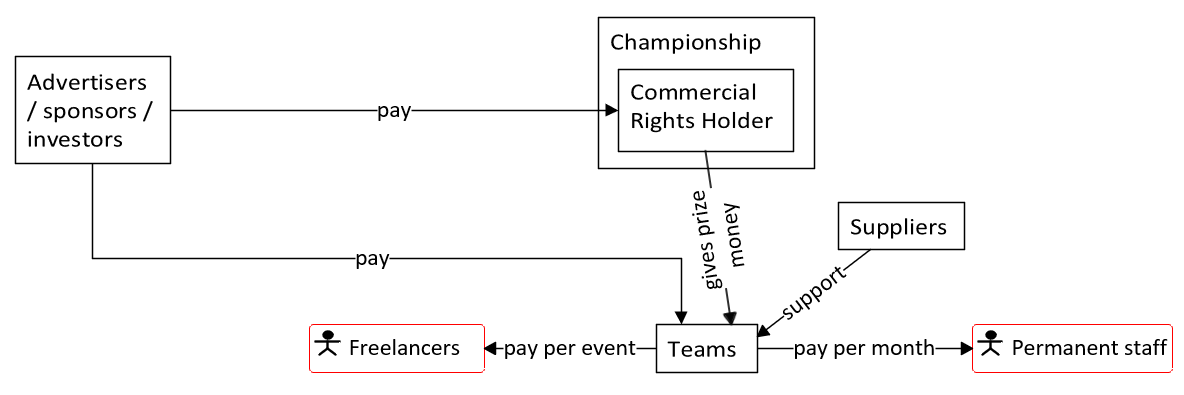
Who are the parties involved, and what are their roles? Let the below diagram explain, using Formula 1 and MotoGP as the key examples…
A simplified view of the motor sport ecosystem.
Much of the above is stating the obvious, however it shows how the ecosystem joins up from one segment to another, from the customer paying the pay TV broadcaster their monthly subscription, all the way through to teams paying their staff.
The diagram is, I admit, a simplistic view of the landscape, but hopefully helps to show how some of the basic activities connect. There are many more inputs and outputs, the diagram only covers the main ones (although if you feel there is a major gap, please shout).
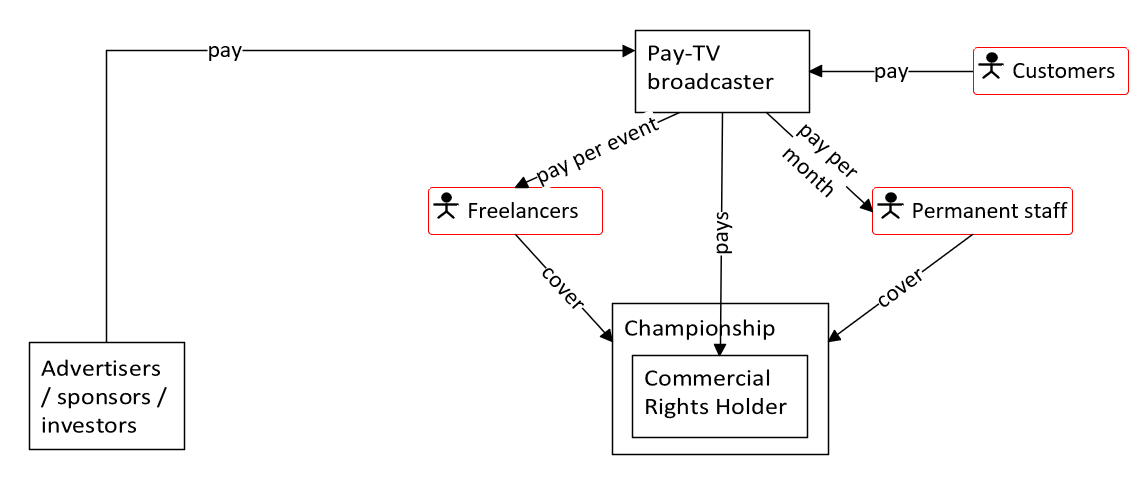
A simplified view of the motor sport ecosystem (branch 1).
Branch 1 – Pay TV > Commercial Rights Holder Pay-TV broadcasters receive income from both their customers monthly, as well as from advertisers / sponsors who want to advertise during their programming. Not all motor sports air on pay-TV, but overall, that is the way.
Some have suggested that UK’s pay-TV broadcasters BT and Sky should refund subscribers of their sports channels during the coronavirus outbreak, however neither are planning to do so currently.
The income pay-TV broadcasters receive allows them to broadcast prestigious events, the broadcaster paying the relevant Commercial Rights Holder an agreed amount each season.
For MotoGP, the Commercial Rights Holder is Dorna, for F1 it is Formula One Management, for World Rally Championship it is WRC Promoter, and so on.
To attract subscribers, pay-TV broadcasters want to utilise the best talent, on and off-screen. For that, they use a hybrid of permanent in-house staff and freelancers.
Both bring their benefits: being a permanent member of staff gives you added security with a regular pay packet, but makes it unlikely that you can work on events not aired on their outlet.
Freelancers on the other hand may work F1 one weekend, MotoGP the next, and then Formula E the weekend after, each paid on a standalone basis. Three different broadcasters and production teams, but not a problem. That approach brings risks: any cancellation will result in a loss of income.
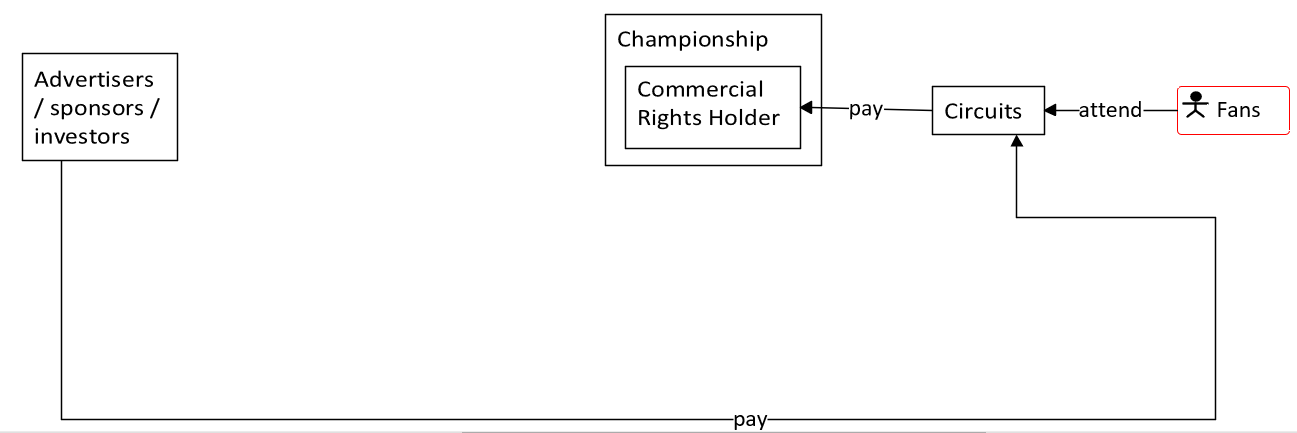
A simplified view of the motor sport ecosystem (branch 2).
Branch 2 – Circuit > Commercial Rights Holder The second area is simpler. Fans pay money to attend the circuit to watch a race, the circuit pays the Commercial Rights Holder the fee for holding the race. Investors and sponsors may pump money into the circuit to improve facilities, increasing the prospects of holding major events there.
It sounds simple, until someone cancels the race, which is where the legal complications come in. Mark Hughes over on The Race summarises the situation in relation to the cancellation of the Australian Grand Prix.
In the event of the cancellation of a race, someone will lose money. Opting not to refund the fans is an untenable option. The organisers refund the fans, in which case the organisers lose money. Unless the Commercial Rights Holder waives the fee and takes the financial hit.
The worst-case scenario for a circuit is that they lose so much money, they go into administration and liquidation.
Circuits need money to keep operating outside of the F1 and MotoGP race weekends, they need to pay their own employees (not labelled in the diagram) to give one example. In the UK, the Rockingham Motor Speedway closed in 2018 after financial issues.
Cancelling one race might be okay, but would be enough to disturb the cashflow of the circuit. What happens though, if the Commercial Rights Holder opted to take the hit, saving the circuit, but putting themselves at jeopardy?
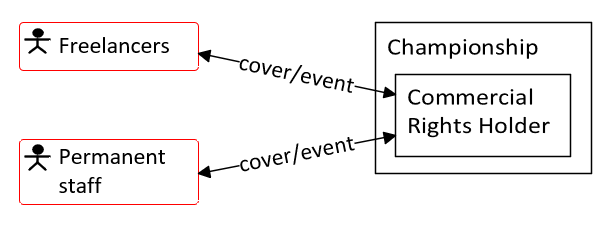
A simplified view of the motor sport ecosystem (branch 3).
Branch 3 – Commercial Right Holder > Staff Like the pay-TV scenario above, the Commercial Rights Holder will pay people to run the World Feed for them all the weekend, both freelancers and permanent staff. The talent varies: from directors, to vision mixers, to replay operators, to camera operators, the list is never ending.
F1 has a mixture of freelance talent and permanent talent, same as above. Same positives, same negatives, same risks.
A simplified view of the motor sport ecosystem (branch 4).
Branch 4 – Commercial Rights Holder > Teams As well as receiving money off pay-TV broadcasters and circuits, the Commercial Rights Holder will receive money off advertisers, sponsors and investors, the Rolex’s of this world.
Pay-TV broadcasters may want compensation off the Commercial Rights Holder if races fall by the wayside, and the same applies for advertisers, whilst circuits may want their fees lowered.
If organisers cancel one race, most championships would be able to deal with it, however when multiple races disappear, the problem amplifies.
For hypothetical sake, assume the Commercial Rights Holder has buckled in the event of cancellation. They have waived the circuit race fee and given both advertisers and pay-TV companies some compensation. Unlikely, but let us continue the worst-case path.
But, hang on. The Commercial Rights Holder needs to the pay the teams their prize money, right? Well, yes. Oh. But, the Commercial Rights Holder has already lost money? Again, yes.
“Okay then, we will not give teams their prize money.” Good luck with that one.
Teams need to pay their permanent staff and freelancers, as well as suppliers, and need some form of income from both the Commercial Rights Holder and sponsors.
Suppliers are important here. Motor sport relies on thousands of small to medium-sized employers worldwide that rarely gets a mention. If any one of those suppliers go under, that could impact the team’s ability to go racing. Suddenly, we have a major problem…
The likes of Mercedes, Ferrari, Repsol Honda, will survive with minimal disruption. The likes of Williams in F1, and many outfits in MotoGP, Moto2 and Moto3, all the way down the motor sport pyramid I worry about.
I worry about the freelancers, inside and outside of broadcasting, who are out of work for at least the next month. I worry about championships who struggle to make a profit each year.
I appreciate this is a simplistic view of the world, and does not account for all factors (there are many indirect lines excluded).
The point I am getting at though is that the motor sport ecosystem will be seriously tested over the next few months, and the potential longer-term consequences for this sport do not bear thinking about…

 Motorsport Broadcasting