Scott Young is to leave his role as Sky’s Head of Formula 1 after a three year stint with the broadcaster, Motorsport Broadcasting can reveal.
The Australian was a major part of motor sport broadcasting down under for three decades, playing a pivotal role in the V8 Supercars offering at the time.
Young joined Sky following the retirement of Martin Turner in late 2017. Since then, Young has helped Sky navigate the past two Formula 1 seasons, as well as the ongoing COVID-19 pandemic.
At times, Young’s decision making has attracted criticism, however under Young’s leadership, Sky have also brought the likes of 2009 Drivers’ Champion Jenson Button and Karun Chandhok into the F1 line-up.
I understand that Young is to leave Sky following the conclusion of the European season. Whether Young has opted to return to Australia, or move to another company within the F1 sphere, is currently unclear.
Relationship between F1 and Sky
Speaking publicly at the Black Book Motorsport Forum last August, Young denied suggestions that Sky’s relationship with F1 had become ‘strained’ in recent times.
At the time, Young said, “The relationship hasn’t improved because they have not strained,” Young said. “We have an extraordinary relationship with every aspect within Formula 1, including the 10 teams and the 20 drivers. And without that relationship we can’t create a narrative.”
“There’s a daily dialogue that goes back and forth between Sky Sports Formula 1 and the team at Biggin Hill, at a granular level of making television, and the team at St James’s Market on an executive level,” he added.
“Whenever they call us seeking content that they like, we always share it. They’re always very good in providing us content or footage that we need to produce our story.”
Since then, the two parties have been working together on a film to commemorate F1’s 70th anniversary.
Sources suggest this has not gone as well as anticipated, evidenced by the lack of reference to the documentary by F1 themselves across social media, with only a passing mention on Sky’s own social feeds.
Update on May 31st at 16:25 – In response to a request for comment from Motorsport Broadcasting, Sky Sports Managing Director Rob Webster said “Scott Young has made a huge impact on our F1 coverage and helped drive the team forward since joining at the start of 2018.”
“He will be with us to lead the F1 team through the restart of the season and through the European races before moving on to a new challenge. He goes with our best wishes and thanks for everything he has done during three seasons of F1.”
One of the two races that Formula 1 is set to hold at Silverstone this season looks likely to air exclusively live on pay television, Motorsport Broadcasting can reveal.
The ongoing COVID-19 pandemic has resulted in the curtailment of the first half of the 2020 season, with the season now expected to begin with a double header in Austria on July 5th and July 12th.
Current plans indicate that Silverstone will play host to rounds three and four on July 26th and August 2nd, circuit bosses confirming today that F1 had reached a deal with the circuit “to host two races behind closed doors this summer.”
However, it appears unlikely that both races will air live on free-to-air television. Since 2012, the free-to-air broadcaster in question (BBC until 2015 and Channel 4 thereafter), have been able to air the British Grand Prix live on free-to-air television.
Up until this point, it has not been clear whether the free-to-air broadcaster could also air other races that took place within the UK. The last time two F1 races took place in the UK in the same year was 1993, when Donington Park played host to the European Grand Prix.
Speaking to this site, a Channel 4 spokesperson has confirmed that the broadcaster will cover the race F1 officially calls the British Grand Prix live. In other words, if F1 decides to badge the second weekend as the European Grand Prix, then it will air exclusively live on Sky.
The key here is the official name of the Grand Prix weekend, not the location F1 are holding the race in.
Of course, the second round from Red Bull Ring also could be called the European Grand Prix, but geographical boundaries suggest that the Slovenian Grand Prix would perhaps a better fit, and there is past precedence in situations like this (see: Imola and San Marino or the Nürburgring and Luxembourg 1997).
The alternative is that F1 badges the second British Grand Prix as ‘British Grand Prix race 2’, in a similar vein to Formula E’s double header weekends. If that happens, well, your guess is as good as mine. Or, alternatively, maybe F1 can finally have their London Grand Prix. Just a 90-minute drive away…
The past two months have felt like an eternity, with coronavirus dominating the news scene worldwide.
But, before COVID-19 hit the UK, there was a time when Formula 1 was looking forward to the 2020 season, beginning with the Australian Grand Prix on Sunday 15th March.
As part of the pre-season build-up, Sky Sports invited selected media – including this writer – to their season launch event at the Westwood Sports Pub & Kitchen in White City, London for an evening of entertainment.
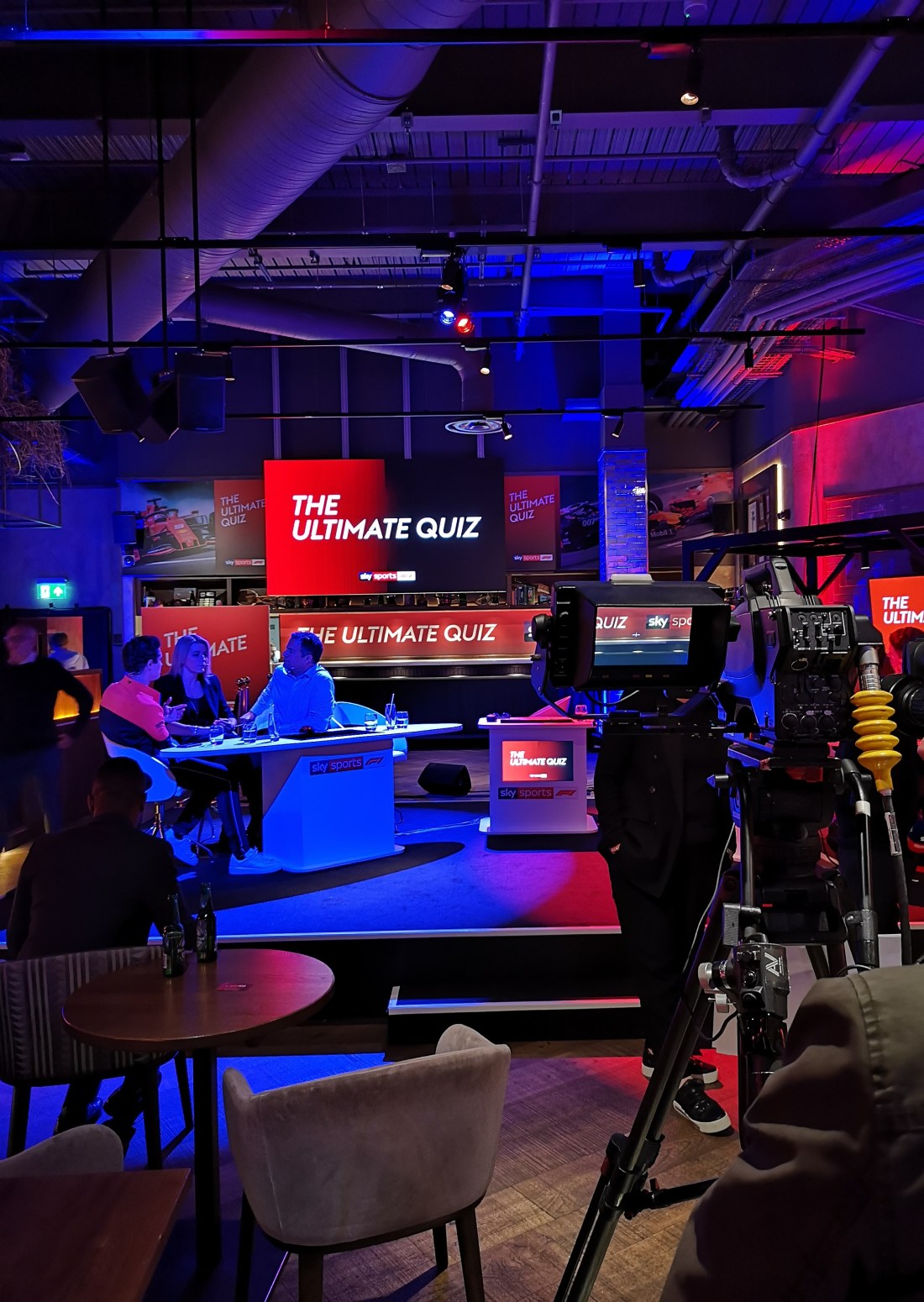
Instead of the usual chatter that goes alongside these events, Sky treated guests to what they billed as The Ultimate Quiz, pitting members of their F1 team against each other.
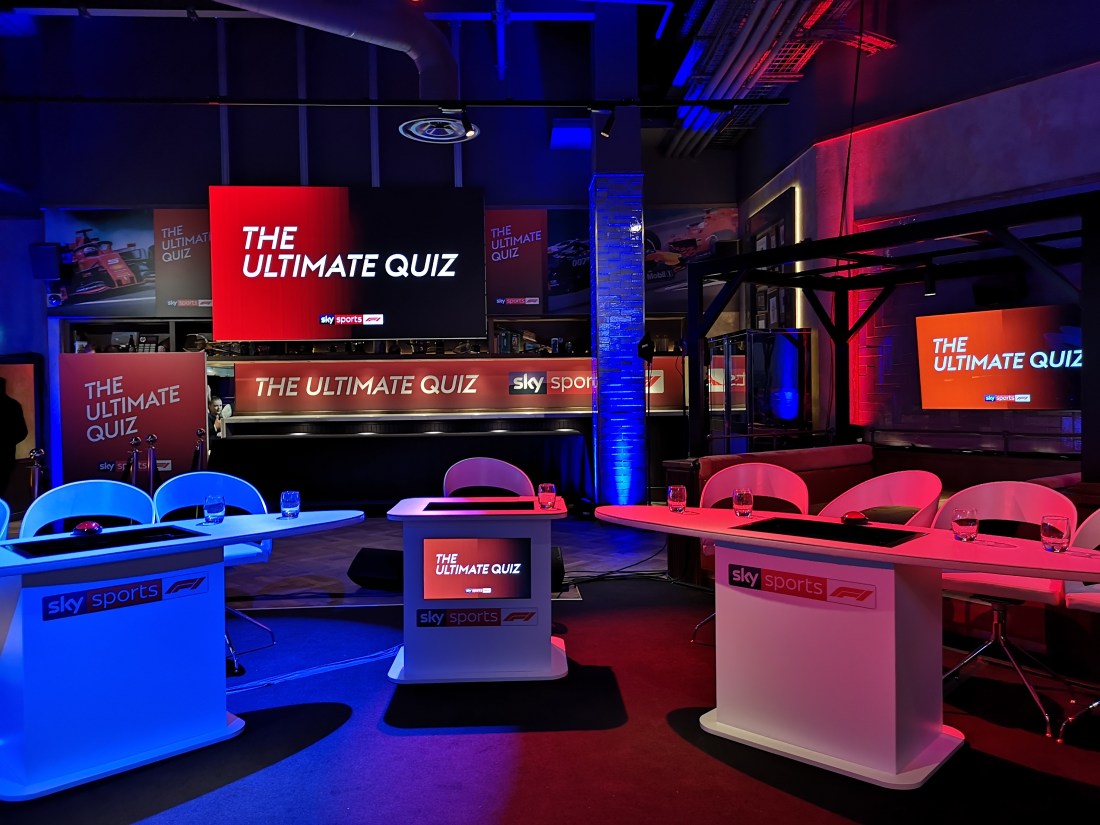
Sky’s Ultimate Quiz set, the Westwood Sports Pub & Kitchen kitted out in full Sky F1 gear.
Think of the BBC’s long running quiz show A Question of Sport, or Sky’s A League of Their Own, but this version pitched towards F1 fans.
With Sky’s regular F1 presenter Simon Lazenby ill on the day of the recording, David Croft stood in as Master of Ceremonies for the 90-minute affair.
On one side, Johnny Herbert led a team that included him, Karun Chandhok, Natalie Pinkham, and Paul di Resta.
On the other side, Sky’s pit lane reporter Ted Kravitz joined Rachel Brookes, and special guest Lando Norris alongside Martin Brundle. Norris was a late surprise to the taping because of Lazenby’s absence.
Off-camera, some of Sky’s production team were present, including their Head of F1 Scott Young, whilst guests could have a swirl on the Sky Pad if they so desired.
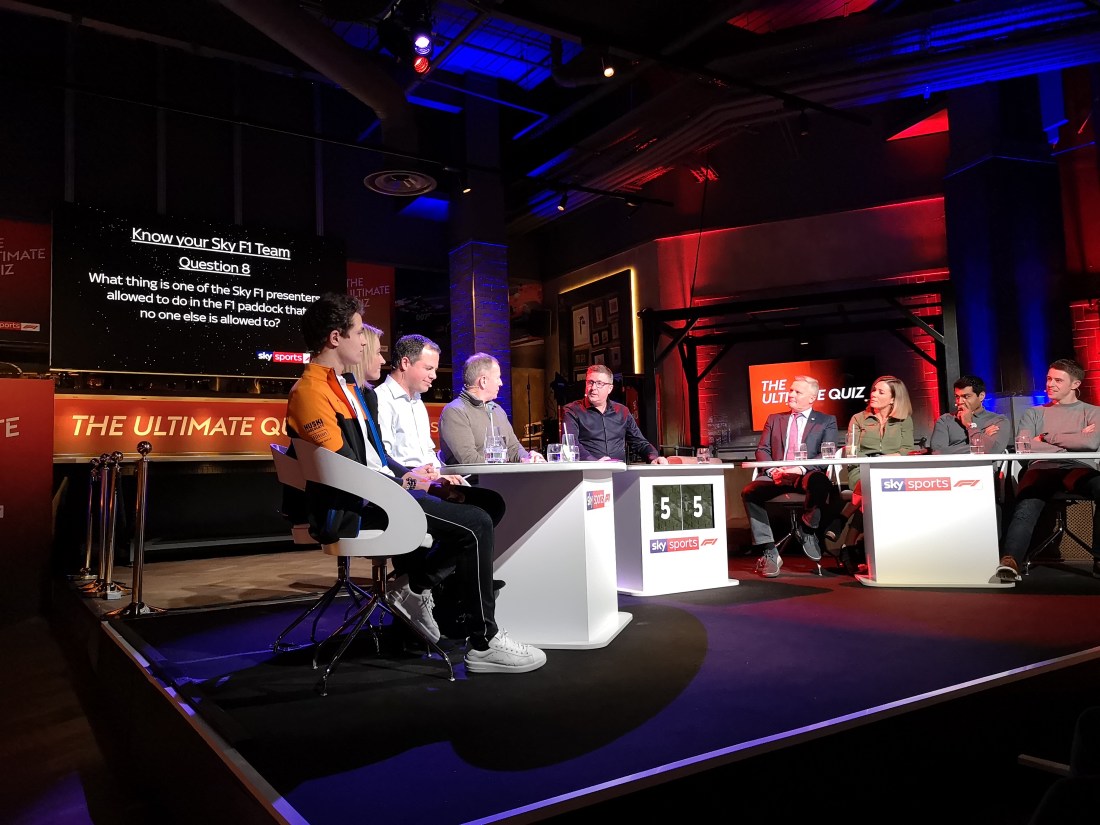
Left to right – Lando Norris, Rachel Brookes, Ted Kravitz, Martin Brundle (team Brundle), David Croft (host), Johnny Herbert, Natalie Pinkham, Karun Chandhok and Paul di Resta (team Herbert).
The quiz itself lasted six rounds, with rounds varying from general knowledge through to ‘What happened next?’ clips from the F1 archive.
Overall, it was a fun, light-hearted evening and worth the five-hour round trip. Croft managed to keep the ship steering in the right direction throughout (just about!). I will save the spoilers for this piece, other than saying it was a close affair throughout.
The first few rounds did overrun somewhat, meaning that the final section was shortened, the crew wrapping up filming at 21:00.
Transmission details are unclear as of writing, although I understand that it will air in some form over forthcoming weeks, so keep an eye on both Sky’s F1 social feeds and the F1 channel itself.
Over the past 50 years, many voices have graced the small screen to broadcast Formula 1 to the masses in a wide range of territories: from the UK to the US, from free-to-air to pay TV and beyond.
But how many would make Motorsport Broadcasting’s on-air team, and why? To answer that question is incredibly difficult, when trying to account for the different eras, the different broadcasters, the age of the talent in question, and so on.
The fan that ITV was trying to attract in the late 1990s may be different to the fan Sky is currently trying to attract to their offering.
As part of the selection process, I am assuming that age is not a factor, that time has no bounds, alive or deceased.
The cast assembled in my opinion brings together the best of the BBC, Channel 4, ITV and Sky Sports into a super team, with a few surprises thrown in for good measure. Think of it as my version of the Avengers, for use of a better term!
Of course, this is all judgemental (I admit to being openly biased for the next 2,000 words) and that there is no right or wrong answer to this question. The line-up comprises of:
2 x presenters
3 x analysts
2 x pit lane reporters
2 x technical reporters
2 x commentators
So, who is in, and who is out? Revealed, Motorsport Broadcasting’s dream F1 presentation team…
Presenters
Every good on-air presentation team needs a presenter to fit the bill. For me, watching Formula 1, there are two presenters that brought warmth with them whenever presenting the sport.
First up, the BBC’s Formula 1 presenter from 2009 to 2012, Jake Humphrey. Humphrey worked his way through the BBC ranks, from children’s television into BBC Sport, and eventually onto BBC F1 for the start of F1’s return to the Beeb in 2009.
Humphrey’s style was a departure from his predecessors Jim Rosenthal and Steve Rider on ITV. Both Rosenthal and Rider are excellent, top-tier presenters, but Humphrey brought with him an additional element. During that period, it felt like Humphrey was one of us: a fan who happened to be living the dream as F1 presenter.
In my view, Humphrey helped bring us closer to the sport that we love, thanks to his presenting style, bouncing off his co-presenters where necessary.
Alongside Humphrey anchoring the show is Georgie Ainslee (nee. Thompson). Ainslee has been round the motoring circles for years, having been part of Sky’s A1 Grand Prix coverage in the mid-2000s.
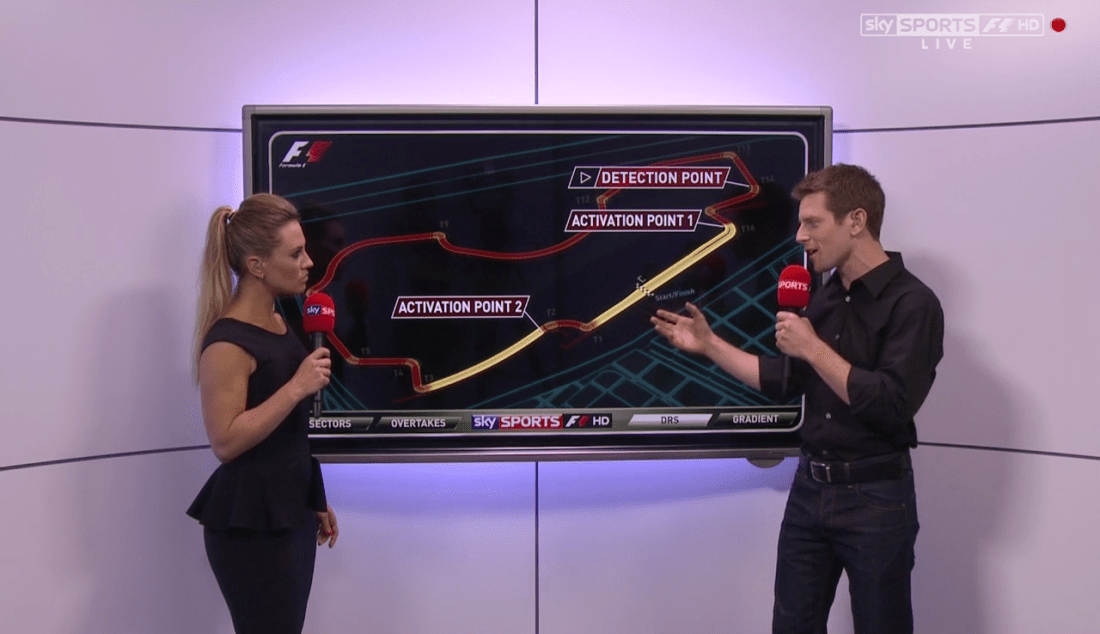
Georgie Thompson and Anthony Davidson analyse the action on the Sky Pad, during Sky’s inaugural race weekend in 2012.
Ainslee was part of Sky’s F1 coverage in 2012, presenting elements of their programming including The F1 Show, but quietly left prior to the 2013 season, with reports at the time suggesting that she wanted a bigger role within the team.
One presenter anchoring the entire weekend is too much, so having two presenters in equal capacity feels the best way to handle the situation.
Back in 2012, I really enjoyed Ainslee’s Sky Pad contributions with Anthony Davidson, and it is unfortunate that she left in the manner that she did, considering she was one of the better parts of Sky’s offering in their inaugural season.
Analysts
This is where the choices get tough, given that there is a plethora of personalities to choose from spanning across the BBC, Sky, Channel 4, and ITV. Narrowing the choices down to three or four stars, past and present, is an extremely difficult challenge. But hey, we did say that this is a dream team.
All three of my choices are natural broadcasters, and all three were part of Sky’s Formula 1 line-up last season. We start with Martin Brundle, 2020 marking his 24th season on the microphone in the commentary box.
Brundle could double up as a third co-commentator, although this piece for brevity keeps Brundle primarily in an analytical role. Alongside Brundle are Sky colleagues Anthony Davidson and Jenson Button, both of whom have shown why they are worthy of being in a dream team in recent years.
Davidson’s broadcasting life started in 2008 alongside David Croft in the BBC Radio 5 Live commentary box, moving over to Sky for the start of their coverage in 2012.
Button joined Sky for five races last year. The thing that lets Sky down is that both Davidson and Button appear on-screen too infrequently across the season, but that is a wider issue surrounding the number of races as opposed to a Sky-specific problem.
On the Sky Pad, Davidson is a wizard, whilst Button has the same characteristics as Humphrey from a broadcasting perspective: a warm style, and a down to earth personality.
If you are looking for entertaining features, maybe this is not the trio for you, it really depends what you are after from a programming perspective.
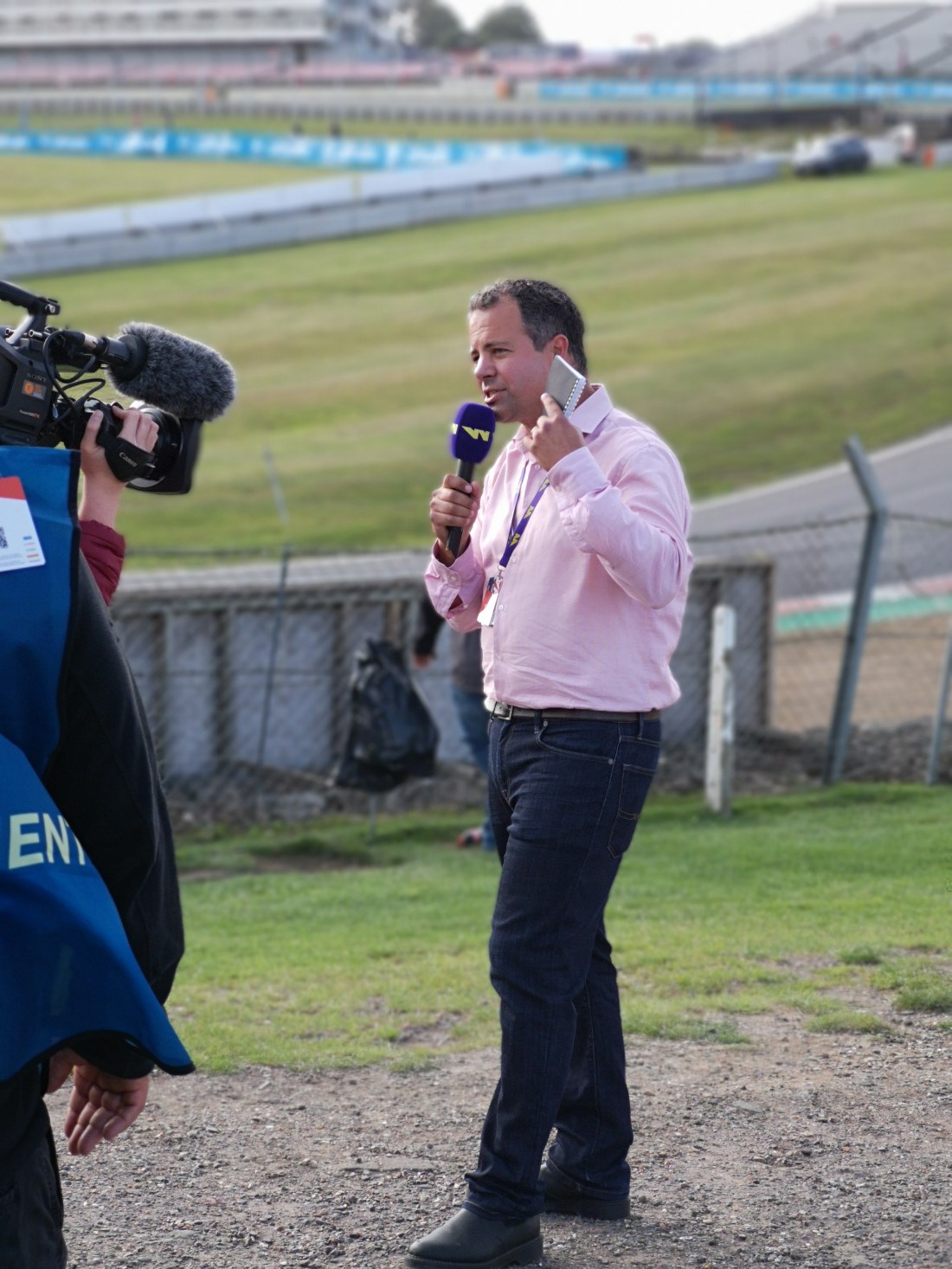
Ted Kravitz dissects the W Series action during his Notebook segment.
For me, I want analysts who live and breathe F1, who know it like the back of their hand, and can articulate their knowledge back to the viewer at home in a digestible manner. Brundle, Button and Davidson tick those boxes for me.
Missing out by small margins are Mark Webber, Karun Chandhok and Allan McNish. On a different year in history, the choice may be different.
Also, it is worth bearing in mind that I am looking at this from a UK broadcasting perspective, so opinions may vary depending on where you are based.
Pitlane
Roving the pit lane are two faces, one of whom has never appeared in an official F1 capacity for a UK broadcaster, either through choice or because they overlooked him at every opportunity.
Enter Will Buxton. Currently Formula 1’s digital presenter, Buxton first made a name on the F1 broadcasting scene as GP2 and GP3 lead commentator. More recently, fans stateside heard Buxton’s voice during both Speed’s and NBC’s coverage of the sport from 2010 to 2017.
Despite being around the sport for nearly twenty years, Buxton has never worked in an F1 capacity for Sky, Channel 4, the BBC or ITV at their respective times. UK’s loss was America’s gain over the past decade.
During NBC’s coverage, Buxton and producer Jason Swales hosted several behind the scenes documentaries on the sport, including the ‘Road to…’ series, which was well received by fans.
Joining Buxton is Channel 4’s Lee McKenzie, who has been part of the UK’s free-to-air F1 output since 2009, grilling the drivers on a variety of topics.
Outside of the small screen, both McKenzie and Buxton are brilliant journalists in their own right, both with a unique ability to get the best out of their interviewee on any given occasion: whether in a pre-race vignette, or during the post-race media pen interviews.
You might think two reporters in pit lane and beyond is excessive. But remember, F1 consists of ten teams, 20 drivers, and hundreds of people that help bring the show to life. It is Buxton and McKenzie that get beneath the skin of the sport, helping to tell the stories that may otherwise go unnoticed.
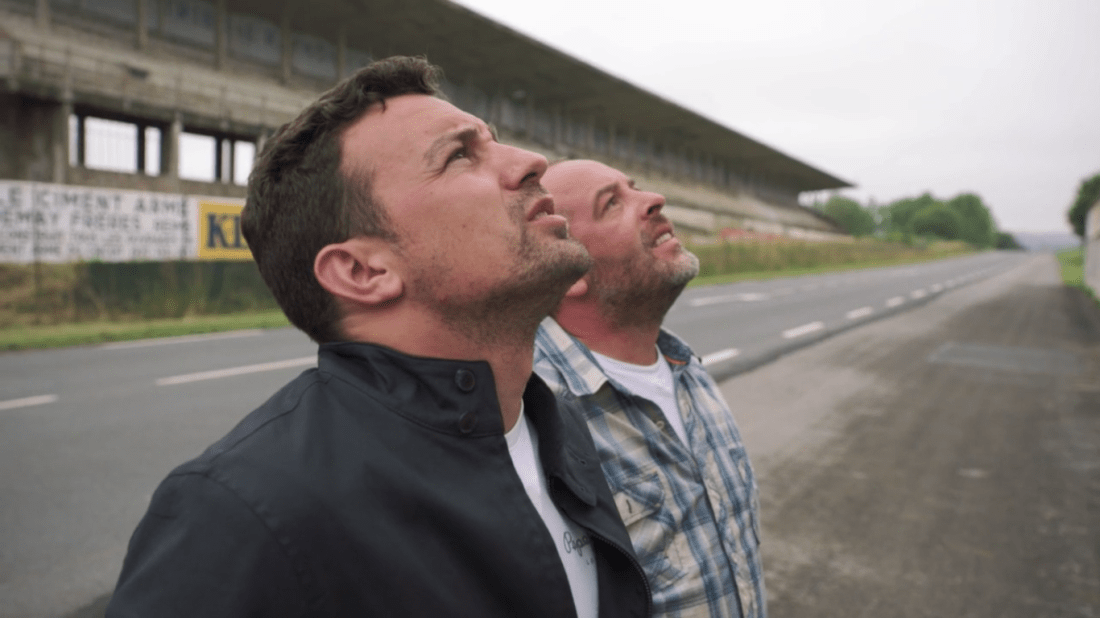
Will Buxton and Jason Swales at Reims for the Road to Mercedes documentary.
Technical
On the technical side, Ted Kravitz leads the output, having been part of the broadcasting scene since the 1990s. Kravitz moved to ITV’s F1 on-air team in a full-time capacity following Murray Walker’s retirement, staying in that role until 2008.
Kravitz moved with F1 to the BBC in 2009, and then again to Sky in 2012, where he has remained ever since, narrowly avoiding the chop from their team prior to the 2019 season. Well-liked by fans, Kravitz’s Notebook has been a fixture of Sky’s F1 coverage since its inception, along with the Development Corner segment.
What Kravitz has never had though, is a good wing man in the technical space, someone to bounce off from time to time. And that is where the second technical expert comes in the form of Craig Scarborough.
With the resources that he has, Scarborough does a great job dissecting the technical innovations across social media, sometimes with Peter Windsor in toe. Both were dropped by Motorsport Network in the latter half of 2018 as part of their cost-cutting exercise at the time.
I suspect no UK broadcaster has ever picked Scarborough up because he has never worked with in an F1 team as technical expert, unlike the likes of Gary Anderson, who was part of the BBC’s F1 offering in 2013 and 2014 before they dropped him.
Nevertheless, if you want an all rounded team that covers both the human element and technical element in equal detail, then you need two technical experts, and Kravitz and Scarborough are the two for me.
Commentators
The beauty of having a broadcasting dream team is that there is no right, or wrong, answer. I started watching Formula 1 in 1999, so caught the later years of Murray Walker‘s commentary.
I met Walker twice: once at a book signing back in 2002, and more recently at Channel 4’s Formula 1 launch in 2016. And, thanks to the internet, many classic races feature his commentary.
“And it’s Go! Go! Go!”
“Three point three six seconds! Damon Hill wins the Japanese Grand Prix!”
“And he exits the final corner for the fifty-third and last time, to win the 2000 Japanese Grand Prix, and the World Championship, for the third time!”
Commentary lines such as these will live on in Formula 1’s history. And it is for that reason that Murray, and his Murray-isms, feature in my dream team. Yes, Walker made mistakes.
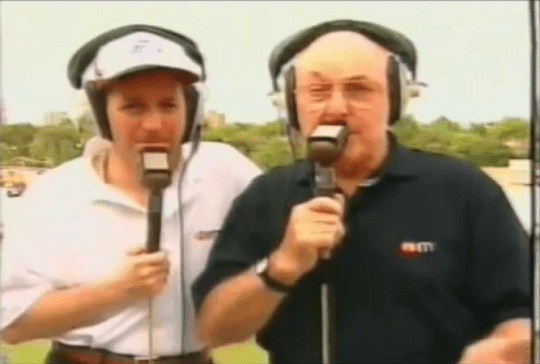
Martin Brundle and Murray Walker on the balcony during ITV’s coverage of the 1997 Australian Grand Prix qualifying session.
But, if I had a choice between a commentator that could make paint dry sound exciting, with a few mistakes here and there, or someone who struggled to capture the excitement that F1 brings, it is the former all day long.
To put it simply, Walker’s voice is infectious, and we are lucky that he stayed in the commentary box for as long as he did. Walker will always be F1 to me, and for a whole generation of fans in their late 20s and onwards.
On the other side, one of Walker’s colleagues left this arena far earlier than they should have. James Hunt passed away at the age of 45 in 1993, days after commentating on the Canadian Grand Prix. Had Hunt opted to retire at the same age as Walker, Hunt would still be commentating on F1 today at the age of 72.
I was too young to watch Hunt’s commentary live – I had not even turned one when Hunt passed away. But what I do know is that Hunt in the commentary box was passionate about the racing that was unfolding in front of him, telling it how it was.
It is a testament to the relationship between Hunt and Walker that the pairing lasted 13 years, from 1979 until Hunt’s untimely death.
In a parallel universe, Hunt would have been commentating alongside Walker for many years to come, but alas, it was not too be. In a dream broadcasting line-up, both Hunt and Brundle would be part of that team (clearly, I am bending the rules in the name of fun).
If time had no bounds, this is Motorsport Broadcasting’s dream F1 presentation team:
Presenter: Georgie Ainslee
Presenter: Jake Humphrey
Commentator: James Hunt
Commentator: Murray Walker
Analyst: Anthony Davidson
Analyst: Jenson Button
Analyst: Martin Brundle
Pitlane: Lee McKenzie
Pitlane: Will Buxton
Technical: Craig Scarborough
Technical: Ted Kravitz
Like with any team, whether the eleven would blend together on-screen is a different question, in the same way that two world class drivers in the best team may go pear shaped.
You want a line-up that is flexible. You do not want a commentator that just commentates, or a technical expert that cannot interview drivers. In the scenario above, Walker would still interview drivers, and Brundle could still commentate, for sake of argument.
Notable by their omission are David Coulthard and Eddie Jordan, amongst other high calibre candidates, which shows how difficult it is to select a dream team cutting across different eras. Had I been focusing on current generation only, then Coulthard and Jordan may well have made the cut.
To bring gravitas to the production is Channel 4’s F1 producer Whisper, but with backing from Sky Sports. Sky bring with them the Sky Pad, the paddock stage set up, as well as the extensive air-time, whilst Whisper bring with them some excellent VTs and a graphics package that is second to none. The best of both worlds, in my view.
And that is my dream Formula 1 broadcasting line-up. What is yours? Have your say and debate the question in the comments below.
Fancy contributing to Motorsport Broadcasting? Head over here for further details…
A massive audience of over 200,000 viewers watched a special F1 Esports event on Sky Sports, consolidated viewing figures from BARB show.
With no action taking place on the circuit within the near future, organisations in the Esports arena have taken advantage by holding their own replacement races.
F1 opted to run a Virtual Bahrain Grand Prix using their F1 2019 video game, featuring McLaren’s Lando Norris, Williams driver Nicholas Latifi and a range of celebrities, including singer Liam Payne and Olympian Sir Chris Hoy.
The action aired live across three Sky Sports channels to an audience of 208,200 viewers from 20:00 to 21:30 on Sunday 22nd March via the TV set.
82,900 viewers watched on Sky Sports Main Event, with 82,600 viewers watching on the F1 channel, and a further 42,700 viewers watching on Sky Sports Mix.* The event was the most watched programme on those three channels for the week commencing 16th March.
To put that figure into comparison, last year’s running of the Indianapolis 500 averaged 172,000 viewers exclusively on Sky Sports F1, which in itself was a record high, whilst the Esports figure comfortably beats any Formula Two or Formula Three race that Sky has aired.
It is possible that the audience figures are some of the highest ever for an Esports event on UK television, but Motorsport Broadcasting is unable to confirm that as of writing.
This is in addition to the online average audience reported by Echarts of 279,000 viewers worldwide across Facebook, YouTube and Twitch.
The Virtual Vietnam Grand Prix is set to air live across Sky’s outlets and social media again this Sunday from 20:00.
* Technical Note: Logs on the BARB website shows the description for the Sky Sports Main Event and Sky Sports Mix as ‘Sky Sports News’ and ‘NBA’ respectively. However, Motorsport Broadcasting can confirm that the underlying figures are for the F1 Esports event.

 Motorsport Broadcasting